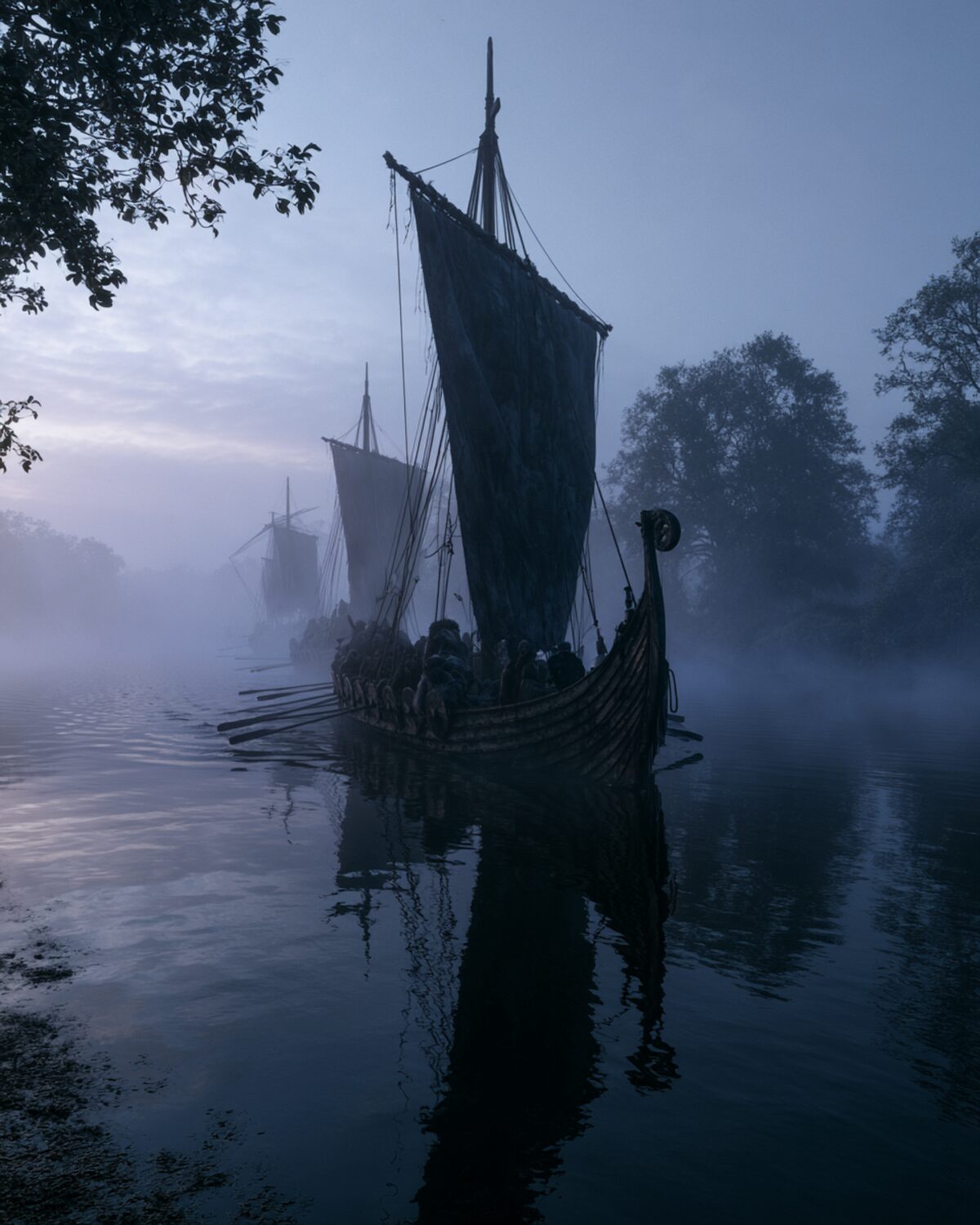
 On the northernmost edge of the Slavic world, where the Volkhov leaves Lake Ilmen, the connection was forged from which the Rus emerged – and with it the bridge between the Viking world and Byzantium.
Coming from the north, out of the Baltic, up the Gulf of Finland and into the Neva, then across Lake Ladoga and up the Volkhov, you eventually reach Lake Ilmen. Here, in the north-westernmost corner of the East Slavic world, sat a tribal federation that scholarship today calls the Ilmen Slavs. They called themselves simply Slovene – "Slavs". They had no special name like the Krivichs or the Drevlians. And it was precisely among them that one of the most consequential encounters of the early Middle Ages began: that between Slavs and Scandinavians.
Their settlement area lay around Lake Ilmen and along the rivers Volkhov, Lovat and Msta. Until about 700 this region was settled exclusively by Finno-Ugric groups; the oldest Slavic settlements date to the 8th century. The neighbourhood stayed mixed: Krivichs to the south and west, plus Chuds, Ves and Merya – Finno-Ugric peoples whose names still echo in the landscape. Archaeology shows farming settlements and tall conical burial mounds, the so-called sopki, with cremations. A metal share from a wooden plough proves developed agriculture.
Above all, though, this was a land made of water. Whoever sat here sat at the junction of two long-distance routes: the way "from the Varangians to the Greeks" via the Lovat and the Dnieper to Constantinople, and the Volga route to the Khazars and on to Baghdad. The Arabic silver that later ended up in hacksilver hoards on Gotland and in Scandinavia came along these rivers.
Staraya Ladoga, Old Norse Aldeigjuborg, has been dendro-dated to the year 753. That makes it one of the earliest Scandinavian-influenced settlements outside Scandinavia – older than Hedeby at its height, older than the raid on Lindisfarne. From the turn of the 760s to 770s East Slavs formed the dominant part of the population. The oldest dirhams in eastern Europe lie here; the earliest coins date to 786/787.
The second key site is Ryurikovo Gorodishche, a fortified princely seat two kilometres south of present-day Novgorod, exactly where the Volkhov leaves Lake Ilmen. Excavations since 1975 have brought a great quantity of Scandinavian finds to light, with a striking concentration of artefacts and silver for the 860s. In Scandinavian sources this place appears most plausibly as Holmgarðr – the name by which the Northmen knew Novgorod.
Novgorod itself is younger than one might think. The earliest cultural layers of the great Troitsky excavation reach into the 920s and 930s. Centre of power (the Gorodishche, mid-9th century) and town (late 10th century) therefore fall apart in time – a finding worth keeping in mind when reading the chronicles.
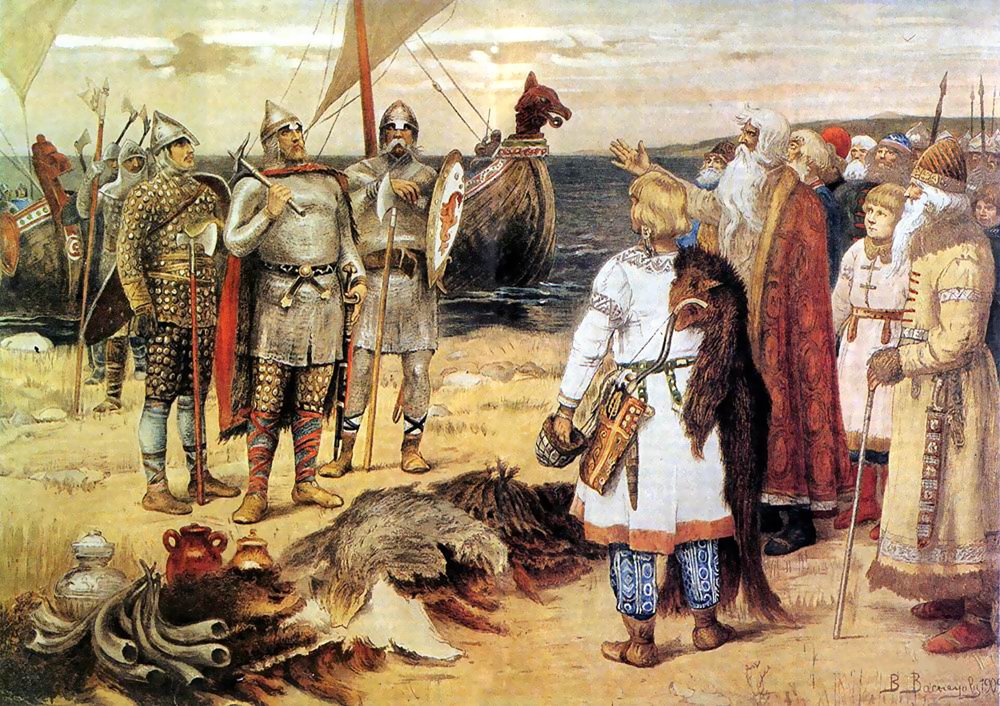
The most famous story of the Russian Middle Ages is set right here. The Primary Chronicle reports for the year 862 that the Slovene, Krivichs, Chuds and Merya drove the Varangians back across the sea and paid no more tribute – and then fell to feuding among themselves.
And there was no law among them, and kin rose against kin, and there were feuds among them … And they said: let us seek among ourselves a prince who shall rule over us and order us according to order and according to law.Primary Chronicle for the year 6370 (862), Hypatian manuscript – original text public domain, own translation
And so, says the chronicle, came Rurik and his brothers Sineus and Truvor. The phrase "our land is great and rich, but there is no order in it" remains a proverb to this day – though the Old East Slavic word naryad does not mean "order" in the sense of tidiness but legal order, direction, administration. The Fourth Novgorod Chronicle even reads "but there is no administrator in it". So the point is not chaos, but a missing ruler.
And here we must be honest. The chronicle was compiled around 1110 to 1112, roughly 250 years after the event, and survives only in copies of the 14th and 15th centuries. The dates of the early entries are regarded in scholarship as "manifestly conventional", that is, imposed after the fact. The tale of three invited brothers has a close parallel in Widukind of Corvey, where the Britons offer rule to three Saxon brothers – a widespread narrative pattern for the origins of dynasties.
The legend is a legend. The Scandinavian presence, however, is real. More than 1,200 Scandinavian objects of the 8th to 11th centuries – weapons, jewellery, amulets, tools – are known from around 70 Old Rus sites, plus some 100 finds bearing Scandinavian runic signs. Scandinavian material appears in all the early trade and craft centres: Ladoga, Timeryovo, Gnyozdovo, Shestovitsa, Novgorod, Pskov, Kiev. And the intensification of these finds in the northern Rus falls in the second half of the 9th century – precisely the period the chronicle speaks of.
Present-day scholarship accepts the Scandinavian character of the Varangians, of the name Rus and of the early elite. It does not, however, see this as a "state founded by foreigners": the emergence of the Rus is regarded as a complex process combining the internal social development of the East Slavic federations with outside impulses. Anyone who knows this debate also understands why it was fought so bitterly – the so-called Normanist controversy has been political as well as scholarly since the 18th century. From here the line runs on to the Varangian Guard in Constantinople, in which men such as Harald Hardrada later served.
The faith of the Ilmen Slavs is as poorly recorded as that of all the Elbe Slavs. This much is certain: in 980 Vladimir's uncle Dobrynya had an idol of Perun set up on the Volkhov at Novgorod. After the baptism of the Rus in 988/989 it was toppled – the Novgorod chronicle reports that Bishop Joakim of Korsun destroyed the cult places, had Perun felled and dragged into the Volkhov. Into the 20th century, people passing the spot would throw a coin into the water.
The place is called Peryn. Excavations by Artsikhovsky (1948) and Sedov (1951/52) uncovered a platform 21 metres across, surrounded by a ring ditch containing charcoal and with a central pit for a massive post. Sedov reconstructed an idol of Perun in the centre and eight arc-shaped fire places around it. That interpretation has entered the scholarly literature – but it is not uncontested.
On 26 July 1951 Nina Akulova found the first piece of inscribed birch bark at the Nerevsky excavation in Novgorod. By 2018 there were more than 1,200 such documents, over 1,100 of them from Novgorod. They are scratched with bronze and iron styluses, never with ink, and the oxygen-poor marshy soil preserved them. Their language is genuine everyday speech, almost free of Church Slavonic influence – shopping lists, debt notes, love letters, even the exercise sheets of a boy called Onfim with his drawings.
The dating matters, though: the birch-bark documents belong to the 11th to 15th centuries. They are therefore not a testimony of the Viking Age but of the high and late Middle Ages. Anyone citing them as evidence of Norse literacy is confusing two eras. What they do prove is remarkable enough: a strikingly high level of literacy reaching down to women and children.
Out of the Ilmen Slavs later grew the Republic of Novgorod. In 1136 the town expelled its prince; from then on the popular assembly, the veche, appointed and dismissed princes itself, elected mayor and archbishop and decided on war and peace. Only in 1478 did Novgorod lose its independence. Their descendants moved further north, to the White Sea, where as Pomors they became seafarers – a late echo of that world of water in which it all began.
Miklagard and the Varangians · Harald Hardrada · Hacksilver – silver as currency · Hedeby · Wolin & Jomsborg.
All History & Finds articles →
Carved in stone over 1,000 years ago, a king proclaims the unification and baptism of Denmark – the same king whose …
Read more →