No piece of Viking-Age equipment shaped history like the ship. It carried traders to the Volga, settlers to Iceland and warriors to distant coasts. Yet the real marvel is not the dragon head at the prow but the hull itself: thin, overlapping planks of split oak that made a boat light, fast and flexible all at once. How it was built, what the finds reveal and which cinema images you can safely throw overboard – that is what we untangle here.
You cannot imagine the Viking Age without its ships. They were transport, weapon, status symbol and grave all in one. A seaworthy longship turned a handful of farms on a fjord into a power that could reach monasteries in England, markets on the Baltic and river towns in the East. Without the shallow, flexible hull there would have been no beach landings, no voyages up the Seine, no crossings of the North Atlantic.
Shipbuilding was therefore no minor trade but central knowledge held by an entire culture. It lived in the hands of the boatwrights, in the choice of the right trees, in experience passed down over generations. That this tradition still lives was recognised by UNESCO in 2021: the Nordic clinker boat tradition has since stood on the Representative List of the Intangible Cultural Heritage of Humanity – jointly nominated by Denmark, Norway, Sweden, Finland and Iceland. It was not a single museum ship that was honoured, but the skill itself.
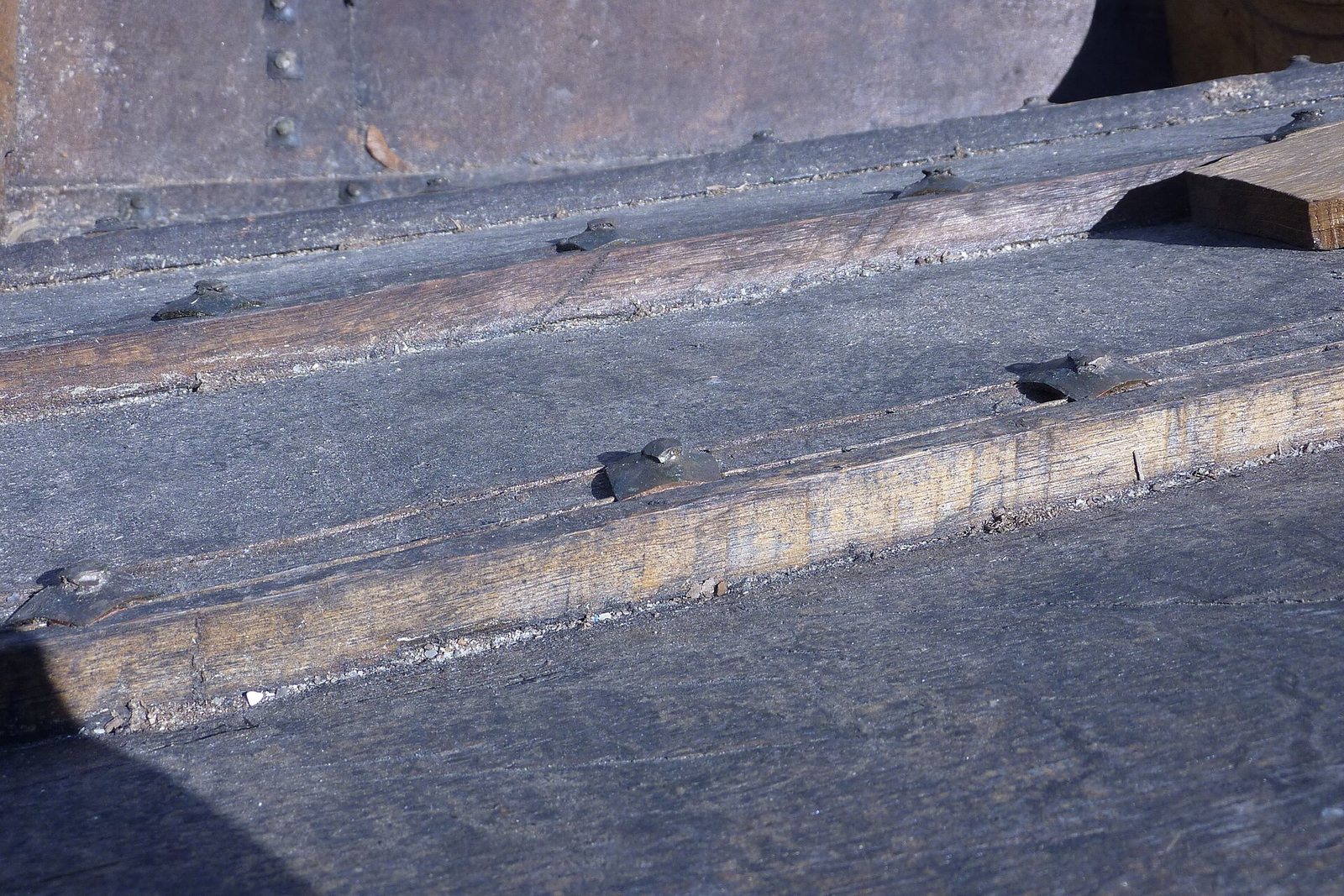
The hallmark of Nordic shipbuilding is clinker construction. The planks of the hull overlap like roof tiles, each upper plank reaching over the edge of the one below. They are fastened with iron rivets whose ends are clenched over small square plates (roves) on the inside. This creates a shell of wood that is built first and is load-bearing – only afterwards do the internal reinforcements go in.
This shell-first method is the great difference from later Mediterranean shipbuilding, where a skeleton of frames stands first and the planks are nailed onto it. The Viking way is the reverse: skin first, ribs second. The result is a hull that is light, has little draught and is allowed to move in a seaway. A longship genuinely works under load – it is deliberately flexible, not rigid.
The plank overlaps were sealed with tarred animal wool or oakum, laid between the planks as they were joined. This caulking kept the water out without stiffening the hull. Step aboard a faithful reconstruction today and you hear the timber creak and see the planks "breathe" – which was exactly the plan.
Perhaps the most important and most underrated point: the planks were not sawn but radially split. An oak trunk was driven apart lengthwise with wedges – from the outside toward the core, like slices of a cake. Each segment yielded a plank whose fibres ran unbroken along the natural grain of the wood.
The advantage is enormous. A radially split plank is far stronger and more flexible along its unbroken fibres than a sawn board, where the saw cuts straight across the grain. From a single large oak trunk a boatwright could win many thin, highly resilient planks. This is why Viking ships could get by with astonishingly thin hull sides.
The tools for this were simple and effective: wedges and mallet for splitting, the broad axe for rough shaping, the adze (a cross-bladed axe) for smoothing the surfaces, and the spoon auger for the rivet holes. A saw as we know it played almost no part in plank work. To understand the craft you must let go of the sawmill image – here, wood was split and hewn.
The first piece of a ship was the keel – ideally from a single long, straight oak trunk. It gave the hull length, longitudinal strength and, in a sailing ship, resistance against sideways drift. At its ends the stems joined on, the upward-sweeping bow and stern timbers that gave the ship its characteristic silhouette.
On this backbone the hull grew upward, plank strake by plank strake. Only once the shell stood were the internal frames fitted and connected to the planks. Tellingly, in many places the frames were not rigidly nailed but lashed with bast or root fibres to cleats worked into the planks. This let the hull twist without breaking. What sounds like a makeshift solution was refined engineering – a deliberately yielding system.
As much as rowing dominates the image, over long distances the sail was the real means of propulsion. Viking ships carried a single large square sail, usually woven from wool and reinforced with a net of leather straps or ropes that took up the enormous loads. Making a sail of this size was a labour of many months – spinning, weaving, sewing and treating it tied up whole households, above all the women of the farms.
Rowing was done through round oar ports in the hull or over oars resting on the gunwale. Steering was not with a central stern rudder but with a side rudder fixed to the right-hand side of the stern. That is exactly where our word "starboard" comes from: Old Norse stýri means "steering oar", and because it sat on the right, ships turned their left side toward the harbour when berthing – hence English port for the left side.
Praise the day at evening, a wife when she is dead, a sword when it is tested, a maiden when she is married, ice when you have crossed it, ale when it is drunk.Hávamál, stanza 81 (translation Henry Adams Bellows, 1923, public domain) – the old warning not to praise anything before it has proven itself: a principle that fits every ship not yet safely back in harbour.
"The Viking ship" never existed. The Norse built a whole family of vessels for different purposes. The slim, fast warship was called skeið in Old Norse, or simply longship – long, low, with many rowing places, built for speed and for landing on shallow beaches.
For trade there was the knǫrr (knorr): broader, deeper, more bulbous, with more cargo space and driven mainly under sail. It carried freight across the North Atlantic to Iceland and Greenland. In between lay smaller general-purpose boats such as the karfi and the nimble snekkja, a smaller warship. You chose the ship for the task – rather as one does not move house in a sports car today.
Our knowledge comes not from sagas alone but from the ground. The Norwegian ship burials of Oseberg (about 834) and Gokstad (late 9th century) delivered complete, magnificently preserved ships – Oseberg with its famous carving, Gokstad a seaworthy vessel whose reconstruction even crossed the Atlantic in 1893. The Tune ship completes this row of Norwegian grave finds.
At Skuldelev in Roskilde Fjord archaeologists recovered five ships that had been deliberately sunk in the 11th century as a barrier to block the approach to the town. They show the full range: heavy freighters, a small trading boat, a fisherman, a smaller and a large warship. Especially instructive is Skuldelev 2, a large longship – tree-ring analysis of the timber proved it was built around 1042 in the area of Dublin. The Viking world was long since a connected space: a ship built in Ireland ended up as a barrier in Denmark.
Older still, and therefore priceless, are the forerunners: the Nydam ship (about 320, a pure rowing boat without a sail) and the Kvalsund ship (about 700), whose pronounced keel marks the transition to the sailing Viking ship. Along this row the development can be read step by step.
Evidence: The five Skuldelev ships were excavated between 1957 and 1962 in Roskilde Fjord and are kept today in the Viking Ship Museum in Roskilde. The dendrochronological dating (tree-ring analysis) of Skuldelev 2 showed timber from the Dublin region around the year 1042 – a hard, scientific date, not a saga tale.
A ship began in the forest, not on the building slip. The boatwright sought out exactly the right trees: a long, straight trunk for the keel, grown curves for stems and frames, thicker trunks for the planks. Wood with a naturally suitable grain was worth gold, for a grown angle is stronger than a cut one. Fresh timber was preferred for felling and splitting, as it was still easy to work.
The build itself was hand labour of many weeks to months, depending on the size of the ship. Modern reconstructions give a sense of the effort: for a large longship of the Skuldelev 2 type, the boatwrights in Roskilde reckoned on an order of several tens of thousands of working hours – though such figures are experience values from the reconstruction, not from a Viking-Age source. What is clear is only this: a seaworthy ship was an enormous asset, into which timber, iron, wool and the work of many hands flowed. To own a longship meant wealth and rank.
What looks elegant from the outside devoured vast amounts of material within. A large ship held its planks together with thousands of iron rivets – each one forged, pushed through, set over a rove plate and clenched. To these came nails, fittings and tools. Iron was expensive and laborious to win from bog and turf ore, so the rivet count alone of a longship concentrated the wealth of a whole district.
This material cost also explains why ships were repaired, rebuilt and kept in honour for decades. A hull was no throwaway item. And it explains why a deliberately sunk ship, as at Skuldelev, was a clear statement: one sacrificed an enormous asset to protect the homeland.
Aboard a longship there was no luxury. The crew sat on their sea chests, which doubled as rowing benches, packed close together. Sleeping was done ashore wherever possible, or under stretched tents and hides on deck. Warm meals were barely possible at sea – one lived on dried fish, flatbread and whatever was carried along.
This tightness welded people together. Rowing, setting sail, bailing water and keeping watch demanded a well-drilled team. Whoever sat at the oars was no subordinate but part of a community that shared both profit and danger. It is exactly this union of craft and solidarity that makes the ships such a powerful symbol to this day.
Not every ship sailed to the end. We owe the most magnificent finds to the custom of burying high-ranking dead in a ship. Oseberg and Gokstad were such grave ships: the vessel was hauled ashore, a burial chamber built within it, and the whole thing mounded over with earth. The clayey soil sealed out the air and preserved the wood for over a thousand years.
The ship in the grave was a message: here rests someone of rank, someone given a whole vessel to take along. Whether the ship symbolised the final voyage to the afterlife or simply the highest wealth – the interpretations differ. What is certain is that the ship, in the thinking of the Norse, was far more than a means of travel.
How well the old craft works is shown by faithful reconstructions. The best known is the Havhingsten fra Glendalough ("Sea Stallion from Glendalough"), a reconstruction of the large longship Skuldelev 2, built with historical techniques. Such reconstructions are experimental archaeology at its best: they answer questions no find alone can answer – how many people fit aboard, how fast such a ship really was, how it behaved in wind and wave.
The result regularly inspires respect. A hull like this is astonishingly fast in a good wind, but also wet, hard and demanding. The romantic notion of comfortable sailing over mirror-smooth fjords quickly gives way to the reality of cold spray and hard work at the oars.
Myth check: Several beloved ideas do not survive the sources. "Drakkar" is not an authentic Viking word but a coinage: the French naval historian Augustin Jal introduced it in 1840, derived from the Old Norse dreki ("dragon"). The Norse themselves spoke of skeið, langskip or dreki – never of "drakkar". Dragon heads did not adorn every ship and were, moreover, removable: the Icelandic Ulfljotr law prescribed taking off the carved animal heads when approaching one's own land, so as not to frighten the guardian spirits of the land (landvættir). And the galley slaves of Hollywood films? Pure fiction. At the oars sat free men of the crew, who were warrior, trader and rower in one – rowing was a matter of honour, not a punishment. Finally, ships were not measured in metres but in rúm, the spaces between the rowing benches: a ship of "25 rowing benches" was a clear size anyone could understand.
The Viking ship fascinates because in it beauty and function coincide completely. Every line has a reason, every plank a purpose. The curving stem is not merely elegant, it parts the wave. The thin hull is not merely light, it lets the ship glide over shallow water. It is engineering that looks like art.
It is exactly this union of honest craft and clear form that speaks to us today – and that we carry on in our workshop with every engraving. A motif showing a Viking ship, a stem or a line of runes holds the same idea: that form and meaning belong together. To understand the ship is to understand the Viking Age a little better.
The longships · The Gokstad Ship · The Skuldelev ships · The Oseberg ship & the two women · Viking navigation.
All Ships & Seafaring articles →
There is an Old Norse word for the quietest terror of seafaring: hafvilla, the “sea-bewilderment.” It does not mean the …
Read more →Some graves are so rich that they still take our breath away. The Oseberg grave near Tønsberg in Norway is one such: a …
Read more →Around the year 1070 the people of Roskilde deliberately sank several old ships in a narrow channel of their fjord – as …
Read more →