Anyone exploring the Viking Age soon trips over strange words: blót, seiðr, ørlög, drengr, kenning. Many are misspelled today, mispronounced, or loaded with modern esoterica. This glossary explains the most important Old Norse and Germanic terms briefly and honestly – grouped by theme, with a pronunciation hint and a link to the relevant deep-dive. We give every word in its dictionary form (nominative singular) and say plainly what is attested and what is reconstruction or invention.
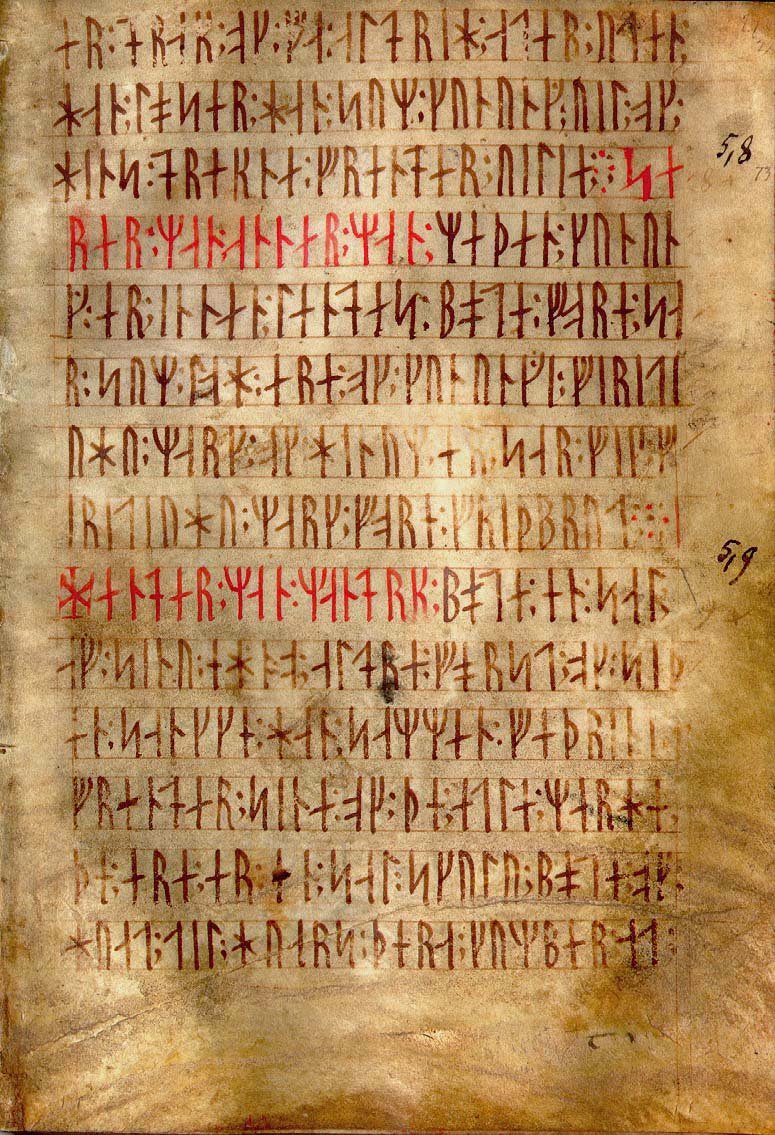
The Codex Runicus — a medieval law book written entirely in runes.
Why word lore?
Old Norse – more precisely the Old West Norse of the Icelandic-Norwegian tradition – is not a secret language of magic but a well-documented medieval tongue with grammar, dictionaries and thousands of lines of text. Most of the terms we meet today come from two sources: the runic inscriptions of the Viking Age itself, and the Icelandic manuscript literature of the 13th century – that is, from a time some two hundred years after conversion. That gap matters: much of what we think we know about heathen belief comes from Christian scholars such as Snorri Sturluson, not from the heathens' own testimony.
The continental Germanic side belongs here too: besides Old Norse we know Germanic terms from Old High German, Old Saxon and Old English as well as from Latin reports. Some words are common Germanic and attested in several languages (Wodan / Óðinn, Donar / Þórr, Tiw / Týr), others occur only in the North. We mark where a term is continental or purely Norse, since throwing both together is one of the commonest inaccuracies. And we consistently separate what the sources say from what scholarship has reconstructed.
We spell the words here in the scholarly standard form, using þ (voiceless „th" as in thing), ð (voiced „th" as in this), æ (open „a") and ö/ø. Every transfer into the modern alphabet is a convention, not a „right" or „wrong" truth – but it should be consistent. The headword is always the nominative singular; in a sentence Old Norse words inflect (Óðinn, but Óðinn's spear = Óðins spear).
Religion, ritual and cult
These are the words most often misunderstood, because they describe religious practice that almost nobody observed and recorded directly.
blót (roughly „bloht") – the sacrificial feast. It is linked to „to strengthen, to worship"; popularly connected with blóð (blood). A blót was a communal meal shared with the gods: animals were slaughtered, the meat eaten, the blood (hlaut) sprinkled. See our Blót calendar.
vé („veh") – the holy, enclosed place; a fenced open-air cult site. It survives in place-names such as Odense (Óðins vé).
hörgr – a stone altar or cairn in the open, often consecrated with blood; named in poetry beside the hof.
hof – a house also used for cult. „Temple" is misleading: free-standing temple buildings are barely visible archaeologically; usually the chieftain's hall doubled as a cult space.
seiðr („saydhr") – a particular kind of sorcery bound up with divination, fate-weaving and trance. Freyja is said to have taught it to the gods; Óðinn practised it though it was deemed „unmanly" (ergi). See „Seiðr – the sorcery of the North".
galdr – the sung or chanted spell, related to gala (to crow, to sing); more formulaic than seiðr, tied to runes and alliteration.
sumbel (also sumbl) – the ritual drinking gathering where the horn passes and toasts, boasts and vows are made.
minni – the memorial toast to gods or ancestors. full is the full cup dedicated to a god (Óðinn's full, Freyr's full „for peace and good harvest").
Cattle die, kinsmen die, / you yourself die likewise; / but one thing I know that never dies: / the fame of a dead man's deeds.Hávamál 77, trans. Henry Adams Bellows 1923 (public domain)
This famous verse contains a key word of the Norse worldview: orðstírr (fame, „word-glory"). What counts is not survival in a reward-world but the remembrance of the living.
Fate and soul
The North did not think of a person as a unit of „body and soul" but as a bundle of forces and parts. Here translation is especially treacherous.
ørlög („örlög") – fate, literally „that which is laid down first". The Norns lay ørlög; they do not weave it (the weaving image is later).
urðr – both the name of the eldest Norn and the word for „fate, that which has become". The Old English cognate is wyrd. See „The Norns" and „Web of Wyrd".
norn (plural nornir) – women of fate. The famous three are Urðr, Verðandi and Skuld, yet the sources know many Norns, good and ill.
hamingja – personal luck, a person's life-force, which could even be inherited or lent.
fylgja („fülgja") – the „follower", a guardian spirit appearing as an animal or a woman, often seen only just before death.
hugr – mind, thought, will; the conscious, rational part. It lies in the raven names Huginn (thought) and Muninn (memory).
dís (plural dísir) – female protective spirits of the kin, honoured at the dísablót. The line to valkyries and Norns is blurred.
Society, law and bond
These terms describe how the free Norse lived – and they are often better attested than the religious ones, because they appear in laws and on runestones.
þing („thing") – the assembly and court of free men, the heart of the legal order. The Icelandic Alþingi met from about 930.
goði (plural goðar) – a chieftain with cultic and legal functions, especially in Iceland; his office was the goðorð.
jarl – a high-ranking leader, a prince below the king; the word lives on in English earl. hersir was the local minor chieftain.
þræll („thrall") – the unfree, the slave. A serious word: the Viking economy also rested on the slave trade. See „Slavery among the Vikings".
drengr – a capable, upright young man; on runestones high praise (drengr góðr, „a good drengr"). It names an ideal of courage, reliability and honour.
félag – partnership, the pooling of wealth for trade or voyage; a félagi is the business partner. Hence English fellow.
hirð – the retinue, a king's household guard. húskarl is the paid house-warrior.
mundr – the bride-price the groom paid to the bride's family for a lawful marriage; distinct from the heimanfylgja, the bride's dowry.
Well attested: Words such as þing, drengr, félag, jarl and þegn appear verbatim on hundreds of Viking-Age runestones – primary sources from the period itself, not later retellings. When a stone praises a dead man as drengr góðr, we hear how that society named its own ideals.
Trade, law and honour in daily life
Beyond the great words, the language carries many everyday terms that shape the character of the Viking world just as much – trade, litigation and the constant eye on one's own honour.
drápa – the great praise poem with a refrain (stef), the most prestigious skaldic form; a flokkr is the same without refrain, a lausavísa a single occasional stanza.
níð („nihd") – grave, honour-wounding slander; a níðstöng was a scorn-pole with a horse's head that cursed an enemy. The law punished níð most severely.
hólmganga – the regulated duel („island-going"), a legally recognised combat, banned at the end of the 10th century.
sátt – the settlement, the amicable agreement. In a society without an enforcing power, compromise mattered more than a verdict.
skógarmaðr – the „forest man", the full outlaw whom anyone could kill without penalty; the lesser outlawry was fjörbaugsgarðr.
eyrir (plural aurar) and mörk – weight units for silver, the basis of the Viking-Age bullion economy of hacksilver and scales.
gestr – the guest; the guest-right was sacred, as many verses of the Hávamál stress.
War and battle
This is where popular culture has invented most. The words themselves are old; their images often modern.
berserkr (plural berserkir) – a warrior in battle-frenzy; the reading „bear-shirt" (ber-serkr) is likely but not certain. The shield-biting is a late embellishment by Snorri.
úlfheðinn (plural úlfheðnar) – „wolf-coat", a wolf-like warrior type, often named beside the berserkir.
skjaldborg („shjaldborg") – the „shield-fort" shield wall. Attested as a word, but the exact tactics are reconstruction; many film details come from the 19th century.
vargr – wolf, and in law the „outlaw, peace-less one". Engraving vargr writes „criminal" rather than „noble wolf" – the neutral wolf-word is úlfr.
leiðangr – the naval levy, the duty of coastal districts to supply ships and crew.
Cosmos and the beyond
The spatial order of the world – from the fenced inside to the wild outside.
Miðgarðr („midhgardhr") – „middle enclosure", the fenced human world. The pairing innangarðr (inside, ordered) / útangarðr (outside, wild) runs through the whole worldview.
Ásgarðr – „enclosure of the Æsir", the world of the gods.
Útgarðr – the outside, realm of giants and chaos.
Yggdrasill – the world tree, usually read as an ash; the name may mean „Óðinn's steed" (the gallows on which he sacrificed himself). See „Yggdrasil".
Ragnarök – „fate of the gods", the end of the world. The form Ragnarökkr („twilight of the gods") is a later variant made famous by Wagner.
einherjar (singular einheri) – the fallen warriors gathered in Valhöll around Óðinn.
Hel – both the death goddess and her realm, the destination of most of the dead. Not a place of punishment – the Christian „hell" is cognate but not the same.
Poetry and language
Skaldic verse is among the most sophisticated word-arts of medieval Europe – and a treasury of names and images.
skáld – the poet, especially the court poet who praised kings and jarls in intricate verse.
dróttkvætt („drohtt-kvætt") – „court metre", the strictest skaldic form: eight lines, fixed syllable count, alliteration and internal rhyme. The tangled word order is craft, not accident.
kenning (plural kenningar) – the circumlocution, a poetic riddle-image: „whale-road" for the sea, „wound-serpent" for the sword, „Kvasir's blood" for poetry. Important for engraving: kenningar follow fixed patterns; freely invented „Norse" coinages quickly ring false to those who know.
heiti – a poetic one-word synonym, such as one of Óðinn's many names (Grímnir, Alföðr, Yggr).
Myth check: Many „Old Norse" terms in use today are modern, reinterpreted or simply misspelled. The formulaic „three rounds of sumbel" (gods, then ancestors, then vows) is a 20th-century reconstruction, not an attested rite. The drawn „Web of Wyrd" as a geometric grid symbol first appears in the 1990s. „Power places", „soul journeys" or a fixed „four-part soul model" are modern, often esoteric systematisations of what the sources hint at far more loosely. And magic signs such as Vegvísir or Ægishjálmr come from Icelandic grimoires of the 16th to 19th centuries – not from the Viking Age. Honesty means: explain the word, state its date of attestation, and mark the modern reinterpretation as such.
Names, places and what they hold
Many Old Norse terms live on in place- and personal names – and those who recognise them read landscapes like a chronicle. Endings often reveal origin: -by (village) and -þorp (hamlet) mark Scandinavian settlements in the English Danelaw; -staðir (stead) and -setr (dwelling) shape Iceland and Norway; -vík (bay) may even lie in the word „Viking" itself. Divine traces appear in -vé, -hörgr and -hof: Odense is Óðinn's vé, Torshov is Þórr's hof. Personal names in turn usually consist of two meaningful elements (Þor-björn „Thor's bear", Sig-ríðr „victory-fair") plus a patronymic (-son / -dóttir) and often a byname (viðrnefni) such as „the Red" or „snake-in-the-eye". Anyone having a name engraved gains much by knowing its building blocks – more in the rune name generator.
On pronunciation and spelling
A few rules of thumb help: þ and ð are both „th" (voiceless and voiced); j is like English „y"; hv sounds like „khw"; the ll in names like Yggdrasill is „dl" in modern Icelandic but was probably still a simple „l" in the Viking Age. For engraving or tattoos: there is no single „authentic" spelling, but there is consistent and inconsistent. We recommend the scholarly standard form (Óðinn, Þórr, Freyja) and, where runes are wanted, an honest transliteration rather than a „secret alphabet". More in the rune lexicon and the rune translator.
How to use this glossary
Treat this word lore as a map, not a substitute for a dictionary. Each entry is a doorway: to truly understand what seiðr was, follow the link to the deep-dive; to learn why the Norns do not „weave", read the Norns article. The thread stays the same throughout: we say what the sources contain, when those sources were written, and where modern enthusiasm has added images of its own. So the old words stay what they should be – windows into a real past, not props of a fantasy.
From our workshop: rune sets of real stone & wood, laser-engraved – honestly explained. To the shop →