Hardly any question reaches us in the workshop as often as this one: "What actually suits my design best?" The answer depends on what a laser does to a material, how that material came to be, and where the finished piece will stand. We explain the three classics, natural slate, solid wood and crystal glass, with their geological and craft backgrounds, name strengths and limits, and clear up a few common misunderstandings.
An engraving is more than a picture on a surface. The material decides how the design looks, how long it lasts and whether it fits the occasion. A Thor's hammer looks massive and ancient on dark slate, a family name looks warm and homely on a tree slice, and a rune verse looks mysterious in the candlelight of a lantern. All our pieces are laser-engraved. But "laser engraving" is not one uniform process; what happens at the surface depends on the material.
The basic principle is quickly explained. A focused laser beam puts a lot of energy into a tiny spot on the surface. In hard materials it knocks out microscopic particles, a process called ablation; in places the material vaporizes, in others it fractures and flakes. Depending on the machine and the material, engravings reach depths of about 100 micrometres and more, shallower marks correspondingly less. Laser types differ in wavelength: CO2 lasers at about 10,600 nanometres are regarded as well suited to wood and many non-metallic, non-reflective materials, while fibre lasers at roughly 1,000 nanometres suit metals. Which optics work where is a workshop detail that matters less for choosing a material than the behaviour of the material itself.
And here our three candidates differ thoroughly. Wood chars at the surface and turns dark. Glass and stone do not vaporize obligingly but flake out in the finest cracks, which on glass gives the matt, satin-like line. In other words: an engraving on wood is darker than its ground, one on glass is lighter and more matt, and on slate a contrast arises that we will look at more closely in a moment. We describe only the basics here for a reason: individual results depend on the slab, the piece of wood, the batch of glass and the design. That is part of being honest.
Slate is a collective term for rocks that split into thin plates. In today's petrography the term applies only to metamorphic or tectonically deformed rocks. Clay slate, from which roofing and writing slate in central Europe is won, forms from claystone that was exposed to directed pressure and raised temperature during mountain building. The clay-mineral grains dissolve in the direction of compression and regrow at right angles to it; that is how the cleavage arises that gives the rock its splitting quality. The grains are mostly smaller than 20 micrometres, the density is around 2.8 grams per cubic centimetre, and colours run from black through grey and blue-grey to greenish, yellowish, red or violet shades. Components include clay minerals, quartz, feldspar, mica and chlorite, with traces of pyrite and rutile.
For the Rhineland this is not remote geology. The Rhenish Slate Mountains, which include the Eifel and the Hunsrück, formed in the course of the Variscan mountain-building between 299 and 419 million years ago, and their rocks come mainly from the Devonian and Carboniferous. The Hunsrück slate is Early Devonian and, according to the specialist literature, was deposited about 390 million years ago as marine mud in a shelf sea near the equator of the day. Whoever holds a slate plaque in their hand is holding a sea floor from almost 400 million years ago, folded, pressed and lifted back to the surface.
As a raw material slate has a long, practical history. Dark clay slate covered roofs, clad gables and façades, and from the Middle Ages to the middle of the twentieth century supplied writing slates and slate pencils. In the eighteenth century roofs in parts of the Holy Roman Empire were required to be covered with slate or tile for fire protection. The Thuringian town of Steinach held a world monopoly on pencil slate until the 1960s, the soft slate from which school-children's pencils were sawn. Around Mayen in the Eifel, Moselle slate was mined; the Deutsches Schieferbergwerk lies there in a tunnel system beneath the Genovevaburg. According to the specialist literature, mining at Mayen and Polch ended in 2019, and in the Hunsrück the Altlay mine was the last in operation. The origin names Moselle, Hunsrück, Sauerland and Thuringian slate were negotiated in the early 1920s between the roofing trade and the slate industry and published in 1932. In 2024 the International Union of Geological Sciences added German roofing slate to its list of heritage stones.
None of this changes the most important caveat: roofing slate and the plates used for engraving are not necessarily the same. Natural slate sold for engraving comes from many deposits, some abroad. Ask where a slab comes from when you buy; we do not invent an origin here.
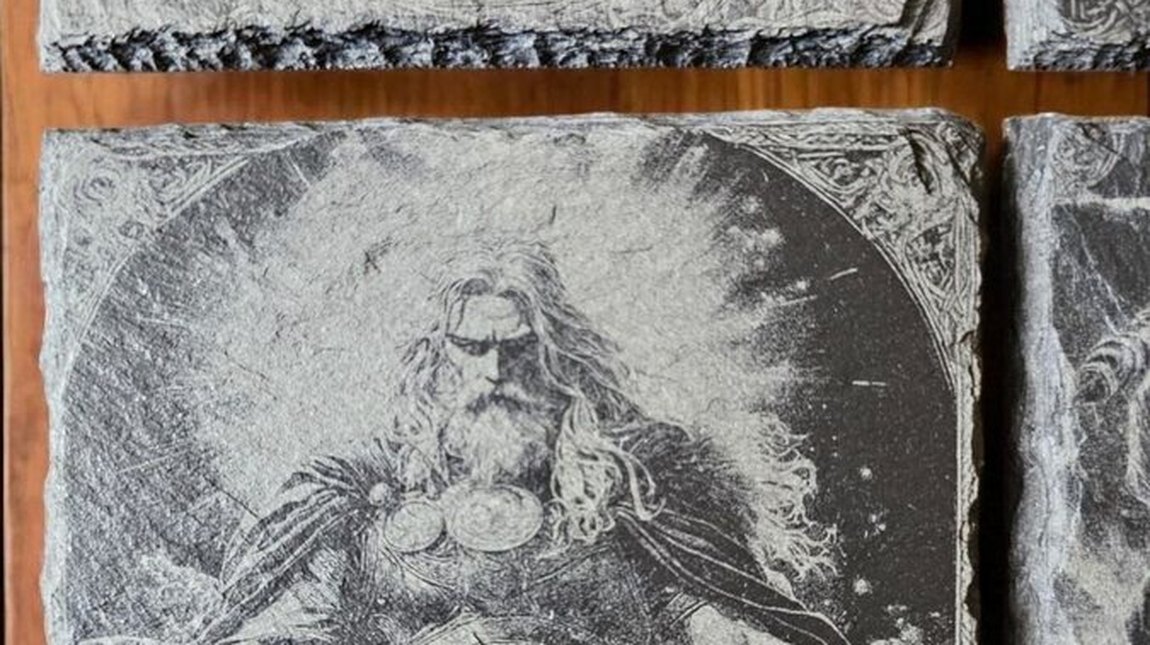
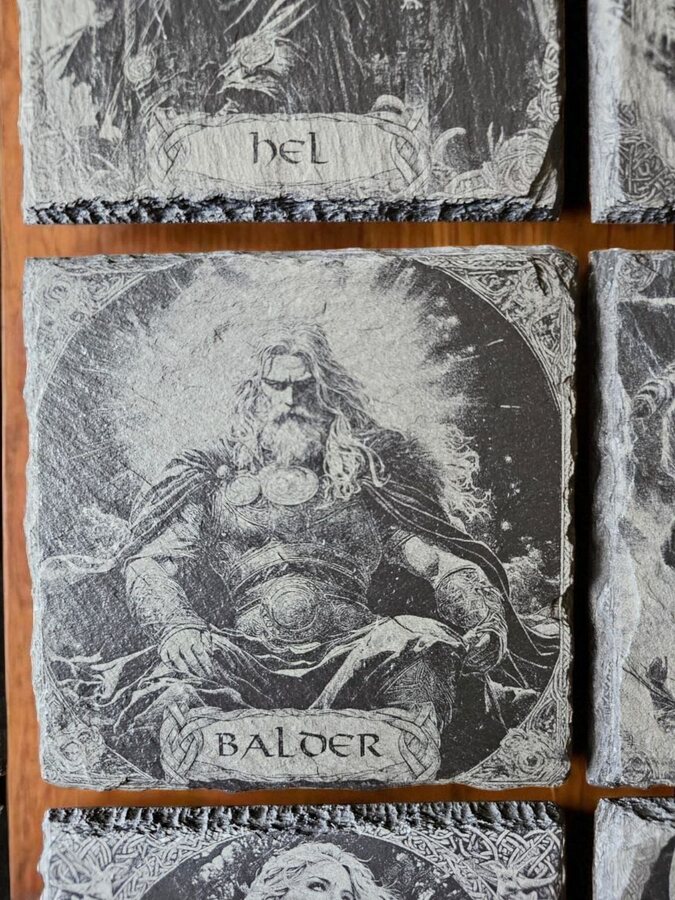
With slate the impression you know from wood is reversed. The engraving looks light, silvery grey, on a dark ground. There is a simple explanation, which we label explicitly as an explanation and not a measurement: as with glass and other stone, the laser breaks the finest particles out of the surface. The roughened zone scatters light more strongly than the dense, smoothly split slab surface and therefore looks lighter. No paint or hidden mineral that would be "uncovered" is needed. What matters is that the contrast grows with the darkness of the ground; the deeper the black or anthracite, the clearer the drawing.
This has consequences for designs. Large, clear areas and strong lines show particularly well on slate: runes, symbols, animal figures, coats of arms, lettering. Very fine detail, hairline strokes and tiny writing, on the other hand, tend to dissolve into the natural texture of the slab. Natural split surfaces are never quite flat, and small irregularities, quartz veins or mica flecks can disturb or enrich the drawing, depending on the eye. If you plan a very delicate design, talk it over in the workshop rather than relying on a sample photo.
On durability: slate is hard, weather-resistant and absorbs very little water, which has made it a roofing material for centuries. Roofing slate is tested under the European standard EN 12326, among other things for water absorption and frost resistance. That applies to roofing slate laid properly, not automatically to every plate someone screws to a wall. A slab left in standing water and frost can flake along its cleavage, because that is exactly where the rock splits. For sheltered outdoor places, such as a covered terrace, natural slate is well suited; we describe care in the article on caring for a slate plaque. If you want to know more about the process itself, see laser engraving on natural slate.
That stone can carry signs was known to the people of the North. The famous "whetstone of Strøm", an early Germanic sharpening stone, carries runes; reference works give no more than that, and we do not want to speculate. From the Viking Age itself we know many whetstones of fine-grained slate found at Hedeby and other trading places. According to common scholarly opinion many of them came from quarries near Eidsborg in Telemark, Norway, whose stone was made into whetstones for "hundreds of years" and was hauled over the ice to Skien in winter and from there shipped to other markets. We leave open the exact rock designation and the dating of production; they are settled in more detail in the specialist literature than we could check here.
More important for our subject is something general: stone is a material that outlasts time. That holds for rune stones as well as for the slate of a roof. Whoever gives an engraving on stone draws on an old idea. More on the history of the trade that moved such stones can be found in the article on Hedeby and in the overview of Viking trade.
Wood is the exact counterpart: warm instead of cool, light instead of dark. Under the laser the surface chars finely, and the engraving appears as a darker drawing. Hardwoods such as walnut, mahogany or maple give good, high-contrast results by general experience; softwoods can be engraved but vaporize more unevenly and, with resinous kinds, tend to leave resin halos around the engraving. Birch, oak or teak, which we use for signs and slices, each behave differently: birch is pale and even, oak strongly grained, teak oily and dark. Every piece of wood has its own pattern, and the engraving merges with it.
The pattern itself, the annual rings, arises because a tree grows differently through the year. Earlywood, formed in spring, is light, loose and built of wide-lumen cells; latewood, formed in late summer, is darker, denser and firmer. Better growing conditions give wider rings. In broadleaved trees the earlywood stays fairly constant while the share of latewood varies; in conifers it is the reverse, which is why fast-grown softwood is softer. Because trees in one region form similar ring patterns, archaeological timber can be dated to the year; at Hedeby, for instance, a well yielded a felling date of about 1020 thanks to this method. The pattern we see on a tree slice is therefore more than decoration: it records the climate of many years.
The downside is moisture. Wood is hygroscopic, taking up and giving off water until it balances with the humidity and temperature of its surroundings. Below the fibre saturation point, which lies at roughly 24 to 32 percent depending on species, it swells as it takes up water and shrinks as it dries, mainly across the grain. As target values for moisture content the literature gives about 11 percent for moderately heated interiors and under 10 percent with central or underfloor heating. In practice this means a tree slice that spends a winter next to a radiator may crack, mostly in radial splits from the pith outward. That is not a defect but a property of the material, and for that reason we say it openly. Anyone who expects a perfectly crack-free piece is better served by slate or glass.
For outdoor places wood is suitable only to a limited degree. Constant rain and frost wear it down; even in a covered outdoor spot the equilibrium moisture lies at around 15 percent by those guide values and swings more with the weather than it does indoors. Indoors wood stays unbeatable: as a door sign, as a tree of life, as a warm surface for names. A closer link with cultural history is made by the article on Viking woodcarving, which shows how much was made from oak, ash and beech in Norse hands, for instance in the find from Oseberg.
Physically, glass is not a crystal but a solidified melt without regular structure; the name "crystal glass" points to brilliance and refraction, not to a crystalline build. In Germany the term is regulated by law. The Kristallglaskennzeichnungsgesetz requires a glass to contain at least 10 percent lead oxide, barium oxide, potassium oxide or zinc oxide (singly or combined), plus a density of at least 2.45 and a refractive index of at least 1.52. An alternative definition names at least 10 percent lead, barium or potassium oxide, a density of at least 2.40 and a Vickers hardness of about 550. That is not the same as "lead crystal": lead glass existed in the Middle Ages, the English are credited with inventing lead crystal in the Baroque period, and around 1970 "24% PbO" was printed on many glasses as a mark of quality. Bohemia developed lead-free crystal glass by adding lime, known as chalk glass.
Why this precision? Because the terms are often muddled in the shops. Whether a particular glass contains lead is stated by its maker; we make no claim here that we cannot prove. For a lantern that does not touch food this makes no difference to use. Drinking glasses are subject to their own rules, and engraved drinking glasses are a different subject from a lantern.
The glasses in our range come from Stölzle in Lusatia, a name whose motto, "born in fire", suits Nordic motifs. The region has a decidedly industrial history. In Weißwasser in Upper Lusatia glassworks were founded from the 1870s on, after the Berlin–Görlitz railway connected the town; quartz sand, clay, wood and coal lay close at hand. In the 1920s Weißwasser was described as the largest glass-producing place in the world, a verdict that goes back to the boom years and the interwar period and whose figures we have not checked here. After 1990 most firms disappeared; today, according to the town's history, two glass companies remain, among them Stölzle Lausitz, formerly Oberlausitzer Glaswerke. The Glasmuseum Weißwasser preserves the history.
In the Viking Age glass was known above all as beads. Hedeby alone yielded more than 7,700 decorative beads; how craftsmen made them is described in the article on the bead makers. Glass drinking vessels, by contrast, were imported and rare. On the Rhine glass has a long tradition: in Mayen, at the edge of the Volcanic Eifel, Roman sarcophagi contained glass grave goods that the museum in the Genovevaburg displays. That is not the Viking Age, but it shows how early glass became part of burial custom and household.
A pretty story about the origin of glass has circulated since antiquity. The Roman scholar Pliny the Elder reports in the thirty-sixth book of his Natural History:
Phoenician merchants carrying a cargo of natron (nitrum) are said to have cooked their meal on the shore of the river Belus and, having no stones, used lumps of natron to support their pots. When the fire burned through sand and natron, translucent streams of a new liquid flowed out, the first glass.Pliny the Elder, Naturalis historia XXXVI, 190–191 (paraphrase in own words; English trans. J. Bostock, H. T. Riley, London 1855, public domain)
Pliny gives this expressly as tradition ("it is said"), not as his own observation.
With glass the engraving runs differently than with wood. Glass does not melt and vaporize obligingly; the laser creates micro-cracks that release tiny chips from the surface. The result is a matt, satin-like line that stands out gently from the clear glass. Thin lines come out more evenly than large filled areas, which can look uneven; the specialist literature describes this behaviour for laser engraving in general. That is why fine line motifs, lettering and ornaments suit glass better than solid areas.
The special charm appears when a candle is lit. The light travels through the clear glass and is scattered at the roughened lines, so the engraving begins to glow. A self-evident safety note applies: never leave candles burning unattended, and put the lantern on a firm, non-flammable surface. For care a soft, lint-free cloth is enough; we recommend cleaning engraved glass by hand.
As a rule of thumb from many years at the laser: gods, runes and large symbolic motifs belong on slate, because the dark ground gives them weight. A Thor's hammer or a valknut looks as if hewn in stone. Family themes, the tree of life, names and sayings for an occasion unfold their warmth on a tree slice; the wood itself already speaks of roots and growth, and the world tree is an obvious motif. When it is about atmosphere, a personal gift or a name in candlelight, the lantern is the first choice. These are suggestions, not laws: a ring of runes also looks good on glass, and a family name suits slate too.
Anyone choosing motifs and runes should look for authenticity. Which signs are attested and which invented is covered in the articles on Nordic symbols and on which rune to engrave; ideas for designs are offered by Viking motifs for engraving and tattoo.
All three materials are easy to look after but want different treatment. Slate can be wiped with a damp cloth; oil is a matter of taste, since it deepens the colour, and is not necessary. Wood likes a little wood oil now and then and should not stand right beside a radiator. Glass needs a soft, lint-free cloth. We enclose detailed notes with every piece. Care prolongs the pleasure of a piece; we claim nothing more.
The geological and glass-history statements rest on generally accessible reference works; figures such as age, fossil numbers or legal thresholds come from there and can be traced through the sources below. What we say about laser behaviour is workshop knowledge and specialist description, not laboratory evaluation. Individual slabs, woods and glasses vary. And our statement that the light contrast on slate comes from a roughened surface is a simple explanation, not a measured finding.
Which material is the most durable for an engraving? Natural slate is the most robust: hard, weather-resistant in measure and suitable for sheltered outdoor areas. Wood and crystal glass are meant for indoors.
Can I hang an engraved slate plaque outside? In a sheltered place such as a covered terrace or an entrance, yes. Do not expose it for years to standing water and frost, because slate can flake along its cleavage.
Why does the engraving turn light on slate and dark on wood? On wood the surface chars and turns darker. On slate the laser breaks out the finest particles; the roughened zone scatters light more strongly and looks lighter than the dark ground.
Can a tree slice crack? Yes. Wood works with the room climate, and drying cracks can form, especially beside radiators. That is a property of the material.
Is crystal glass the same as lead crystal? No. The term crystal glass is defined by law and includes lead-free glasses containing barium, potassium or zinc oxide. Lead crystal is a glass containing lead. The maker states the composition of a particular glass.
Can I have my own material engraved? In principle yes. Because every material reacts differently to the laser, we like to get to know your piece first. Contact us through custom engraving; you can lay out a design beforehand in the engraving configurator.
For courage. For remembrance. For legends that live on.
Runes & their meaning · Thor's Hammer.
A dark slate plate, a brief beam of light, and where there was deep anthracite a moment ago, a bright, silvery-white …
Read more →The great milestones of life deserve more than an off-the-shelf present. A Norse gift bearing a name, a date and an old …
Read more →A word of love engraved in stone or glass outlasts any card and any bouquet. But how did „I love you" actually sound in …
Read more →Natural slate is a rewarding material: sturdy, millions of years old and genuinely low-maintenance. Still, there are a …
Read more →