
A dark slate plate, a short beam of light, and where deep anthracite sat a moment ago, a pale, silvery-grey drawing appears. No paint is applied; the contrast arises on and in the stone itself. But what exactly happens? From the workshop's point of view, we explain what natural slate really is, how a CO2 laser works, why photos succeed through screening, and where the explanations in the technical literature honestly stay open.
The slate we use for our plates is a clay slate. It began as mud: the finest clay particles settling in a sea, layer upon layer, over millions of years. Later, mountain building folded these deposits and pressed them together under directed pressure and raised temperature. Clay mineral grains dissolved perpendicular to the direction of pressure and recrystallised across it. The result is a rock that splits along closely spaced, parallel planes into thin plates. Geology calls this property cleavage, and it explains why slate can be made into flat plates at all.
Two things are often confused. First, slaty cleavage and the original bedding frequently sit at an angle to each other; whoever splits a plate follows the cleavage, not the old sedimentary layers. Second, "slate" is a collective term. In current petrology it applies to rocks that are metamorphic or tectonically deformed. Many rocks historically called "slate" in German, such as the Posidonia shale or the Kupferschiefer, are strictly speaking claystones, siltstones or marls that have kept the name out of habit. We speak here only of clay slate, the classic roofing and writing stone. One step further up the metamorphic scale lies phyllite, whose larger mica flakes give a silky sheen; slate itself looks dull on fresh cleavage surfaces.
Mineralogically, clay slate consists mainly of quartz, illite and chlorite, which together can make up as much as 95 percent. Feldspar and mica are added, plus small amounts of iron oxides, pyrite, rutile and carbonates. The grains are mostly smaller than 20 micrometres, so the exact composition can only be determined by X-ray diffraction. Density is about 2.8 grams per cubic centimetre. Under the microscope, slate shows thin quartz-feldspar lenses separated by mica layers, typically under 100 micrometres thick.
The colours run from black through grey and blue-grey to green, yellow, red and violet. The dark shades we prefer for engravings are the best known, but not the only ones. Where the darkness comes from matters for our topic and is often simplified: dark clay slates contain finely dispersed carbon, derived from the organic matter of the former sea floors, plus iron compounds. That is the usual explanation in rock science; how much a particular plate holds depends on the deposit.
For our region, slate is no imported stone but a feature of the landscape. The Rhenish Massif arose in the course of the Variscan orogeny. Its rocks date mainly from the Devonian and Carboniferous, a span of roughly 419 to 299 million years ago. It covers about 25,800 square kilometres on both sides of the Rhine and includes the Eifel, Hunsrück, Taunus, Westerwald and Sauerland, plus, across the border, the Ardennes with the High Fens south of Aachen. The geologist Karl Georg von Raumer gave it its name in 1815.
Pure slate of the kind needed for roofs occurs there only in limited areas: on the Moselle, on the Lower Rhine, in parts of the Bergisches Land and in the Siegerland. The picture of the whole massif is shaped by sandy claystones, sandstones, greywacke and quartzite. The best-known quarrying area lies around Mayen in the Eifel. The Katzenberg mine in Mayen produced slate, by the available accounts, since Roman times until the last wagon left on 29 March 2019. The name "Moselschiefer" arose in the sixteenth century because the stone was shipped down the Moselle to the Lower Rhine. In 2024 the International Union of Geological Sciences added German roofing slate to its Heritage Stone list.
The global picture is different. By volume, Spain, France, Britain, Germany and Portugal lead according to the available figures. Spain is the largest producer and exporter of natural slate and supplies about 90 percent of Europe's roofing slate; Brazil comes second. Where the stone of a particular plate came from therefore cannot be said without delivery papers. Anyone who wants to know should ask the supplier. We deliberately do not generalise here: origin can influence colour, splitting and the response to the laser.
More on slate in the Rhineland, the Bundenbach fossils and proper care is in our piece on caring for engraved slate plates.
Slate was long a working stone. The roof is its best-known use: roofing slate is fireproof, its water absorption is, by the available figures, below 0.4 percent for roofing grades, and roofs can last 60 to 125 years or more when properly fixed. Add facades, floor slabs, stair treads, insulating switchboards in the early twentieth century, laboratory benches and billiard tables. Japanese Go sets use slate stones, and the rock was also used for gravestones and Maya stelae.
In Germany many people know it as the school slate. From the Middle Ages until the middle of the twentieth century, slates and slate pencils were made; the pencils came mostly from Steinach in Thuringia, which held the world monopoly on pencil slate into the 1960s. Until the 1960s primary pupils used small writing slates of slate, later of plastic. They wrote with white-marking pencils and cleaned with a sponge. The example shows a trait of the material: slate takes marks without anything having to stick. The writing slate is a surface for scratching and wiping. Laser engraving does the opposite: it lets the drawing stay.
In the north, slate plays a smaller part in the Viking Age than one might think: whetstones of schistose rock are among the frequent finds of the period. Runestones, by contrast, are mostly granite, gneiss or sandstone, not slate. We therefore build the bridge to our motifs not through the stone but through the imagery; more in our pieces on picture stones and on the Jelling stones, whose colours survive today only as traces.
A CO2 laser produces infrared light at a wavelength of 10.6 micrometres (and also 9.6 µm). It was invented in 1964 by C. Kumar N. Patel at Bell Laboratories and is among the earliest gas lasers. Its efficiency can reach 20 percent, which is very high for a laser. Many materials absorb this wavelength strongly, among them water, biological tissue and many natural and synthetic substances. The effect on stone is more complicated, and we come to that shortly.
An engraving machine consists in essence of three parts: the laser, a controller and the work surface. The controller sets the direction, intensity, speed and focus of the beam. The beam is focused to a tiny spot; only there is the material noticeably changed. Because the controller knows the beam's position at every moment, no stencil or mask is needed. The beam does not touch the workpiece, so there is no tool wear and no pressure on the plate.
Specialists distinguish engraving from marking. In engraving, material is removed, to depths of about 100 micrometres or more; in marking, colour or surface changes without much material disappearing. Two modes are common. In vector engraving the beam traces outlines like a plotter, which suits lines and hatching. In raster engraving it sweeps back and forth line by line, each line overlapping slightly with the next, so that areas and photos are filled in. Raster is the most widespread mode today.
On safety: these machines sit in the highest hazard class. Class 4 lasers can burn skin and cause severe eye damage, even from scattered reflections; CO2 radiation is absorbed by the cornea. In practice such machines run in closed, interlocked enclosures, and the standard IEC 60825-1 governs classification. We mention this because it is often missing from the conversation about laser engraving: the device is an industrial tool, not a household appliance.
Now the core question. Where the laser beam hits the dark slate, the spot turns lighter. The phenomenon is undisputed; the explanation in detail is not. We have found no study that settles, for clay slate in general, which mechanism dominates. Three explanations are discussed, and they probably operate side by side.
The engraving is therefore not bleaching in the everyday sense, even if we sometimes use the word in the workshop. It is a combination of removal, roughening and alteration of the topmost mineral layer. What reaches the viewer is a silvery-grey to whitish tone that creates contrast on the dark ground. That the effect differs from plate to plate also fits this variety of causes.
The technical literature on laser engraving, incidentally, often recommends other methods for stone and glass: since these materials neither evaporate nor melt easily, the laser fractures them and produces chips, and sandblasting, diamond tools or waterjet are frequently considered better suited. For clay slate, which tends to split finely anyway and is dark, the laser nonetheless gives legible results. We say this so that it stays clear: the method has limits, and quality depends strongly on the plate and the settings.
A laser at first knows only two states: dot placed or not. How do grey tones arise from that? With a trick that printing history has known for more than 150 years, halftone screening. The technique of representing continuous tones by dots can be traced to William Fox Talbot, whose 1852 patent describes "photographic screens or veils". Georg Meisenbach patented the "autotype" process in Germany in 1882 and is usually named as the inventor of printed halftone pictures. Newspapers and books worked this way for a long time.
The principle: the image is broken into countless tiny dots that differ in size or spacing. Many light dots close together make a light area, few make a dark one. When the dots are small enough, the eye at normal viewing distance averages the ratio of light to dark area and sees smooth transitions. In digital methods, algorithms called dithering decide which dots are set. Specialists distinguish regular screens with varying dot size from so-called stochastic screens, in which spacing varies. Both principles are used in photo engraving.
For slate, practical consequences follow. The photo must be prepared for the stone: converted to greyscale, raised in contrast, adjusted in tonal values. Engraved areas are light, so in the picture they are the highlights. A photo that looks punchy on screen can look flat on stone, because the darkest tones come from untreated slate and the lightest from the engraving. Very fine structures, such as thin hairs or small writing in the background, disappear in the grain. Anyone who supplies a sharp, high-contrast motif with a clear foreground will usually get the best results.
The plate's own grain also plays a part. Slate has fine lines and shading by nature, sometimes inclusions. They do not retreat in the engraving; depending on the plate, a vein may draw the eye or disturb a face. That is why choosing the plate belongs to the craft, not only setting the machine.
A good engraving begins long before the laser. First the artwork is prepared: graphics are cleanly cut out, photos converted to greyscale, contrast and brightness matched to the light engraving tone. With lettering we check legibility at the intended size, because very thin lines vanish on rough slate. If you have your own motif, you can submit a template through our custom engraving service, or design it yourself in the engraving configurator.
Then comes the interplay of focus, speed and power. The laser must be focused exactly on the surface; pace and energy determine how light and how fine the engraving turns out. Too much energy leads to a deep, coarse drawing with chipping; too little leaves it pale. Because natural slate is a natural product and every plate reacts a little differently, a test run belongs to the work. Concrete values remain a matter of experience and depend on the machine.
Engraving produces dust. Slate contains quartz, and fine crystalline quartz dust does not belong in the airways: inhaling respirable silica dust over time can lead to silicosis. In the literature the dust arises mainly in cutting, grinding and sandblasting; it gives no figures of its own for laser engraving. In operation, extraction is therefore standard. Smoke and fumes, which any laser processing creates, are drawn off as well, and the plate is cleaned afterwards so that loose particles do not stay on the surface.
With us the rule is: every plate is checked before engraving, aligned and assessed before it goes under the laser. That way we make sure grain and motif fit together, and we see whether a plate has cracks or cleavage faces that would spoil the result.
Honestly, several routes have their place. Classic hand engraving with a burin or chisel carries the trace of the person who makes it, with all its quirks. Viking-age runestones were worked with chisels, and the carving was often painted; traces of colour survive on the Jelling stone and show how colourful it once was. Woodcarving belonged to it as well, as our piece on Viking woodcarving shows.
"Do you know how to carve? Do you know how to read? Do you know how to stain? Do you know how to test?"Hávamál 145 (numbering after Bellows, public domain; our translation from the Old Norse)
The verb "to stain" is meant literally here: according to the editor Henry Adams Bellows's note, runes were commonly cut into wood and then coloured red. Whether the stanza itself is more a religious formula than a craft instruction research leaves open; it does show that carving and colouring were seen as belonging together.
Beside them stand today's methods. In sandblasting a stencil is applied and a stream of grit removes the unprotected areas. It makes deep, bold engravings and suits large surfaces and memorials, but needs stencils and creates a lot of dust. Milling and diamond engraving use a tool that touches the surface and wears. Fibre lasers (around 1,000 nm) are optimised for metals; CO2 lasers at 10.6 µm remain widespread for wood, some plastics and many stones. UV lasers give cleaner results on glass.
We work with the CO2 laser, for good reasons. It is precise down to fine detail, handles delicate lettering, complex patterns and photo engravings, and can be set reproducibly: a motif can be realised in constant quality. What is not lost is care in preparation, in choosing the plate and in checking. The laser is the tool; the eye and experience behind it stay human. For a comparison with wood and glass as engraving grounds, see our piece on choosing a material for engraving.
That the engraving does not lie on the stone but in it is a weighty argument. There is no paint layer that can flake, wash off or fade in light. A lettering made with varnish or sticker suffers more in this respect. Still, "everlasting" is a word we avoid for honesty's sake. For laser-engraved clay slate we know of no systematic long-term study. Our workshop experience is positive, but experience is not an expert report.
A few properties are worth knowing. The engraved area is rougher than the surrounding stone and takes up dirt, grease and moisture more readily. Oils and waxes change the colour impression of slate, making it look darker and richer, and can reduce the engraving's contrast. Hard scrubbing with stiff brushes or scouring powder can wear down the fine structure of the engraving. Plates are also brittle: slate breaks along its cleavage if it falls on an edge. The handling of the plate is described in detail in our piece on caring for engraved slate plates.
On the question of outdoors: slate is weatherproof as a roofing stone, but whether a particular engraved plate should stand outside for years depends on placement, frost and quality. We recommend sheltered spots for outdoor use. That is a cautious recommendation, not a promise.
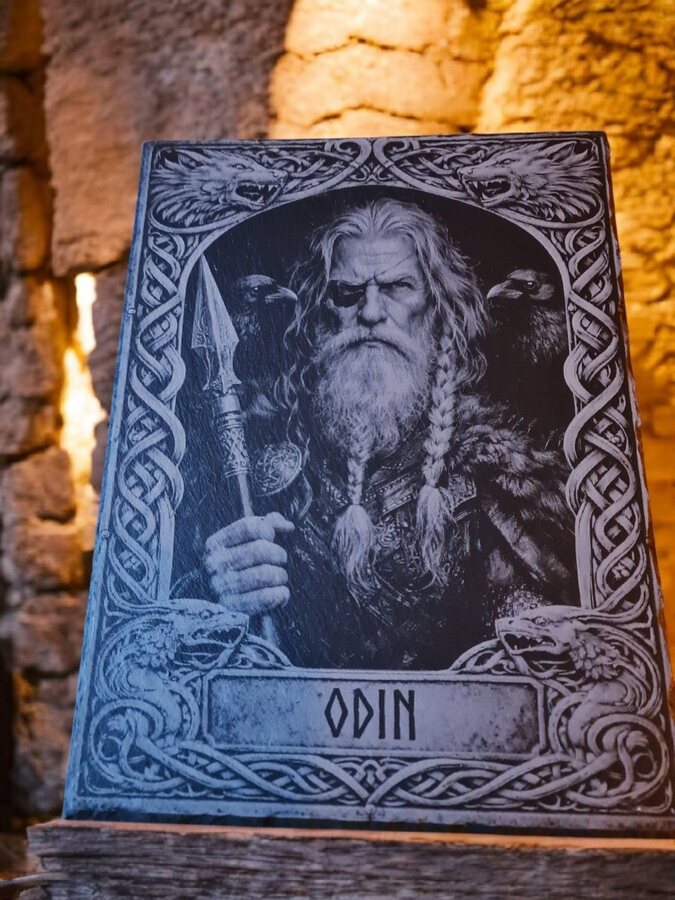
That Nordic and Germanic motifs look so good on slate has several reasons. The dark, matte ground gives runes, animals and knotwork a calm backdrop. The engraving is pale and reads like chalk on a board or moonlight on rock. That relationship is a matter of design; all that can be shown is that the effect appeals to many people.
Anyone wanting runes engraved should know that not every sign circulating online comes from historical times. Which signs are genuine we sort out in the piece Nordic symbols: genuine or invented?, and a selection for engravings is in Which rune to engrave?. The state of runic research is in our piece on runic scholarship, and common motifs from tattoo and engraving are covered in Viking motifs for engraving and tattoo. The link to the art styles of the period is explained in Viking art styles.
In our family workshop in Alsdorf, no plate goes under the laser unchecked. Because natural slate is alive, we lay out each piece individually, align grain and motif and judge the result. That is how we combine the precision of laser engraving with an eye for the material, so that in the end a stone results that carries its story with dignity.
A closing assessment. Secure is the rock science: formation, mineral content, properties and occurrence of clay slate are well described. Secure too is the working principle of the laser: focused infrared light, computer-controlled, without mechanical contact. Secure is the technique of screening, which begins with Talbot and Meisenbach in the nineteenth century.
Less secure are two points that we have named deliberately. First, the mechanism of lightening in detail, which probably differs from plate to plate. Second, long-term behaviour: we know that no paint can fade, but not how every plate behaves under every condition over decades. Anyone reading advertising claims that promise "for eternity" or "indestructible" should be sceptical; that includes anything we once simplified ourselves.
Does the engraving fade over time? Since no paint is applied, nothing can bleach or wipe off. The engraving can, however, become dirty or be worn by hard scrubbing. We know of no systematic long-term study for laser-engraved clay slate.
Can photos be engraved on slate? Yes. Through fine screening the laser converts a photo into greyscale. This works best with a sharp, high-contrast template; we prepare the image for the stone. Very fine details can be lost in the grain.
Is the engraving coloured? No. Neither paint nor ink is used. The pale tone arises because the laser removes, roughens and thermally alters the top layer of the slate.
Can I have my own motif engraved? Gladly. Whether your own picture, a wish text or an idea, our custom engraving service realises your motif. If you would rather design it yourself, try the engraving configurator. Ready-made motifs are under slate plates.
Does the slate come from the Rhineland? That depends on the plate. The Rhenish Massif is a classic quarrying region, but most of Europe's roofing slate comes from Spain. The origin of an individual plate should be asked about.
Is laser engraving on stone dangerous? The laser is a top-hazard-class device and runs in enclosed housings. Dust and smoke arise during engraving and are extracted. The finished plate is harmless to handle, but should be treated with care since slate is brittle.
For courage. For remembrance. For legends that live on.
Slate, Wood or Glass? · Slate plate care · Viking gifts for men · Runes & their meaning · Thor's Hammer.
The great milestones of life deserve more than an off-the-shelf present. A Norse gift bearing a name, a date and an old …
Read more →A word of love engraved in stone or glass outlasts any card and any bouquet. But how did „I love you" actually sound in …
Read more →Natural slate is a rewarding material: sturdy, millions of years old and genuinely low-maintenance. Still, there are a …
Read more →Are you the thinker or the protector? The trickster or the watcher? The Norse pantheon isn't a distant gallery of idols …
Read more →