A tie, a shower-gel set, one more mug with a slogan: men often get what is already in the cupboard. An engraved Norse gift is the opposite – provided you know what the motifs stand for. This guide joins the two. It shows what the sources say about giving in the North, from the gift stanzas of the Hávamál to the Mjölnir finds, separates evidence from modern addition, and sorts our ideas by type and occasion.
A good present hits the person, not the calendar. Norse motifs have been popular with men for years because they stand for something: courage, loyalty, a link with the ancestors, a bit of wilderness in everyday life. Giving Thor, Odin, runes or the World Tree says quietly: I thought about who you are. Add what a shower-gel set never has – personalisation. A name, a date, a line in runes, and there is exactly one of this piece.
That this is more than decoration becomes clear from the sources. Giving was no side-ritual in the Germanic and Norse world. It bound people together, it created friendship and allegiance, and it had rules that sound surprisingly familiar today. The first sections deal with that. The practical ones follow: gifts by personality, by occasion and by material, with honest notes on which motifs hold up historically and which do not.
The Hávamál, "Sayings of the High One", is a poem of the Elder Edda put into Odin's mouth as a counsellor. It survives only in the thirteenth-century Codex Regius but is generally thought to have its core in the ninth or tenth century. Much of it is rules for living, and a surprising amount concerns giving. Two stanzas stand out, numbered 41 and 42 in the common editions:
With weapons and garments friends shall gladden one another, as each can see for himself. Those who give and give back stay friends longest, if all else goes well. To a friend be a friend, and repay gift with gift.Hávamál, stanzas 41 and 42 (own translation from the Old Norse)
Weapons and garments, exactly what a man needed and wore, are the standard presents between friends. A gift in return is taken for granted. Later stanzas make room for the small: "No great thing need a man give," says stanza 52; "often a little buys praise. With half a loaf and a half-filled cup I won myself a friend." A present need not be costly; it must be meant. In stanza 47 the speaker recalls how rich he felt, travelling alone, when he found a companion: "man is man's delight." Stanza 48 adds that the brave and generous live best, and that the miserly give nothing gladly.
About 850 years before the Hávamál took shape, the Roman Tacitus described similar habits in his Germania (c. AD 98). He had never been to Germania, relied on reports, and wrote with a moral edge, holding up a mirror to his Romans. The work goes back to a single medieval manuscript found at Hersfeld abbey in 1425, which was later lost; copies survive, among them the Codex Aesinas.
In chapter 15 he reports that it is the custom of the tribes to bring their chiefs, freely and each as he can, some cattle or grain; they take special pleasure in presents from neighbouring peoples, sent not only by individuals but in the name of the community – choice horses, heavy arms, medallions and neck rings. In chapter 21 he describes hospitality: to turn any human being from one's roof is thought a crime, and each receives a guest with a meal according to his means. A departing guest is given whatever he asks, and asking in return is just as easy. People like presents, but they do not count them up and feel no obligation for those received.
That last point sits in some tension with the Hávamál, where the return gift is a duty. It should not be ironed out. Tacitus describes from outside and generalises across many tribes; the Edda speaks from within, for another time. Taken together they show gifts as a social currency that people took seriously. What Tacitus writes about marriage gifts we have unpacked in a separate piece on Norse gifts for weddings and naming.
Anyone in the Viking Age who wanted to give something special gave metal. The poets called kings ring-breakers or ring-givers; the Old English epic Beowulf has the same idea, and in both literatures a ruler who hands out jewellery is a good ruler. Archaeology fits: hack silver, cut-up arm rings used as payment where coins were scarce. We have described it in the article on hack silver.
A well-documented example comes from Egils saga. After the battle of Brunanburh (937, Vínheiðr in the saga), where Egill Skallagrímsson fought for King Æthelstan of England and his brother Þórólfr fell, the king gives him two chests of silver to pass on to his father Skalla-Grímr, and holds out an arm ring on the point of a sword. Later come two gold rings and a cloak the king himself had worn. The saga was written down in the thirteenth century and is ascribed by many scholars to Snorri Sturluson; the battle itself is attested elsewhere. The sequence is shaped by storytelling, but the pattern – thanks for service in silver, rings and clothing – is the same in many sources.
That giving is a science of its own shows in the history of research. The French sociologist Marcel Mauss published his Essai sur le don ("The Gift") in 1925. His thesis: in societies without markets, gifts are "total prestations" that link communities, and the return keeps the relationship alive while its absence ends it. As evidence Mauss drew, among others, on the Old Norse gift stanzas. Medievalists took the idea up: Aron Gurevich studied wealth and gift exchange among the early Scandinavians in the 1960s. Criticism came later, for instance of Mauss's reading of the Maori hau, where according to Jonathan Parry a poor translation caused much confusion; this does not touch his Edda evidence directly, but it urges caution about generalising.
For everyday use, this means: when you give a man something Norse, you move within a tradition that really was meant this way. The present is to express a bond, not to settle a bill. Whether it is returned is, today, his business.
The exchange of presents under the tree is a modern custom, and anyone who credits it to the Vikings is inventing something. What the sources say about Yule is plainer. Hákonar saga góða in Snorri's Heimskringla relates that King Hákon the Good, who wanted to Christianise Norway, moved Yule to Christmas. Anyone without a measure of ale was fined, and the feast lasted as long as the ale did. At the sacrificial feasts in Mære and Lade the king had to take part, toasts included. Haraldskvæði, around 900, says of a king that he "drinks Yule". A sacrifice, a banquet, a lot of ale: that is the picture, not a gift-giving.
There is one hint of gifts at the feast, in the language: Old Norse jólagjǫf means "Yule gift". No more than the existence of the word can be drawn from it. When people gave to each other, and whether it belonged to the heathen or the Christian feast, we do not know. If you give something Norse at Christmas, you give a motif from the North within a present-day tradition, which is perfectly fine. We have written about the feast in an article on Yule.
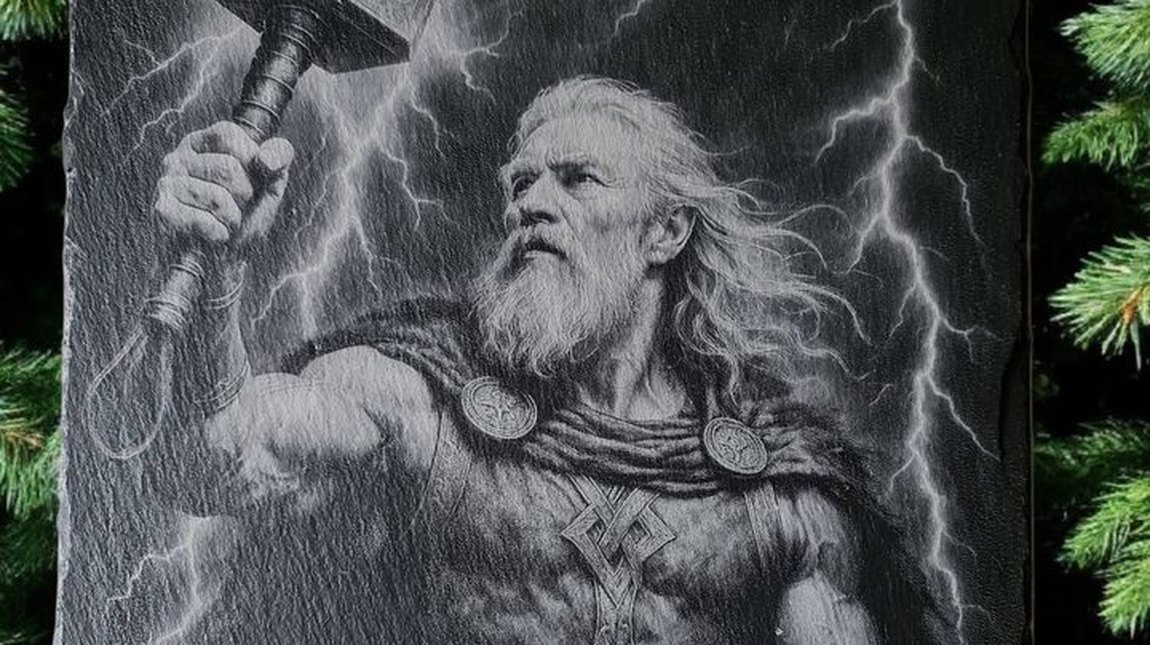
He likes it strong, straight, without frills? Then Thor is his god. The thunder god with the hammer Mjölnir stands for protection and strength, and among Norse motifs he is the best supported by finds. Hammer pendants of the Viking Age are among the best-known evidence. Around a thousand have been found so far in the Nordic countries, England, northern Germany, the Baltic and Russia. Most are plain, in iron or silver; about a hundred carry more elaborate decoration. Only some ten per cent come from graves, nearly all of them cremations, and part of those are interpreted as women's graves. A casting mould from Trendgården in Jutland that could cast both hammer and cross is often cited to show that craftsmen served both customers.
Katherine Beard sorted the finds by type in a database called Eitri in 2019; she suggests that the growing popularity of the hammer may have been a reply to the spread of the Christian cross. Poetry knows the hammer, too, as an instrument of consecration: in Þrymskviða it is laid in the bride's lap to hallow her. More in our articles on Thor and the Thor's hammer.
How fluid the line between the signs could be is shown by a silver pendant from Foss in Iceland, dated to about the eleventh century. It is called a "wolf cross" because it can be read as a Christian cross and as Thor's hammer. The piece fits what we know about the Christianisation of the North: old and new signs lived side by side for a time, and it is conceivable that not every wearer decided for one; that cannot be proved.
As a laser-engraved slate plaque, dark natural slate gives the lightning a fitting stage. For something to wear, the natural jewellery range has Mjölnir pendants modelled on real finds.
The thoughtful one, who would rather read than roar, is in good hands with Odin. According to the Edda the All-Father gave an eye for wisdom and took up the runes from the tree, in the Rúnatal of the Hávamál: nine nights Odin hangs on the windy tree, wounded by a spear, given to himself. That the tree is Yggdrasil is a common but not explicit reading. More on the god in our piece on Odin.
A short saying makes an excellent engraving, and the best known stands in stanza 77 of the Hávamál: "Cattle die, kinsmen die, you yourself die likewise; but a good name never dies for the one who wins it." The line appears in similar form in Eyvindr skáldaspillir's Hákonarmál, which helps date the text to the tenth century. More sayings are collected in the piece on Hávamál sayings. If you want them in runes, the basics are under runes.
Are roots important to him, family, the feeling of being part of something larger? Here the theme meets the core of the sources. Royal houses traced their descent to gods: the Anglo-Saxon king lists end at Woden, and the Ynglingatal traces the Ynglings back to Yngvi-Freyr, Snorri's Ynglinga saga to Odin. That was a claim to rule as much as family pride. A row of gods on slate – Odin, Balder, Loki, Idun, Frigg and more – takes up the thought, even if it is not an ancestry in the genealogical sense.
The tree of life is warmer still. According to the Eddas, Yggdrasil links the nine worlds; the world-view is explained in the pieces on Yggdrasil and the nine worlds. As a tree slice of real wood, sanded and oiled, it becomes a wall piece, ideally with the family name or an important date. How kin and family worked in the Viking Age is covered in the article Kin and family.
Is he the host, the man for the campfire, the first to stand at "cups up and skål"? Then drinking culture is the obvious route. Ale and mead belonged to the feast, as the Yule report above shows, and the hospitality Tacitus describes was a duty. How the ale tasted and was brewed is in the article on Viking ale, mead is explained in mead, and the toast itself in skål.
An engraved storm lantern of Stölzle crystal glass from Lusatia, born in fire and laser-engraved by us, brings hall atmosphere to any table. Historically the storm lantern is a modern invention; longhouses were lit mainly by the fire of the hearth (longhouse). What counts is the feeling, and that should be said honestly: a gift with a Norse motif, not a museum find.
The kind who would rather be in the forest than in a shopping centre and thinks wolves are cool? Two paths meet here. The motif: Fenrir, the great wolf who breaks his fetters at the end of the world in the Edda (Fenrir), or a pair of wolves on dark slate. In poetry the wolf also belongs to the warrior: Haraldskvæði names the úlfheðnar, "wolf-coats" (Ulfhednar, wolf in the North). The material: a tree slice, sanded and oiled, with bark at the edge and a wolf in the middle. Woodcarving was a core craft of the Viking Age (woodcarving).
Sometimes the occasion matters more than the type. A short guide, with no claim to historical precedent: most of these occasions are modern.
Birthday. This one can be personal. A slate plaque with his favourite god plus his birth date, or a storm lantern with his name, joins motif and personalisation. Round birthdays can take something bigger, such as a tree slice for the wall.
Father's Day. In Germany it falls on Ascension Day, which has nothing to do with Norse tradition. Fitting are motifs of protector and origin: Thor, a tree of life with the children's names, a row of gods.
Christmas. Warm light and Norse motifs go together, storm lanterns especially. Whoever is early has it personalised; whoever is late picks a ready-made motif from the shop.
Wedding, naming, new home. Here the sources offer something to hold on to, from Tacitus to the Þrymskviða. What is attested and what is not is in the article on weddings and naming.
Just because. Perhaps the best present needs no reason. The Hávamál say it themselves: a little often buys praise, and half a loaf is enough to win a friend. Small pendants or compact slate plaques are made for it.
Whoever chooses a gift with meaning should know how old the meaning is. Mjölnir is attested by hundreds of finds. Yggdrasil and the gods come from the poetry of the Edda, written down in the thirteenth century but preserving older material. The valknut, three interlocked triangles, is attested as an image on Gotland picture stones (Stora Hammars I, Tängelgårda) and in the Oseberg find, but bears a modern name: how it was called then is unknown, and reading it as a sign of Odin is a conjecture. The valknut is also used in extremist circles, which is worth knowing before an engraving.
The step from nice present to hit is the engraving with a personal link. We put names, dates, initials or a saying on the piece, in runes on request. A look at the script is worth it: the Elder Futhark with 24 runes is attested from about AD 150 to 800, the oldest inscriptions being the Vimose comb (about 160) and the Kylver stone (about 400). From the late eighth century the Younger Futhark with 16 runes took over, the script of the Viking Age. Anyone who wants an authentic Viking style therefore takes the younger row; the Elder Futhark is older, handsome and widely used, but not the Vikings' script. The two rows are compared in the piece on the Futhark comparison, and which rune fits which occasion is discussed in Which rune to engrave?.
The simplest route is our custom engraving: you tell us motif, text and material, we do the rest. If you want to design it yourself, try the engraving configurator and see the preview at once. Names in runes are a modern transcription, since the Vikings wrote names by sound, not by fixed spelling rules; we settle the spelling with you.
All our pieces are laser-engraved. Natural slate here means clay slate: a rock formed from the clay mud of a sea, transformed under pressure and heat, which splits into plates. Its grains are smaller than 20 micrometres and its density is about 2.8 grams per cubic centimetre, so even a small plaque has some weight. The engraving is not applied paint; the pale contrast is made in the stone itself. Similar rocks occur in the Rhenish Slate Mountains, as our article on laser engraving on natural slate shows. Care advice is in the piece on caring for slate plaques.
Wood chars on the surface under the laser and turns dark; glass chips finely and looks matt. Every slab, blank and batch of glass is a little different, so the result can deviate from the preview. A comparison is in the material comparison.
Honestly: in many places only partly. The Hávamál is a thirteenth-century manuscript with a core that may be older but cannot be dated securely. Tacitus wrote about people he had never visited, and with a moral purpose. Egils saga is a narrative put on parchment a century or more after the events. For the Yule feast we have the account of a thirteenth-century saga that draws on older sources.
What the earth has yielded is firmer: hammer pendants, arm rings, hack silver. From these one can read that jewellery and metal were valuable gifts in the North. How exactly presents were made, returned and interpreted can be sketched only in outline. We add nothing here: a gift with a Norse motif is not a reconstruction of a Viking custom but a thought in this tradition, with all we know of it and all we do not.
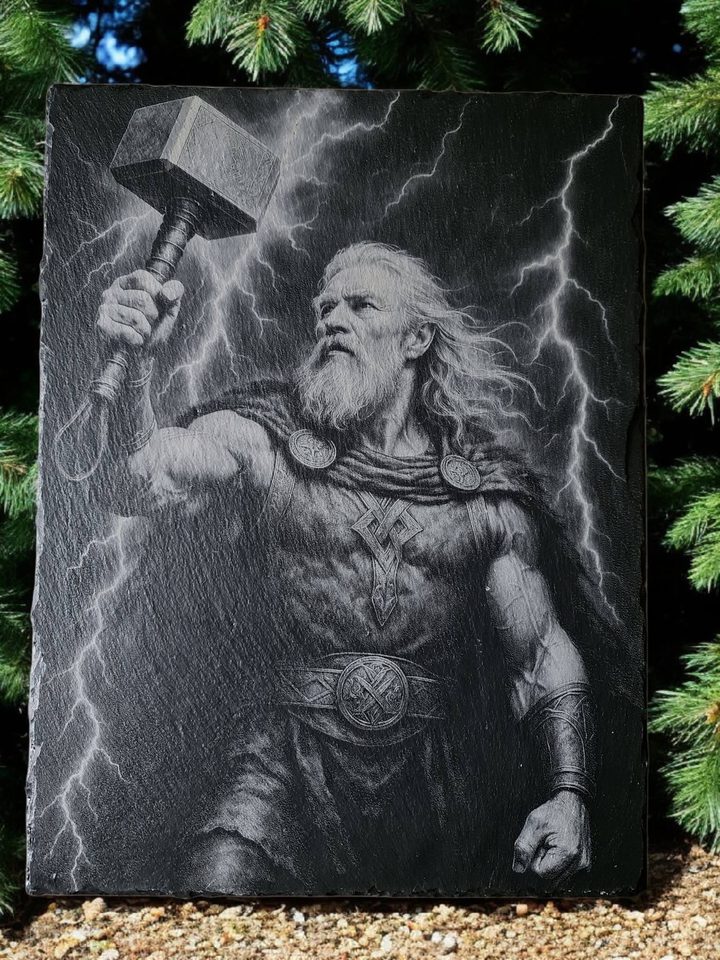
What do you give a Viking fan? Best something with a real link: a motif that suits his character (Thor for the fighter, Odin for the thinker, the wolf for the nature lover), combined with personalisation such as a name or date.
Which gift costs less than 30 euros? Natural-jewellery pendants and compact slate plaques are often in that range; current prices are in the shop under natural jewellery and slate plaques.
Can I have a name or my own saying engraved? Yes. A name, date, initials or a whole saying can be done through the custom engraving, in German, English or runes.
Did the Vikings exchange presents at Christmas? The sources know the Yule feast with ale, sacrifice and toasts, but no gift-giving ceremony. The word jólagjǫf attests Yule gifts as a term; what they were is unknown.
Which runes did the Vikings use? The Younger Futhark with 16 runes. The Elder Futhark with 24 runes is older and belongs to the period before the Viking Age.
How long does a personalised gift take? Allow a few days, especially before Christmas. When time is short, a ready-made motif helps; you can ask any time through the custom engraving or on Etsy at glanzundgravur.etsy.com.
For courage. For remembrance. For legends that live on.
Slate, Wood or Glass? · Thor's Hammer · Runes & their meaning · The Valknut.
The little blue symbol on your phone is over a thousand years old: two interlocking runes – the initials of the Viking …
Read more →Few questions reach us in the workshop as often as this one: „Which material actually suits my motif best?" Whether …
Read more →A dark slate plate, a brief beam of light, and where there was deep anthracite a moment ago, a bright, silvery-white …
Read more →The great milestones of life deserve more than an off-the-shelf present. A Norse gift bearing a name, a date and an old …
Read more →