Around the year 700 people in the North wrote with twenty-four signs. A hundred years later there were sixteen. In the same period their language had changed so much that it had to distinguish considerably more sounds than before. Fewer letters for more sounds – it is like thinning out the toolbox just as the job gets harder. That is exactly what happened, and it remains one of the strangest decisions in the history of European writing. Here are both rows side by side: what they can do, where they come from, how to tell them apart.
Runes are not one uniform script. There are three main branches, and anyone who confuses them will misread inscriptions or misdate them by centuries.
The Elder Futhark has twenty-four signs and runs from the second into the eighth century. The Younger Futhark has sixteen and begins around 800; it is the script of the Viking Age. The Anglo-Saxon futhorc in England and Frisia goes the other way and grows to twenty-eight and later up to thirty-three signs.
The name comes in each case from the first signs of the row: f, u, þ, a, r, k. That the Anglo-Saxons call theirs futhorc is down to a sound change – their old a-sign became an o. A full overview of both Nordic rows with all their signs is on our runes page.
About three hundred and fifty inscriptions in the Elder Futhark are known, some two hundred and sixty of them from Scandinavia. The rest are spread across the Germanic-speaking world as far as southern Germany and south-eastern Europe. They sit on brooches, combs, weapons, bracteates and stones – rarely long texts, mostly names, ownership marks and formula words.
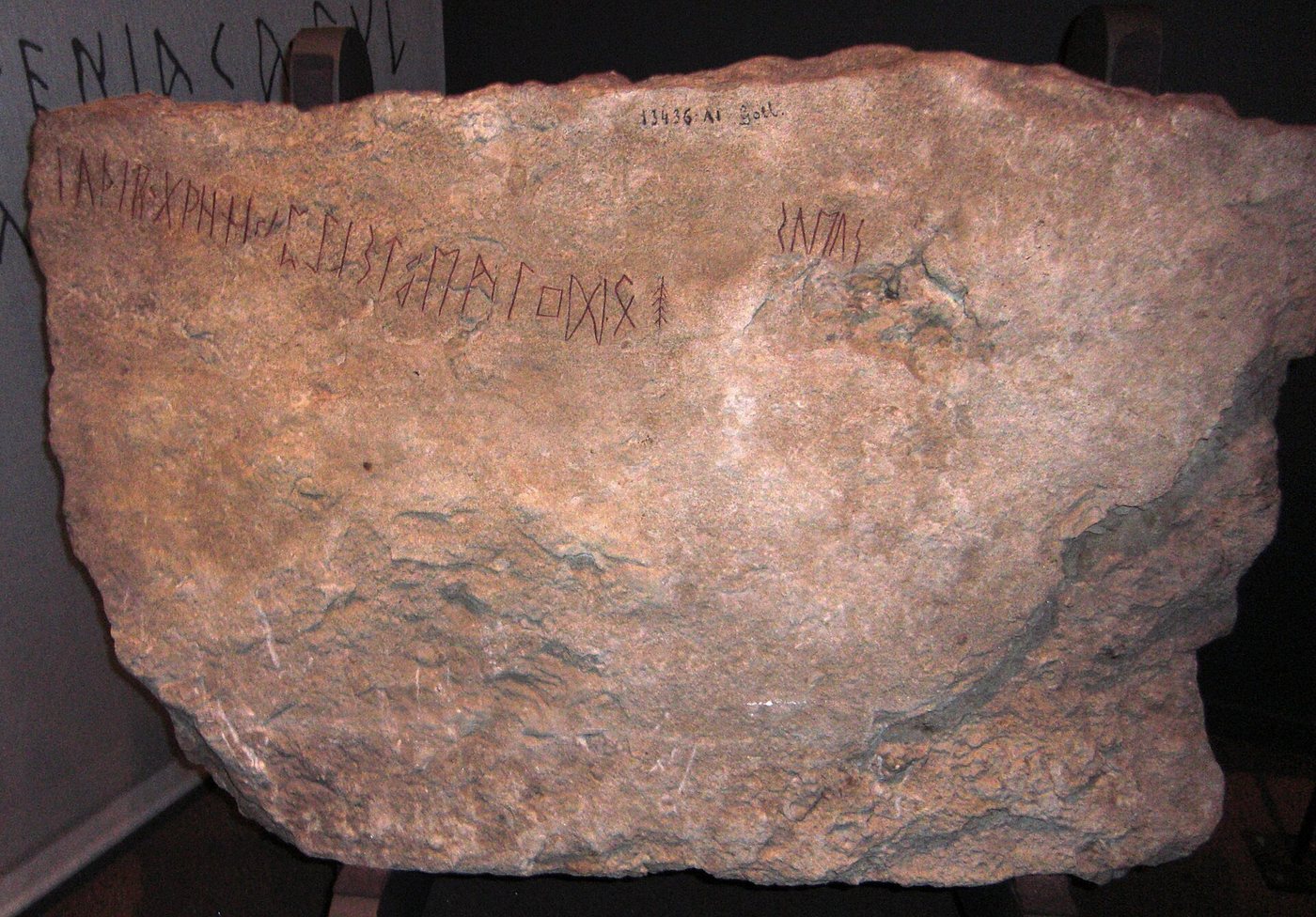
The oldest reasonably secure inscription is on a comb from the bog deposit at Vimose in Denmark, dated around 160. A single word: harja. The oldest complete row is on the underside of the Kylver stone from Stånga on Gotland, around 400, a grave slab. On some bracteates the row is divided by dots into three groups of eight – the division later called ættir.
The most famous sentence in this script stood on one of the Golden Horns of Gallehus, early fifth century:
ek hlewagastiz holtijaz horna tawido
"I, Hlewagast, the Holting, made the horn."Inscription on the second Gallehus horn, Denmark; English rendering our own. Whether holtijaz names a place of origin or a father is disputed.
The language of these inscriptions is Proto-Norse. It still has full endings, and the twenty-four signs cover its sound system fairly cleanly. One sign, one sound – as far as an alphabetic script ever manages that. If you want to work through the signs one by one, we have them on our page on the Elder Futhark.
Between roughly 650 and 800 lies a transitional period in which inscriptions mix old and new forms. At the end of it stands a row of sixteen signs, and it stays in use for four hundred years: f, u, þ, ą, r, k – h, n, i, a, s – t, b, m, l, ʀ.
These sixteen signs appear on practically every Viking Age runestone. Sweden has, depending on how you count, between 1,700 and 2,500 runestones, with almost 1,200 inscriptions recorded in Uppland alone; Denmark has around 250, Norway some 50. The bulk date from 950 to 1100. An early example is the Kälvesten stone in Östergötland, which speaks of a voyage east; the best known are the Jelling stones of the late tenth century. Reading the signs on them is what our page on the Younger Futhark is for.
The typical inscription is short and follows a formula: X had this stone raised in memory of Y, his father or brother. Then often: where the dead man ended up, what rank he held, who cut the runes, and from the eleventh century a prayer to God or Michael. Runestones are memorials and proofs of inheritance, not narratives.
Here lies the real contradiction. While the row shrank, Proto-Norse was turning into Old Norse: unstressed endings dropped away, umlauts arose, gastiz became gestr. By the end the language had more distinguishable vowels than before, not fewer.
The result is a script that is massively ambiguous. One sign had to carry several sounds: the u-sign stood for u, o, y, ø and w; the i-sign for i and e; the k-sign for k, g and ng; the t-sign for t and d; the b-sign for b and p. Long and short vowels were not separated. On top of that came the habit of not writing the same rune twice in a row even when the sound was doubled.
Why anyone did this, nobody knows for certain, and serious runology says so. Several reasons are discussed: a row that is quicker to learn and quicker to cut; an adjustment to actual practice, in which the reader supplies the rest from context; a deliberate standard that spread because it was simple. None of these is proven. Only the result is.
In practice this means a Viking Age inscription can almost never be turned letter by letter into a single reading. Runologists therefore give first a sign-by-sign transliteration, then a normalised Old Norse form, then a translation – three stages, with the uncertainty sitting between the first and the second.
The sixteen signs occur in different shapes. The sound value stays the same, the appearance does not.
Long-branch runes, also called Danish or normal runes, have full, generously drawn branches. They are typical of formal monuments; the Jelling stones are the model case.
Short-twig runes, also called Swedish-Norwegian or Rök runes, shorten the branches and in several signs drop the full vertical stave. They are quicker to cut and turn up often on wood and in everyday use. The Rök stone in Östergötland carries both variants side by side, plus cipher runes and a passage in the Elder Futhark – a showpiece of runic craft, and the best proof that the forms were not separate worlds.
Staveless runes, named Hälsinge runes after their main area, push the shortening to its limit and drop the vertical stave altogether. They appear from the tenth into the twelfth century, above all in central Sweden, and are barely legible without practice.
At some point the ambiguity came to be felt as a defect. The solution was simple: a dot inside the sign. The i-rune with a dot became e, the k-rune became g, the u-rune became y, and later t became d and b became p. These stungnar rúnar, dotted runes, appear at the end of the tenth and during the eleventh century and are fully developed by the early thirteenth.
The result is called the medieval futhark. It has a sign for every sound and is thus as capable as the Latin alphabet – except that by then the Latin alphabet had long since arrived and the Church was writing with it. Runes stayed in use anyway, and in large numbers.
The proof lies in Bergen. After a harbour fire in 1955, more than six hundred and fifty inscriptions were found at Bryggen, mostly on small wooden sticks, from the twelfth to the fourteenth century: goods tags, debt notes, messages, prayers, declarations of love, obscenities. They show a literacy that has nothing to do with monuments – runes as an everyday script, alongside Latin and parchment. In remote areas runic writing lasted far longer still; in Dalarna runes were used into the nineteenth century.
In the British Isles and on the Frisian coast the development went the other way. There the row grew: first to twenty-six signs, then to twenty-eight, and in northern English manuscripts to over thirty. The reason was sound change in Old English, above all the splitting of the old a into several sounds for which new signs were created.
Whether the script reached England or Frisia first is open; the finds do not settle it. The earliest inscription from England is on the Undley bracteate, placed in the late fifth century. The best-known piece is the Franks Casket of the early eighth century, a whalebone box that sets Germanic legend beside Christian scenes and mixes runes with Latin letters. The seax of Beagnoth, dredged from the Thames in the nineteenth century, carries the complete row.
In England runes disappeared earlier than in the North. After the Norman Conquest of 1066 they are effectively out of use; scholars still knew them, but writing was done in Latin.
Every rune has a name, and this is where most goes wrong. For the Elder Futhark these names are not attested. Not one. What stands in books and tables – fehu, uruz, þurisaz, ansuz – are reconstructions into Proto-Germanic, inferred from three groups of sources, all of them considerably later.
The first are the rune poems, three texts that go through a row and give a short stanza for each sign. The Old English rune poem stood in a manuscript that burned in the Cotton library fire of 1731; it survives only because George Hickes had printed it in 1705. The Norwegian rune poem is known from a seventeenth-century copy of a lost medieval original. The Icelandic one appears in manuscripts from around 1500 onward, the oldest of which is damaged in places and read differently by different editors.
The second source is the names of the Gothic letters, preserved in a ninth-century manuscript from Alcuin's circle. The third is the Abecedarium Nordmannicum, also ninth century, in a St Gall manuscript: the sixteen signs of the Younger Futhark with their names, in a mixture of Old Norse, Old Saxon and Old High German. That text was destroyed in the nineteenth century by a chemical reagent and essentially survives only through a drawing Wilhelm Grimm made in 1828.
From this follows an uncomfortable sum: the earliest evidence for the names lies several centuries after the end of the Elder Futhark, and the complete poems six to eleven centuries after it. They come from Christian times, they contradict one another, and the Norwegian and Icelandic versions read the same signs differently. That the names are old in principle is made likely by the agreement between the language branches. What any single name meant in the age of Gallehus cannot be shown. Anyone who fits a rune with a fixed, mystical meaning is relying on a text younger than much of what it is supposed to explain. How we weigh all that is set out in our introduction to the runes.
Contemporary evidence means the inscriptions themselves: around 350 in the Elder Futhark, several thousand in the Younger, plus the medieval wooden finds. They are the only material that comes from the period it informs us about.
Archaeological evidence covers find spot, find layer and the object carrying the text – and with them the dating. A comb in a bog, a grave slab, a stick in harbour mud: the context dates the writing, not the other way round.
Later tradition means the rune poems, the Abecedarium Nordmannicum, the Gothic letter names and everything medieval Icelandic manuscripts say about runes. Useful, but younger than their subject.
Modern interpretation covers the reasons for the reduction to sixteen signs, the origin of runes in a Mediterranean alphabet, the question of Frisia or England – and above all any assignment of fixed meanings to individual signs.
We have been engraving runes for as long as we have existed, and we tell our customers the same thing every time: which row you choose is not a matter of taste. A name in twenty-four signs belongs to the fifth century, the same name in sixteen signs to the Viking Age. Know that, and you are not wearing decoration, you are wearing a date. For courage. For memory. For legends that live on.
Runes & their meaning · The Jelling stones · The Kälvesten stone · The Rök Stone · The Golden Horns of Gallehus · The Franks Casket – a runic box between Wayland and the Magi.