The Hørning runestone (DR 58) is a Viking Age memorial from East Jutland, Denmark, raised around 970–1020 by a man called Tóki the smith for Þorgísl, son of Guðmundr, “who gave him gold and freedom”. That makes it one of the very few runic monuments that seem to speak directly of manumission – the step from slavery into a life of one’s own. The original stands today in Moesgaard Museum near Aarhus. Here is what the stone really says, where the reading is shaky, and what freedom meant for a former thrall.
Runestones were status symbols. Anyone who could have a boulder weighing several tonnes dragged into place, carved with a band of runes and set up where everyone would pass it was making a statement about wealth, family and claims. So most inscriptions speak of kings, retainers, big landowners and their widows. On the Jelling stones, Harald Bluetooth announces that he won the whole of Denmark. The Hørning stone, by contrast, carries the voice of someone who once stood at the other end of that society.
His name is Tóki, his byname smiðr, “the smith”. And the reason he raised a stone is written right there: the dead man, Þorgísl, gave him gold and freedom. Nobody phrases it that way unless they were once unfree. That single clause has made this modest monument a favourite of runologists for more than 170 years.
We at Glanz & Gravur have a soft spot for this stone. Not because of battles or kings, but because it shows what people a thousand years ago carved letters into stone for: to hold on to a relationship. A debt of thanks. A name that was not supposed to disappear.
The inscription runs in three lines across an elongated stone. The runes are 10.5 to 18 centimetres tall and only shallowly cut. The third line climbs up from the base in the middle of the stone and ends in a carved cross. In the most recent study, by Ejvind Hertz and Lisbeth M. Imer (Kuml 2023), the transliteration reads:
toki : smiþr : riþ : stin : ift | þurkisl : kuþmutaʀ : sun : is : hanum | kaf : kul : uk : frialsiHørning stone, DR 58 – transliteration after Hertz & Imer
Normalised into Old Norse, that gives roughly Tóki smiðr reisti stein ept Þorgísl Guðmundar sun, es hánum gaf gull ok frjálsi. In English, in our own rendering:
Tóki the smith raised the stone in memory of Þorgísl, Guðmundr’s son, who gave him gold (?) and freedom.DR 58, our own translation
Two small details tell us something about the carver. Instead of the usual risþi (“raised”) we find just riþ – an abbreviation that Hertz and Imer know from no other runestone. And instead of the younger form iftiʀ (“after, in memory of”) there is a clipped ift. Whoever cut these runes was saving space or effort, but knew exactly what he was doing.
The name Þorgísl, incidentally, survives in modern Danish as Troels, which is why the standard Danish translation has “Toke Smed” raising the stone “efter Troels Gudmundssøn”. For how such names were built, see our article on Viking names.
Many popular accounts – including the first version of this article – claim the reading is unambiguous. It is not quite that simple. The word frialsi is secure: it belongs to Old Norse frjáls, “free”, contracted from an older frí-hals, literally “free neck”. The image is of a neck from which the collar or fetter has been taken off – whether after acquittal or when a slave was freed.
The word before it, kul, is the problem. In the Younger Futhark the rune ᚴ stands for both k and g. That opens up two readings:
Hertz and Imer consider both readings possible and stress that each has parallels in the medieval provincial laws and the sagas. Wimmer could point, for instance, to the Zealand law of King Valdemar, which deals with what happens when a man has a child by his serving woman.
Here is the interesting part: the two readings are not that far apart in substance. According to the Danish and Swedish provincial laws, freeing a slave there normally required the freedman to be taken into a free kin group anyway. In the North, freedom was not an abstract quality but a matter of belonging. To be free, you needed people who would stand up for you.
No runestone carries a year. Dates come from language, rune forms and ornament. Hertz and Imer place the Hørning stone stylistically around 970–1020 – the decades after Harald Bluetooth brought Christianity to Denmark, which is exactly when most Danish runestones were raised. The older shorthand “10th/11th century” is not wrong, just blurry.
The carved cross at the end of the third line fits that picture. It marks the monument as Christian, even though the text itself – unlike many later stones – has no prayer such as “God help his soul”. We are looking at a society in transition: a new faith, but the old medium of memory, the raised stone with runes.
So “around 1000” is a sensible rule of thumb. Anything more precise is not available at present, and anyone who gives you an exact year is making it up.
The stone turned up in 1849. Jens Mortensen, who farmed in Hørning from 1809 to 1853, struck it while ploughing. The rural dean, Peder Mikkelsen Schinnerup, had it brought to Hørning church that same year; it later stood in the church porch and then by the churchyard wall along the road to Aarhus.
In 1850 J. J. A. Worsaae came to see it – one of the founding fathers of Danish archaeology and at the time the state inspector of ancient monuments – and offered the first interpretation of the text. Then things got odd. A later parish priest, Knud Peter Knudsen, wanted to give the stone to the museum in Aarhus. The museum’s director declined, because the stone belonged to the state and could not be moved without permission from Copenhagen. The priest hired a haulier anyway and simply had it unloaded at the museum. Letters, quarrels and paperwork followed; a letter from curator Vilhelm Boye in 1873 records the trouble with the priest. In the end, the stone stayed in Aarhus.
Where it originally stood is unknown. Hertz and Imer combed old National Museum notes and land-registry maps and narrowed the find spot down to an area of roughly 50 by 50 metres on farm plot no. 3, close to two burial mounds and just under a kilometre from Bering Bro, the bridge over the Aarhus Å. The older idea that it stood right at the bridge – as some runestones do at river crossings – they regard as a mistake. Being near burial mounds, on the other hand, suits a memorial stone well.
The original is in Moesgaard Museum just south of Aarhus, in the Viking Age galleries. So it did not end up in Copenhagen, as you might expect for a state-owned monument, but where that headstrong priest once had it carted.
In Hørning itself, a replica now stands on a newly laid-out square by the church. The trigger was a surge of local interest in the Viking Age after a richly furnished chamber grave from around 950 was discovered at Fregerslev near Skanderborg in 2012. The copy was made by a stonemason’s workshop in Horsens, with the runes cut by rune carver Erik Sandquist. If you are in the area, the original in Moesgaard and the copy in Hørning make an easy day out together.
To understand what “freedom” means on this stone, you need to picture unfreedom. Viking Age Scandinavia was a slave-holding society. That is not a modern accusation but what the sources say. An unfree man was a þræll in Old Norse – hence English thrall – and an unfree woman an ambátt. People became thralls by birth, through capture on raids, through debt or as a punishment. We cover this in depth in our article on slavery among the Vikings.
The evidence comes from very different directions. Archaeologically, iron shackles are known from trading sites such as Birka and Hedeby; some may have been for animals, but many fit a human neck, wrist or ankle better. Contemporary texts, such as Rimbert’s life of the missionary Ansgar, mention captives in the trading towns. The Arab envoy Ibn Faḍlān describes Rus merchants on the Volga around 922 who were selling enslaved women. And the Icelandic law books and sagas take the presence of thralls entirely for granted.
How the elite viewed the unfree shows in Rígsþula, an Eddic poem about the origin of the social ranks. The god Ríg first fathers the ancestor of the thralls, Þræll, who with his wife Þír has a brood of children with mocking names – among them a “byre-boy” (Fjósnir) and a daughter simply called “Bondmaid” (Ambátt). Their work: building fences, dunging fields, tending pigs, cutting peat. The poem was written down only in the high Middle Ages and its date is disputed, but it reflects a worldview in which thralls did not need names of their own.
For how life on a farm worked when free and unfree laboured side by side, see How the Vikings really lived.
In the North, freeing a slave was not a one-sided act of grace but a legal procedure with witnesses. The surviving laws are younger than the Hørning stone – they were written down in the twelfth and thirteenth centuries – but they preserve older legal customs. Keeping that caveat in mind, they give a fairly detailed picture. For legal life in general, see our articles on Viking law and the thing and on the thing assembly.
Norway – the Gulathing Law. The West Norwegian Gulathing Law knows two stages. Someone freed but not yet fully confirmed was a frjálsgjafi. Only after giving his frelsisǫl, the “freedom ale” – a feast at which his new status was established before witnesses and before his former master – did he count as a leysingi, a freedman with wider rights. Until then he could legally make bargains only up to a third of an öre (an ertog). Even afterwards the ties stayed close: the master decided whom he married, he could not leave his district without permission, and his compensation for injury was half of what a free farmer could claim. His children could inherit from him only if both parents were freed and had held the freedom ale. One provision in the same law’s Christian section stands out: the assembly was to free one thrall every year.
Iceland – Grágás. Icelandic law, first written down in 1117/18, also calls the freedman frjálsgjafi. Here too the former master remained a reserve heir: if a freedman died childless, his estate passed to the man who had freed him. Slavery was never formally abolished in Iceland, but it seems to have faded out in the twelfth century.
Denmark and Sweden. Here the provincial laws – with the exception of one Zealand law book – generally required the freedman to be adopted into a free kin group. Manumission had to be confirmed by oath and announced publicly, at the assembly or in church. The former master provided housing, inherited the estate and had a say in the freedman’s marriage. In old age the freedman often depended on the church.
Against that background, the Hørning stone reads differently again. If Tóki received “gold and freedom”, he got not only the collar off his neck but also the means to hold his freedom ale, set up a household or build a workshop. If Wimmer is right and it is “kin and freedom”, he got the other thing a freedman in the North needed: a family to back him. Either way, it was a start in life.
That leaves the question that makes the stone so unusual: why would a freedman raise a monument to his former master? The legal sources offer a sober answer that takes nothing away from the sentiment. A freedman remained bound to the man who freed him and to that man’s family – legally, economically and socially. His estate could fall to the master’s family, and the master in turn had duties towards him. In that web, a memorial for the patron was also a public statement: I belong to this house, and this house made me a free man.
Runestones were also often inheritance documents. Many inscriptions spell out exactly who honours whom precisely because claims could be read from them. Scholars have shown this for many stones, for example the monuments of a woman like Ragnhildr, whom we introduce in our article on Glavendrup and Tryggevælde. For Tóki such a background is conceivable but cannot be proven. The inscription says nothing about inheritance; it says only what Tóki was grateful for.
And then there is the simple fact that Tóki could afford it. A runestone cost labour, transport and a carver – or skills of your own. Whoever could pay for one was no longer poor.
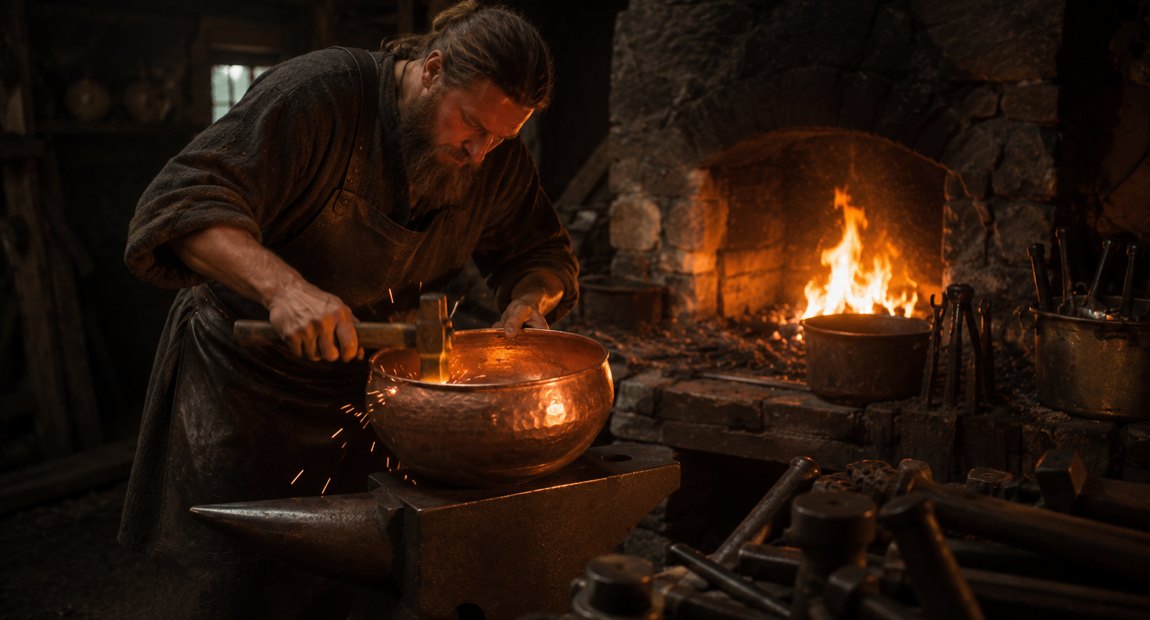
This is where Tóki’s byname matters. Old Norse smiðr meant not just a blacksmith but any skilled craftsman working metal, and sometimes wood. A smith was indispensable: no ploughshare, axe, needle or weapon without him. Tool finds like the Mästermyr chest from Gotland, and graves in which men were buried with hammer, tongs and anvil, show what that work looked like. More in our article on Viking blacksmithing.
Whether Tóki already worked as a smith while unfree or only after being freed, we do not know. Both are plausible. Larger farms had their own workshops where thralls worked too, and a skilled craftsman was valuable to his master. Manumission with starting capital could look exactly like this: the master releases a trusted man into independence, and he goes on working for himself while staying tied to the household. Neil Price, in his account of the Viking Age, notes that it remains unclear whether Tóki’s trade was new or a holdover from his time as a thrall.
Tradition gives smiths remarkable weight. In the Edda, Völund the smith is one of the most striking and darkest figures – a captive, hamstrung craftsman who takes terrible revenge on the king who holds him. There is no need to build a direct link to Tóki. But it shows that a smith in the North was no nobody; his skill commanded respect and sometimes fear. For other trades, see our overview of Viking jobs and crafts.
Tóki the smith may not appear only at Hørning. In Grensten church, south of Randers, there is a runestone known since 1627. Its inscription reads, in our translation: “Tóki the smith raised this stone in memory of Hrifli, son of Ásgeirr, Bjǫrn’s son. God help their souls.” Wimmer, and later Jacobsen and Moltke, took this Tóki to be the same man as at Hørning. Hertz and Imer support this with observations on rune forms and abbreviations: Grensten too has the shortened risþ instead of risþi, and a similarly shaped þ-rune.
If that is right, Tóki raised a stone not only for his own patron but also for a member of another family. That raises a tempting question: did Tóki perhaps work as a rune carver himself? For a smith used to chisels it would not be a big step. It is not proven – both stones say only that Tóki “raised” the stone, not that he carved the runes.
A third candidate is the Gylling stone south of Odder, found in 1839 in the foundations of a barn. On older readings it names a “Tóki, son of Þorgísl”. Whether this Tóki has anything to do with our smith – say, in line with Wimmer’s idea that Tóki was Þorgísl’s own son – is completely open. The inscription is damaged, its language looks more archaic than at Hørning and Grensten, and Hertz and Imer propose re-examining it with 3D scanning. Nothing should be claimed here that the stone has not yet given up.
Direct references to slavery and manumission are extremely rare in the runic corpus. That is no accident: thralls could as a rule not raise stones, and hardly anyone raised one for a thrall. That makes the few exceptions all the more precious.
Hovgården on Adelsö (U 11). On the royal estate in Lake Mälaren, opposite Birka, stands a richly decorated eleventh-century stone. It names Tolir, the king’s bryti “in Roðr”, and his wife Gylla, who had it carved in their own memory; the commissioner is a King Hákon, usually identified with Håkan the Red (1070s). A bryti was an estate steward, originally perhaps the one who “breaks” and hands out the bread. In several laws the bryti is unfree. Whether Tolir himself was unfree is debated – but the stone shows that a steward with this title could be married and afford a showpiece monument.
Oklunda in Östergötland. This one is not about slavery but about legal status: a man named Gunnar had it carved into the rock that, after a killing, he fled to a sanctuary. The inscription is among Sweden’s oldest legal documents. How it is read and what “asylum” meant at the time is explained in our article on the Oklunda inscription.
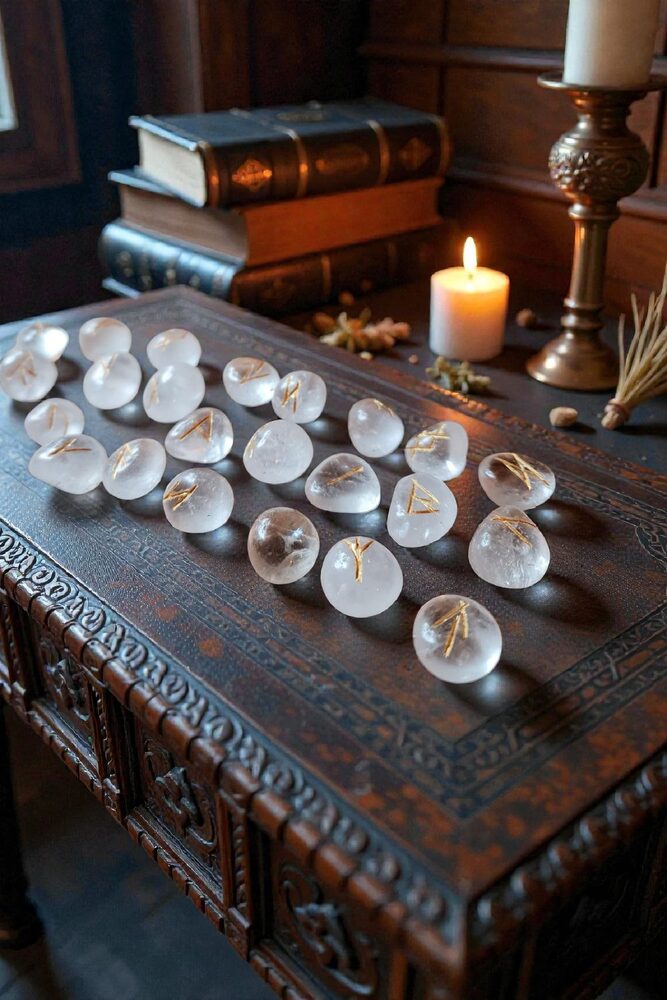
The word “free” itself. That frjáls appears on the Hørning stone at all is the real stroke of luck. Most runic inscriptions use rank and honour terms like þegn, drengr or bóndi – words for free, respected men. Their counterpart, the world of the unfree, stays silent almost everywhere. For rune forms, readings and corpus numbers like “DR 58”, see our honest introduction to the runes and our longer scholarly treatise on runology.
A single stone is not a statistic. Tóki’s story does not tell us that manumission was common or that former thralls easily became prosperous. For every Tóki whose name survives, countless people vanished without a memorial, without a name, often without a grave. Most thralls of the Viking Age are known to us only as categories in law texts or as anonymous skeletons – sometimes even as grave goods in their masters’ burials.
What the stone does show is that rising was possible. A man could start out unfree and end up a free craftsman, able to afford a runestone and to say in public whom he owed it to. It also shows that a real bond could exist between master and freedman – whether out of gratitude, duty or both, we can only guess.
And it shows something we meet every day in our engraving workshop: people want to record whom they are grateful to. A name in stone is an answer to the question of who counts. Tóki answered it, for himself and for Þorgísl, around the year 1000. We are still reading his answer.
What does the Hørning runestone say? Roughly: “Tóki the smith raised the stone in memory of Þorgísl, Guðmundr’s son, who gave him gold and freedom.” The word for “gold” could also be read as “kin”; “freedom” is certain.
Where is the Hørning stone now? The original is in Moesgaard Museum south of Aarhus, Denmark. A modern replica stands by the church in Hørning.
How old is the Hørning runestone? It is dated on stylistic grounds to about 970–1020, so around the year 1000, shortly after Denmark’s conversion to Christianity.
Was Tóki the smith a slave? Very probably he was unfree before Þorgísl freed him. An older interpretation suggests he could have been Þorgísl’s son by an unfree servant woman, later taken into the family.
What rights did freed slaves have in the Viking Age? Fewer than the freeborn: lower compensation, limited inheritance and continuing ties to their former master. Full equality usually came only with their descendants.
Are there other runestones about slaves? Very few. Besides Hørning, the best known is the Hovgården stone (U 11), which names a royal steward (bryti) whose status is debated.
For courage. For remembrance. For legends that live on.
Runes · Everyday Viking Life · Hedeby · Thing & Law.
All Runes & Writing articles →
It is the largest group of runestones commemorating a single event: about 26 stones, scattered across central Sweden …
Read more →When one thinks of Vikings, one thinks of England and the North Sea. But the way of the Swedes led east – and the …
Read more →Not every runic text honours a dead man. Some tell of a flight. The Oklunda inscription in Östergötland is a rare legal …
Read more →A granite block nearly four metres tall, densely covered on all five faces with around 760 characters: the Rök Stone …
Read more →