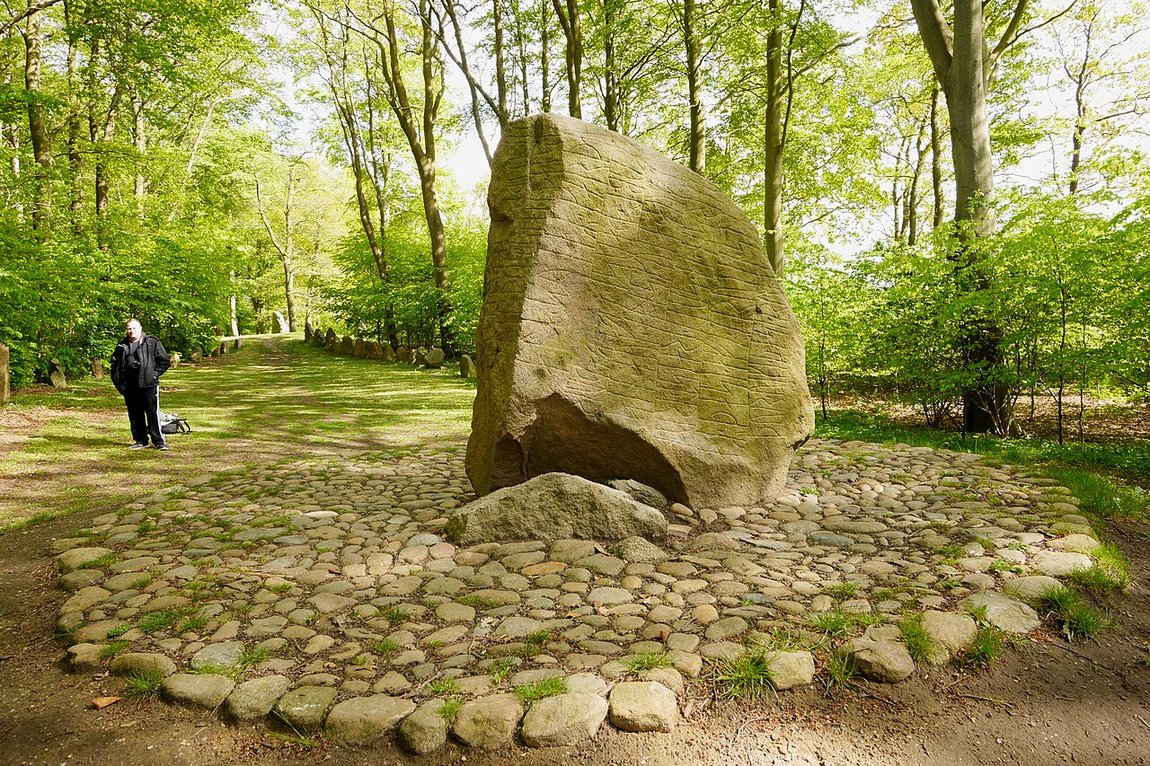
The Glavendrup runestone (DR 209) is a Viking Age memorial on the Danish island of Funen, carved in the first half of the 10th century – and with around 210 runes it carries the longest runic inscription in Denmark. A woman named Ragnhild raised it for her husband Alli, a goði and retainer; the carver Soti asked Thor to hallow the runes and cursed anyone who would damage the stone. Here you get the full text, our own translation, the stone ship, the excavation history and the questions scholars still argue about.
Most runestones are polite. They name the dead, they name whoever paid for the carving, and that is it. Glavendrup does not stop there. It talks at length, lists titles and offices, calls on a god by name – and then it threatens you. Whoever damages this stone, or drags it off to honour someone else, shall become a ræte. Nobody is entirely sure what a ræte was. It was certainly not a compliment.
The threat is cut into a granite block weighing an estimated six to seven tonnes, standing at the end of a stone ship in the north of Funen. Few monuments show as clearly how pagan cult, remembrance of the dead and claims to land and status were bound together in Denmark on the eve of conversion. And the monument belongs to a woman: Ragnhild.
Glavendrup lies in Skamby parish in today's Nordfyn municipality, about twelve kilometres north-west of Odense. The runestone still stands where it was first raised, in a small wooded park the Danes call Glavendruplunden, “the Glavendrup grove”. That matters. Many Danish runestones were hauled away in later centuries, built into church walls or used as thresholds. Glavendrup is one of the few you can still see in the place its makers chose.
The site is layered in time. At the eastern end lie two Bronze Age burial mounds, Flinthøj and Rævehøj, some two and a half thousand years older than the runes. Between them and the runestone runs the Viking Age stone ship, an outline of a vessel made of upright stones. At the western end, roughly at the stern, stands the inscribed stone. Add a few 20th-century memorial stones put up by a local society, and you are walking through three thousand years of commemoration in a few minutes.
Placing a new monument beside ancient mounds was common in the Viking Age. Older graves were reused and incorporated – a way of claiming ancestors and, just as importantly, claiming the land around them. For more on this monument type, see our article on stone ships.
The runes run across three faces of the stone. They are in the Younger Futhark, the 16-character alphabet of the Viking Age (we compare it with the older 24-rune row in our Futhark comparison). The text bands end in straight lines with no serpent or animal heads, a plain early layout runologists label “RAK”. The Danish runic database dates the inscription on runic and linguistic grounds to around 900–950 and rates that date as “reasonably certain”.
Here is the transliteration – the letter-by-letter rendering of the runes – following the Danske Runeindskrifter database at the University of Copenhagen:
Normalised into Old Danish, the opening reads: Ragnhildr satti stæin þannsi æft Alla Sǫlva, goða vīa, liðs hæiðverðan þegn. Our own translation, with the doubtful words flagged:
“Ragnhild placed this stone in memory of Alli the Pale (?), goði of the sanctuaries, honourable thegn of the retinue. Alli's sons made this monument in memory of their father, and his wife in memory of her husband. And Soti carved these runes in memory of his lord. May Thor hallow these runes. May he become a ræte who damages (?) this stone or drags it away to stand in memory of another.”Glavendrup stone, DR 209 – our translation, based on the reading in the Danske Runeindskrifter database
The last clause is very practical. Stealing a fine standing stone and recarving it for your own dead was a real risk, as the many relocated runestones of Denmark show. Ragnhild saw it coming.
The first sentence introduces Alli three ways: by nickname, by religious office and by secular rank. Each has its own scholarly debate.
The nickname. The run of runes sauluakuþa is the most argued-over spot on the stone, because no word dividers separate it. The usual reading splits it as Sǫlva goða and takes Sǫlvi as a byname, “the Pale” or “the Sallow”, from a word for a pale, yellowish colour. Another reading takes Sǫlva as the name of a group or district: Alli would then be “goði of the Sølvar”, the people of a particular area. There is a good parallel for that kind of title on Funen itself, as we will see.
The office. Goði (plural goðar) derives from goð, “god”. In Iceland, sagas and law texts of the 12th and 13th centuries use it for a chieftain holding a goðorð, a position that combined religious duties, legal clout at the assembly and a political following (more in our piece on the Icelanders). Glavendrup proves the title is far older and existed in Denmark too, centuries before the Icelandic texts were written. Vīa is the genitive plural of vé, “sanctuary, holy place”. Alli was “goði of the sanctuaries”, apparently responsible for cult sites where sacrifices and feasts took place. What that involved day to day, the stone does not say (on cult sites in general, see blót sites).
The rank. Liðs hæiðverðan þegn means “honourable thegn of the lið”. A lið is a war band or retinue, and þegn is a common honorific on Danish runestones. Whether it marks a free landholder, a royal retainer or a local magnate with his own following is an old question in runestone studies, and the reading liðs itself has been doubted by some runologists. What is certain is that Alli combined religious authority and worldly standing in one person.
Glavendrup is not alone. Two more Funen stones name a goði. The Helnæs stone (DR 190) reads: “Hróðulfr, goði of the nœrar, placed the stone in memory of Guðmundr, his nephew. They drowned …” – the text breaks off, and a man named Ávarr signs as the one who “coloured” the runes. The Flemløse 1 stone (DR 192) reads: “In memory of Hróðulfr stands this stone, who was goði of the nœrar. Sons placed it. Ávarr coloured.” Same man, same rune painter.
The nœrar are usually understood as “dwellers on the ness” – the people of a headland, and Helnæs is exactly such a peninsula. Hróðulfr was goði of a particular community. If Sǫlva goða works the same way, Funen had a small network of regional goðar, each tied to a group or district. It is an attractive idea – an interpretation, not a finding.
Who actually built this memorial? The stone is unusually precise. Ragnhild “placed” the stone. Alli's sons – unnamed – “made this monument”; the word is kumbl, which can mean the whole complex, perhaps including the stone ship. Ragnhild did the same “in memory of her husband”. And Soti carved the runes “in memory of his lord” (dróttin).
That clears up a common mistake in popular retellings: Soti was not Alli's son. He carved for his lord, which makes him a retainer or dependant who offered his skill with the chisel as his own tribute. Carvers signing their work is not unusual on runestones, but here the signature is also a statement of loyalty.
Whether the sons were Ragnhild's own children the text does not say; “Alli's sons … and his wife” allows either reading.
What stands out is that Ragnhild comes first, before the sons. Women as sponsors of runestones are well attested in Scandinavia, but rarely this prominently. Widows could manage property, secure inheritance and act in public, and a monument like this was as much a statement of the family's claims as an act of grief. For the wider picture, read our article on women in the Viking Age. Her name is typical too: Ragnhildr joins regin, “the gods, the ruling powers”, with hildr, “battle” – we explain how these names were built in our guide to Viking names.
Now the line most people search for: þur uiki þasi runaR, normalised Þórr vīgi þassi rūnaR – “May Thor hallow these runes.” The verb vígja means to consecrate or make holy, and it shares its root with vé, sanctuary. Thor is asked to place the inscription under his protection and make it inviolable.
This is not poetic decoration. It is a genuine formula found on several stones. Two more Danish examples are secure:
In Sweden the formula appears on the Velanda stone (Vg 150) in Västergötland and possibly on the Korpbron stone (Sö 140); a Thor reading on the Rök stone is disputed (we have a separate article on Rök). Strikingly, Thor is the only god invoked by name in this way on Viking Age runestones. Odin, Freyr and Tyr are never called upon. On some stones a carved hammer takes the place of words – an image that probably did a similar protective job. What the hammer symbol and the amulet finds really tell us is covered in our article on Thor's hammer Mjölnir.
Why Thor? In myth he guards gods and humans against the giants; a monument meant to secure memory naturally calls on the guardian. Some scholars also read the 10th-century Thor formulas as a pagan answer to the Christian prayers that were starting to appear on stones – plausible, but impossible to prove. How the consecration of runes was imagined more generally is the subject of our article on rune hallowing.
Side C carries the threat: at rita sa uarþi is stain þansi ailti iþa aft ąnąn traki. Literally: “A ræte be he who ælti this stone or drags it in memory of another.” Two words are uncertain.
The verb ælti is usually taken as “damages” or “topples”, but that meaning is inferred from context rather than from a well-attested word. Harder still is ræte (spelled rita here, rata on other stones). Suggestions include “wretch”, “outcast” and “sorcerer”. The Rundata database translates it as “warlock” – not in the sense that the vandal would gain magic powers, but that he would be branded unnatural and cast out. In 2008 the Danish scholar Anette Jensen pointed to the dialect word ræde, “scarecrow”, which was also used as an insult. There is no certainty.
A Swedish parallel sharpens the tone. On the Saleby stone (Vg 67) in Västergötland the sponsor wishes that the destroyer become a rata and an argr woman. Argr, and the related noun ergi, branded a man as unmanly, cowardly and sexually “perverse” in the Norse code of honour – and was tied up with a disreputable kind of sorcery, seiðr. The runologist Erik Moltke considered argr the most loathsome thing a carver could call anyone. Glavendrup does not use argr, but the family resemblance shows where the curse is aimed: loss of honour and expulsion from the community, in a society where honour was the real currency.
Similar curses appear on the Tryggevælde stone (DR 230), on Sønder Vinge 2 in Jutland and on the Glemminge stone in Scania, then part of Denmark.
The runestone is only part of the complex the inscription calls kumbl. It also includes the stone ship: a row of standing stones tracing the outline of a vessel, with the runestone at its western end. Sand digging in the 18th and 19th centuries badly disturbed it. After his 1958 excavation, Erling Albrectsen estimated its original length at about 55 to 60 metres, with a maximum inner width of around 12 metres. Older figures vary wildly. The restored setting you see today is around 50 metres long.
Alli's grave has never been found. Between the stone rows the excavators found several small pits with traces of burning but no grave goods. Albrectsen thought they were Viking Age; other accounts assign the cremation graves found there to the Early Iron Age. Whether Alli lies under the stone, in one of the mounds or somewhere else entirely – or whether the site was above all a memorial rather than a burial – remains open.
The two mounds at the eastern end are much older. Rævehøj was originally about 14 metres across with a kerb of stones; in 1958 it yielded several burials, including one with burnt bone and a bronze arm ring from the end of the Early Bronze Age, plus Late Bronze Age graves. Under Flinthøj, plough marks showed that the land had been farmed before the mound went up.
Whether the ship stood for a “voyage to the afterlife”, as is often claimed, the sources never say outright – more on that in our article on boat burials.
The modern era nearly finished the monument off. Sand was dug around it in the 18th century, and the stone was largely buried. A first drawing was made in 1804. In 1806 the antiquarian Lauritz Vedel Simonsen had it dug out and raised – by his own account twenty men worked on it for two days – and Rasmus Nyerup published the inscription that same year. Some accounts give 1794 as the year of discovery; the details vary.
The first largely correct reading came in 1826 from the linguist Rasmus Rask. In 1864 Magnus Petersen surveyed the site; in 1873 the runologist Ludvig Wimmer found the stone ship badly damaged. In 1892 the whole site was formally protected, and Vilhelm Boye restored it for the National Museum, giving the runestone a freshly heaped mound.
The most thorough investigation so far was carried out by Fyns Stiftsmuseum from 8 October to 27 November 1958 under Erling Albrectsen. The runestone was temporarily lifted out and carefully re-erected, and the top 60 centimetres of the modern mound were removed. So the mound the stone stands on is not Viking Age – worth knowing when you visit.
Further east, in eastern Zealand, another stone names a Ragnhild: the Tryggevælde stone (DR 230). It is first recorded in 1597 in the courtyard of the Tryggevælde estate, where a local official had moved it around 1550 from an unknown site. Today the granite, about 3.25 metres tall, stands in the runestone hall of the National Museum in Copenhagen. In our own translation:
“Ragnhild, sister of Ulf, placed this stone and made this mound in memory of Gunnulf, her husband, a loud (?) man, son of Nærfi – and this ship. Few will now be born better than he. A ræte be he who damages (?) this stone or drags it away from here.”Tryggevælde stone, DR 230 – our translation, based on the Danske Runeindskrifter database
The parallels are hard to miss. Again a Ragnhild as sponsor. Again a stone ship, here called skæið, the word for a warship. Again the ræte curse, almost word for word. Runic forms and language again point to around 900–950. The Copenhagen database considers the two stones closely related, possibly the work of the same hand.
Was it the same woman? Many scholars think so: Ragnhild would have been married twice, once to Alli on Funen and once to Gunnulf on Zealand, and raised a monument to each. It cannot be proven. Ragnhildr was a common name, and shared formulas might reflect a regional workshop tradition rather than one patron. The claim, sometimes repeated, that Soti carved both stones is an attribution based on style and wording: he signs his name only at Glavendrup.
Yes, as far as the specialist literature goes. The Danish reference work lex.dk counts around 210 runes and calls Glavendrup the longest runic inscription in Denmark; the University of Southern Denmark and the Danish heritage agency say the same. The famous Jelling stones of Gorm and Harald Bluetooth are better known, not longer. Glavendrup is also older than Harald's great stone, on which he boasts of making the Danes Christian. Between Ragnhild's appeal to Thor and Harald's “baptismal certificate” there may be only a single lifetime. (More on the dynasty under Gorm the Old.)
Across the whole Norse world, the record belongs to the Swedish Rök stone with more than 700 runes. Glavendrup's title is a Danish one.
The site lies in Glavendruplunden near Skamby, off Stenagervej, and is an open, freely accessible grove. The Danish heritage agency's site map shows parking, a toilet, a barbecue shelter and a fire pit. A few tips:
For photos of the runes, wait for a low sun from the side. Raking light brings out every groove – we know that from our own workshop.
We work with engraved words every day, and Glavendrup is a reminder that an inscription is always a claim as well as a memorial. Ragnhild wanted Alli remembered – and she wanted everyone to know who honoured him. The same questions come up when someone asks us to engrave a memorial plaque or a rune in slate: who is it for, and what should last? For the basics, see our honest introduction to the runes.
A widow, a retainer with a chisel, sons without names, a god as guardian and a very clear message to the neighbours to keep their hands off the granite. More than a thousand years later the stone is still standing. The curse seems to have worked.
For courage. For remembrance. For legends that live on.
What does the Glavendrup stone say? Ragnhild raised it for her husband Alli, a goði and thegn; Alli's sons and Ragnhild built the monument, and Soti carved the runes for his lord. Then come “May Thor hallow these runes” and a curse on anyone who damages or moves the stone.
How old is the Glavendrup runestone? On runic and linguistic grounds it is dated to about 900–950, the first half of the 10th century.
What does “Thor hallow these runes” mean? The formula Þórr vígi þessar rúnar asks Thor to consecrate and protect the inscription. It also appears on the Danish stones of Virring and Sønder Kirkeby.
Is Glavendrup the longest runic inscription in Denmark? Yes. With around 210 runes, Danish scholarship counts it as the longest in Denmark. The longest runic inscription anywhere is on the Swedish Rök stone.
What is a goði? A man responsible for cult sites who also held status and a following. In Denmark the title is attested on only three runestones, all on Funen: Glavendrup, Helnæs and Flemløse 1.
Where is the Glavendrup stone? In Glavendruplunden near Skamby in northern Funen, about 12 km north-west of Odense, still in its original position at the western end of a stone ship. The grove is freely accessible.
Runes · Thor & Mjöllnir · Women of the Viking Age · Burial & Remembrance.
All Runes & Writing articles →
Most runestones honour lords and warriors. The Danish Hørning stone, however, gives space to a very different voice …
Read more →It is the largest group of runestones commemorating a single event: about 26 stones, scattered across central Sweden …
Read more →When one thinks of Vikings, one thinks of England and the North Sea. But the way of the Swedes led east – and the …
Read more →Not every runic text honours a dead man. Some tell of a flight. The Oklunda inscription in Östergötland is a rare legal …
Read more →