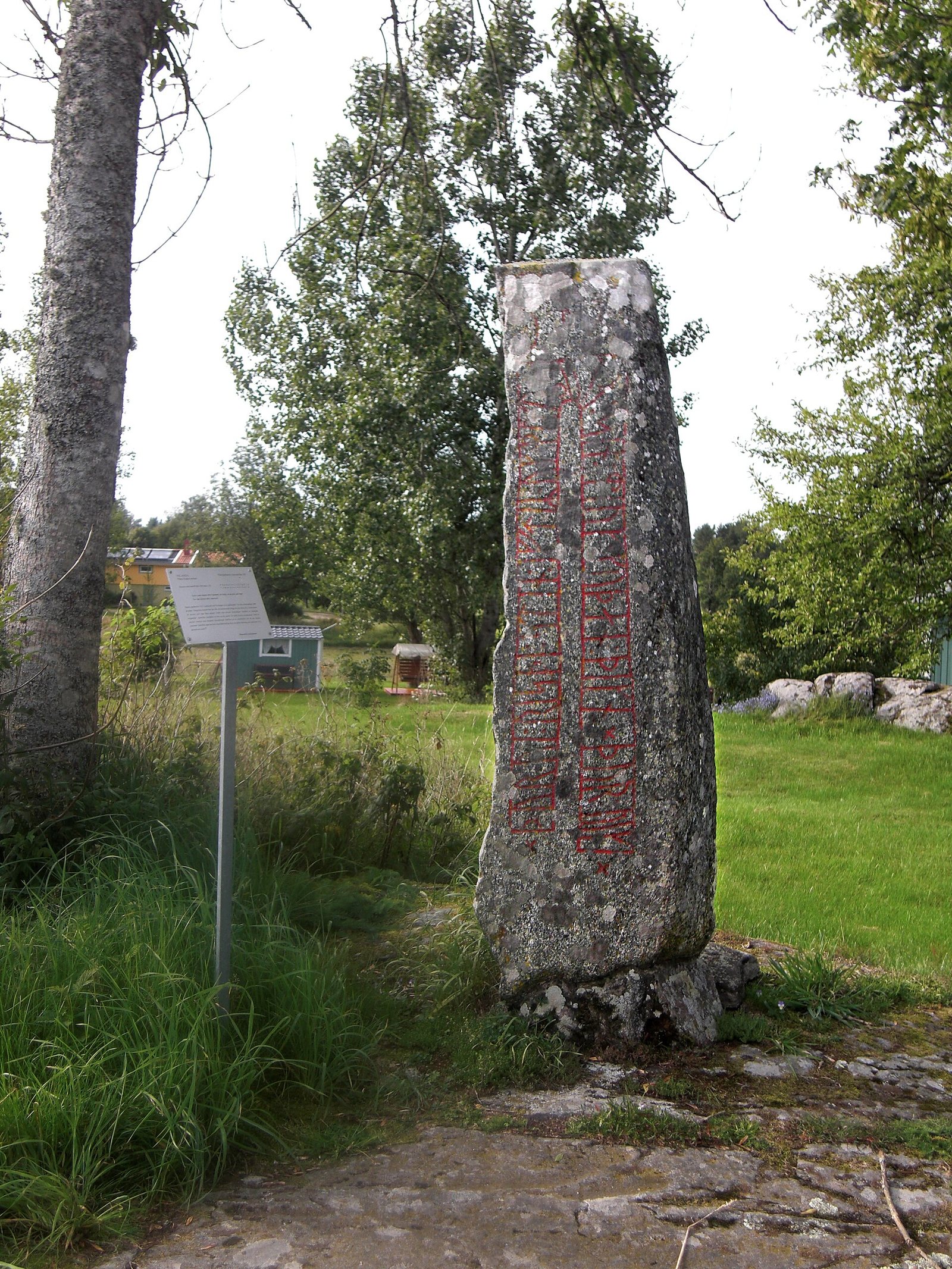
What is a „rune consecration“ – and did it exist at all? This detailed treatise walks through every form: from the attested formula „Þórr vígi“ on genuine runestones, through the reddening and painting of the signs, the formula words and amulets, to the kinds of runes in the poetry and the modern „rune consecration“ – step by step, with sources and an honest separation of secure evidence from mere interpretation.
Search for „rune consecration" today and you will quickly find solemn rituals, secret formulas and a great deal of candlelight. So let us be honest from the outset: „rune consecration" is not a documented technical term of the Viking Age. No rune-carver of the Iron Age or Viking Age would have used the phrase. It is a modern umbrella term under which we group several quite different acts and formulas that the inscriptions themselves actually record: carving and expressly naming the act of making, dedicating a monument to a god, painting and reddening the signs, and formulas of protection and cursing.
That distinction matters, because it shifts our view away from the romantic image of „mysterious magic runes" toward what runestones, amulets and bracteates really say. And here it is worth recalling the runologist R. I. Page's caution: the overwhelming majority of surviving runic inscriptions are profane. They give names, mark ownership, commemorate the dead, or simply record who carved or paid for something. A ritual-magical use of runes did exist – but alongside, not instead of, ordinary everyday writing.
Handle the word with care: „rune consecration" gathers several distinct practices under a single modern label. No unified, fixed ritual „of rune consecration" is attested. Anyone who claims otherwise is selling interpretation as fact.
In this article we stay first with what is attested epigraphically – that is, by the inscriptions themselves – before turning separately to the poetic sources (Sigrdrífumál, Egils saga and the like) and to the modern „rune consecration." First it is the stone, the metal, the little plate of bone that counts.
The strongest, clearest evidence for a genuine „consecration" of runes lies in a single Old Norse verb: vígja – to hallow, to consecrate. On several runestones a god is called upon to hallow the monument, or expressly the runes, and thereby to protect them. And that god is regularly Thor.
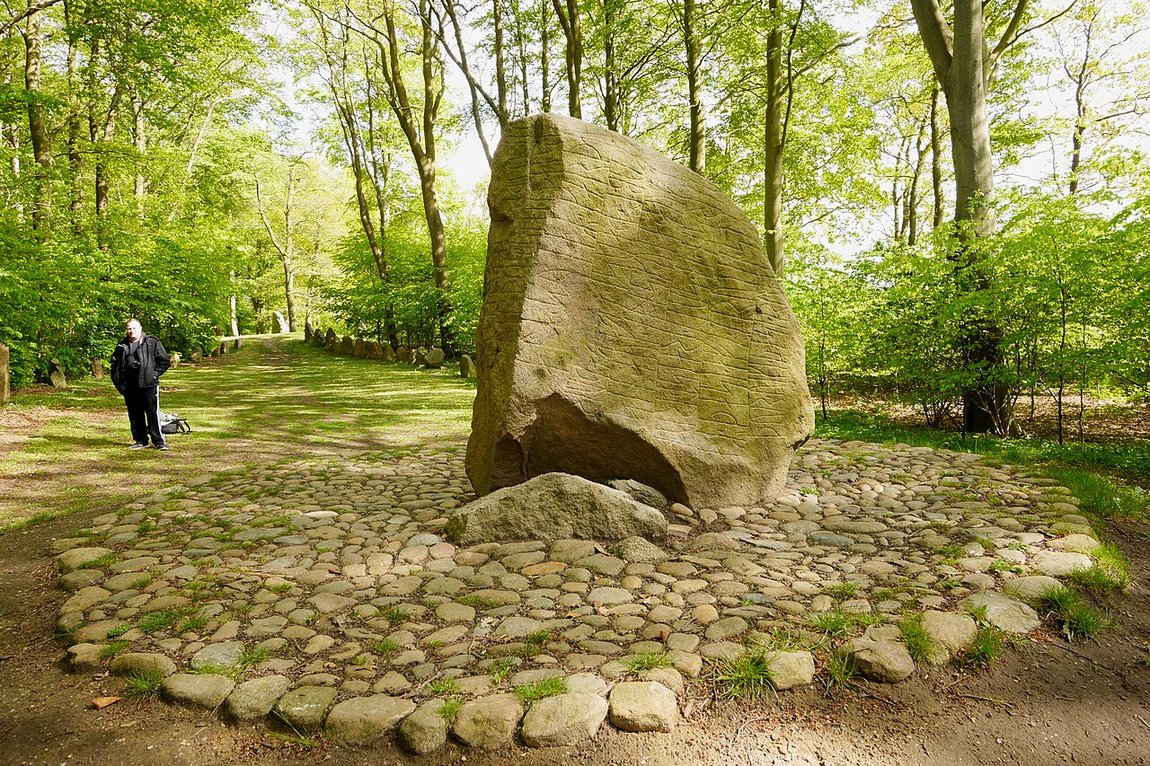
The most famous is the Glavendrup stone on Funen (DR 209, c. 900–925), the largest runic monument in Denmark, raised by a woman named Ragnhildr for her husband. After the commemorative text comes the invocation:
þur : uiki : þasi : runaʀ — „Thor hallow these runes."Glavendrup stone, Funen (DR 209); transliteration after Rundata, sense translation by Glanz & Gravur
Here the inscription itself is placed under divine protection. Not a person, not an office, but the thunder god is to hold his hand over the carved signs. This is no esoteric detour but a dedication formulated in plain words – on stone, datable, attested more than once.
The formula „Þórr vígi" (Thor hallow) is no isolated case. It, or closely related wordings, also appears on the Sønder Kirkeby stone (Falster, DR 220), the Virring stone (Jutland, DR 110) and the Velanda stone (Västergötland, Vg 150). Several independent monuments thus show the same act: hallowing the runic work to Thor.
The Christian counterpart, which spreads across the whole North only a little later, is telling: instead of „Thor hallow these runes" we now read, in countless intercessions, „God help his soul" or „God and God's mother help his soul." The underlying attitude stays the same – the monument and the dead are placed under a higher protection. Only the address has changed.
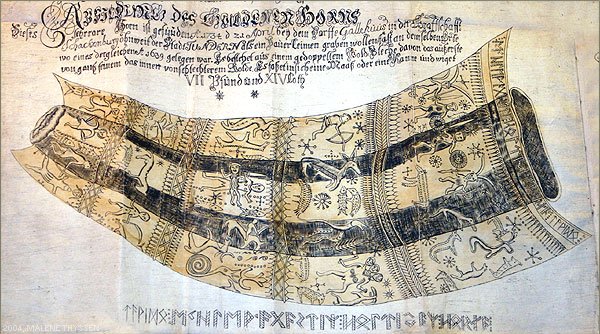
A second, very old feature of Germanic runic inscriptions is that they expressly name the act of making – often in the first person, almost ceremonially. The carver steps out of the work and says: I made this.
On the Einang stone in Norway (roughly 4th century) stands the phrase runo faihido – „(I) painted the rune." On the golden horns of Gallehus (early 5th century) we read ek hlewagastiʀ holtijaʀ horna tawido – „I, Hlewagastiʀ [of] Holt, made the horn"; tawido simply means „I made." Related verbs are worahto/wrait („I wrought/wrote/carved") and fáði („painted"). These are not merely signatures in the modern sense – they make the act of making part of the inscription itself.
The wording rewards a close look: tawido refers to fashioning the object, whereas faihido denotes painting or colouring the signs (cognate with „to paint/dye"). That one word alone shows that runes were not only carved but painted.
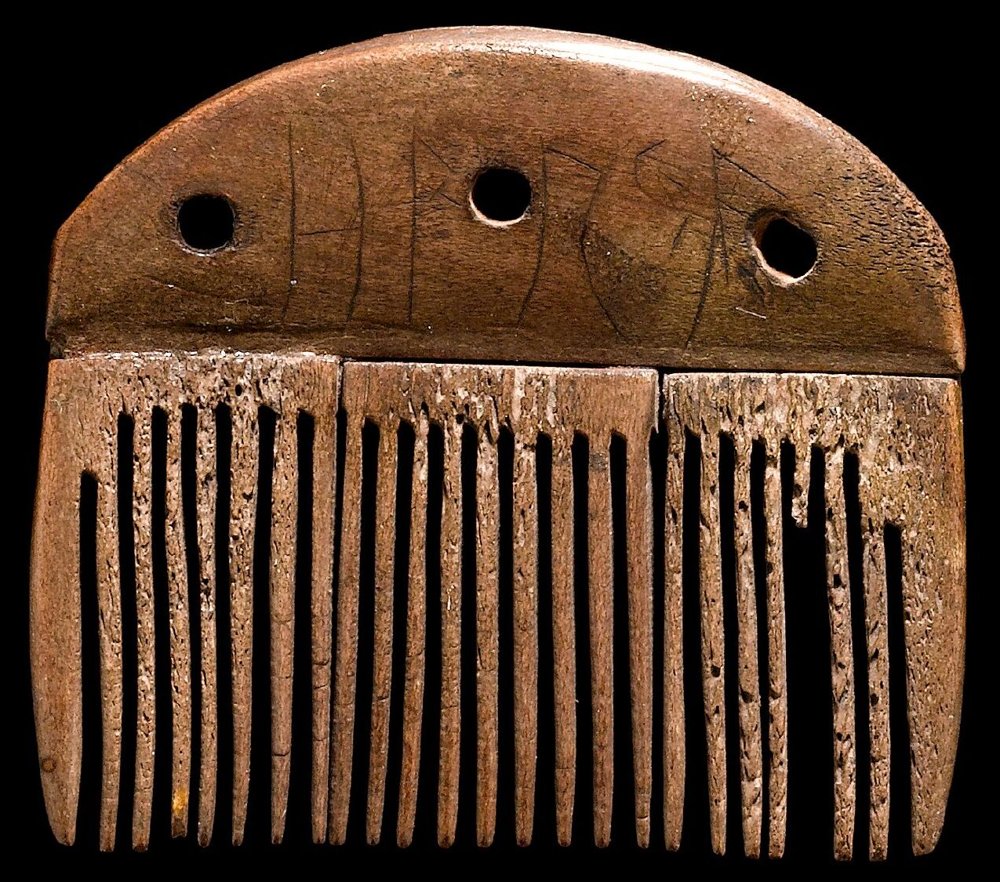
Often the rune-literate person names himself in the process. A striking title appears in several early inscriptions: the erilaʀ. What exactly it meant – rune-master, leader, ritual specialist – is disputed, but it plainly marks someone of special standing in dealing with the script. The Lindholmen amulet (Scania, DR 261) opens with self-assurance: ek erilaʀ sa wilagaʀ haiteka – „I, the erilaʀ, am called the cunning/wily one." Whoever begins like that understands carving as a skill, not a coincidence.
If runes were expressly painted, the question of colour follows at once. And indeed: traces of pigment – red, black, white – have been detected on numerous runestones. The signs were not left as grey notches but filled with colour so that they stood out, legible and effective. The verb faihido („to paint/colour") from the early inscriptions belongs precisely here.
Out of this archaeologically secured painting the tradition develops a second, more dramatic idea: reddening the runes with blood, Old Norse rjóða („to redden"). In poetry – for instance the Sigrdrífumál – and in the saga literature (Egils saga), runes are described as being smeared with blood to make them effective in the first place. We take up that literary thread in detail further below.
Kept cleanly apart: painting the runes with colour is archaeologically attested (pigment residues on stones, the word faihido). Reddening with blood is a literary tradition – a powerful poetic image, but not secured for the actual ritual practice of the Viking Age. Colour, yes; blood: unproven.
There is a small group of words that stubbornly resist any plain explanation. They stand on bracteates (golden pendants of the Migration Period), on amulets and on stones, and they can hardly be read as ordinary messages. Precisely for that reason they count as the strongest candidates for a cultic, „consecrating" use of runes.
The most common is alu. Its meaning is open – „protection/warding," „ecstasy," „ale" (in the sense of a ritual drink) and „taboo/the sacred" have all been proposed. Then there is laukaʀ („leek"), read as a sign of growth, purity and fertility – the leek was a valued, potent plant. And finally laþu, probably „invitation, summons, calling-forth," a calling-up of something effective.
Tempting as these readings are, the exact meaning of alu, laukaʀ and laþu is not secured. Scholarship (Düwel, Runenkunde 2008; MacLeod & Mees, Runic Amulets and Magic Objects 2006) discusses them as probably formulaic-cultic words – but every fixed translation remains interpretation, not proof.
The methodological point matters: precisely because these words yield no practical message, much suggests they had a function beyond mere communication. That is as close to a „consecrating" word-magic as the sources will let us come – and at the same time a field where honesty means naming the limits of what we know.
The protective function of runes becomes most tangible on small, portable objects. Here someone deliberately carries the signs on the body – not as a grave monument, but as a defence.
The Lindholmen amulet (Scania, roughly 5th–6th century), an inscribed piece of bone, carries, besides the proud erilaʀ formula, a row of runes and the word alu – early evidence that such formula words found their place on an amulet. From the late Viking Age comes the Kvinneby amulet from Öland (11th century), a small copper plate: on the widely accepted reading it calls upon Thor's protection, with his hammer, for the wearer. And the Sigtuna amulet (also copper) is aimed, as a ban, against a fever or a demonic „thurs" (giant).
These objects show runes expressly in a protective, warding role: alu on the Lindholmen amulet, the invocation of Thor with his hammer on the Kvinneby plate, the banning formula against the „thurs" on the Sigtuna amulet. Unlike the everyday note or the ownership mark, they are recognisably designed to have an effect.
One sees clearly here how the separate threads converge: the invocation of a god (as on the Þórr-vígi stone), the formula word (alu) and the explicit reference to a threatening opponent (fever, thurs). This is protective magic lived out in metal and bone – attested, datable, portable.
To hallow is to protect – and protection has a reverse. Whoever places a monument under a higher protection can turn that same protection as a curse against anyone who touches it. This negative consecration is attested on stone just as much as the friendly kind.
The most famous examples are the two stones of Björketorp and Stentoften in Blekinge (southern Sweden, roughly 7th century, in the transitional runes between the older and younger futhark). Stentoften combines a blessing about a good harvest with a looming curse; Björketorp carries an outright prophecy of ruin against anyone who breaks the monument.
A prophecy of ruin … restless and (marked) by an insidious death (be) he who breaks this.Björketorp stone, Blekinge (DR 360), sense translation by Glanz & Gravur after the Rundata transliteration
The Blekinge stones (Björketorp, DR 360; Stentoften, DR 357) are the clearest epigraphic evidence for a curse formula: runes meant not only to name and commemorate but to bind and punish. It is the dark reverse of the very idea that also speaks in „Þórr vígi."
Who carved and consecrated the runes? At the very beginning stands a puzzling title: erilaʀ. On several inscriptions from the Migration Period (roughly 400–600) a person expressly calls themselves an erilaʀ – on the Kragehul spearshaft, on the By stone in Norway, and on the Rosseland stone. The formula there usually runs „ek erilaʀ …", meaning „I, the erilaʀ …". The word plainly denotes someone of special standing in dealing with the script. How far that standing reached is still debated: interpretations range from „rune master" to „leader" to „ritual specialist". Some scholars even connect the word with the tribal name of the Heruli; this is far from certain.
ek wagigaʀ irilaʀ agilamundonRosseland stone, Norway (ca. 5th–6th c.); roughly: „I, Wagigaʀ, the erilaʀ of Agilamundō." – own translation
In the Viking Age the craft becomes more tangible, because the carvers begin to sign their work. On the runestones of the 11th century, above all in the Swedish province of Uppland, masters emerge by name. The best known is Öpir, to whom a great many stones are attributed (the figures vary by count into the several dozen). Other carvers known by name include Ásmundr Káresson, Balli and Fótr. And already some two centuries earlier a man named Varinn left, on the Rök stone (Rundata Ög 136), the longest known runic inscription of all – a memorial to his dead son.
Evidence: The title erilaʀ is attested on several genuine Migration-Period inscriptions (Kragehul, By, Rosseland among others). Signing Viking-Age rune masters such as Öpir, Ásmundr Káresson, Balli and Fótr are documented through the stones they executed and sometimes named themselves (Rundata; Düwel, Runenkunde 2008). The Rök stone (Ög 136) names Varinn as patron and carver.
Interpretation, not proof: That an erilaʀ was a priest or magician is a conjecture – the exact meaning remains open. And not every carver was a ritual expert. Many runestone signatures come from simply literate craftsmen who took pride in their skill. „Carving" and „consecrating" did not automatically coincide.
A runestone was no spontaneous scribble but a multi-stage piece of work. First the surface was smoothed and the text, together with its ornament, drawn out. Then the master drove the lines into the stone with chisel and mallet – on smaller or softer stones a knife would do. The last step, however, is often forgotten: the finished inscription was painted. Only colour made the signs legible at a distance.
That runestones were painted is not merely reported but chemically demonstrated: pigment traces have been found on several stones. Red was usually red lead (minium) or iron ochre, black was soot or charcoal, with occasional white. The vividly red-picked-out runes seen today in museums and at open-air sites are therefore a well-founded reconstruction – not the chance state after a thousand years of weather. The very verb the stones themselves use says it clearly: faði means „wrote" or „painted".
… in Varinn faði, faðiʀ, aft faigian sunuRök stone, Ög 136 (early 9th c.); roughly: „… and Varinn painted (the runes), the father, for his death-doomed son." – own translation
By far the greatest part of all runes, however, was never made on stone at all but on perishable material: on little wooden staves and bone, scratched with a knife in daily life. That so little survived is due solely to the material. The roughly 670 inscribed wooden finds from Bryggen in Bergen show how widespread everyday runes were – even though that group of finds dates largely to after the Viking Age proper.
Evidence: The painting of runestones is repeatedly secured by pigment analyses (red = mostly minium/ochre, black = soot). The verb faði/fá („to paint") can be read on numerous stones themselves. The mass of finds from Bryggen documents runes as an everyday script on wood (MacLeod & Mees 2006; Düwel 2008).
Interpretation, not proof: A formal „consecration ceremony" during the carving is nowhere attested. Manufacture and ritual act are two different things: that runes were painted is fact; that every act of carving was accompanied by a consecration rite is pure assumption.
Runes served not only for remembrance but were also held to be a means against illness, pain and demons. Beyond the well-known amulets – the copper sheet from Kvinneby and the Sigtuna amulet are mentioned here only as cross-references – several telling objects bear this out.
There is the Ribe skull: a fragment of a human skull from the 8th century, into which runes were carved. The inscription names deities (including Óðinn) and is probably to be understood as an appeal for help against pain – against a „dwarf", which in Old Norse thought could be imagined as a disease-bringing being. The exact reading is disputed, but its character as a healing charm is broadly accepted.
Roughly three centuries younger is the Canterbury charm: a line of runes entered in the margin of an English manuscript of the 11th century. It is directed against a „blood-thurs", that is a wound or bleeding demon, and expressly calls upon Thor to do so.
Gyril, wound-causer, be off now! You are found. May Thor consecrate you, lord of the thurses.Canterbury charm, runic entry in a manuscript (11th c.); paraphrased rendering – own translation
The Continental Germanic world is reached by the Nordendorf fibula (roughly 6th/7th century), found in Bavaria. It bears the divine names Wodan and Wigiþonar – the latter literally the „battle-" or „consecration-Donar", that is the Continental thunder god. It thus shows that inscribed pieces of jewellery too could serve as bearers of appeals to the gods.
Evidence: The Ribe skull (~8th c.), the Canterbury charm (11th c.) and the Nordendorf fibula (6th/7th c.) are genuine, published finds with runes in a healing, protective or god-invoking context (Düwel 2008; MacLeod & Mees, Runic Amulets and Magic Objects 2006).
Interpretation, not proof: The readings of these inscriptions are partly contested, individual words uncertain. That runes were held to be a remedy is well attested – whether they „worked" is not a question for historical scholarship but of the belief of the people of that time.
Among the most striking bearers of runes are the gold bracteates of the Migration Period (5th/6th century). They are thin, single-sided stamped gold discs worn as pendants. In rough orders of magnitude, around a thousand are known. Many show an image – often a head or rider above an animal – and carry runes as well, frequently the formula words already familiar: alu, laþu, laukaʀ or ota.
Two pieces stand out. The Vadstena bracteate (Sweden) bears an early, complete futhark row, ordered into its three groups of eight – a rare proof that the sequence of the alphabet itself was regarded as meaningful. And the Vindelev hoard from Denmark, discovered with a metal detector in 2020 and scientifically published in 2023, contains a bracteate with a sensational line.
… iz Wōðanas weraz …Vindelev bracteate, Denmark (5th c.), reading Imer et al. 2023; roughly: „… he is Wōðanaʀ' (Odin's) man." – own translation
This line is regarded as the earliest hitherto secure naming of Odin at all – centuries before the Icelandic manuscripts from which we know most of the god-stories. Bracteates were worn and again and again laid into the ground in hoards. Much speaks for their having been protective or consecration gifts; the exact intention remains open, but their cultic character is broadly accepted.
Evidence: Gold bracteates with runic formula words survive in large numbers. The Vadstena bracteate bears a futhark row; the Vindelev bracteate, found in 2020 and published in 2023, contains the earliest secure naming of Odin („iz Wōðanas weraz", Imer et al. 2023).
Interpretation, not proof: Why exactly bracteates were laid down in hoards – as offering, as safekeeping of valuables, or both – is not conclusively settled. The figures given are rough orders of magnitude, not exact counts.
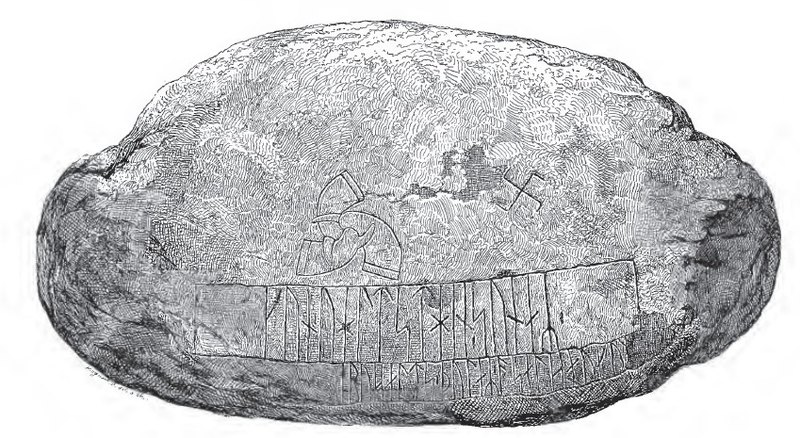
At the end of the Viking Age the consecration of runes does not disappear – it changes its address. The old heathen plea „Þórr vígi" („may Thor consecrate"), as known from stones such as Glavendrup, finds its continuation in a Christian intercession that stands on thousands of runestones of the 11th century.
Guð hjalpi ǫnd hanscommon closing formula of Viking-Age runestones (11th c.); roughly: „God help his soul." – own translation
The frame remains the same: a person sets a stone for a deceased and calls on a higher power for aid. Only the addressee has changed – from Thor to the Christian God. This transition was no hard break. In the age of upheaval people wore Thor's-hammer pendants and cross pendants side by side; from the Danish workshop of Trendgården a casting mould is even known that could produce both at once – hammer and cross.
The script itself, too, survived the change of faith with ease. Runes remained in use in the Christian North: on grave slabs, in churches, on church bells. It was therefore no „battle of symbols" but a gliding transition, in which the need to place a work and a person under protection remained unchanged.
Evidence: The intercession „Guð hjalpi ǫnd hans" is the standard closing formula of countless 11th-century runestones (Rundata). Double moulds for Thor's hammer and cross (Trendgården, Denmark) as well as runes on medieval grave slabs and church bells document the continuity of the script across the change of faith.
Interpretation, not proof: The coexistence of hammer and cross need not mean that a person adhered to both gods at once – it may reflect fashion, caution, or a phase of searching. Certain is only the contemporaneity of the objects, not the conviction behind it.
When we speak of a „rune consecration," the path leads almost inevitably to one of the most famous scenes in Norse poetry: Odin's self-sacrifice on the world-tree. In the so-called Rúnatal, stanzas 138 to 145 of the Eddic poem Hávamál („The Sayings of the High One"), the god relates in the first person how he won the runes in the first place. He hangs for nine nights on a windy tree, wounded by a spear, given to himself – „gefinn Óðni, sjalfr sjalfum mér", given to Odin, myself to myself. Without bread, without drinking-horn, he peers downward until he „takes up" the runes, screaming, and falls back down.
I know that I hung / on a windy tree / nine long nights, / wounded with a spear, / given to Othin, / myself to myself, / on that tree / that none may know / from what roots it rises.Hávamál 138, translation Henry Adams Bellows 1923 (public domain)
For our subject the double movement is decisive: the runes are not simply invented, they are won through a sacrifice – and in the same breath the poem turns to craft. The following stanzas speak of carving, of interpreting, of colouring and of the right handling of the signs. Who carves them, who reddens them, who tests them? These very verbs – to carve, to colour, to interpret – return in almost every later literary rune-scene.
Afterwards, in the Ljóðatal (Hávamál 146 to 163), Odin lists eighteen spells that he commands: against sorrow and sickness, to loosen fetters, to slow arrows in flight, to tame fire, to make the dead speak, to win a woman's love. Here a very common error lurks, one worth stating plainly.
Careful – a widespread mistake: the eighteen stanzas of the Ljóðatal describe eighteen spells, not eighteen runes. The text contains no row of eighteen signs; it contains a list of eighteen effects. From this confusion an entire misunderstanding later grew (see below, Guido von List). The historical Elder Fuþark has 24 runes, the Younger has 16 – never eighteen.
The second great poetic source is the Sigrdrífumál, a heroic lay from the circle of the Sigurd legend. The valkyrie Sigrdrífa, sent into a long sleep by Odin with the sleep-thorn and woken by the hero Sigurd, teaches him in gratitude various „runes." These are not individual letters but modes of application – rune-crafts for particular situations in life. This is the classic source whenever people today speak of „different forms of rune consecration":
Sigrúnar (victory runes) one should know if one wishes to win in battle; they are carved into the sword-hilt, and the god Týr is named twice. Ölrúnar (ale or beer runes) guard against another mixing harm into your drink; one carves them on the drinking-horn and on the back of the hand and lays leek (laukr) in the cup. Bjargrúnar (helping or birth runes) aid a woman in childbirth. Brimrúnar (surf or sea runes) are carved into the prow and the rudder and burned into the steering-blade, so the ship comes safe through the waves. Limrúnar (branch or limb runes) are healing runes; one cuts them into the bark and the leaves of trees. Málrúnar (speech runes) help before a court and guard against retaliation. Hugrúnar (thought runes) make one wiser than any other.
Alongside this the poem gives, as it were, a set of instructions that supplies the four core terms of ritual handling: rísta (to carve), rjóða (to redden, to colour with blood), fá (to paint, to fill in with colour) and ráða (to interpret rightly). Carve, redden, paint, interpret – the poetic conception of rune magic can hardly be summed up more tightly.
Kept cleanly apart: these seven „kinds of runes" are a poetic system from a high-medieval lay, not an archaeologically attested handbook of consecration. Individual elements have real counterparts – the leek (laukr) we do indeed know from genuine inscriptions and amulets, and the invocation of gods we know from curse and protection formulas. But the ordered list sigrúnar–ölrúnar–bjargrúnar as a closed system is literature, not an excavation find.
The image becomes most striking in Egils saga, written down in the 13th century but telling of the 10th-century skald and farmer Egil Skallagrímsson. Two scenes have become famous. In the first, Egil is offered a poisoned drink at a feast. He carves runes into the horn, reddens them with his own blood, which he cuts from his palm – and the horn shatters, the drink runs into the straw. Carving and reddening, exactly the terms from the Sigrdrífumál, here translated into action.
The second scene is the one that truly instructs. Egil comes to the sickbed of a girl who, despite every effort, is not getting better. He searches the bed and finds a piece of whalebone (talkn) into which a neighbour's son had carved runes – meant as a love-charm, but set wrongly by an untrained hand. Instead of helping, they only made the girl worse. Egil scrapes off the signs, throws the shavings into the fire, carves new ones and lays them under her pillow. And he speaks perhaps the single most important verse the Old Norse tradition has on rune consecration:
Skal-at maðr rúnar rísta, / nema ráða vel kunni. – No man should carve runes / unless he knows well how to read them. / Many a man goes astray / over a dark stave: / ten hidden signs / I saw cut into the bone, / and they have brought the woman / long and heavy grief.Egils saga, Egil's verse at the sickbed (ch. 72–75 depending on edition); Old Norse core lines, own sense-for-sense translation
That is, compressed into two lines, the ethical ground rule of any serious rune consecration: skill before effect. Whoever does not know what he is doing causes harm – not because the runes are evil, but because the wrong sign works wrongly. It is about care, about knowledge, about responsibility. Not about conjuring tricks.
Once you gather the sources together, one thing becomes clear at once: „rune-hallowing" was never a single act, but a whole bundle of very different practices. Some are attested epigraphically, that is, through surviving inscriptions; others we know only from poetry; still others were added only in modern times. The overview that follows is our attempt to make that bundle manageable – eight forms that keep recurring in the material. For each one we say how firm the ground beneath it really is.
The first form is the hallowing to a god: the inscription, or the whole monument, is deliberately dedicated to a deity. The clearest case is the formula „Þórr vígi" – „may Thor hallow (these runes/this memorial)" – on several Danish and Swedish stones; the gold bracteates with their references to Odin belong in the same neighbourhood. This form is attested epigraphically.
The second form is the hallowing of the making: not the content but the act of making itself is named, and thereby raised up. Early Norse words such as faihido („I painted/wrote"), tawido („I made") or worahto („I wrought"), and the self-naming ek erilaʀ („I, the rune-skilled one"), lift the act of carving onto a solemn plane. This form is attested.
The third form is the hallowing by colour, or the reddening: the carved signs are painted so that they become visible and effective. That runes really were coloured is attested by traces of pigment. Reddening with blood, however – Old Norse rjóða – is known chiefly from poetry and saga prose; it is a literary tradition, not confirmed by finds.
The fourth form is the hallowing by formula-word: the setting of cultic words such as alu, laukaʀ or laþu, which recur again and again on bracteates, amulets and small finds. That these words carried a special, apparently protective or blessing function is attested; what exactly they meant remains open to this day.
The fifth form is the hallowing of protection and amulet: portable signs to ward off harm. The copper sheet from Kvinneby, the amulet from Sigtuna and the rune-bearing skull fragment from Ribe show that people carried runes on their bodies to keep illness, fever and evil powers at bay. This form is attested.
The sixth form is the healing and helping runes: signs against sickness and for a safe birth. The Sigrdrífumál names bjargrúnar (helping runes for childbirth) and limrúnar (limb or healing runes) in particular; Egil's sickbed episode belongs here too. This form is predominantly a literary tradition, yet it clearly echoes in the real protective and healing amulets.
The seventh form is the hallowing of curse and binding: runes that punish, bind and enforce the peace of the grave. The southern Swedish stones of Björketorp and Stentoften openly threaten with harm anyone who destroys the monument. This form is attested.
The eighth form, finally, is the hallowing of name, ownership and remembrance – and it is at the same time the most common real case. In practice, people „hallowed" above all a name, a possession or a memory: they set it fast. The countless memorial stones „X raised this stone after Y" and the ownership formulas of the type „X owns me" make up the greatest part of all surviving inscriptions. This form is attested and, in sheer numbers, dominant.
Honesty requires us to add: these eight forms are an ordering synthesis of the sources by us, not a system handed down from the past. The Viking Age knew no catalogue of „the eight hallowings", no priestly doctrine that would have kept these practices neatly apart. In reality they flowed into one another – a memorial stone could invoke a god, pronounce a curse and be coloured all at once. Anyone who reads today „this is how rune-hallowing worked" is reading a modern ordering, not an ancient rulebook.
A small but telling field of words runs through the whole subject. Once you know it, you understand that for the people of the runic age „hallowing" was not a single spell but a chain of doing and understanding. Six Old Norse and early Norse words are enough to grasp the whole thing.
At the beginning stands vígja – to hallow, to make holy. It is the word of the formula „Þórr vígi": something is deliberately raised into a protected rank, set apart from everyday life. The craft itself is described by rísta – to carve, to cut into stone, wood, bone or metal. Where the signs were not carved but painted or coloured, the word is fá (early Norse faihido, „I painted/coloured"): the sign is completed only through colour. A heightened, bodily variant of this is rjóða – to redden, and in poetry specifically with blood; here colouring merges with the idea of giving the sign life and power.
Decisive, however, is a word that is often overlooked: ráða – to read rightly, to interpret correctly, to think through to the end. It is the key term in the famous verse attributed to Egil.
Skalat maðr rúnar rísta, nema ráða vel kunni.Egils saga (Old Norse wording, public domain) – „No man should carve runes unless he well knows how to read them."
That line says everything about how the rune-skilled saw themselves: hallowing was not only doing, but understanding. One who could rísta but not ráða did harm – in the verse Egil heals a sick woman only after he has recognised the wrongly carved signs and scraped them away. The sixth word fits here: kenna – to know, to be aware, to teach. Rune-craft was passed on; it was a knowledge, not a mere handgrip. Only in the interplay of rísta, fá and vígja on the one side and ráða and kenna on the other did there arise what the sources understood as an effective setting of runes. No true reading, no hallowing – that is the sober core behind everything that was later raised into romance.
One point is often passed over: in rune-hallowing women are remarkably prominent – not as a modern wish, but in the sources themselves. The great stone of Glavendrup (DR 209) on Funen, which bears the formula „Þórr vígi", was raised by a woman: by Ragnhildr, in memory of her husband Alli. The same Ragnhildr is connected with the related stone of Tryggevælde (DR 230) on Zealand, which she likewise raised. A woman thus stands behind two of the most impressive Danish hallowing and memorial monuments there are.
On numerous Swedish runestones, above all in Uppland, women appear as commissioners – widows, mothers, daughters who had a stone „raised" and thereby set fast an inheritance, a memory and the family's claim. Raising a memorial stone was plainly no purely male affair; here women commanded means, right and voice.
In poetry the feminine stands out even more sharply. In the Sigrdrífumál it is a valkyrie, Sigrdrífa, who teaches the hero the craft of runes – she lists the kinds of runes, naming victory-, ale-, helping- and limb-runes, and explains on what one carves them. The teacher here is female, and the völva, the seeress, is likewise a female figure: in the tradition, knowledge of hidden signs and things to come lies again and again with women.
One must not, however, forge a modern picture from this. A „rune-mistress" in the sense of a carver signing her name is only rarely securely attested – by far the most carvers who set their name beneath a work are men, foremost among them the much-employed Uppland master Öpir. What the sources do show is something else, and yet weighty: women as commissioners of the monuments, as keepers of remembrance, and, in poetry, as the teachers of rune-craft. This is no gender wish-image but simply what stands on the stones and in the lays – and it is more than the common picture of the bearded runemaster would lead one to expect (cf. Düwel 2008).
Set both sides side by side – the attested formulas (the consecration formula „Þórr vígi," the formula-words alu and laukaʀ, the „faihido" of the painters, the amulets and curse-stones) and the poetic images from Hávamál, Sigrdrífumál and Egils saga – and together they yield a rich, coherent picture. But together they yield no transmitted, closed „rune consecration ritual" with a fixed sequence that one could simply look up and follow.
What we can say with some confidence: runes could be consecrated – they were expressly placed under the protection of a god (Þórr, Odin). They were coloured, partly with blood, partly with paint. They served as protection, as blessing, as curse, as remedy and as a mark of status. And handling them was bound to skill – that we are told not only by Egil, but also by the real miscarvings and erasures on genuine finds.
What we do not know: the exact procedures. No text tells us which words were spoken at a consecration, in what order, at what time of day, with what gesture. The poetry shows us how the high Middle Ages imagined rune magic – idealised, sharpened, shaped as narrative, a good two hundred years after the end of the Viking Age. It is a window into a world of ideas, not a record of lived practice. We owe the subject this honesty – and it does not diminish the old testimonies, it makes them more credible.
What circulates today under the name „rune consecration" – „charging" individual runes, „consecrating" them with breath, blood or saliva, assigning each rune a fixed magical effect, consulting them from a table of meanings like a deck of cards – is, for the overwhelming part, modern reconstruction and new invention. That is not a put-down; it is a dating.
The central root is called Guido von List. In 1902, while temporarily blind after an eye operation, the Austrian writer experienced a „revelation" and from it derived the 18 „Armanen runes" – exactly eighteen, drawn directly from the eighteen spells of the Ljóðatal (see above: those are spells, not runes). This row List freely invented; it is nowhere attested epigraphically, appears on not a single genuine runestone, and was first published in 1908. From this Ariosophy and the völkisch „rune lore" of the early 20th century springs almost everything that later became popular as „rune gymnastics" or „rune yoga" and as rune oracles with a fixed table of meanings.
One may happily practise this modern rune mysticism if it gives something – but one should know that it is young and does not reach back into the Viking Age. Even the famous „blank rune" of modern divination sets is an invention of the late 20th century, not an Old Norse sign.
Only briefly and purely for context, because it unavoidably belongs here: individual runes were misused under National Socialism – the Sig or Sowilō rune as a doubled sign, the Odal rune as a badge. This has nothing to do with historical rune consecration. It is a political appropriation of the 20th century, and we clearly distance ourselves from it.
Which leaves the loveliest question for the end: can one still „consecrate" runes today? We think – yes, in the honest way. Whoever now has a rune, a name or a short inscription engraved into slate, wood or glass steps into a very long line of people who did exactly that: deliberately, carefully, with a thought behind every sign. That, at heart, is what rune consecration always was – not the trick, but the intent.
For that you need claim no invented effect, consult no table of meanings, ascribe no magical power to any single sign. The real thing about it is the care in the setting, the meaning you yourself put into it, and the good wish that goes along – just as the old „Þórr vígi," „may Thor hallow it," was nothing other than a blessing fastened to a beloved person or an important object. Whoever carves with knowledge and reads with good sense even keeps Egil's rule. And that is all it takes.
Runes: origin & history · Runes & their meaning · The Rúnatal – the spell-songs of the Hávamál · Rune magic – alu, laukaʀ and the formula words · Which rune to engrave?.
All Runes & Writing articles →
Some runic inscriptions form no smooth sentence, but only single, recurring words: alu, laukaʀ, laþu. They stand on …
Read more →Some runestones move us across a thousand years. The Skarpåker stone in Södermanland is one: a father casts his grief …
Read more →A Danish stone from the early 9th century carries two riddles at once: a symbol of three interlocking drinking-horns …
Read more →A runestone from Jutland reveals how closely the North was interwoven with the southern shore of the Baltic – through a …
Read more →