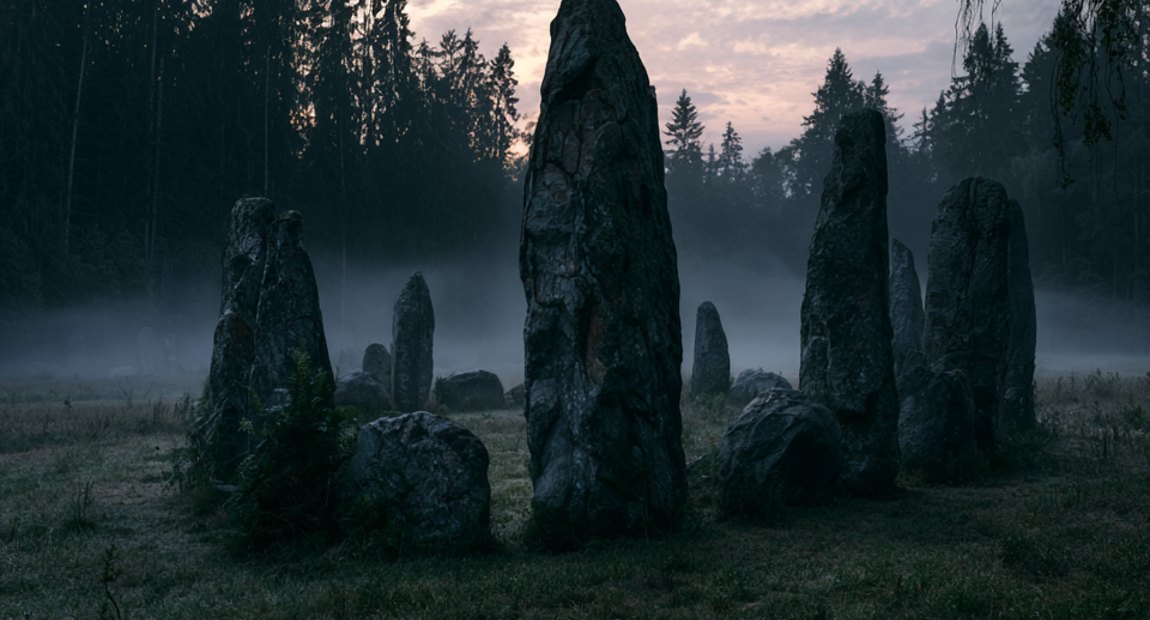
A granite block nearly four metres tall, densely covered on all five faces with around 760 characters: the Rök Stone from Sweden is the Everest of runestones. A father raised it for his dead son – and packed the lines with so many riddles, ciphers and allusions that scholars still argue about what the stone is actually trying to tell us.
There are many runestones in the North – several thousand in Sweden alone. But none is like the one at Rök. Today it stands beside the small church of Rök in Östergötland, where it was raised some 1,200 years ago in the early 9th century. Counting the part buried underground, the block is nearly four metres tall, and it is covered with runes from top to bottom: front, back, both narrow sides, even the top edge. Around 760 characters make it the longest known runic inscription in the world.
It helps to picture what that meant. In an age when writing was expensive, laborious and rare, when most messages on a runestone amounted to a terse formula – „X raised this stone for Y" – someone here chiselled an entire cosmos into granite. This was no evening project. It was a vast, deliberate effort.
The occasion is as old as humankind and as simple as it is heartbreaking: grief. The opening formula names the two people around whom everything turns. A man called Varinn raised the stone in memory of his dead son, Vämod. No king, no hero of legend – a father and his child. Everything that follows, this whole forest of runes and riddles, is at its heart a monument to a father's love.
That is the moving thing about Rök: the record, the learning, the encryption – all of it serves a very human feeling. When you lose your child, you want the world to remember. Varinn simply went a few sizes larger than others. He clearly wanted to preserve not just a name, but the whole store of knowledge, the whole lineage, the whole greatness he ascribed to his son – forever.
The Rök Stone is a masterpiece of secret writing. Varinn – or the rune master he commissioned – plays virtuoso games with the entire toolkit of runic craft. He mixes the younger and the older Futhark, even though the older one had long fallen out of use by his time. He employs cipher runes, in which the signs are replaced by a numerical system, and shift ciphers, in which each rune must be counted a few places along the row to yield its meaning.
This was neither an end in itself nor mere showing off. Encryption said: this message is precious, and it is not for everyone. Whoever could read it belonged to the initiated, the few who knew the old rows and the hidden tricks. A runestone like this was at once a monument and a test – proof that Varinn's family stood among those who guarded the great knowledge. For us today, that is precisely why so much about the Rök Stone remains disputed: every cipher you crack opens three new questions.
In the middle of the tangle of riddle-questions appears one of the most famous stanzas in all of Norse tradition. It names a ruler seated on his horse, shield strapped to his shoulder, the prince of the sea-Goths. Most scholars read this as a reference to Theoderic the Great, the Ostrogothic king who ruled Italy from Ravenna in the 6th century and whose equestrian statue became the stuff of legend. With that, the Rök Stone arches back across centuries into the Migration Period – turning grief for a single son into a story woven into the great heroic memory of the North.
„This I say as the twelfth, where the horse of the Valkyrie sees food on the battlefield, where twenty kings lie." Rök Stone, inscription Ög 136 (rendering, public domain)
„The horse of the Valkyrie" is a kenning, a poetic circumlocution – it means the wolf that devours the fallen. No stonemason speaks like that; a skald does. The Rök Stone is therefore also one of the earliest testimonies to the art of coded imagery that would later shape the whole of skaldic poetry.
For almost twelve centuries Rök was read as a heroic monument: a father placing his son among great warriors and kings. Then, in 2020, came an interpretation that made headlines around the world. A team of Swedish researchers read the stone anew – not as a chronicle of old battles, but as a series of nine artfully posed riddle-questions about the sun, light and the god Odin.
The driving force behind it, the theory holds, was fear: fear of a new cosmic catastrophe. In the 6th century, a good two hundred years before the stone, a series of enormous volcanic eruptions had darkened the sky. Years of cold, failed harvests and a dramatic population collapse followed across Scandinavia. The memory of that time, the researchers argue, may have fed into the myth of the Fimbulwinter – that endless winter which heralds Ragnarök. The Rök Stone, they say, negotiates the opposition of warmth and cold, light and darkness, life and death, and is thus structurally akin to the Eddic poem Vafthrudnismal, in which Odin proves his knowledge in a deadly contest of riddles.
As enticing as the climate reading sounds, it is contested – and honesty demands saying so. Other runologists hold to the older, heroic-genealogical interpretation: that Rök is a monument placing Varinn's family in a long chain of warriors, kings and legendary matter. The dispute turns on the fundamental question of how one resolves the encrypted passages at all, and in what order one arranges the parts. Because the ciphers permit several readings, hardly any interpretation can be definitively proved or disproved.
Perhaps that is the finest quality of this stone: it forces no one into an easy answer. It was carved as a riddle, and a riddle it remains. What survives beyond all interpretive quarrels is the core – a father who laid warmth, knowledge and remembrance so deeply into stone that they outlasted twelve centuries. That is exactly why memorial inscriptions still move us today: a name in stone is a quiet defiance against forgetting.
The Rök Stone (inscription Ög 136) stands in Östergötland and is dated to the early 9th century. With around 760 characters it bears the longest known runic inscription. The opening formula names Varinn, who raised the stone for his dead son Vämod. The text mixes the younger and older Futhark with several ciphers and contains the famous stanza about a mounted prince, usually referred to Theoderic the Great. Source: Riksantikvarieämbetet, Rundata Ög 136.
The „climate-anxiety" reading proposed in 2020 – Rök as a series of riddle-questions about the sun, light and a threatening Fimbulwinter after the 6th-century volcanic eruptions – is a well-argued but contested theory, not a settled result. It stands beside the older heroic-genealogical reading. Because the ciphers permit several solutions, no interpretation can be definitively proved. Anyone who explains Rök „unambiguously" is hiding the dispute.
You need not be a 9th-century rune master to understand what Varinn wanted. The wish not to surrender a person to oblivion is timeless. The Rök Stone is the most monumental form of that wish handed down to us – but on a small scale, every memorial engraving does the same. A clearly legible line on slate or wood, a name, a date, a word that holds: that is the plain, honest sister of the great riddle-stone of Rök. No secret code required – only the firm intention that something should remain.
Runes & their meaning · The picture stones of Gotland · The Snoldelev stone · The Glavendrup stone · The Jelling stones.
All Runes & Writing articles →
It is one of the most powerful scenes in all Norse poetry: Odin, the highest god, hangs nine nights self-sacrificed in …
Read more →Before the runes became oracle stones in a pouch, they were simply the first alphabet of the North – for names, trade …
Read more →Some runic inscriptions form no smooth sentence, but only single, recurring words: alu, laukaʀ, laþu. They stand on …
Read more →Some runestones move us across a thousand years. The Skarpåker stone in Södermanland is one: a father casts his grief …
Read more →