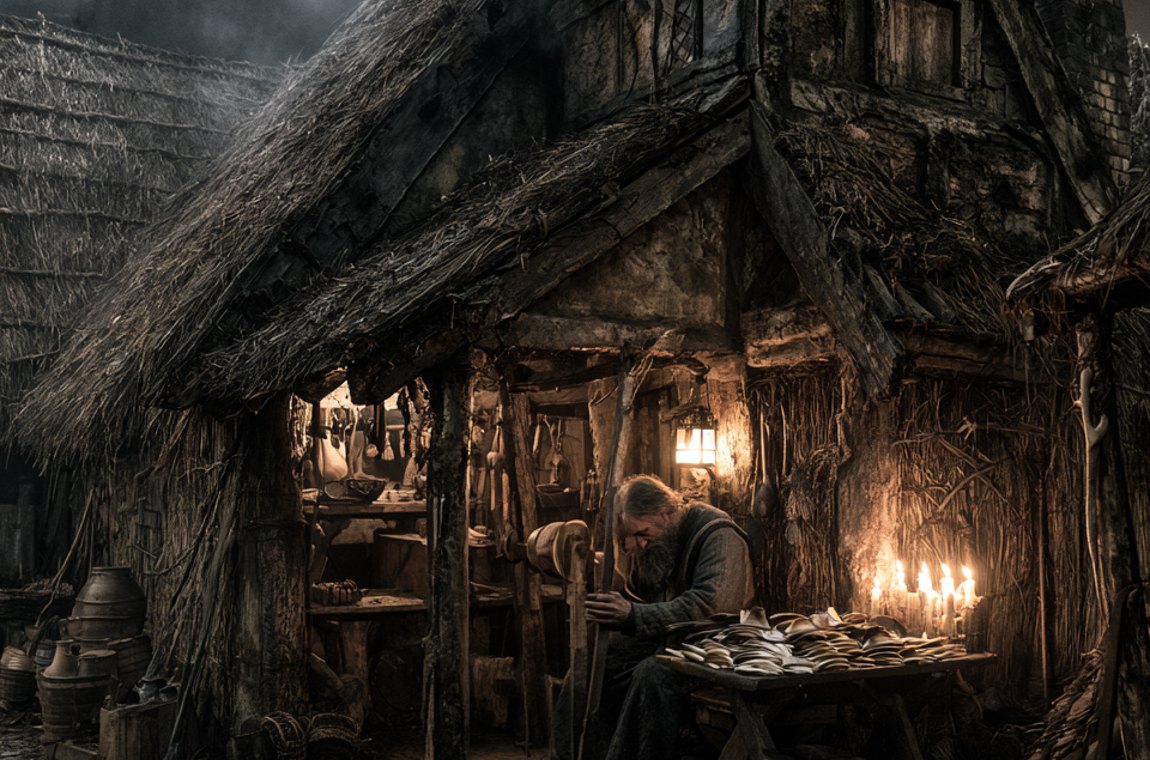
Some legendary figures live on through their deeds, a few through their works – and very few through both. Völundr, called Wieland by the Germans and Weland by the Anglo-Saxons, is the great smith of Germanic tradition: a man whose hands shape wonders and whose vengeance is as cold and measured as a blade drawn from the anvil. His story is among the oldest and most widely travelled of the North – and among the darkest.
Völundr is neither an Ás nor a Van. He appears in no list of gods, receives no cult, rules no world. And yet he stands above ordinary men: his craft is so perfect that it borders on sorcery, and the Poetic Edda calls him vísi álfa and álfa ljóði – "prince of the elves" or "one of the elves". What exactly that means is unclear; the Edda uses the term ambiguously, and whether it points to a supernatural being, an exceptionally skilled man, or some third, lost idea can no longer be decided.
What is certain is that Völundr is the smith as such. Wherever the Germanic world needed a legendary master of the forge, it gave him this name. He is the figure through which the old world imagined what a person could achieve with fire, iron and skill – and what happens when such a man is made a slave.
The main source is the Völundarkviða, preserved in the Codex Regius of the Poetic Edda (manuscript around 1270, the material itself considerably older). The lay opens peacefully, almost like a fairy tale: three brothers – Völundr, Egill and Slagfiðr – live in the Wolf-dales when three women come to them from the south, valkyrie- or swan-like beings who spin flax and shape fates.
Maids from the south / through Myrkwood flew,
Fair and young, / their fate to follow;
On the shore of the sea / to rest them they sat,
The maids of the south, / and flax they spun.Völundarkvitha 1; translation Henry Adams Bellows, 1923
For seven winters the women stay; in the eighth they long to leave, and in the ninth they are gone – following their own fate, as the fate-wise beings of the North do. Two brothers set out to find them. Völundr, however, remains alone and forges: red gold rings, one after another, waiting for his wife's return. It is precisely this waiting that becomes his undoing.
Níðuðr, king of the Njars, hears of the lone smith and his gold. He has him ambushed and bound in his sleep. When Völundr wakes, he is a prisoner. The ring he made for his wife now sits on the finger of the king's daughter Bǫðvildr; the king wears his sword.
On the queen's advice, Níðuðr has the sinews behind the smith's knees cut through. It is a coldly calculated cruelty: the crippled man can no longer flee, but his hands remain unharmed. They set him on a lonely island called Sævarstöð, alone with forge and tools, and force him to work for the king. The free master has become a useful instrument. The Edda records his condition in a few hard lines – Völundr sits, does not sleep, strikes with the hammer, and broods.
What follows is one of the grimmest episodes in Norse poetry, and the source tells it not with triumph but soberly, almost as a matter of record. The king's two young sons come secretly to the island to marvel at the smith's treasures. Völundr draws them to his work, kills them, and hides the bodies beneath the bellows.
Then he turns his craft against his tormentors. From the boys' skulls he fashions drinking bowls set in silver and sends them to the king; from their eyes he makes gems for the queen; from their teeth he makes ornaments for Bǫðvildr. The court wears and uses the remains of its own children without knowing it. When Bǫðvildr brings her broken ring – his wife's ring – to the smith to have it mended in secret, Völundr dulls her with beer and violates her. The vengeance is now complete: upon the king's sons and daughter he has repaid the harm done to him.
At last Völundr rises laughing into the air and escapes. Before he flies off, he reveals everything to the king: what became of his sons and what happened to his daughter. He leaves Níðuðr sworn to do no harm to the crippled smith – a prisoner who leaves his jailer broken behind him. It is a story with no victor, only a survivor.
Few Germanic legends have travelled so far. In England, Weland appears on the Franks Casket, a whalebone box of the early 8th century: there the vengeance scene is fixed in image – the smith at his forge, a headless body at his feet, Bǫðvildr receiving the cup. The art of rune-carving and pictorial storytelling merge on this piece; anyone wishing to read the signs upon it will find more in our article on the Franks Casket and on the world of the runes.
The Old English poem Deor names Weland and Beadohild (Bǫðvildr) as examples of suffering endured and overcome. The later continental Þiðreks saga makes Wieland the father of the hero Witege and sets him within the great cycle of Dietrich of Bern and the Nibelungs – the same story-world in which the tale of Sigurd and the dragon's hoard unfolds. And in the English landscape a neolithic long barrow in Oxfordshire still bears the name Wayland's Smithy. Folk belief held that whoever left a horse there overnight with a coin would find it freshly shod by morning. A legendary smith the countryside clung to for centuries.
Völund is a deeply ambivalent figure, and that is where his force lies. He is the maker and multiplier of beauty – rings, blades and ornaments of unmatched quality come from his hands. And he is the executor of a vengeance that flinches at nothing. The two belong together: precisely because his craft is so great, the humiliation weighs so heavily; and precisely because his freedom was taken, he turns his craft into a weapon. The anvil on which he shaped beauty becomes the place of horror.
One should not smooth this material over. The old poetry does not celebrate Völund's vengeance as a heroic deed; it sets it before us, cold and complete, and leaves the judgment to the listener. Like the fate-wise women at the beginning – kin to those powers that in the North spin the lot of humankind, the Norns – there stands at the end a course of events that runs because it was once set in motion. Völundr flies away, but no one leaves this story unmarked.
Attested: The main source is the Völundarkviða of the Poetic Edda (Codex Regius, manuscript around 1270). Weland on the Franks Casket (early 8th century, now in the British Museum) and the mention in Deor attest the legend independently in Anglo-Saxon England; the continental Þiðreks saga (13th century) makes Wieland the father of Witege. Wayland's Smithy in Oxfordshire has borne the name since the early Middle Ages (recorded in a 10th-century charter). The core elements – captivity, laming, revenge on the king's children, flight through the air – agree across these widely separated witnesses.
Myth-check: Völundr is a legendary smith, not a god – he receives no cult and appears in no list of gods. The Edda calls him álfa ljóði ("one/prince of the elves"), but the reading as "elf" is uncertain; the term stays ambiguous. How he escapes varies between versions: the Þiðreks saga has him build a feather cloak that carries him like a bird; the Völundarkviða only hints at the flight and does not explain it. And the legend is common-Germanic, not specifically of the Viking Age: its roots reach into the early Middle Ages and beyond, across the North and West Germanic world.
The Völundarkviða, the actual Wayland lay of the Poetic Edda, survives in full in only one place: the Codex Regius, that Icelandic vellum manuscript of the late 13th century which also preserves the Völuspá and the Hávamál. Without this single book we would know almost nothing of the Norse Völundr – a thought that makes the whole tradition as fragile as a cold anvil in a bog.
The lay is preceded by a short prose introduction that tends to surprise the modern reader: it does not open with vengeance and longing at all, but with a quiet, almost tender prelude. Three brothers – Völundr, Egill and Slagfiðr, sons of a king in the far north – live in a valley called Úlfdalir, the "wolf-dales". One morning they find three women by the shore who have laid aside their swan-cloaks and are spinning flax. They are valkyrie-like beings; the manuscript names them Hlaðguðr svanhvít, Hervǫr alvitr and Ǫlrún. The brothers take them as wives, and for seven winters they live happily together.
"Maids from the south / through Mirkwood flew,
Fair and young, / their fate to follow;
On the shore of the sea / to rest them they sat,
The maids of the south, / and flax they spun."
Völundarkviða; translation Henry Adams Bellows 1923 (public domain)
But in the eighth winter the swan-maidens grow restless, and in the ninth they fly away. Egill and Slagfiðr set out to search the world – Völundr, however, stays behind and forges rings for the one whose return he still hopes for. It is into this solitude that King Níðuðr later breaks. The famous horror of the lay – hamstringing, captivity, revenge – thus grows out of a love story, and this frame of longing and loss is the real heartbeat of the text.
Wayland is one of the very few legendary figures one can not only read about but actually look at – and centuries before the Icelandic manuscript was written. The most striking witness is the Franks Casket, an Anglo-Saxon box of whalebone from the early 8th century. On its front panel the Wayland scene stands directly beside the Adoration of the Magi: on the left the smithy, in which Völundr holds a headless body with his tongs – the slain king's son – while a female figure, read as Bǫðvildr, approaches the workshop with a servant. That a Christian craftsman should combine the heathen revenge tale and the birth of Christ in a single field says a great deal about how naturally the two worlds lived side by side back then. We have a dedicated deep-dive on the Franks Casket and its runic script.
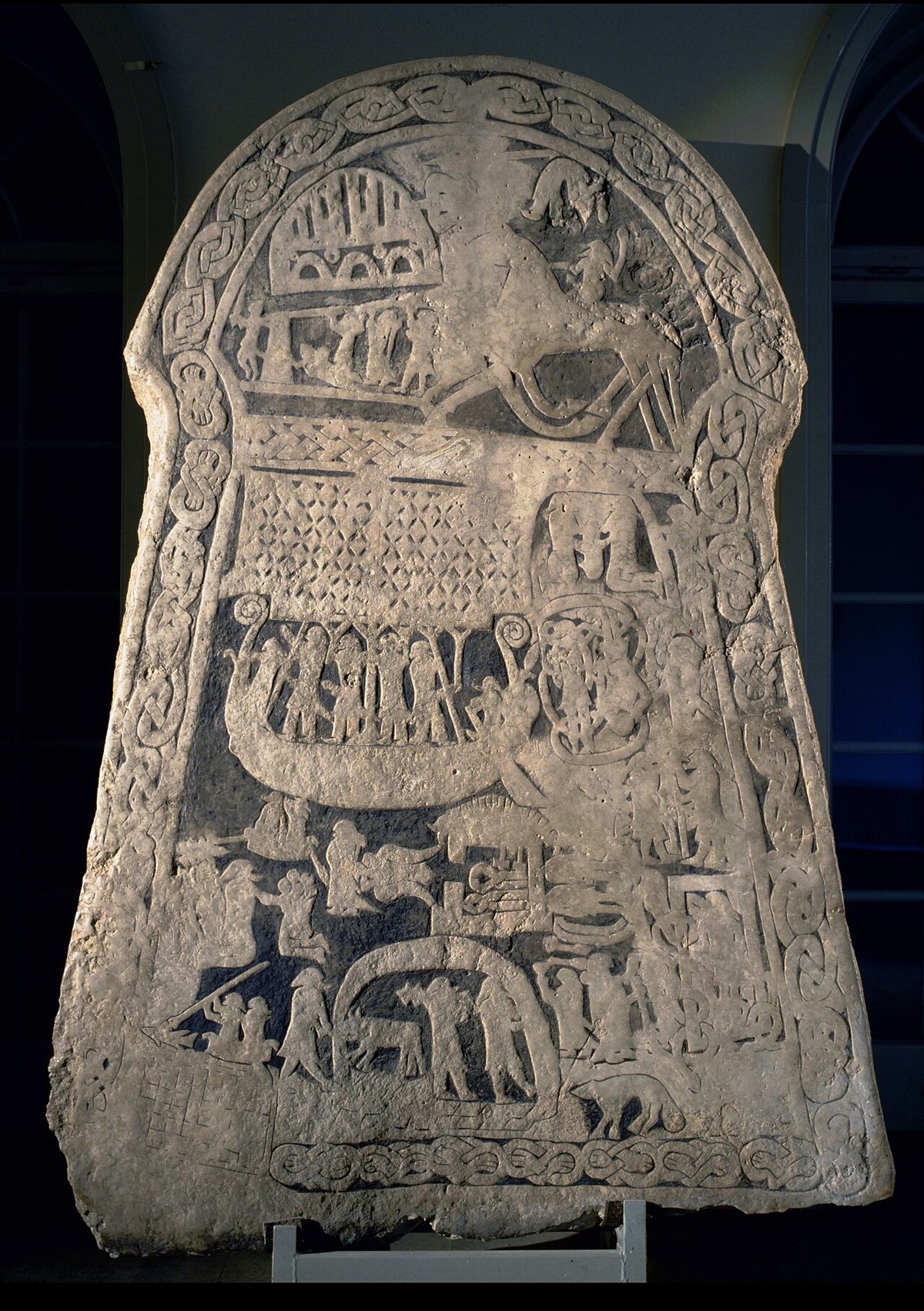
He appears in stone in the North as well. On Gotlandic picture stones – the best known is Ardre VIII – scholars believe they can make out a smithy, together with headless figures and, at the edge, a figure at the workshop door. Such picture stones are not illustrations in the modern sense but condensed narrative signs; their reading often remains a cautious perhaps. Anyone interested in the visual language of these stones will find more in our survey of the Norse animal and art styles.
Nowhere was Wayland so present as in early medieval England, where he is called Weland. His name even clung to the landscape: a Neolithic chambered long barrow in Oxfordshire, not far from the famous Uffington White Horse, still bears the name Wayland's Smithy – "Welandes smiððan", Weland's smithy. An Anglo-Saxon boundary charter of the 10th century already calls the place by that name. That a burial mound thousands of years older should be attributed to the legendary smith shows how deeply he was rooted in popular belief.
In poetry he appears as the yardstick of the highest craftsmanship. In Beowulf, Beowulf's mail-coat is "Welandes geweorc" – a work of Weland, which is to say: the best there is. The Old English elegy Deor opens with his suffering and that of the king's daughter Beadohild (Bǫðvildr), and turns it into the refrain that this, too, passed away. And King Alfred the Great, in his translation of Boethius's "Consolation of Philosophy", simply replaced the "bones of Fabricius" with the bones of Weland and asked: where now are the bones of Weland the wise goldsmith? An ancient name is swapped for a Germanic one – a legend could hardly have become more thoroughly at home.
He was known on the continent too. The Norwegian Þiðreks saga of the 13th century, a compilation of continental heroic legend gathered around Dietrich of Bern, contains as a section of its own the story of the smith Velent. There he is given a whole ancestry: he is the son of the giant Vaði and learns his craft from the legendary smith Mímir and from two dwarves inside a mountain – an apprenticeship meant to explain his uncanny skill. His son, in turn, is Viðga (Wittich, Witige), a celebrated hero of the Dietrich cycle.
In this way Wieland is interlocked with the great body of continental legend, to which the story of Sigurd and the Nibelungs also belongs – our article on Sigurd the dragon-slayer shows how closely these materials are related. The finding is clear: Wieland is not a purely Norse figure but a common Germanic inheritance. From Anglo-Saxon England across the Frankish-German continent to Scandinavia people told of the same smith – a rare case in which a figure can be traced across language borders and across centuries.
Why a smith, of all people? In a world where metal decided over life and death, harvest and war, the man at the fire was always both at once: indispensable and slightly uncanny. He forced raw ore into shape, he mastered fire and transformation – abilities that bordered on sorcery. Völundr carries this double nature in its purest form: the greatest of artists and, at the same time, the coldest of avengers.
It is tempting to compare him with figures of other traditions as a type. The Greek Hephaestus is, like Völundr, a limping, lamed god of the forge – and the Daedalus of legend escapes his prison, as Völundr does, by wings of his own making. Such parallels prove no direct borrowing; rather, they show that peoples independently recognised in the smith the same border figure between art, power and danger. The Edda itself lifts Völundr into the superhuman: it calls him "vísi álfa" and "álfa ljóði", prince of the elves. Whether this points to an elvish, otherworldly nature, to a foreign, perhaps northern-Sámi origin, or simply to his incomprehensible skill, remains debated to this day. For us he remains the smith who forges art out of suffering and freedom out of art – and whose work, as Beowulf already knew, was the highest praise an object could bear.
Attested: The Völundarkviða survives in full only in the Codex Regius (late 13th c.). Weland is named in the Anglo-Saxon Beowulf (l. 455, "Welandes geweorc"), in the elegy Deor and in Alfred's Boethius translation; the place-name Wayland's Smithy appears in a 10th-century boundary charter. Pictorial witnesses are the Franks Casket (early 8th c., whalebone) and Gotlandic picture stones such as Ardre VIII. The continental version Velent is preserved in the Þiðreks saga (13th c.).
Myth-check: The attribution of Wayland's Smithy to Weland is folk tradition – the barrow is millennia older than the legend. Readings of individual figures on picture stones (Ardre VIII) remain interpretation, not a secured pictorial programme. The parallels to Hephaestus and Daedalus are typological, not proof of borrowing. And the phrase "prince of the elves" (álfa ljóði) is open in meaning and should not be read too quickly as evidence of an "elf-god".
The Vikings before Aachen · Hedeby · Dorestad – the great trading place · The North Frisian ring forts · The Viking winter camps.
All History & Finds articles →
The Vikings came, raided – and stayed. Over the winter, at least. Instead of sailing home after every raid, they …
Read more →Many call the Varus battle the „big bang of Germany". Yet another battle shaped our lands far more deeply – one in …
Read more →High above the world of humans, beyond the burning rainbow bridge, lies Asgard – the fortified home of the Æsir. It is …
Read more →Almost 1,500 years before the first Germanic peoples entered Roman history books, a highly developed Early Bronze Age …
Read more →