For almost three centuries England was the great prize of the Northmen – from the first monastery raid that shook Christian Europe, to the day a Danish king ruled from London, and on to the day a Norwegian army was destroyed at a bridge in Yorkshire. „The Vikings in England" is not one story but many: raid and realm-building, plunder and plough, Danegeld and dynasty. Why England of all places? Because the wealth was there – monasteries full of silver and relics, fertile farmland, good harbours and rivers reaching deep inland – and because the island was split into rival kingdoms: Northumbria, Mercia, East Anglia and Wessex. Disunity holds the door open. Here we trace the whole arc from 793 to 1066, with a link to the full article behind every chapter.
On 8 June 793, armed men from the north fell upon the island monastery of Lindisfarne off the Northumbrian coast, plundered it, killed monks and carried others off. For the literate world of the cloister this was the end of an age in miniature: a holy place, unarmed and consecrated to God, was simply taken. The scholar Alcuin, then at the court of Charlemagne, sent horrified letters back home. The Anglo-Saxon Chronicle records the year with dark portents:
This year came dreadful fore-warnings over the land of the Northumbrians, terrifying the people most woefully: these were immense sheets of light rushing through the air, and whirlwinds, and fiery dragons flying across the firmament. […] And a little after that, in the same year, the harrowing inroads of heathen men made lamentable havoc in the church of God in Holy-island, by rapine and slaughter.Anglo-Saxon Chronicle, entry for 793 (transl. J. Ingram, 1823)
The fiery dragons, in all honesty, are not an eyewitness account but a portent motif – that is how doom was told in those days. Nor was Lindisfarne the very first contact: already in 789, on the Wessex coast near Portland, a royal official had ridden out to meet three strange ships and had been killed. But Lindisfarne is the blow that burned itself into collective memory and that, for us, marks the beginning. We have written up the full story of that day in our deep-dive on Lindisfarne.
What followed in the decades after Lindisfarne were summer raids – swift, limited strikes along the coast. In 865 the register changed completely. That year a host the Anglo-Saxon Chronicle calls the „great heathen army", the micel here, landed in East Anglia. This was no longer a raiding trip but a campaign of conquest: the army wintered over, secured horses and moved from kingdom to kingdom. In 866/867 Northumbria fell; Anglo-Saxon Eoforwic became Norse Jórvík – today's York, for nearly a century a centre of Viking power on the island. In 869 King Edmund of East Anglia fell, later revered as a martyr. Mercia came under pressure, and only Wessex still held.
By tradition the army was led by the sons of that half-legendary Ragnar Lodbrok – Ivar the Boneless, Halfdan and Ubba. How much of this family history is firm and how much is saga we sort out carefully in our articles on the Great Heathen Army and on the sons of Ragnar. This much is certain: a single large, coordinated army redrew the political map of England within a few years.
In early 878 things looked bleak for Wessex. A surprise winter attack drove King Alfred into the marshes of Somerset, to Athelney, where he stayed hidden and regrouped. In spring he struck back: at Edington he decisively defeated the army under Guthrum. Instead of annihilating his enemy, Alfred did something shrewd – he had Guthrum baptised and made peace. The surviving treaty between Alfred and Guthrum drew a boundary line across England and set out how Anglo-Saxons and Northmen were to deal with one another.
From this period comes the term around which most misunderstandings still cluster: the Danelaw. It denotes the part of England in the east and north where Norse law and Norse custom held – a legal and cultural sphere, not a state with a capital, a king and border posts. Those who lived there were often not the raiding warrior at all, but farmer, trader, free peasant. Why the Danes shaped mainly the east of England while Norwegians steered for the North Atlantic, we explain in our overview of the regional Vikings. And how the fugitive of Athelney became the only English king ever called „the Great" you can read in our article on Alfred.
Alfred saved Wessex – his descendants went on the offensive. His son Edward and his daughter Æthelflæd, the „Lady of the Mercians", pushed the Danelaw back piece by piece and secured the gains with fortified burhs. The provisional endpoint was set by Alfred's grandson Æthelstan: in 927 he took Jórvík and so ended the Norse kingdom of York; in 937 at Brunanburh he defeated an alliance of Viking Dublin, the Scots and British Strathclyde. To many, Æthelstan counts as the first king who truly ruled over „the English" – many realms became one. That the Danelaw was not simply „cleansed" in the process, but that its Norse-flavoured population, its law and its language lived on, is the real point: conquest here means fusion, not erasure.
At the end of the tenth century a second wave came. Under the luckless King Æthelred, given the byname „the Unready", great fleets returned. In 991 the ealdorman Byrhtnoth faced the Northmen at Maldon in Essex – and fell. The event was preserved in one of the finest Old English poems, which celebrates precisely the courage shown in a hopeless situation. More practical, but more fateful, was the crown's answer: they paid. Ten thousand pounds of silver were given as tribute to persuade the attackers to withdraw.
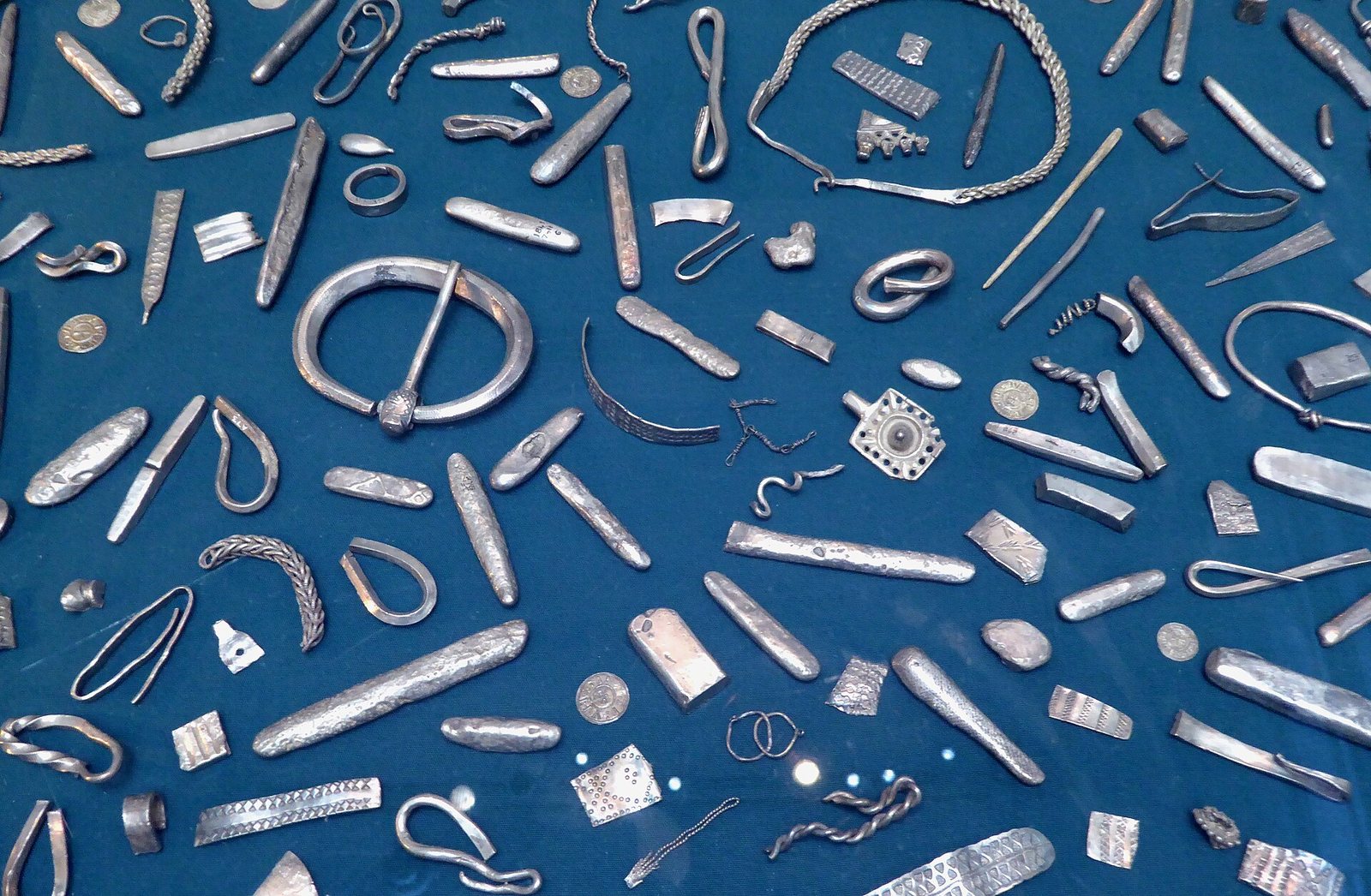
This „Danegeld" became a habit – and a trap. Whoever pays once invites the next; the sums rose from time to time. A good part of the great mass of Viking-age silver that lies in Scandinavian hoards today flowed north from England along this route. How a lost battle became a poem for the ages, and a payment became a strategic dead end, is told in our article on Danegeld and Maldon.
Tribute buys time, not safety. The Danish king Sven Forkbeard, son of Harald Bluetooth of the Jelling dynasty, meant business in 1013: he landed with an army, subdued England within a few months, Æthelred fled to Normandy – and Sven was accepted as king. Yet he died in early 1014, before he could truly rule. His son carried on what his father had begun: in 1016, after hard fighting, Cnut became king of England. Under him something arose that had never existed in this form – a North Sea empire uniting England, Denmark and, for a time, Norway under one crown. Cnut ruled not as a foreign occupier but as an English king with his own law codes; the Viking became a Christian ruler of empire.
The roots of this dynasty stand carved in stone at Danish Jelling, „Denmark's certificate of baptism". Anyone who wants to understand the family behind the North Sea empire will find the threads in our articles on Sven Forkbeard, on Cnut the Great and on the Jelling stones.
The year every schoolchild knows has two battles, not one. Before William the Conqueror landed at Hastings, one last great Viking king arrived: Harald Hardrada of Norway, allied with the exiled English earl Tostig, came to seize the English throne. On 25 September 1066 King Harold Godwinson met him at Stamford Bridge in Yorkshire – after a forced march no one had reckoned with. The Norwegians were crushingly defeated, Hardrada and Tostig fell. Less than three weeks later Harold marched south against William, and at Hastings all was lost. But the Viking age ended that day at the bridge in Yorkshire.
Around Stamford Bridge clings the famous scene of the lone Norse giant who held the bridge single-handed until a spear-thrust from below felled him. Beautifully told – only it does not appear in the early accounts but surfaces first in later manuscripts of the Chronicle. A fine example of how an event gathers its legends over the decades. The whole story of this turning point is in our article on Stamford Bridge.
The Northmen did not roll back out like a tide – they stayed, settled, married and became part of the land. You hear it most clearly in the place-names: anything ending in -by (Derby, Whitby, Grimsby), -thorpe, -toft or -thwaite carries Norse heritage. Everyday English vocabulary, too, is shot through with words from the tongue of the Northmen – law (from Old Norse lǫg), sky, skin, egg, knife, window (from vindauga, „wind-eye") and many more. And York is still called that because Eoforwic once became Jórvík.
A widespread error concerns the English weekdays: Tuesday, Wednesday, Thursday and Friday do go back to Germanic gods (Tiw, Woden, Thunor, Frigg) – but these are the Anglo-Saxons' own gods, a shared West Germanic inheritance, not a Viking import. Kinship yes, Viking souvenir no. And that is exactly the honest appeal of this history: the traces are real, but they often sit somewhere other than the quick myth believes.
Attested: The most important contemporary source is the Anglo-Saxon Chronicle, recording year by year the raids, winter camps and treaties. The treaty between Alfred and Guthrum survives in its wording; Viking York issued its own coinage; Cnut left his own law codes. To this are added the hard, silent witnesses: the dense scatter of Norse place-names in the east and north, Norse loanwords in English, and the free peasants (sokemen) recorded in Domesday Book (1086) precisely in the old Danelaw territories.
Myth-check: „Vikings = indiscriminate plunderers" falls short. Yes, there were raids, and they hit hard – but in the Danelaw the Northmen were, over generations, above all settlers, farmers and traders who shaped the land rather than merely emptying it. The Danelaw itself was a sphere of law and custom, not a state with king and borders. And the fiery dragons over Lindisfarne, like the lone hero at the bridge of Stamford, are later embellishments, not eyewitness reports – good stories, best kept cleanly apart from the evidence. For courage. For remembrance. For legends that live on.
The Vikings before Aachen · Hedeby · Dorestad – the great trading place · The North Frisian ring forts · The Viking winter camps.
All History & Finds articles →
The Vikings came, raided – and stayed. Over the winter, at least. Instead of sailing home after every raid, they …
Read more →Many call the Varus battle the „big bang of Germany". Yet another battle shaped our lands far more deeply – one in …
Read more →High above the world of humans, beyond the burning rainbow bridge, lies Asgard – the fortified home of the Æsir. It is …
Read more →Almost 1,500 years before the first Germanic peoples entered Roman history books, a highly developed Early Bronze Age …
Read more →