Bluetooth is named after the Danish king Harald Bluetooth (Harald Gormsson, died around 986/87), and its logo is his initials written in runes: Hagall (ᚼ) for H and Bjarkan (ᛒ) for B, merged into a single bind rune. Intel engineer Jim Kardach suggested the name in 1997 as a temporary codename, because Harald had brought Danish lands under one crown, just as the new radio standard was meant to bring phones and computers together. Here is the whole story, from the runestone at Jelling to the earbuds in your pocket, with fact and legend kept firmly apart.
Pick up your phone. Somewhere in the status bar or the quick settings there is a small, angular symbol that looks like a B that has been folded the wrong way. You probably tap it several times a day to pair headphones, a speaker or your car. What hardly anyone tells you is that you are pressing the monogram of a Viking king, written in a script that was being cut into stone more than a thousand years ago.
That sounds like a marketing fairy tale. It isn't. The story is remarkably well documented on both sides: on the king's side through a runestone, chronicles and excavations, and on the technology side because the man who coined the name wrote down his own account, and the Bluetooth Special Interest Group confirms it. Things only get interesting where the two sides touch, and where a surprising number of popular articles have quietly picked up errors. Let's clear those up.
Harald was the son of Gorm the Old, the first securely documented king of the Jelling dynasty, and of Queen Thyra. Nobody knows when he was born. His sole rule is usually dated from around 958, when Gorm died, although the twelfth-century Roskilde Chronicle speaks of a joint reign with his father, so Harald may have been co-king earlier. His end falls somewhere between 985 and 987. The Danish national encyclopedia (lex.dk) carefully says that he died in 987 at the latest.
If you want the full portrait of the man and his politics, read our article on Harald Bluetooth. For the Bluetooth question a few fixed points are enough. Harald held together a realm that already stretched from Jutland across the islands to Scania, he made Christianity the religion of the crown, he built on an extraordinary scale, and in the end he was overthrown by his own son. It is this image of Harald as the great unifier that, a thousand years later, gave an engineer in North America an idea.
Time for honesty: nobody knows for certain. Harald never called himself Bluetooth. His runestone simply says "King Harald". The nickname first turns up roughly 150 years after his death, in the Roskilde Chronicle (Chronicon Roskildense) of around 1140, in Latin form. In Old Norse he is Haraldr blátǫnn, in Danish Harald Blåtand, in Norwegian Blåtann. The English "Bluetooth" is simply a literal translation.
There are essentially three camps when it comes to explaining it:
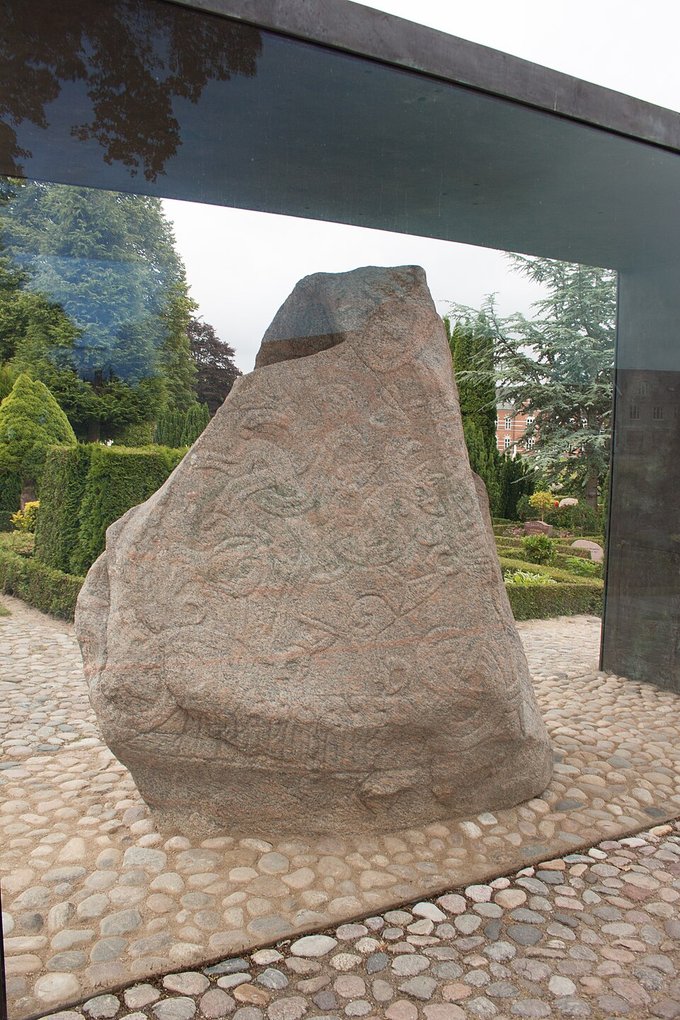
Around 965 Harald had a massive three-sided runestone raised at Jelling in central Jutland, today catalogued as DR 42. We have a separate article on the site, The Jelling Stones, so here are only the essentials. The inscription reads, in our own translation:
"King Harald ordered these monuments made in memory of Gorm, his father, and in memory of Thyra, his mother – that Harald who won for himself all of Denmark and Norway and made the Danes Christian."Great Jelling Stone (DR 42), c. 965; our own translation
One face shows a great beast entwined by a snake, another the oldest known depiction of Christ in Scandinavia. That is why the National Museum of Denmark calls it "Denmark's baptismal certificate". Since 1994 the stones, the two mounds and the church at Jelling have been a UNESCO World Heritage Site.
One detail is a particular treat for our story. The inscription opens with Harald's name, in runes haraltr, and the very first character is the rune ᚼ, the same one hidden in the Bluetooth logo today. You won't find a B for "Bluetooth" there, though. The nickname simply did not exist yet.
"Won for himself all of Denmark and Norway" is self-promotion. Any king who raises a stone this size is writing his own report card, and Harald graded himself generously. So what lies behind it?
Denmark: Historians assume that Gorm already ruled much of what later became Denmark. Harald consolidated the realm, bound the islands and Scania more firmly to the crown and made royal power visible. "Won" here means something like: forced under one crown and kept there.
Norway: For a time Harald's influence reached into southern Norway, exercised through the powerful Earl Håkon Sigurdsson of Trøndelag. After the death of the Norwegian king Harald Greycloak around 970, Harald Bluetooth was overlord there, though more on paper than through any administration of his own. By the mid-970s at the latest, Håkon was going his own way.
Christianisation: The best-known account comes from Widukind of Corvey, a Saxon monk who wrote his history of the Saxons (Res gestae Saxonicae) in the 960s and 970s, during Harald's lifetime. In his third book he relates how, at a feast, the Danes argued that Christ might be a god but that the old gods were mightier. A cleric named Poppo disagreed. Harald demanded proof, and the next morning Poppo carried a red-hot iron for as long as the king wished and then showed an unharmed hand. After that, Widukind says, Harald decreed that Christ alone was to be worshipped as God and ordered his people to cast off their idols.
Whether it happened like that cannot be checked. An ordeal as a conversion miracle is a familiar storytelling pattern. Later writers tell it differently: Adam of Bremen (around 1075) has Harald baptised after a defeat by Emperor Otto I, which neatly suited his archdiocese of Hamburg-Bremen and its claims over the North. Saxo Grammaticus (around 1200) transfers the miracle to Harald's son Sweyn. And the gilded copper plates from Tamdrup church in eastern Jutland, made around 1200, show Poppo's ordeal and the king's baptism as a picture story.
Some of what Harald left behind, besides stones, still lies in the ground today, and it explains why historians see him as an exceptionally capable organiser. The dates come mainly from dendrochronology, which dates timber by counting and matching its growth rings.
The ring fortresses. Trelleborg on Zealand, Fyrkat and Aggersborg in Jutland, Nonnebakken in Odense and Borgring near Køge, confirmed only in 2014, all follow the same strict plan: a circular rampart, four gates facing the cardinal points, two crossing streets, and houses in groups of four. The timbers at Trelleborg were felled around 980. What the fortresses were for is debated: strongholds against internal rivals, assembly points for a royal army, or sheer statements of power. There is more in our articles on the Trelleborg ring fortresses and on Borgring.
The Ravning Enge bridge. About ten kilometres south of Jelling a timber bridge crossed the wide, marshy valley of the Vejle Å. It was around 760 metres long and at least five metres wide, carried by some 280 trestles, each with four vertical and two raking posts. The timbers date to around 979/980, and lex.dk calls it the oldest known bridge in northern Europe. It seems to have been in use only briefly, which fits the idea that it was more a display of royal power than an everyday road.
The Danevirke. Harald also built on the great border rampart in the south, the Danevirke near Hedeby. He needed it: in 974 Emperor Otto II took the Danevirke and the area around Hedeby. Only in 983, after Otto's defeat in southern Italy and a major Slav uprising, did the Danes win it back.
Look at that list and you can see why Harald of all people became the godfather of a connectivity standard. Bridges, roads, a single blueprint for fortresses across the whole realm: that is a standard in all but name, only made of oak and earth.
Harald's reign ended badly. His son Sweyn Forkbeard rose against him, probably around 986/87. We can only speculate about the reasons; lex.dk suggests that the enormous building projects and the burdens they placed on the army and the farmers had bred resentment. There was fighting, and Harald was wounded.
According to Adam of Bremen he fled to Jumne at the mouth of the Oder and died there of his wounds. Later Icelandic texts, the Jómsvíkinga saga and the Knýtlinga saga, connect this with the legendary Jomsborg, which we look at more closely in our article on the Jomsvikings. Where exactly Jumne lay is still a matter of research; it is usually identified with Wolin in today's Poland.
Adam says Harald was buried at Roskilde, in a church he is said to have founded himself. No grave that can be securely linked to him has been found. The Swedish archaeologist Sven Rosborn argues that Harald lies at present-day Wiejkowo in Pomerania, basing this on a gold disc with a Latin inscription naming Harald as king, the so-called Curmsun disc. That theory is disputed among specialists.
Now we change millennium. The technology itself started in Sweden: in 1989 Nils Rydbeck, chief technology officer at Ericsson Mobile in Lund in southern Sweden, set out to connect headsets to mobile phones without wires. From 1994 the work there was led above all by the Dutch engineer Jaap Haartsen and the Swede Sven Mattisson, who developed a short-range radio link in the licence-free 2.4 gigahertz band.
At the same time, from 1996 onwards, the industry and in particular Intel, Ericsson and Nokia were looking for a common standard so that devices from different makers could talk to each other instead of every company doing its own thing. At some point a project like that needs a name that belongs to nobody and that everyone can use.
In late 1997 Jim Kardach of Intel and Sven Mattisson of Ericsson met in Toronto to present their plans at an event. By Mattisson's later recollection, the presentation got a rather lukewarm response. So the two spent the evening on a pub crawl through the wintry city. Kardach, a keen history buff, got talking with Mattisson about the Vikings, and Mattisson told him about a novel that almost everyone in Sweden knows.
The novel is Röde Orm by the Swedish author Frans G. Bengtsson, published in two parts in 1941 and 1945 and known in English as The Long Ships. Set in the tenth century, it follows Orm from Scania, who is carried off as a young man, ends up as far away as Andalusia and later on long voyages, and whose path keeps leading back to the court of King Harald Bluetooth. Orm even marries Ylva, who in the novel is one of Harald's daughters.
Bengtsson's book is literature, not history. It is ironic, earthy, very funny and well researched, but its characters and many of its scenes are invented. For our purposes only one thing matters: this novel was how Kardach first heard of a Danish king with the odd nickname Bluetooth. Mattisson later sent him a copy.
Back in the United States, Kardach also read A History of the Vikings by the Welsh historian Gwyn Jones (1968). In it he found a picture of the Jelling stone and the statement that Harald had united Denmark and Norway. In his own retrospective, published in EE Times in 2008, he describes how it struck him at that moment that this would make a good codename for the programme.
Kardach put together a presentation slide: the Jelling stone, with the supposed Harald figure holding a mobile phone in one hand and a notebook computer in the other, plus a translation of the inscription. But "Bluetooth" was only ever meant to be an internal codename until marketing came up with something really cool.
According to the Bluetooth SIG, two candidates were lined up for the final name: "RadioWire" and "PAN" (for Personal Area Networking). PAN was the favourite, but a search turned up tens of thousands of hits online, so it could not work as a trademark. RadioWire, in turn, could not be cleared in a full trademark search before launch. Kardach also mentions in his retrospective that the name "Flirt" was discussed at one point. So the thing that was only supposed to be temporary stayed.
On 20 May 1998 the Bluetooth Special Interest Group (SIG) was formally announced, with five founding members: Ericsson, Intel, Nokia, Toshiba and IBM. Specification 1.0 followed in 1999, the same year the first Bluetooth device was shown, a hands-free headset. Today the SIG counts tens of thousands of member companies, and billions of Bluetooth devices ship every year.
Which leaves the symbol itself. The Bluetooth SIG describes it explicitly: the logo is a bind rune merging the Younger Futhark runes Hagall (ᚼ) and Bjarkan (ᛒ), Harald's initials.
Three terms need a quick explanation:
Younger Futhark is the runic alphabet of the Viking Age. From the eighth century onwards, the older 24-character system was reduced in the North to just 16 runes. Almost every Viking Age runestone is written in these sixteen signs, including the stones at Jelling. We compare the two rows in our article Elder and Younger Futhark.
Hagall (ᚼ) means "hail" and stands for the sound H. In the so-called long-branch form that is usual on Danish stones, it looks like a star, or a cross with extra diagonal strokes. This is exactly the rune that opens Harald's name on the Jelling stone.
Bjarkan (ᛒ) means "birch" or "birch twig" and stands for B. It looks strikingly like our Latin B, because both go back to a shared, very old letter shape.
A bind rune, finally, is a ligature: two or more runes share a main stave and are fused into one sign. Bind runes do occur in real inscriptions, usually to save space or for design reasons. In the Bluetooth logo the star of the Hagall rune sits over the upright stave of the Bjarkan rune, and the two bows of the B jut out from it in sharp points. Once you know what to look for, you see both characters immediately.
You could call it chance: a pub-night whim, a placeholder that happened to stick. But the story holds up for a better reason. Harald's legacy is, at its core, about connections: between regions, between the old faith and the new, between the banks of a river valley. His runestone is itself a communication device that has been broadcasting a message for more than a thousand years, no battery required.
It is also one of the rare places where the real Viking Age sits, completely unnoticed, in the daily lives of billions of people. Not as a horned-helmet cliché, not as a TV costume, but as two correct runes belonging to a historically documented king. Once you know the symbol, you see it everywhere: on the car stereo, on the electric toothbrush, on your grandmother's hearing aid.
That is exactly what fascinates us about runes: they hold on to a name, clearly and permanently. For Harald it has worked for over a millennium. If you want to see what your own name looks like in runes, try our rune name generator. For more on the characters themselves, their names and their origins, see our big article on runes. And if you would like your initials turned into something that lasts, we engrave them in slate, wood or glass, properly researched and without fantasy runes.
Why is it called Bluetooth? The name comes from the Danish king Harald Bluetooth (Harald Gormsson, died around 986/87). Jim Kardach of Intel proposed it as a codename in 1997 because Harald had united Danish lands, just as the technology was meant to connect devices.
What runes are in the Bluetooth logo? The logo is a bind rune made of two Younger Futhark runes: Hagall (ᚼ) for H and Bjarkan (ᛒ) for B. Together they form Harald's initials, H and B.
What does Bluetooth actually mean as a nickname? Nobody knows for sure. The most common explanation is a dead, dark-coloured tooth; another theory proposes a "dark thegn". The nickname is first recorded around 1140, more than 150 years after Harald's death.
Who invented Bluetooth? The radio technology was developed at Ericsson in Lund from 1989, chiefly by Jaap Haartsen and Sven Mattisson. Jim Kardach of Intel proposed the name, and the Bluetooth SIG has standardised the technology since 1998.
Is Harald Bluetooth shown on the Jelling stone? No. The human figure on the great Jelling stone is Christ, the oldest known depiction of Christ in Scandinavia. Harald only had the stone raised.
What was Bluetooth almost called? "Bluetooth" was only meant as a placeholder. The favourites, "PAN" and "RadioWire", failed because of too many existing uses and a trademark search that could not be finished in time.
For courage. For remembrance. For legends that live on.
Few questions reach us in the workshop as often as this one: „Which material actually suits my motif best?" Whether …
Read more →A dark slate plate, a brief beam of light, and where there was deep anthracite a moment ago, a bright, silvery-white …
Read more →The great milestones of life deserve more than an off-the-shelf present. A Norse gift bearing a name, a date and an old …
Read more →A word of love engraved in stone or glass outlasts any card and any bouquet. But how did „I love you" actually sound in …
Read more →