Harald Bluetooth (Old Norse Haraldr Gormsson, Danish Harald Blåtand) was king of the Danes from about 958 until 986/87: son of Gorm the Old and Thyra, convert of the missionary Poppo, rival and partner of the Ottonian emperors, overlord of parts of Norway and the greatest builder of Viking-Age Denmark. In the end he was overthrown by his own son, Sweyn Forkbeard. Here is what runestones, chroniclers and tree rings really tell us about his life – and where legend takes over.
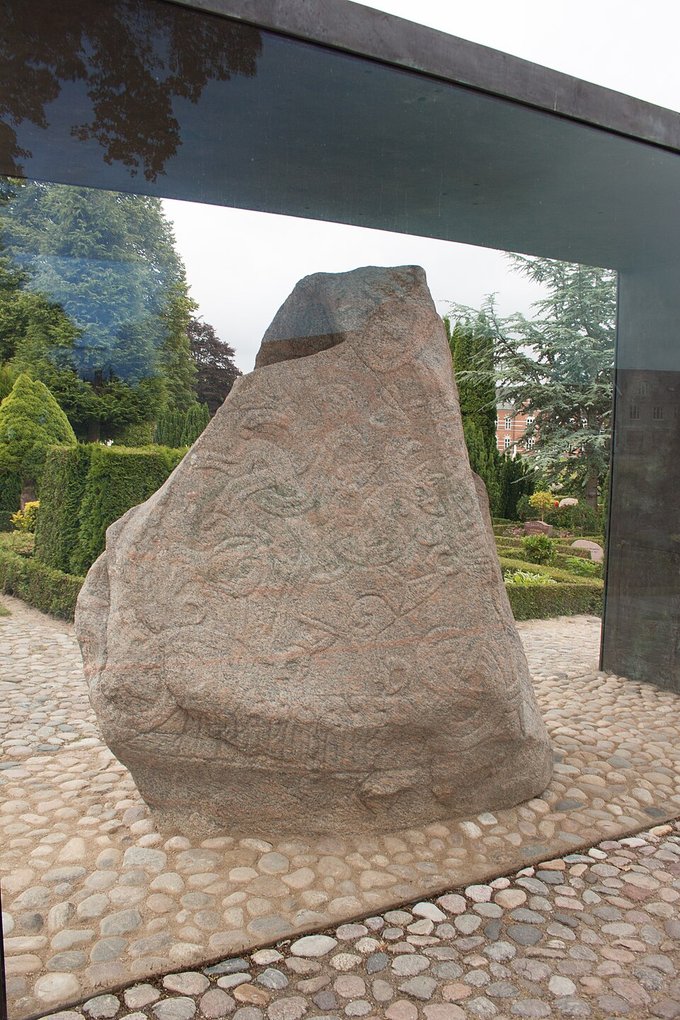
Picture a king who has himself carved into stone. Not as a warrior brandishing a sword, but as a man who claims two achievements: winning a whole country and baptising a whole people. That is exactly what Harald did at Jelling around 965. The sentence on his runestone is still the shortest end-of-term report in Scandinavian history. And like every end-of-term report, it is worth checking the numbers.
With Harald, that is easier than with almost any other Viking king. Still, much of what is told about him comes from texts written one to three centuries after his death. We take that difference seriously.
First come the runestones. The great Jelling stone is Harald's own voice – first-hand propaganda. Equally contemporary is Widukind of Corvey, a monk from Saxony who wrote his Deeds of the Saxons (Res gestae Saxonicae) in the late 960s and early 970s, while Harald was on the throne.
About a century younger is Adam of Bremen, who around 1075 wrote the history of the archbishops of Hamburg-Bremen. Adam had informants at the Danish court, but he also had an agenda: to prove that the Church of the North belonged to Hamburg-Bremen. Later still come the Danish historians around 1200 (Sven Aggesen and Saxo Grammaticus) and the Icelandic sagas of the thirteenth century, above all Jómsvíkinga saga, Knýtlinga saga and Snorri Sturluson's Heimskringla. They are vivid, dramatic – and often free with the facts.
The fourth witness is silent but does not lie: archaeology. Burial chambers, palisades, bridges and fortresses can be dated by dendrochronology, the method of matching the growth rings of building timber against a reference curve to find the year the tree was felled. Harald's great building projects left a lot of oak behind.
We know Harald's parents from the Jelling runestones. His father was Gorm the Old, the first Danish king we can grasp as a person at all. His mother was Thyra, for whom Gorm raised the smaller Jelling stone, calling her "Denmark's adornment" (runic tanmarkaR but). Harald's great stone names both parents explicitly. No source gives a year of birth. Since Harald took power around 958 and his son Sweyn was old enough to rebel by the mid-980s, he was probably born in the first third of the tenth century.
Whether Gorm already ruled all of Denmark is disputed. Harald's later boast that he "won all of Denmark" suggests that he added territories his father had not held, or not held securely – probably the islands and Scania, which then belonged to Denmark.
We do not learn when Gorm died and Harald became sole king from a chronicle, but from a grave. Inside the North Mound at Jelling, excavators found a timber burial chamber. Its wood was felled in the winter of 958/959. The chamber is regarded as Gorm's original grave, which makes "around 958" the best date for the start of Harald's reign.
The chamber, however, was empty; already in the Viking Age the body had been removed. In 1978/79, beneath the later church at Jelling, archaeologists found the bones of a man in a chamber grave, which many researchers interpret as Gorm's reburied remains. If that is right, Harald moved his pagan father into a church after his own baptism – turning a heathen ancestor into a Christian founding father after the fact. It is not certain, but it is plausible. You will find more in our article on the Jelling stones.
We meet Harald's wife in an unusual place. The runestone of Sønder Vissing in central Jutland reads, roughly: "Tove had this monument made, Mistivoj's daughter, in memory of her mother; wife of Harald the Good, Gorm's son." Tove was the daughter of Mistivoj, a prince of the Obotrites, a Slavic people in what is now Mecklenburg and eastern Holstein. The marriage was politics: it secured Harald an ally on his south-eastern flank, between Denmark and the Ottonian Empire.
Note the epithet on that stone: Harald is called "the Good" (Haralds hins góða). No contemporary source calls him "Bluetooth". Adam of Bremen, by contrast, names a Gunhild as Harald's wife, and Saxo later a Gyrid. Whether Harald married more than once or the tradition simply got tangled remains open.
His children are said to include Sweyn Forkbeard, later conqueror of England, a son called Haakon, and daughters, among them Thyra, who according to later sagas was married first to the Swede Styrbjörn and then to Olaf Tryggvason. A daughter Gunhild, supposedly killed in the St Brice's Day massacre in England in 1002, is known only from the twelfth-century English chronicler William of Malmesbury; her existence is doubtful.
Widukind of Corvey tells the story in the third book of his history (chapter 65). At a feast at the Danish court, the guests argued about the gods. The Danes, Widukind says, admitted that Christ was a god, but held other gods to be greater, because they showed mightier signs. A cleric named Poppa objected: there was only one true God, and the others were demons.
King Harald asked whether he was ready to prove it. Poppa said yes. The next day the king had a large, heavy piece of iron heated until it glowed and ordered the cleric to carry it for the Catholic faith. According to Widukind, Poppa carried it as far as the king wished and then showed his unharmed hand. Thereupon Harald decided to worship Christ alone as God, ordered his people to reject the idols, and from then on gave priests the honour due to them.
This is an ordeal: a procedure in which a higher power is expected to reveal the truth through a physical test. Nobody can check whether it happened like that. But it was written down close to the event, and Widukind had no particular reason to flatter Hamburg-Bremen. Most historians therefore date Harald's baptism to around 963–965. Widukind adds an intriguing aside: the Danes had "long been Christians", yet worshipped idols on the side. That fits what we know from traders at Hedeby and Ribe, where churches had stood since Ansgar's mission in the ninth century: Christ was no stranger in the North, just not yet the only god.
Around 1200 the scene became a picture cycle. The gilded copper plates from the church of Tamdrup in eastern Jutland, now in the National Museum in Copenhagen, show Poppo's ordeal and Harald's baptism in a series of panels. Saxo Grammaticus, meanwhile, moves the story to Harald's son Sweyn. That is how legends travel.
Adam of Bremen tells the conversion quite differently. In his account, Emperor Otto I defeats the Danish king in a campaign that reaches deep into Jutland, forcing him to accept baptism. Harald is baptised together with his wife Gunhild and his little son; Otto himself stands godfather to the boy, who is therefore called Sweyn Otto. The Archbishop of Hamburg-Bremen appears as the driving force of the mission.
Modern historians are sceptical. There is no contemporary evidence for such a campaign by Otto I, and Widukind – a Saxon who would happily have reported any victory of his emperor – says nothing about it. The Danish historian Michael Gelting calls Adam's version spurious. More likely Harald was baptised out of his own political calculation: a Christian king removed his powerful southern neighbour's pretext for converting Denmark by the sword.
Denmark had bishops before it had a baptised king – at least on paper. At the Synod of Ingelheim in 948, three bishops signed for Danish sees: Hored for Schleswig, Liafdag for Ribe and Reginbrand for Aarhus. All three had been consecrated by Archbishop Adaldag of Hamburg.
Whether they ever set foot in their dioceses is an open question. No source shows that they actually resided in Denmark before Harald's baptism. Many historians see the consecrations of 948 above all as a move by Hamburg-Bremen to secure its status as an archbishopric by having suffragans, that is, subordinate bishops. Others regard at least Schleswig and Ribe as real mission stations, since churches had stood there since Ansgar's time.
The ground firms up in 965. In that year Otto I issued a charter for the bishoprics of Schleswig, Ribe and Aarhus that freed their possessions from dues and services to the king and confirmed the authority of the Archbishop of Hamburg over them. Soon afterwards a fourth diocese, Odense, followed. Whether the bishops now truly lived in Denmark is still unclear – but the Church had an address in the North.
As long as Otto I lived, relations with the Empire stayed largely calm. After his death in May 973, Harald tested the young successor. In 974 Danish forces attacked north of the Elbe. Otto II struck back in the autumn of the same year, broke through the Danevirke – the great rampart across the neck of the Jutland peninsula – and had a fortress built there. For almost a decade the area around Hedeby stayed under Ottonian control.
A runestone from Hedeby probably speaks of this very period. A man named Thorulf raised it for his comrade Erik, who died "when warriors besieged Hedeby". The stone does not say which siege; many runologists think of the fighting of the 970s or 980s.
983 brought the turn. In the summer of 982 Otto II had suffered a heavy defeat against an Arab army in southern Italy, and in 983 the Slavs east of the Elbe rose in a great revolt. In the same year the Danes retook the borderland around Hedeby. This is where the marriage to Tove paid off: Harald's father-in-law Mistivoj and his Obotrites were on the side of the rebels.
Harald's runestone claims that he won Norway. What lies behind that? According to the sagas – that is, sources from the twelfth and thirteenth centuries – Harald first backed the sons of Eric Bloodaxe, who returned from exile in Denmark to take power in Norway. The eldest, Harald Greycloak, was killed around 970 at the Limfjord in Jutland – according to Snorri in an ambush that Harald Bluetooth helped to arrange. Whether that is true cannot be tested; the sagas love an intrigue.
After that, Norway was ruled by Haakon Sigurdsson, the jarl of Lade in Trøndelag (more about him and his family in our article on the jarls of Lade). Haakon recognised Harald as his overlord. A jarl was a prince ranking below a king, often with great power of his own – so Harald was more an overking than a king of Norway in any modern sense.
The loyalty did not last. Snorri tells that in 974 Haakon came with troops to the Danevirke to help Harald against Otto II and was baptised there under pressure. On the voyage home, the story goes, he put the priests he had been given ashore and renounced both Christianity and Harald. The details are saga; the core is accepted by Lex.dk too: after 974 Haakon turned against Harald. Danish overlordship in Norway probably lasted only a few years in the 970s.
What truly sets Harald apart from the other kings of his day is his building programme. Here it is not chroniclers who speak, but oak trees.
At Jelling, Harald enclosed the royal seat with a rhomboid timber palisade of about 360 by 360 metres, surrounding some 12.5 hectares. Inside stood houses of the Trelleborg type. Add to this a huge stone ship setting about 360 metres long, the second mound and the great runestone, and Jelling became the stage of a dynasty. The palisade timber was felled between 958 and 985, most likely around 968. At some point it burned down, and after Harald's death the site was apparently abandoned quickly.
Ten kilometres south of Jelling, the Ravning Enge bridge spanned the broad valley of the Vejle river. It was about 760 metres long and at least five metres wide, resting on 280 bays, each with four vertical posts plus angled supports. Its timber was felled around 979. What it was for is debated: a road to Jelling, a military axis, a statement of power – probably all at once.
Best known are the ring fortresses: perfectly circular ramparts with axial streets and longhouses arranged in squares. Trelleborg on Zealand is tree-ring dated to 980/981. What they were for – strongholds against internal rivals, assembly points for an army, administrative centres – is still argued over. What they share is a short period of use.
A less visible reform belongs here too. According to the Danish numismatist Jens Christian Moesgaard, Harald introduced Denmark's first uniform, realm-wide coinage, decorated with a cross, in the 970s and 980s.
And this may be the key to his downfall. Lex.dk suggests that the enormous labour burden of these great projects, all crammed into a few years around 980, fuelled resentment in the country. Bridges and fortresses cost timber, time and people.
Around the middle of the 980s, Harald's son Sweyn rose against him. The sources disagree about why. Adam of Bremen portrays Sweyn as a pagan rebel who allied with the enemies of Christianity and toppled his pious father. Adam needed a wicked son to make the father shine. The National Museum of Denmark explicitly calls Adam's picture of Sweyn as a cruel heathen inaccurate.
A classic power struggle is more likely, fuelled by the burdens of the building programme and perhaps by the losses in Norway. How the fighting went, nobody knows for sure. What is certain is that Sweyn won, and Harald lost his throne and, shortly afterwards, his life.
According to Adam of Bremen, Harald was wounded in battle against his son, fled by ship to the Slavs at the town of Jumne and died there of his wounds; tradition gives 1 November as the day of his death. Jumne is very probably today's Wolin at the mouth of the Oder, an important trading place – and, in the later sagas, the seat of the legendary Jomsborg. The year of death is given as 985, 986 or 987 at the latest.
His body, Adam goes on, was brought back by his men to Roskilde and buried in the church he had built there in honour of the Holy Trinity. Roskilde Cathedral does contain a pillar tomb meant to hold Harald's remains; according to Lex.dk it is empty, and Adam's statement is considered uncertain. No church of Harald's has been found archaeologically at Roskilde.
In his own lifetime, as far as we know, he was simply Harald, Gorm's son – on the Jelling stone haraltr kunukR, "King Harald" – or "Harald the Good", as on his wife's stone. The byname "Bluetooth" first appears around 1140 in the Roskilde Chronicle, as "Blatan sive Clac Harald", that is "Blåtand or Klak-Harald". A gloss from the late twelfth century explains blatan as dens lividus vel niger, "a bluish or black tooth".
The usual explanation is therefore a conspicuous dead, dark tooth. Old Norse blár did not only mean blue but also a dark blue-black – exactly the colour of a dead tooth. In 1997 the Danish historian Benito Scocozza proposed a very different solution: the name might derive from an English title, something like "blue thegn". That theory has not won wide acceptance. In short: there is a plausible explanation, but no secure one. The only certainty is that the name is two centuries younger than the king.
In Icelandic saga literature Harald is rarely the hero. In Jómsvíkinga saga he is an ageing, shady king whose conflict with Sweyn and with the Jomsviking leader Pálnatóki drives the plot. There Harald does not fall in battle but is struck by an arrow from ambush, shot by Pálnatóki – an ignoble death that Saxo Grammaticus tells in similar fashion. Saxo also has the episode in which Harald forces the archer Toko (Pálnatóki) to shoot an apple off his son's head – a motif that later lives on in the William Tell legend.
Lex.dk rightly calls these stories colourful and largely fictional. They reveal more about the twelfth and thirteenth centuries than about the tenth: people needed origin stories for the Jomsvikings, for Sweyn's rule and for Cnut the Great, Harald's grandson, under whom the Danish North Sea empire reached its height.
We end where we began, with the stone. In our own translation its inscription reads: "King Harald ordered these monuments made in memory of Gorm, his father, and in memory of Thyra, his mother – that Harald who won for himself all of Denmark and Norway and made the Danes Christian." The stone also carries the oldest depiction of Christ in Scandinavia.
Each of the three claims only partly survives scrutiny. "All of Denmark" – probably yes, though it is unclear what had been missing before. "Norway" – for a few years, through a jarl who soon deserted him. "Made the Danes Christian" – the king was baptised and promoted the Church, but converting the country took generations more. That is precisely what makes the stone so valuable: it shows how a tenth-century king wanted to be seen.
Then there is an afterlife Harald could never have dreamed of. In 1997 the Intel engineer Jim Kardach proposed the code name "Bluetooth" for a new wireless standard meant to connect different devices, just as Harald had united the Danes. The logo combines the runes for H and B. We tell the whole story in our article Your phone carries a Viking king.
At Glanz & Gravur we engrave runes every week, and we keep noticing that hardly any name from the Viking Age is as present today as this one. All the more reason to know the real Harald – the man from Jelling, not just the logo.

When did Harald Bluetooth live? His year of birth is unknown, probably early in the tenth century. He was king from about 958 until his death in 985, 986 or 987 at the latest.
Who were Harald Bluetooth's parents? Gorm the Old and Queen Thyra. Harald names both on the great Jelling stone.
How did Harald Bluetooth become a Christian? According to the contemporary Widukind of Corvey, the cleric Poppo convinced him by carrying red-hot iron without being burned. Adam of Bremen's later version of a forced conversion after defeat by Otto I is considered unreliable.
How did Harald Bluetooth die? According to Adam of Bremen he was wounded fighting his son Sweyn Forkbeard, fled to Jumne (Wolin) and died there. The saga version of Pálnatóki's arrow is legend.
Where is Harald Bluetooth buried? According to Adam at Roskilde, but the tomb in the cathedral is empty. No secure grave is known.
Why is he called Bluetooth? The byname is first recorded around 1140 and is usually explained as a dead, dark tooth. That explanation is not certain.
For courage. For remembrance. For legends that live on.
Cnut the Great · The Danevirke · Trelleborg – Harald's ring fortresses · Hedeby · Rollo of Normandy.
All History & Finds articles →
Long before the Vikings, a Roman writer describes a Germanic tribe that defeats its enemies not by number or strength …
Read more →The most famous eyewitness account of the Vikings comes not from the North, but from Baghdad. In 921 the Caliph sent …
Read more →Carved in stone over 1,000 years ago, a king proclaims the unification and baptism of Denmark – the same king whose …
Read more →Long before the Vikings they settled between the Eifel and the Danube, leaving behind gold hoards and princely graves …
Read more →