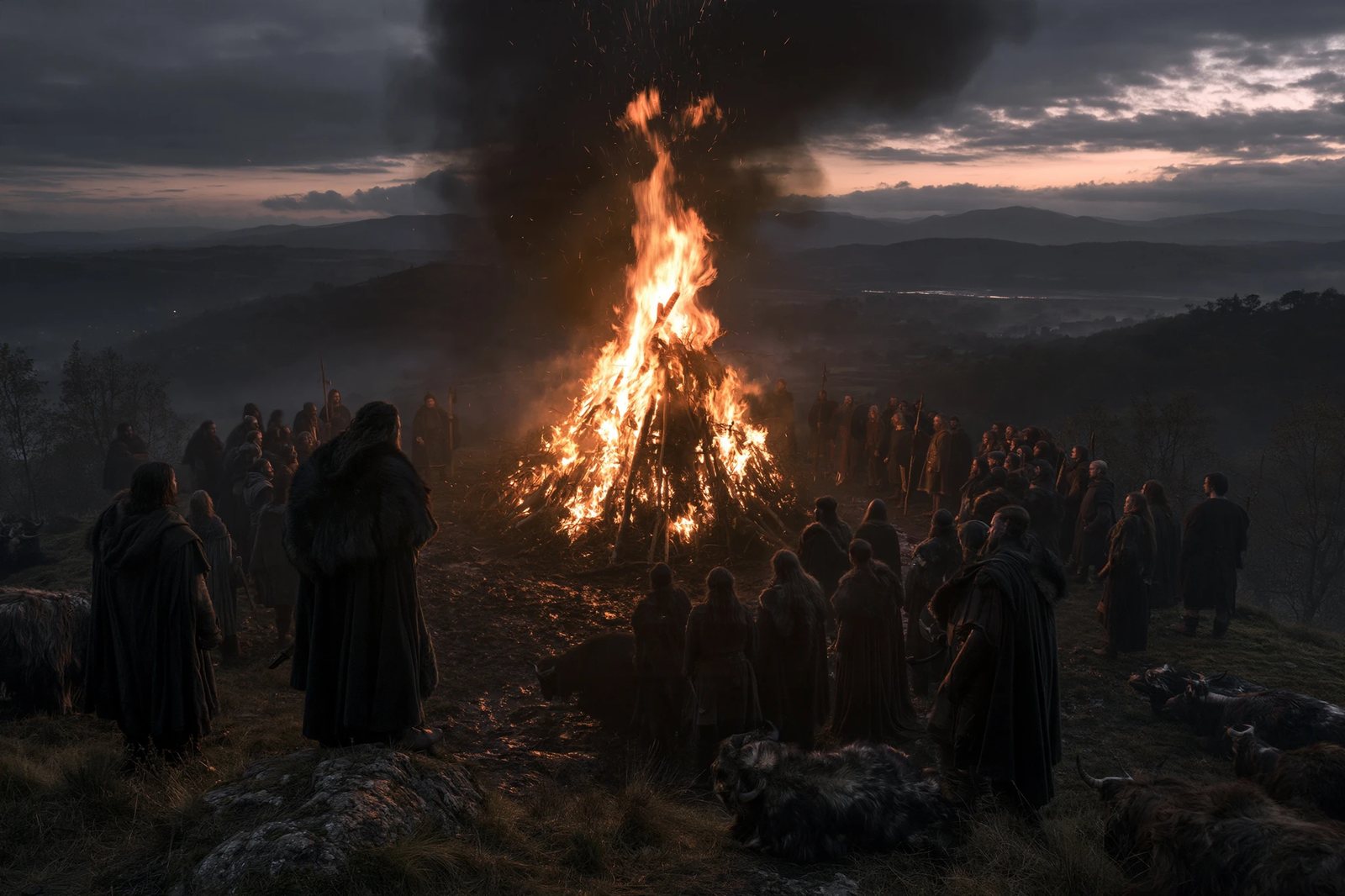
Samhain (Irish, pronounced roughly "sow-in") marked among the Celts the beginning of the winter half of the year – early November. It was the most important of the four great Celtic festivals and counted as the turn of the year: the end of harvest time and the beginning of the dark half of the year.
"Wits must he have who wanders wide, but all is easy at home."Hávamál 5, after Henry A. Bellows 1923 (public domain)
Samhain (1 November) was the most important festival of the Celtic year – the transition from the bright to the dark half of the year, the end of harvest and the beginning of winter. For the Celts the new year began here, so to speak.
On the night of Samhain the boundary to the otherworld was regarded as especially permeable. Spirits, ancestors and beings from the world beyond could come across. People lit fires, made offerings and protected themselves from uncanny visitors.
Through the Christian reinterpretation as All Saints' (1 November) and All Souls', Samhain lives on to this day – above all in Irish-influenced Halloween. Today's pumpkin has its root in the hollowed-out turnips of the old customs.
Samhain stands at the beginning of the dark half of the year, as Beltane at the beginning of the bright. Both festivals frame the Celtic year and show a people that lived in the rhythm of light and dark.
Samhain is the dark threshold of the Celtic year – a festival of the ancestors that echoes into our Halloween. Related is the Germanic idea of the Rough Nights. More in the overview Celtic Religion.
Celtic Religion · Belenus · Brigid · Lugh · The Rauhnächte & Mother's Night.
All Festivals & Belief articles →
Emperor Barbarossa sits in the Kyffhäuser, his head propped on the table, his beard grown through the stone slab …
Read more →The summer solstice is the longest day of the year – and was one of the great feasts of pagan Europe. Germanic peoples …
Read more →