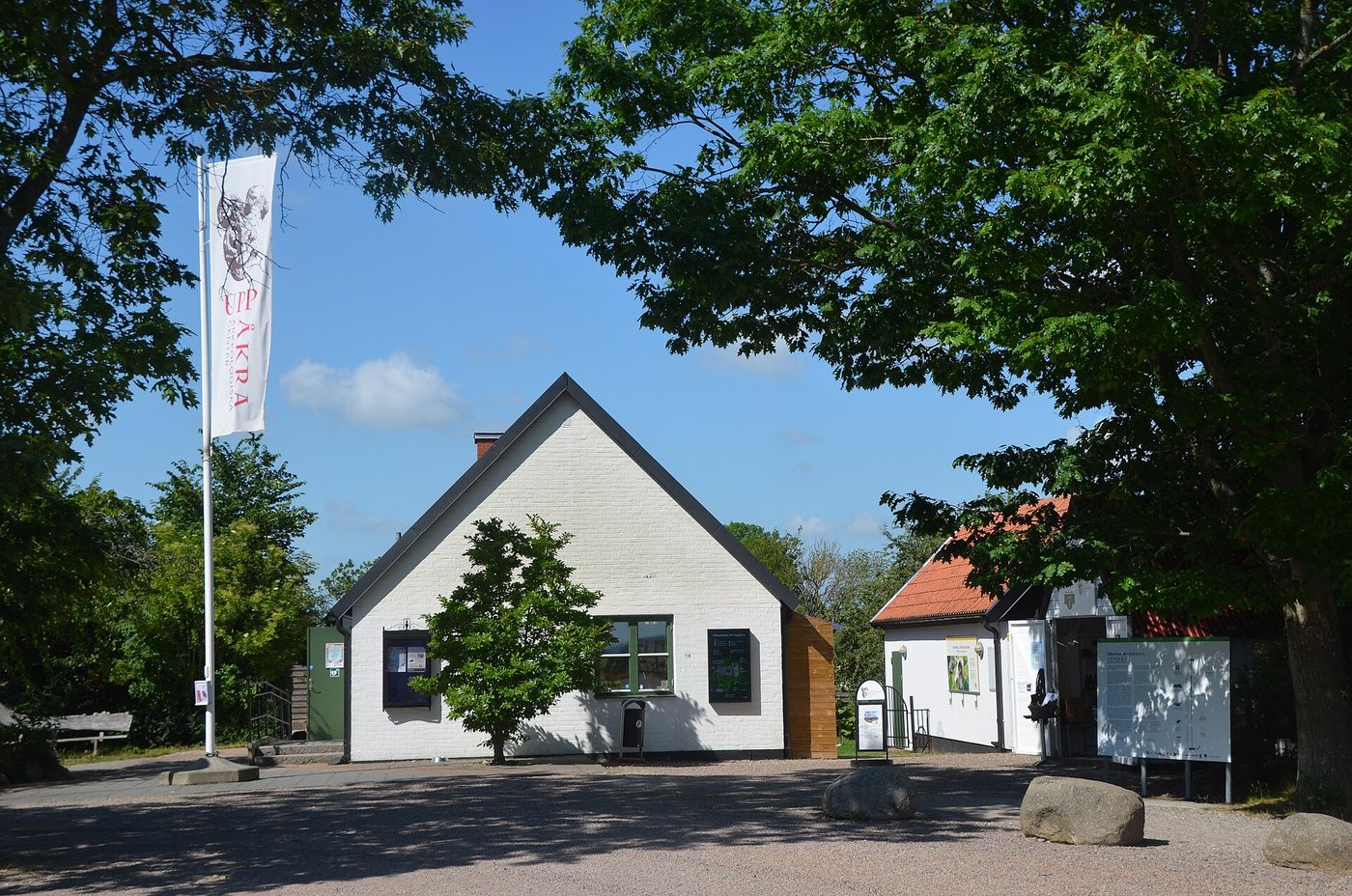
Uppåkra is an archaeological site about five kilometres south of Lund in Scania, southern Sweden, where one of Scandinavia's richest settlements stood from roughly 100 BC until shortly before AD 1000 – complete with a small cult house that was rebuilt on exactly the same spot for centuries. No chronicle, saga or king ever names it. Everything we know comes out of the soil: around 30,000 registered finds, gold-foil figures, a gilded beaker, hundreds of deliberately bent spears. Here is what is solid, and where interpretation takes over.
Most of the places we write about in this series we meet first in books. With Uppåkra it works the other way round. No chronicle, no saga, no runestone names the place in its heyday. Everything we know was brought up by plough, metal detector and trowel. That makes Uppåkra a lesson in method: you see very clearly how much archaeology can tell you – and exactly where it falls silent.
Uppåkra lies in Scania (Swedish Skåne), at the southern tip of modern Sweden, in the municipality of Staffanstorp. Today you will find a village church among flat, fertile fields, about six kilometres from the Øresund. To understand the Viking Age, though, you need a different map in your head: Scania belonged to Denmark throughout the Middle Ages and stayed Danish until the Treaty of Roskilde in 1658.
For the years around 890 we even have a contemporary witness. The seafarer Wulfstan, whose account was added at King Alfred's court to the Old English version of Orosius, sailed east from Hedeby and listed the lands that lay to port, on his left:
… on bæcbord him wæs Langaland and Læland and Falster and Sconeg; and þas land eall hyrað to Denemearcan.
"… to port he had Langeland and Lolland and Falster and Scania; and these lands all belong to Denmark."Old English Orosius, account of Wulfstan; our own translation
Blekinge, Öland and Gotland, Wulfstan adds, belonged to the Swedes. How firm that "belonging" was in 890 we cannot say. But it is a useful warning: when people talk about "Swedish Vikings", Scania should not simply be counted in. Why the old split into Danes, Swedes and Norwegians is rougher than it looks, we explain in Danes, Swedes, Norwegians.
Uppåkra is often filed under "Viking site". That is true only of its final chapter. Most of its story belongs to the Iron Age, centuries before the first longship reached Lindisfarne. So that the dates in this article don't blur together, here are the periods as Scandinavian archaeology usually divides them. The boundaries are scholarly conventions, not anniversaries anyone celebrated at the time.
So when we talk about "the cult house" in a moment, we mean a building that is mostly Iron Age. What people did inside it should not be equated with what Snorri Sturluson wrote about pagan feasts in the 13th century. A full thousand years separate the first posts at Uppåkra from Snorri's writing desk.
That something unusual lay here has been known since 1934. When a farm building went up near the church, workers hit settlement remains, and archaeologist Bror Magnus Vifot carried out the first excavation. At about the same time Olof Arrhenius was mapping soil phosphate across Scania. Phosphate builds up wherever people and livestock live for a long time, where rubbish, dung and bones go into the ground. The fields around Uppåkra church gave some of the highest readings in the whole province. Even so, very little happened for decades.
The breakthrough came in the 1990s. Early metal-detector surveys showed that the plough was dragging finds out of the occupation layers every year – and destroying them in the process. From 1996 Lund University ran a large research programme, led by Lars Larsson and Birgitta Hårdh. Systematic detecting turned up material in quantities nobody had expected.
The figures you will read vary depending on what is counted, and when. Earlier summaries mention some 20,000 metal-detector finds; later ones speak of more than 28,000, and now of around 30,000 registered finds from detecting, excavation and surface survey combined. The settlement covers at least 40 hectares, and the occupation layers are up to about two metres thick in places. Less than one per cent has been excavated. That makes Uppåkra the largest known prehistoric settlement in southern Sweden.
What really stands out is the duration. Most Iron Age villages in Scandinavia "wandered", shifting a little every few generations as posts rotted and soils tired. Uppåkra stayed put for more than a thousand years. That is why researchers call it a "central place": somewhere power, craft, trade and cult were concentrated, generation after generation.
Between 2000 and 2004 a team led by Lars Larsson excavated a building at the centre of the site that did not fit the pattern. Iron Age homes were longhouses: long, often 30 metres or more, with living quarters and byre under one roof. This one was small – about 13 metres long and just over six metres wide. Measurements differ slightly by phase and method; some summaries give roughly 15 by 7 metres.
What it lacked in length it apparently made up in height. Four massive central posts, at least 70 centimetres thick to judge by their stone packing, stood in pits more than two metres deep, and the corner posts were deeply set too. The walls were vertical oak planks set in a trench – a stave technique later familiar from the first timber churches. Three doors led in, two on the south side and one on the north.
How tall it was nobody knows. Reconstructions with and without a tower above the central posts both fit the evidence.
The most remarkable thing is its longevity. According to Larsson the first version was built in the 3rd century, in the Roman Iron Age. It was then rebuilt several times – six or seven, depending on how you count – always in the same spot and to almost the same plan. The last version dates to the early Viking Age. Unlike the great halls next to it, the cult house shows no trace of fire in the analyses published so far. For timber buildings that normally rotted within a generation or two and were rebuilt elsewhere, this loyalty to one spot is exceptional. Something tied this building to exactly this patch of ground.
Close to the hearth inside, the excavators found two vessels you would never expect in a farmhouse: a funnel-shaped beaker of bronze and silver, about 20 centimetres tall, with bands of gold foil showing humans, snakes and horses; and a two-coloured glass bowl that probably came from the region north of the Black Sea. Both are dated to around AD 500, the Migration Period. Shards of about ten further glass vessels came with them.
Whoever owned such things was part of a network reaching the edge of the classical world. Glass in the North was a luxury that nearly always came from far away. The beaker and bowl are now in the Historical Museum at Lund University.
There were also two large iron door rings, one of them from the fill of a posthole. Later tradition knows rings at cult buildings as oath rings; whether a door ring at Uppåkra played that role, no find can prove. More in The oath rings.
The floor layers also held brooches, beads, potsherds and small pieces of gold, layer upon layer. That suggests things were placed here again and again over a long time – and that gold was being worked nearby.
The best-known finds are the gold-foil figures, known in Swedish as guldgubbar, "little gold men": paper-thin sheets of gold the size of a fingernail, stamped with human figures. Some show a single man, fewer a woman, and some a couple facing or embracing each other.
Uppåkra produced them in large numbers, most from the wall trenches and postholes of the cult house. The totals given differ: a 2025 report from Lund University speaks of around 120, while other summaries give about 180 or nearly 200, depending on whether fragments and finds outside the house are counted. What is not disputed is that it is the largest concentration in Sweden. Only Sorte Muld on Bornholm has produced more, and some Uppåkra pieces were struck with the very same dies as examples from there.
The Uppåkra foils mostly date to the late 6th and 7th centuries, the Vendel Period. In 2025, X-ray analysis at the MAX IV facility in Lund showed that some are not pure gold but electrum, a gold–silver alloy. The researchers suspect that Uppåkra's lords had only limited access to gold – a neat example of laboratory science reopening an old question.
What were they for? The usual view is that they were deposited when the house was built or renewed – perhaps as offerings, perhaps as tokens of alliances or agreements. What the figures depict – gods, ancestors, a bridal couple, a scene from a myth – remains disputed.
North of the cult house the archaeologists found weapons that had been deliberately put out of use. Mostly lance and spearheads – around 300 according to a recent summary – many of them bent or broken, along with shield parts, fragments of swords and helmets and pieces of horse harness. Some lay on layers of stones, together with animal bones and a few human bones. More weapons turned up south of the house.
Most of these deposits date to the Roman Iron Age and the Migration Period, roughly the 3rd to 6th centuries, with isolated weapon finds continuing until around 700. That recalls the great war-booty sacrifices in the Danish bogs, at Illerup and Ejsbøl, which we cover in The army sacrificed in the bog. There, the equipment of whole defeated armies was smashed and sunk.
At Uppåkra the difference is the location: the weapons were not taken out to a remote bog but laid down in the middle of the central place, beside the cult house. That fits a wider shift in Iron Age sacrificial practice, away from bogs in the open landscape and towards the halls of the powerful. That these were offerings of war booty is a reasonable reading, not a proven one.
The cult house did not stand alone. Around it lay great halls, built in the Migration Period and rebuilt again and again into the Viking Age; the largest was at least 40 metres long. Some burned down, and in one 5th-century hall three people were found who died in the fire. Whether that was accident or attack, the evidence does not say clearly.
Workshop debris, moulds and half-finished pieces show that bronze, silver and gold were worked here; by the Merovingian Period at the latest, smiths seem to have been permanently on site. Coins from much of Europe and parts of Asia show how far the connections reached.
Since 2022 a Lund University project led by Mats Roslund and Torbjörn Ahlström has been re-examining the great hall. Some of the figures in this article may well be out of date in a few years. At Uppåkra, that is simply normal.
Among the latest finds is a piece often called a brooch. Strictly, it is an openwork mount of copper alloy, gilded all over, 7.5 centimetres long and a little over 50 grams in weight. It was found in September 2011 by the gable of the youngest hall, apparently placed on purpose in a layer of fire-cracked stones. Three iron rivets sit on the back, but there are no signs of wear – it was probably never fitted to anything. Its ring-chain ornament in the Borre style places it around 950–1000, in the site's late phase.
It shows a human figure with feathered wings and a bird's tail. The idea that this is Wayland (Völundr) the smith came up during the excavation itself; archaeologist Michaela Helmbrecht published the piece in Fornvännen in 2012 and set out the case. In the eddic Völundarkviða the lamed smith escapes into the air after taking revenge on King Níðuðr; in the later Þiðreks saga his brother Egil shoots an arrow that strikes a bladder of blood under Völund's arm.
We find the reading persuasive, but it remains a reading. Norse tradition has more than one winged or shape-shifting figure, and the mount carries no inscription. Even so, the historian of religion Torun Zachrisson pointed out in 2017 how well a smith myth suits a place where gold and bronze had been worked for centuries.
Writing in Antiquity in 2007, Larsson called the small building the first in Scandinavia that can justly be called a "temple". That was a deliberate provocation, because it touches one of the great questions in the history of religion: did pre-Christian Scandinavians have dedicated cult buildings at all?
The written sources don't make it easy. Old Norse has words such as hof and hörgr. A hörgr was probably first a cairn or open-air altar; a hof in the sagas is a building where sacrificial feasts took place. But the sagas were written down in the 13th century by Christian Icelanders, who could easily picture pagan "temples" on the model of their own churches. More on this in Blót sites: hörgr, hof and cult hall.
The most famous description comes from Adam of Bremen, who wrote about the temple at Uppsala around 1075 – without ever having seen it:
In hoc templo, quod totum ex auro paratum est, statuas trium deorum veneratur populus …
"In this temple, which is entirely adorned with gold, the people worship the statues of three gods …"Adam of Bremen, Gesta Hammaburgensis ecclesiae pontificum IV, 26; our own translation
Adam puts Thor in the middle, flanked by Wodan and Fricco – usually taken to be Freyr – and describes a great sacrificial festival every nine years. In 1966 the Danish archaeologist Olaf Olsen reached a sober conclusion in his study Hørg, hov og kirke: separate temples could not be demonstrated archaeologically, and cult had taken place in the halls of wealthy farmers and chieftains. For decades that was the textbook view.
Uppåkra moved the debate without settling it. The small house is not a free-standing temple in a sacred landscape but part of an elite residence, set among halls and workshops – in that sense it supports Olsen's core idea that cult and power went together. At the same time it shows that a separate building, not used for living, could stand beside the hall. Comparisons with Old Uppsala and with Gudme on Funen are obvious and instructive. But Adam's gleaming golden temple should not simply be laid over Uppåkra's postholes: it is centuries later and describes a different place.
The question is obvious: if this was a cult building, which festivals took place in it? The honest answer is that we do not know. No find gives a date or the name of a feast. What the written sources say about blót, Yule or the Winter Nights comes from much later, mostly from Norway and Iceland. We have sorted out what holds up in Germanic festivals and pagan holidays.
What archaeology shows is more modest but concrete. West of the house lay fire-cracked stones, animal bones and a paved area – traces of fire and meals. A gilded beaker and a glass bowl are drinking vessels, not tools. Together with the weapons and gold foils, this points to communal meals, drink offerings and deposits in a very exclusive setting. Who was invited, and to which god they raised their cups, remains open.
How Uppåkra was ruled is unknown too. A place this rich implies an elite, perhaps a ruler who controlled part of Scania from here. No find gives a name, a title or a realm. Nor can a direct line be drawn to peoples of older tradition, such as the Geats or the Danes of the Beowulf world.
Shortly before the year 1000, Uppåkra's time as a central place comes to an end. At almost the same moment, Lund appears five kilometres to the north. Its earliest structures are dated by dendrochronology – tree rings in the building timber – to around 990; some accounts place the beginnings around 980. Lund quickly became the most important town in eastern Denmark, with a mint and many churches, and from 1103/04 the seat of the first archbishop for all of Scandinavia.
It is tempting to see a transfer: the role of the old, pagan-tinged central place passes to a new Christian town under royal control. Many researchers see it that way, although how direct the handover was remains open. Lund's foundation is often linked to Sweyn Forkbeard; that cannot be proven. Uppåkra itself lived on as a village with a church and, according to the Danish national encyclopaedia, appears among the royal properties in Canute the Holy's deed of gift to Lund Cathedral in 1085.
If you expect walls or reconstructed halls, you are in for a surprise: Uppåkra is above all a field. The Uppåkra Archaeological Centre at Stora Uppåkravägen 101 near Staffanstorp offers guided tours with archaeologists (tickets online), as well as footpaths with information boards, an audio-guide app in Swedish and English and a 1:3 scale model of the cult house. Opening times vary with the season.
The finest finds, including the beaker and the glass bowl, are on show at the Historical Museum of Lund University. Field in the morning, museum in the afternoon – and you will see for yourself how close the old and the new central place lie to each other.
Archaeologically established: the settlement from about 100 BC to shortly before 1000; the repeatedly rebuilt cult house with beaker, glass bowl and gold-foil figures; the destroyed weapons; the halls; precious-metal working; the winged mount.
Contemporary written evidence: only the wider setting – Wulfstan counts Scania as Danish around 890. No source from Uppåkra's heyday names the place.
Later tradition: Adam of Bremen writes about Uppsala around 1075, not Scania. Völund's flight and Freyr's wooing survive in 13th-century manuscripts.
Modern interpretation: the label "temple", the meaning of the gold foils, Völund as the winged figure, a ruler of Uppåkra, and the shift of central functions to Lund.
What remains is a place that mattered for a thousand years and that nobody wrote about – and a small house that people kept rebuilding on the same spot, because that is where it belonged.
Where is Uppåkra? In Scania in southern Sweden, in Staffanstorp municipality, about five kilometres south of Lund. In the Viking Age Scania was part of Denmark.
How old is Uppåkra? The settlement began around 100 BC and ended as a central place shortly before AD 1000. Most of its history therefore belongs to the Iron Age; only the last phase falls in the Viking Age.
Was the Uppåkra cult house a temple? Its excavator, Lars Larsson, calls it one; others prefer "cult house" or "ceremonial building". Nobody disputes that it was not a dwelling and that it was rebuilt on the same spot for centuries.
How many finds have been made at Uppåkra? Depending on the count, over 20,000 metal-detector finds and now around 30,000 registered finds in total – yet less than one per cent of the site has been excavated.
What is the connection between Uppåkra and Lund? Lund was founded around 990 a few kilometres to the north, just as Uppåkra lost its role. Most researchers see Lund as the successor of the old central place.
Can you visit Uppåkra? Yes. The archaeological centre offers guided tours, footpaths and a model of the cult house; the key finds are in the Historical Museum in Lund.
For courage. For remembrance. For legends that live on.
Danes, Swedes, Norwegians · Uppsala · The Geats · The Gotlanders · The silver figurine from Lejre · The People of Vestfold.
All History & Finds articles →
No place stands more for the pagan cult of the North than Gamla Uppsala: the golden temple, the great sacrifice every …
Read more →