Few stones carry as many stories as amethyst: it is said to guard against drunkenness, to teach bishops humility, and even today to help you sleep. We genuinely love the violet glow of this quartz – which is exactly why we separate, cleanly, what is mineralogy, what is old legend and what is modern esotericism. Because a beautiful stone needs no miracle tales to be beautiful.
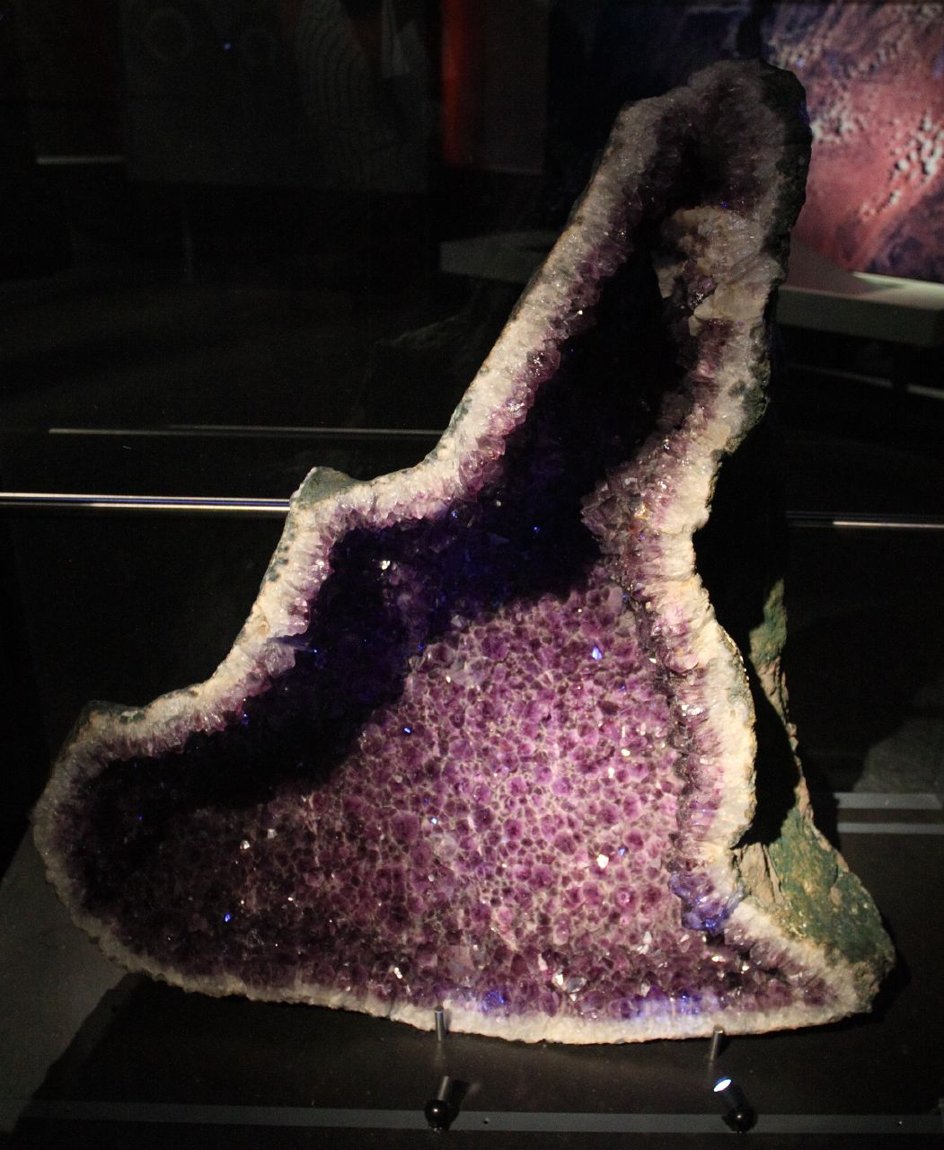
Amethyst is not some exotic rarity but simply the violet variety of quartz – chemically silicon dioxide, SiO₂, the same base material as ordinary rock crystal or the sand on a beach. Quartz crystallises in the trigonal system, has a glassy lustre, a conchoidal fracture and a white streak. The only thing that sets amethyst apart from colourless rock crystal is its colour: a violet that can range from gentle lilac through a reddish hue to a deep, almost black-purple tone. In many specimens the colour sits only in the tips of the crystals while the rest stays milky white – a typical mark of how the crystal grew.
Amethyst forms where silica-rich solutions seep into cavities in rock and slowly crystallise over enormous stretches of time. This happens most impressively in volcanic rock: within old basalt flows, geodes and druses grow that can stand taller than a person, their interiors lined all over with violet crystals. Intriguingly, this crystallisation does not always require searing heat – in cooled lava flows amethyst geodes can form at surprisingly low temperatures, over thousands of years, long after the rock itself had gone cold.
The colour of amethyst is a neat little mineralogical puzzle. It is caused by tiny amounts of iron built into the crystal lattice of the quartz, taking the place of individual silicon atoms. On its own, iron does not yet turn the quartz violet. Only when natural radiation from the surrounding rock is added does the charge state of the iron change, creating what is called a colour centre – one that absorbs exactly those parts of the light our eye then reads as violet. Think of it as a finely tuned filter that only comes into focus through the interplay of trace element and radiation.
This knowledge also explains a few of the stone's quirks. Heat amethyst strongly and the colour centre collapses, and the stone shifts to yellow or orange-brown – this is how much of the citrine on the market is produced, being essentially heated amethyst. Where a crystal grows violet and yellow zones side by side, the result is called ametrine. The greenish variety prasiolite is usually produced by heating certain amethysts as well. And because the colour centre is light-sensitive, intensely violet amethyst can indeed fade a little after years of strong sunlight. That is no cause for alarm, but a good reason not to leave the stone permanently in a bright shop window.
As a quartz, amethyst reaches a value of 7 on the Mohs scale of hardness. That is considerably harder than window glass or a steel knife and makes it robust enough for daily use in a ring, a pendant or an earring. It is not entirely carefree, though: against topaz, sapphire or diamond it comes off worse, and a hard knock on an edge can chip it because of the conchoidal fracture. For care, lukewarm water with a little mild soap and a soft cloth is enough; harsh cleaners, ultrasonic baths for cracked stones and, again, permanent sunlight are best avoided. That way the violet stays strong for decades.
Few stones carry their legend in their very name. "Amethyst" comes from ancient Greek: améthystos, made up of the negating prefix a- (like our "un-") and méthy, the word for intoxicating drink, for wine. Literally, then, the stone means something like "not intoxicated" or "sober". Behind it lies an ancient superstition: whoever carried amethyst or drank from an amethyst cup was supposed to stay sober. The reason is more obvious than one might think – and it has nothing to do with a mysterious power, but simply with the colour. Diluted wine shimmers in a reddish-violet not unlike the stone, and where image and meaning line up so neatly, an interpretation is quick to form.
The Roman polymath Pliny the Elder described amethyst in his "Natural History" – and was already wonderfully sceptical back then. He knew the superstition about sobriety perfectly well and placed it exactly where, in his judgement, it belonged: among the charlatans of his day.
The lies of the magicians would have us believe that these stones prevent drunkenness, and that it is from this that they took their name.Pliny, Natural History 37.40 (own translation after a public-domain edition)
This is remarkable twice over. On the one hand it shows that the "anti-intoxication" idea was already regarded as popular superstition in the first century AD, not as serious natural science. On the other, Pliny demonstrates that honest scepticism towards supposed stone powers is no modern invention – a Roman wrote it down almost two thousand years ago. We rather like that sober view, in the fullest sense.
Search today for the "Greek amethyst myth" and you will find almost everywhere the same pretty story: the wine god Dionysus (Bacchus to the Romans) desired a nymph named Amethyste, who refused him. In answer to her prayer, the chaste goddess Artemis (Diana) turned the girl into a pure, white stone to protect her. The remorseful Dionysus then poured wine over the stone – staining it violet forever. A lovely narrative that fits the wine colour and the name perfectly.
Except: it is not an ancient myth. Not a single surviving Greek or Roman source tells this story. It appears only much later – its familiar form goes back to a French Renaissance poet of the sixteenth century, who essentially invented the ancient-sounding tale. Over the centuries it became an "age-old legend" because it sounds so good and was copied again and again. That makes it no worse as a story – but it should be named for what it is: a literary invention of the early modern era, not a myth out of Hellas.
Beyond the superstition, amethyst in antiquity was above all one thing: a sought-after, decorative gemstone. It was worked into beads and pendants, set into rings and cut with astonishing finesse into gems and seals – small engraved stones pressed as personal seals into wax or clay. Roman women and men alike wore it, and its violet came close enough to imperial purple to count as refined. Sources lay in the eastern Mediterranean, in Egypt and beyond; along the trade routes of the empire the stone reached the workshops of the gem cutters.
In the Christian Middle Ages amethyst enjoyed a second career – as an ecclesiastical stone. Its violet was seen as the colour of penance, reflection and mourning, and was linked to the Passion of Christ. The ancient idea of sobriety turned into a spiritual virtue: temperance, self-control, humility. These were exactly the values a cleric was meant to embody, and so amethyst became the favoured stone in the bishop's ring. It adorned rings, crosses and reliquaries, and in the medieval lapidaries – the stone-books that catalogued the virtues and effects of stones – it was known as the "stone of humility". That a stone once meant to guard against drunkenness should become, of all things, the emblem of ecclesiastical restraint is one of the more delightful twists in cultural history.
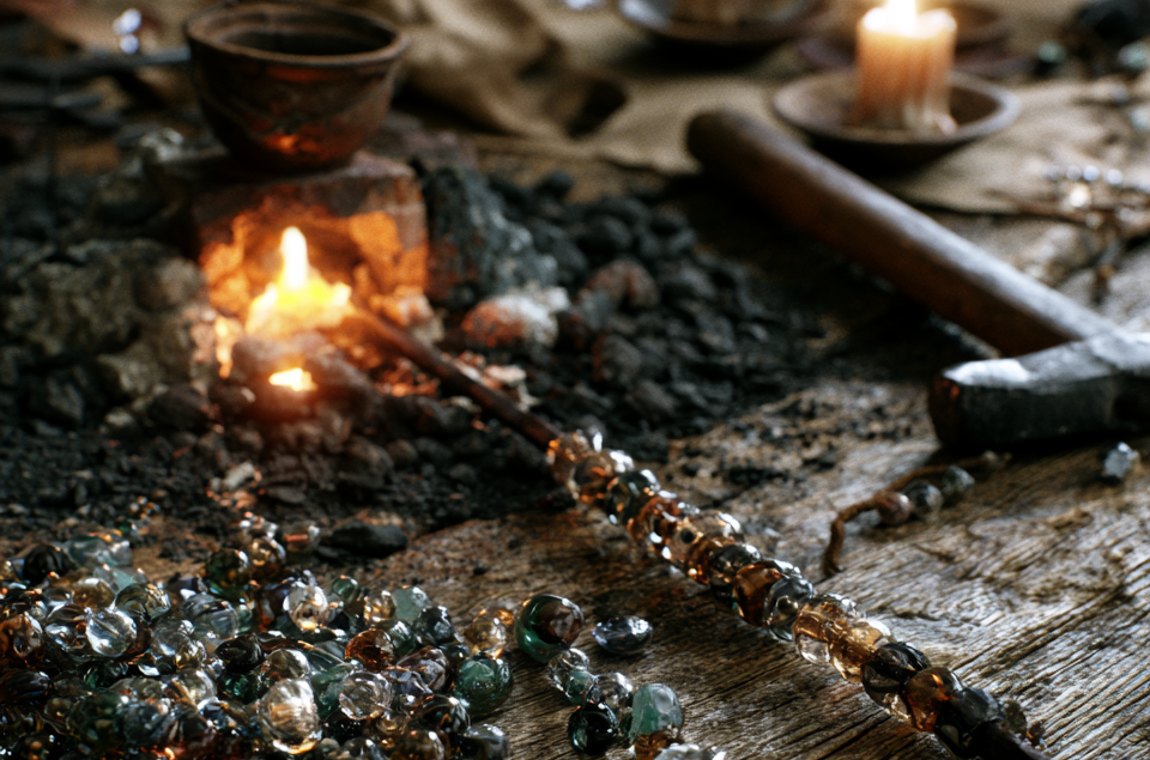
And now we come to the point where, as a workshop steeped in the Norse tradition, we have to be honest: amethyst was not a typical stone of the Viking Age. Look at the beads and settings from trading towns such as Hedeby or Birka and you find mostly other materials – glass beads in every colour, plus imported carnelian (the red-orange chalcedony), rock crystal (colourless quartz), garnet and native amber. These stones travelled the great trade routes into the North, carnelian and rock crystal for instance from the Orient and along the eastern rivers as far as the Volga. Amethyst jewellery was not what a Viking-Age woman typically wore around her neck.
Evidence: In the great Viking-Age trading centres, imported semi-precious beads are dominated by carnelian and rock crystal; Hedeby even imported both as raw material and as finished beads. A frequently cited "amethyst ring" from Birka is in fact made of violet glass with a silver band and an Arabic inscription – coloured glass, not the mineral amethyst. That is why we sell our amethyst as what it is: a beautiful, durable ornamental stone – and do not claim it to be an "authentic Viking motif".
This does not mean violet quartz was entirely unknown in the North – trade carries many things far and wide. But the honest statement is this: amethyst is not part of the core repertoire of Viking-Age gemstones. Anyone wearing a piece in the Norse spirit does so as a present-day interpretation, not as a reconstruction of a grave find. And that is perfectly fine – as long as one knows the difference.
Historically, the violet crystals from the Russian Urals were especially prized; their deep violet, sparkling reddish in artificial light, long set the standard. As long as amethyst came from only a few sources, it was correspondingly expensive and held in high esteem. That changed when the vast deposits of South America were opened up in the nineteenth century. Today the lion's share of the material comes from Brazil and Uruguay, where those impressive geodes lie within old basalt flows; further sources include Zambia, Madagascar and other countries. Germany, too, had small historical deposits, for instance around the agate and gemstone town of Idar-Oberstein, famous for its cutting tradition. Because amethyst is now available in large quantities it has become affordable – happily so, for that takes nothing away from the beauty of the stone.
Because amethyst is plentiful today, the value of a stone is decided not by its rarity but by its quality – and that you can judge quite well with the naked eye. Colour counts most: a rich, even violet is considered especially beautiful, neither too pale nor darkened to near-black, and at best showing fine flashes of red or blue. A stone that is violet only in its tips and otherwise stays milky is appealing as a rough specimen, but less sought-after for a cut gem. To this add clarity – as few visible inclusions as possible – and a clean, symmetrical cut that makes the colour glow rather than hiding it in dull facets.
A word on treatment, because honesty is part of the deal for us: a portion of the amethyst on the market has been heated to even out or lighten the colour – a long-established and stable treatment, but one that should be known and named. Where we know it, we say it. And anyone buying a specimen from us gets an honest answer as to whether it is a naturally grown, a heated or a dyed stone. Because a buyer should know what they are holding.
Now to the most important point, and here we are deliberately clear. Modern esotericism attributes all sorts of things to amethyst: it is supposed to reduce stress, improve sleep, clear the mind, "harmonise energies" and whatever else the list holds. It sounds soothing – but it is not supported by evidence.
Myth-check: The modern notion of amethyst as a "healing" or "energy" stone against stress, sleeplessness or for "good vibrations" is modern esotericism and is not scientifically supported. A stone has no demonstrable healing effect on body or mind. Even the ancient "anti-intoxication" idea rests not on any effect but purely on the colour: diluted wine resembles the violet of the stone – Pliny already called it the superstition of the magicians. So we promise no effect. We sell amethyst as what it is: a beautiful, hard, durable ornamental stone.
This does not embarrass us in the slightest – quite the opposite. A stone that has drawn people to it for thousands of years, that adorned emperors and bishops, and that in a metre-high geode is simply breathtaking to look at, needs no invented healing power. It is allowed simply to be beautiful. Whoever buys an amethyst buys colour, craftsmanship and history – and that is more than enough.
In our workshop you will meet amethyst where its violet comes into its own: in plain settings, combined with natural materials, and wherever a touch of colour gives a piece depth. We choose it by what can genuinely be judged – colour, clarity and clean workmanship – not by promises no stone can keep. Honesty, for us, is not a slogan but the foundation: we tell you where a material comes from, what it is and what it is not. Because only when you work with good products and an open hand does something come out at the end that we can stand behind with our name.
For courage. For remembrance. For legends that live on.
Gemstones in the North · Rock Crystal · Carnelian – the Vikings' red beads.
All Everyday Life & Craft articles →
An entire heroic epic on a single teak panel: rider, ship and figures. Our Atli motif stands in an ancient Norse …
Read more →No animal stood closer to the people of the North and yet remained as alien to them as the bear. It shared their …
Read more →It is glass-clear, harder than almost any other ornamental stone, and it hung around necks and lay in the graves of the …
Read more →A stone that is warm rather than cold, light as wood, honey-gold in the light – and sometimes carrying within it an …
Read more →