Fáfnir was not born a dragon. He was a farmer's son, a smith's brother, a man with a name and a family. What changes him is not a spell from outside but an inheritance: a heap of gold paid as compensation for a slain otter, with a dwarf's curse lying on it. Fáfnir kills his father for it, drives off his brother, lies down on the hoard – and at some point stops being a man. The order matters, and it is the whole point of the story: first the greed, then the scales.
It starts with a family, not a monster. Hreiðmarr has three sons: Fáfnir, Reginn and Otr. Otr goes fishing in otter shape, and that is what kills him – Loki strikes him down with a stone while Odin and Hœnir look on. The gods do not know whom they have killed. Hreiðmarr does.
What follows is the oldest legal procedure of the North in its purest form: weregild. The otter skin is stuffed with gold and covered on the outside until not a hair shows. The whole story of that gold – how Loki catches the dwarf Andvari in pike shape in the waterfall, how Andvari surrenders the ring and curses it, how in the end a single whisker sticks out – we have told separately: Andvari's cursed gold and the otter payment.
For Fáfnir only one sentence matters, the one Andvari sends after his treasure. In substance: this hoard will kill everyone who owns it. In Norse poetry a line like that is not a threat. It is a description of the future.
Hreiðmarr gets his gold – and keeps it. Fáfnir demands his share, does not get it, and kills his father in his sleep. Reginn, the second brother, then demands a share of his own. Fáfnir says no, puts on the ægishjálmr, the "helm of terror", and drives him off. Then he hauls everything to Gnitaheath, lies down on it and stays there.
How the man becomes the worm, the sources do not agree. Völsunga saga simply reports that he turned into a dragon; Snorri mentions the transformation in Skáldskaparmál without explanation either. The poem itself, Fáfnismál, describes a crawling serpent with no wings. The Old Norse word is ormr: worm, snake. He breathes no fire anywhere; he blows venom.
This is not a footnote for textual critics but the core of the figure. The dragon of Norse poetry is an armoured, venomous crawler, not the flying flamethrower of later book illumination. More on that in Dragons and serpents in the Norse world. And Fáfnir is not the only one of his kind: at the root of the world tree lies Níðhöggr, who is made of quite different material.
What the name Fáfnir means cannot be said with any certainty. Several explanations have been offered; none is secure. We leave it open.
Reginn, cheated of his inheritance, becomes smith at the court of King Hjálprekr and fosters a boy there: Sigurðr, the posthumous son of the slain Sigmundr. Reginn forges him a blade, Gramr, from the fragments of Sigmundr's sword – after Sigurðr has smashed two earlier attempts against the anvil. Gramr splits the anvil and slices a tuft of wool drifting against its edge in the river. Only now is the sword good enough.
Reginn's plan is simple: the boy is to kill the brother, the gold is to come back. Sigurðr first avenges his own father, then rides to Gnitaheath.
The advice he gets there comes in two halves. Reginn says: dig a pit on the path to the water and stab upwards. An old bearded man – the texts leave no doubt who that is – says: dig several pits, or you will drown in the blood. Sigurðr listens to both. He stabs upward into the heart as the worm crawls over him.
Here the story turns unusual. Fáfnismál spends not one stanza on the fight – the prose introduction disposes of it in a sentence. The poem begins afterwards, and it consists almost entirely of a conversation between the mortally wounded dragon and his killer.
Sveinn ok sveinn! Hverjum ertu sveini um borinn?
Hverra ertu manna mögr?
"Boy and boy! To what boy were you born? Of what people are you the son?"Fáfnismál, stanza 1; English rendering our own
Sigurðr answers evasively. He calls himself "noble beast" and claims to have neither father nor mother. The reason is in the manuscript's prose: a dying man's curse was held to strike harder if he knew his killer's name. Only afterwards does Sigurðr identify himself.
What follows is not a death struggle but a lesson. Sigurðr asks the worm about the norns and about the plain where the gods will fall – material that otherwise comes from the Völuspá. Fáfnir answers. And then he says the line the whole legend turns on:
Ræð ek þér nú, Sigurðr, en þú ráð nemir
ok ríð heim heðan!
It gjalla gull ok it glóðrauða fé —
þér verða þeir baugar at bana
"I counsel you now, Sigurðr, and take the counsel: ride home from here! The ringing gold and the ember-red wealth – those rings will be your death."Fáfnismál, stanza 20; English rendering our own
The dying creature warns the victor. That is why this scene sits so firmly in Norse verse: Fáfnir is not a monster to be defeated but a witness who turns out to be right.
The rest is well known. Reginn cuts out the heart, drinks the blood and has Sigurðr roast it. Sigurðr burns his thumb, puts it in his mouth – and suddenly understands the birds in the tree. They warn him about Reginn. Sigurðr strikes off his foster-father's head, loads the gold onto his horse Grani and rides on. Where to is in our article on Sigurd and the Völsung legend.
The Fáfnir story is not in one work but in three, and they do not stand on equal footing.
Reginsmál and Fáfnismál are poems in the Codex Regius, the Icelandic manuscript of the 1270s. Both titles are post-medieval; the manuscript itself draws no dividing line here but lets verse and explanatory prose run into each other. Fáfnismál has 44 stanzas in the usual count.
Völsunga saga is prose of the late thirteenth century, surviving in a single medieval manuscript of around 1400. Its author had eddic poems in front of him and worked them into a continuous narrative. That makes it convenient – and risky: where it is fuller than the poems, it is not necessarily older, merely fonder of storytelling.
Snorri Sturluson summarises the material in Skáldskaparmál because he has to explain why skalds call gold "otter payment" or "Fáfnir's bed". For him the story is a tool, not an end in itself.
One gap matters too. The Codex Regius is missing an entire gathering of vellum, eight leaves, in the middle of the Sigurðr cycle. What stood there we know only because Völsunga saga retells it in prose. Without that saga, part of the story would simply be gone.
South of the North Sea the same material runs differently. In the Middle High German Nibelungenlied, written around 1200 in the Danube region, the hero is Sîfrit, and the dragon fight is not a scene but a passing remark. Hagen tells the court at Worms what he has heard about the stranger:
Noch weiz ich an im mêre, daz mir ist bekant.
einen lintrachen den sluoc des heldes hant.
"I know more about him yet, that is known to me: the hero's hand slew a dragon."Nibelungenlied, stanza 100; English rendering our own
Two lines, and on it goes. What matters is the difference in construction: in the Nibelungenlied the dragon has nothing to do with the hoard. Sîfrit wins the Nibelung treasure on a quite separate occasion, in the quarrel of the brothers Schilbung and Nibelung. The dragon supplies only the bath in blood that makes his skin horny – with the famous spot between the shoulders where a linden leaf fell.
In the North, dragon and gold belong together and share one curse. In the German epic they are two separate back-stories. That is not a translation error but a sign that both versions go back to older traditions told in different ways. A third variant is offered by the Norwegian Þiðreks saga of the thirteenth century, which draws on north German sources and mixes the motifs.
Fáfnir is one of the few Norse legends you can look at rather than only read. Looking, however, calls for care.
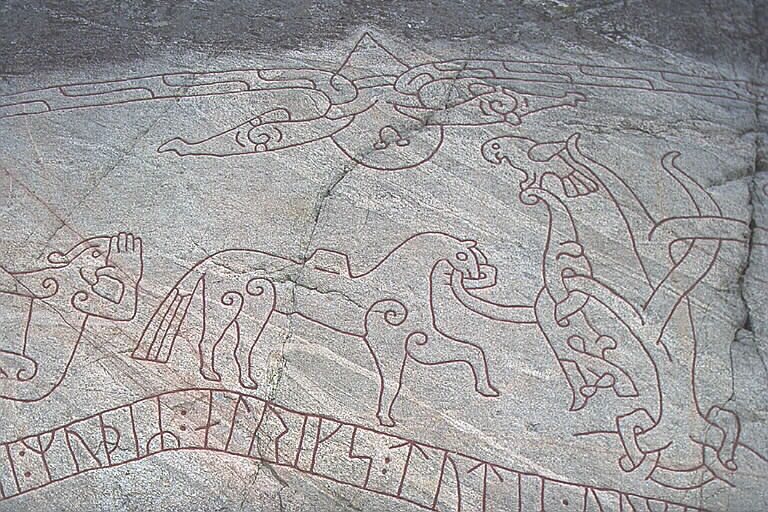
The Ramsund carving in Södermanland, catalogued as Sö 101, is not a standing runestone but a rock carving, made around 1030. The worm's body forms the runic band. Visible are: a man stabbing the worm from below; a man putting a thumb in his mouth in front of a fire with spits; birds in a tree; a laden horse; a headless man beside smith's tools; a four-legged animal usually read as Otr.
That combination – thumb, birds, horse, smith's tools – is why the identification here is unusually secure. It is not a single motif but a whole cluster of them fitting one story. The inscription itself says nothing about any of it: it records that Sigríðr, Alríkr's mother and Ormr's daughter, had this bridge made for the soul of Holmgeirr, father of her husband Sigrøðr. Picture and text belong to different worlds and share the same rock.
The Gök stone (Sö 327) a few kilometres away repeats the same motifs, but jumbled, and adds a Christian cross. Scholars suspect the carver did not understand his model – or rebuilt it deliberately. Neither can be proven.
The Hylestad portal from Setesdal in Norway, carved in the second half of the twelfth century or around the turn of the thirteenth, is the fullest pictorial witness of all. The stave church was pulled down in the seventeenth century; the carved planks later entered the collections in Oslo. In sequence they show: Reginn at the anvil, Sigurðr testing the blade, the thrust from below, the roasting of the heart with the thumb in the mouth, the birds, the beheaded Reginn, Grani with his load, and Gunnarr in the snake pit. A Christian church door with a whole sequence of scenes from a heathen heroic legend – that this was no contradiction is the real message of the portal.
With other stones the reading is thinner. Where only a single motif appears – a man with a raised sword, a serpent, a bird – Fáfnir cannot be proven. Several Scandinavian stones are counted as "Sigurd stones"; for some that is well founded, for others it remains a proposal.
Pictorial evidence for the story begins in the first half of the eleventh century: Ramsund around 1030, the Gök stone somewhat later, Hylestad towards the end of the twelfth century. That is the oldest datable trace of the tale – two centuries before the oldest manuscript.
Manuscript evidence is Reginsmál and Fáfnismál in the Codex Regius of the 1270s, Völsunga saga from the late thirteenth century and Snorri's prose of around 1220. All three are Christian Icelandic records, several centuries younger than the Viking Age.
A separate strand of tradition is the German Nibelungenlied of around 1200 with its quite differently built back-story, plus Þiðreks saga as a hybrid.
Modern interpretation covers the dating of the individual poems, the question of which version is older, the meaning of the name Fáfnir, and every match of image to text where only a single motif survives.
What remains is a story that needs no monster. A brother kills his father, guards his gold until he can no longer walk upright, and warns the man who will be destroyed by it next. Anyone who knows the dwarfs and their curse knows the warning will not help. For courage. For memory. For legends that live on.
Sigurd the dragon-slayer · Dragons of the North · Niðhöggr – the gnawer at the root · The Dwarves · Andvari's cursed gold · Völuspá – the Seeress's Prophecy.