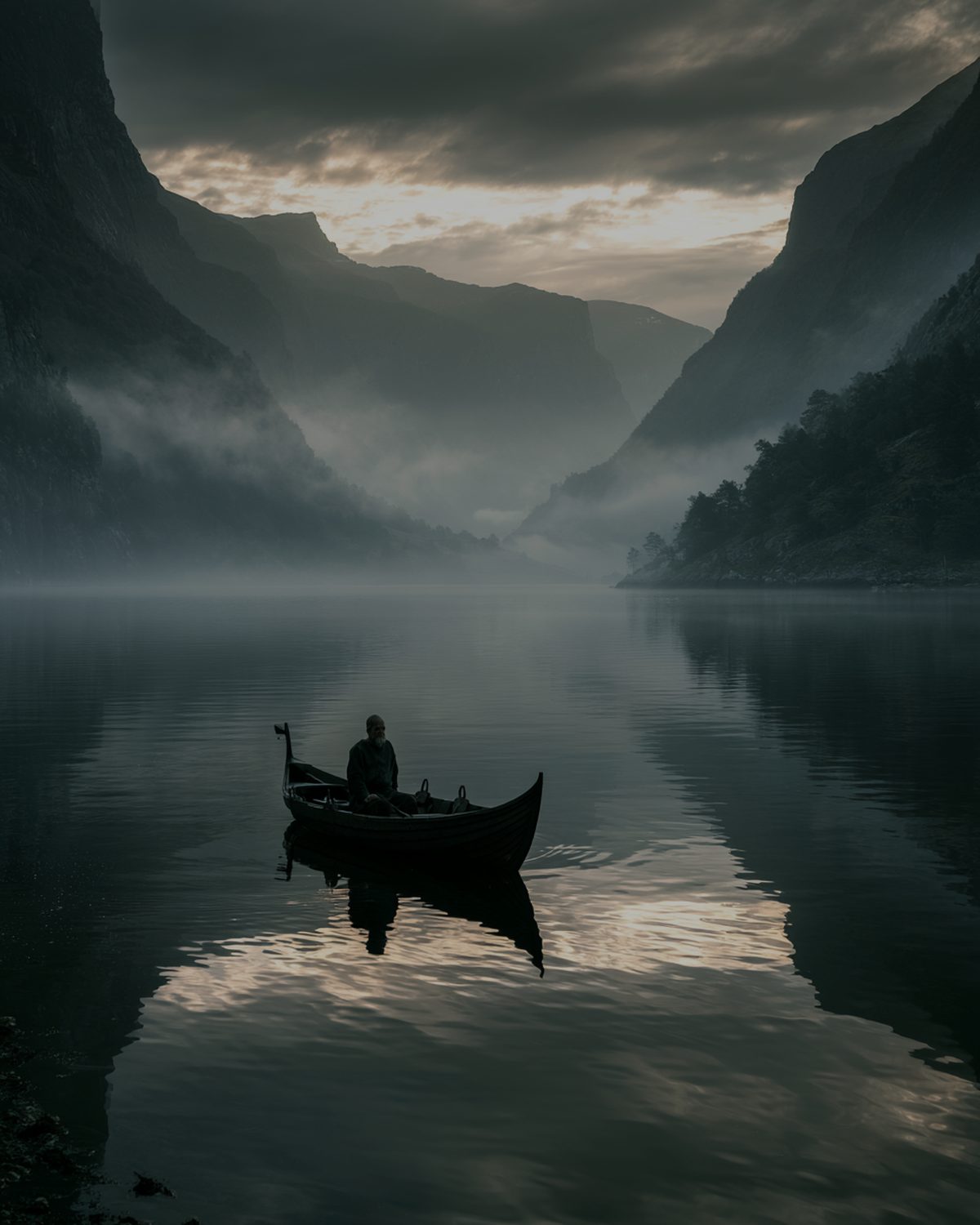
Ginnungagap is the yawning void that existed before the world in Norse mythology: a chasm between icy Niflheim in the north and fiery Muspelheim in the south. Where rime and heat met in its middle, the primeval giant Ymir came into being, and from his body Odin and his brothers later built earth, sea and sky. Here is what Völuspá and Snorri's Gylfaginning actually say, what the puzzling name might mean, and how Ginnungagap ended up as a place name on medieval maps of the North Atlantic.
Most creation stories open with someone doing something. A god speaks, a cosmic egg cracks, a diver brings up mud from the bottom of the sea. The Norse version opens with an absence. No sand, no sea, no earth, no sky. Just a gap, and a name for it that still sounds like wind across empty space: Ginnungagap.
Out of that gap, in the version most people know, comes everything else. Cold flows in from one side, heat from the other, and where they meet the first living being drips into existence. The gods later kill him and build the world from his body. It is a story pieced together from one line of poetry, a few related verses and the prose of a thirteenth-century Icelandic scholar, with a startling echo in ninth-century Bavaria and a strange afterlife on maps of the North Atlantic.
“Of old was the age when Ymir lived; / Sea nor cool waves nor sand there were; / Earth had not been, nor heaven above, / But a yawning gap, and grass nowhere.”Völuspá, stanza 3, translated by Henry Adams Bellows (1923, public domain)
The oldest witness to Ginnungagap is the Völuspá, the “Prophecy of the Seeress”. A völva, a seeress, tells Odin the history of the world from its beginning to its destruction and beyond. In the third stanza she describes the primeval state almost entirely in negatives: no sand, no sea, no cool waves, no earth, no heaven. Only one thing is named in positive terms, in the famous half-line gap var ginnunga, literally something like “gap was of the ginnungs”. Bellows rendered it “a yawning gap”, and noted that the phrase is sometimes treated as a proper name.
The poem survives chiefly in the Codex Regius, an Icelandic manuscript written around 1270 and now kept in Reykjavík. When the poem itself was composed is disputed. Many scholars think of the decades around the year 1000, when Iceland was converting to Christianity, but there is no certainty. Our article on the Edda as a source covers the manuscript tradition in more detail.
Even the first line comes in two versions. The Codex Regius reads Ár var alda, þar er Ymir bygði, “It was the dawn of ages, when Ymir dwelt”. Snorri Sturluson, quoting the same stanza in his Prose Edda, gives þat er ekki var, “when nothing was”. Bellows pointed out the difference in his notes. One reading already places the primeval giant inside the void; the other leaves the beginning truly empty. Nobody can say for certain which is older. Clearly, medieval Icelanders themselves pictured the gap differently.
Around 1220 the Icelandic chieftain, poet and scholar Snorri Sturluson wrote Gylfaginning, “the beguiling of Gylfi”. In it a Swedish king named Gylfi visits the Æsir in disguise and questions three mysterious figures about the nature of the world. When he asks what came first, Snorri unfolds, across chapters 4 to 8 in the usual numbering, a cosmogony (an account of how the world came to be) more systematic than anything else in Old Norse.
First of all, Snorri says, there was a world in the south called Múspell. In Arthur Gilchrist Brodeur's 1916 translation it is “light and hot”, burning and blazing, impassable to anyone who does not belong there. At its border sits Surtr with a flaming sword. We look at that realm of fire in our article on Muspelheim. Many ages before the earth was shaped, Niflheim, the “mist world”, came into being in the north. In its middle lies the spring Hvergelmir, usually glossed as “roaring cauldron”, and from it flow rivers that Snorri names one by one: Svöl, Gunnþrá, Fjörm, Fimbulþul, Slíðr and Hríð, Sylgr and Ylgr, Víð, Leiptr and Gjöll. Together they are the Élivágar, a name usually interpreted as “storm waves” or “ice waves”.
Then the story turns almost into physics. When the Élivágar had flowed so far from their source that the venom in them hardened “like the slag that runs out of the fire”, they turned to ice. Where the ice came to a halt, venom spurted out of it and froze into rime, layer upon layer, filling the northern part of Ginnungagap with heaviness, ice, drizzle and gusts of wind. The southern part was lit by sparks and glowing embers flying out of Muspelheim. And the middle? In Brodeur's words, “Ginnungagap was as mild as windless air”.
So in Snorri's hands Ginnungagap is not a black hole. It is a zone in between: cold pressing in from one side, heat from the other, and in the middle a stillness in which something can happen.
When the breath of heat met the rime, it began to thaw and drip. From those drops, Snorri writes, life was quickened, “by the power of that which sent the heat”. The creature that grew from them had the shape of a man and was called Ymir; the rime giants called him Aurgelmir. Here Snorri explicitly quotes Vafþrúðnismál: venom dropped from the Élivágar and grew until it became a giant.
Ymir, says Snorri, was evil from the start, and so were all his descendants. As he slept, he began to sweat. Under his left arm grew a man and a woman, and one of his feet begot a son with the other. That is how the race of rime giants began.
What did Ymir live on? Snorri has an answer for that too. As the rime dripped, a cow called Auðhumla came into being as well. Four rivers of milk ran from her udders, and they fed Ymir. The cow herself licked the salty blocks of rime. On the first day a man's hair appeared where she licked, on the second day his head, and on the third day the whole man stood there. His name was Búri, and he was handsome, tall and strong.
Búri had a son called Borr (also spelled Burr or Bor), who married Bestla, daughter of the giant Bölþorn. Their three sons were Odin, Vili and Vé. So the gods, remarkably, have a giantess for a mother. The border between gods and giants, drawn so sharply in later myths, is still porous at the beginning of the world.
Auðhumla does not appear in any surviving Eddic poem. She is known only from Snorri, and whether he took her from a lost source or added her himself, we cannot tell.
The sons of Borr killed Ymir. So much blood poured from his wounds that every rime giant drowned in it except one. Bergelmir escaped with his wife on a lúðr, a word usually understood as a boat or a box, although its exact meaning is uncertain. The later giant clans descend from him.
Then the brothers carried Ymir into the middle of Ginnungagap and made the world out of him. In Brodeur's translation, “the land was made of his flesh, and the crags of his bones”, and “of his blood the sea and the waters”. Teeth, jaws and splinters of bone became stones and scree. His skull they raised as the sky over the earth and placed a dwarf at each corner: Norðri, Suðri, Austri and Vestri, north, south, east and west. The embers and sparks that had flown out of Muspelheim they set in the sky as stars. From Ymir's eyebrows they built a wall against the giants, and the enclosed space inside it was called Miðgarðr, Midgard. His brains they threw into the air, and they became the clouds.
And Ginnungagap? At this point it quietly disappears from the story. The void is no longer empty; it is filled with a dead giant who has become the habitable world. How that world grows into the structure of the nine worlds around the world tree Yggdrasil is another story, and one the sources do not tell entirely consistently.
Now for the question that brings most people to this word. The second half is straightforward. Old Norse gap means “opening, chasm, gulf”, related to the verb for gaping open-mouthed, and English gap is its direct descendant. The first half, ginnunga, is the hard part. Grammatically it is a genitive plural, so the phrase means “gap of the ginnungs”. The trouble is that no word ginnungr or ginnung is securely attested outside this expression. That leaves room for several interpretations.
One: the yawning gap. The most common explanation links ginn- to a family of words for yawning and gaping, which also includes German gähnen, “to yawn”. Jan de Vries takes this line in his Old Norse etymological dictionary. Ginnungagap would then be a doubly emphatic emptiness, a “gaping gap”, which is where the familiar translation “yawning void” comes from.
Two: the charged void. Old Norse has a prefix ginn- that turns up in sacred or powerful contexts: ginnheilagr, “most holy”, used of the gods; ginnregin, “the great powers”, again the gods; ginnrúnar, “mighty runes”. Read from this angle, Ginnungagap is not a dead emptiness at all but a space charged with creative, perhaps magical power. This reading is widely cited, and Rudolf Simek discusses it in his dictionary of Northern mythology.
Three: the deceptive void. The verb ginna means “to beguile, to trick, to lure”. It sits right in the title Gylfaginning, the beguiling of Gylfi. Some have therefore seen in Ginnungagap a “deceptive gap”, a space that looks empty but is full of potential. Tempting, since Snorri frames his whole account as a king being deceived. Whether the words really belong together historically is not established.
Four: a loan from the south. The Edda scholar Ursula Dronke suggested the word might be borrowed from Old High German, from something like ginunga. She thought the same of Múspell, which has a counterpart in the ninth-century Old High German poem Muspilli. Dronke also pointed to the Norwegian skald Þjóðólfr of Hvinir, who plays on the phrase ginnunga vé in his poem Haustlǫng. If that reading holds, the word was already current in poetry long before Snorri, apparently outside the creation story as well.
Read the third stanza of Völuspá, then glance at early German literature, and you run into a remarkable echo. In a Latin miscellany manuscript now in the Bavarian State Library in Munich (Clm 22053), named after the monastery of Wessobrunn from which it came, there is a short poem. It was probably composed around 790 or soon after, and the surviving copy is dated to about 814. It begins like this:
“Dat gafregin ih mit firahim firiuuizzo meista, / dat ero ni uuas noh ufhimil, / noh paum noh pereg ni uuas …”Wessobrunn Prayer, lines 1–3 (Old High German, early 9th century, public domain)
Roughly: “This I learned among men as the greatest of wonders: that there was no earth nor heaven above, nor tree nor mountain.” The poem goes on to say that there was no star, no sun shone, no moon gave light and there was no sea. Only then does it turn to the almighty God who existed before everything.
The parallels are hard to miss. Both texts describe the primeval state through a chain of negatives: no earth, no heaven, no sea. And Old High German ufhimil corresponds word for word to the upphiminn of Völuspá, both meaning “heaven above”. One small detail makes the manuscript a treat for rune enthusiasts: the syllable ga in gafregin is written with a sign that looks like the rune gebo (ᚷ) and serves as an abbreviation.
What does the resemblance mean? Opinions differ. One view sees the remains of a shared Germanic poetic formula for the beginning of the world, surviving both in Christian Bavaria around 800 and in the North. The other stresses that the Wessobrunn Prayer is unmistakably Christian: at its beginning stands God, who creates the world from nothing, and that is precisely what distinguishes it from Völuspá, where there is no creator before the void. Then again, an old formula can carry new content. What is firmly established is the linguistic and stylistic closeness, not a shared pagan myth behind it.
Snorri's account is so elegantly symmetrical that scholars have long asked how much of it comes from pagan tradition and how much from Snorri's own learning. He was one of the best-educated Icelanders of his day. He knew the Latin scholarship of his era, and the prologue to the Prose Edda explains the pagan gods, in good medieval fashion, as deified humans descended from Troy.
Several points suggest learned influence. Placing the cold and wet in the north and the hot and dry in the south recalls medieval teaching on the elements and climate zones. Greek cosmology knows a primordial entity called Chaos, a word that originally meant something like “gaping space” and is related to the Greek verb for yawning; in Hesiod, Chaos comes first of all. And Snorri's phrase that life was quickened “by the power of that which sent the heat” strikes many readers as a veiled creator of the kind a Christian author would assume. The Norwegian scholar Anne Holtsmark drew particular attention to such learned and Christian elements in Snorri's mythology in the 1960s.
On the other side: the basic building blocks are older than Snorri. The gap is in Völuspá, the venom drops of the Élivágar and the giant's body as building material are in Vafþrúðnismál, and the word ginnunga may already appear in a skald's verse around 900. Snorri did not invent; he arranged, supplemented and harmonised. Exactly how much he added cannot be measured. The core is old; the tidy map of north, south and middle is at least partly learned thirteenth-century systematics.
Now things get curious. In the late Middle Ages the name migrated from myth into geography. When Icelanders thought about the sea to the west, about Greenland and the Vinland described in the sagas, they reached for the old word for the primeval gulf to label the unknown ocean at the edge of the world.
The clearest witness is a geographical text known as Gripla, which the Icelandic scholar Björn Jónsson of Skarðsá included in his seventeenth-century collection on Greenland. In the 1906 English translation it reads: “between Vinland and Greenland is Ginnungagap, which flows from the sea called Mare oceanum, and surrounds the whole earth”. The text is generally regarded as late medieval, though precise dating is difficult. The Danish antiquarian Carl Christian Rafn printed it in 1837 in his Antiquitates Americanae.
A trail also leads to Bremen. Adam of Bremen, writing around 1075, was the first author anywhere to mention Vinland (book IV, chapter 39) and went on to tell of Frisian seafarers who sailed north into a dark ocean and were nearly dragged into an abyss. Adam himself never uses the name Ginnungagap. A marginal note, a so-called scholion, in a later manuscript of his work is reported to give the Norse word “Ghimmendegop” for this northern abyss. We rely on secondary literature for this and have not seen the manuscript ourselves.
The name was still in use around 1600. The Icelandic bishop Guðbrandur Þorláksson, famous for his Bible translation and his map of Iceland, used “Ginnungegap” for a narrow strait between southern Greenland and the land to the west, which the historian Kirsten Seaver identifies as probably today's Davis Strait. The void before creation had become a stretch of water you could sail through.
Search for Ginnungagap today and you quickly hit comparisons with the Big Bang. The appeal is obvious: first nothing, then energy, cooling, matter.
A different thought is closer to home. The Prose Edda was written down on an island where glaciers and volcanoes sit side by side. Whether that landscape actually shaped Snorri's picture of fire and ice cannot be proven, and parts of the core imagery may be older than the settlement of Iceland. Still, the idea fits.
In our workshop, Ginnungagap has an almost practical side. Every engraving starts with an empty surface, a piece of slate, a pane of glass, a freshly sanded slice of wood, waiting for the first line. If you would like a motif around Ymir, the nine worlds or the Völuspá stanza itself on slate, get in touch through our custom engraving page.
Ginnungagap is not a place you can travel to, even if medieval scholars believed for a while that you could. It is the idea that an open space stands before all becoming, and that opposites, when they touch, bring forth something new.
What does Ginnungagap mean? Literally something like “gap of the ginnungs”. It is usually translated “yawning gap” or “yawning void”; another reading takes the first element as pointing to a sacred or magically charged void.
Where is Ginnungagap in Norse mythology? According to Snorri, between icy Niflheim in the north and fiery Muspelheim in the south. Its middle was as mild as windless air, and there the primeval giant Ymir arose from melting rime.
How was the world created in Norse mythology? Odin, Vili and Vé killed the giant Ymir, carried him into the middle of Ginnungagap and made the earth from his flesh, the sea from his blood, the rocks from his bones and the sky from his skull.
Which sources mention Ginnungagap? Explicitly stanza 3 of Völuspá (“gap var ginnunga”) and, in detail, Snorri's Gylfaginning, chapters 4 to 8. Vafþrúðnismál supplies further details about Ymir and the Élivágar.
Was Ginnungagap a real place? Not the mythical void, but late medieval Icelandic texts and maps from around 1600 used the name for the sea between Greenland and North America.
For courage. For remembrance. For legends that live on.
Ymir & the making of the world · Yggdrasil, the world tree · The Norse pantheon · Ragnarök · What comes after? · The Edda as a source.
Neither iron nor chains tamed the mightiest monster of the North, but a ribbon thin and soft as a silken thread …
Read more →A king has gold and peace ground for him – and grants the maids who turn the mill no rest. Grottasöngr is one of the …
Read more →A boar whose bristles are gold and glow in the dark, running over sky and water faster than any horse: Gullinbursti …
Read more →Thor has his hammer, Freyr his ship – and Odin has the spear. Gungnir is the weapon of the All-Father: forged by …
Read more →