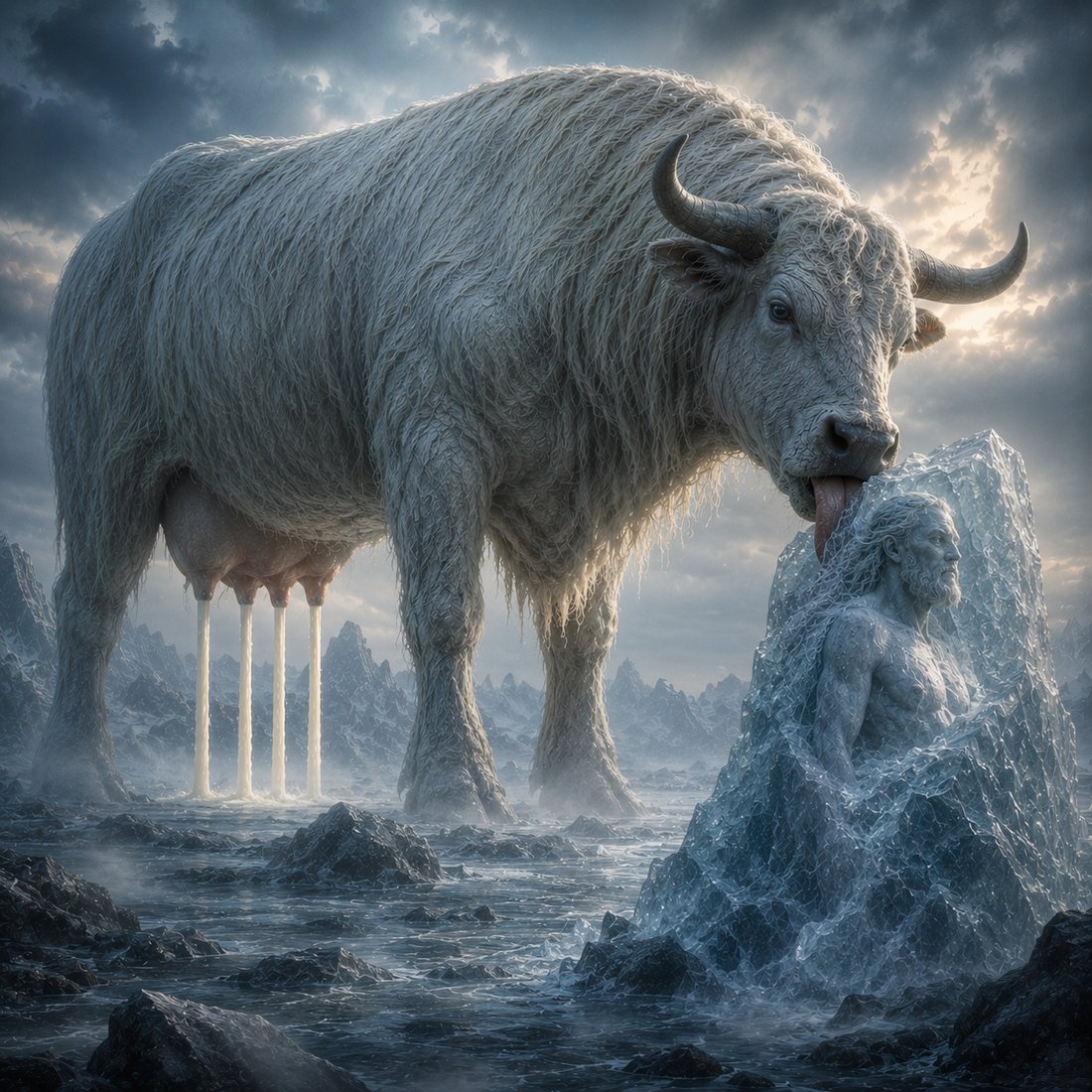
Audhumla (Old Norse Auðhumla) is the primeval cow of Norse creation myth: she forms from thawing rime in the void of Ginnungagap, feeds the primordial giant Ymir with four rivers of milk, and over three days licks Búri, Odin's grandfather, out of a block of salty stone. The only narrative source is Snorri Sturluson's Gylfaginning, written around 1220 – none of the Eddic poems mention her. Here is what the text actually says, what her name means, which comparisons scholars draw, and why a cow at the dawn of time made perfect sense to a Viking-age farmer.
Most creation stories open with something grand: a voice, a flash of light, a war between titans. The Norse version, as Snorri tells it, opens with a cow. No barn, no pasture, no herder. Just ice, a giant drinking from her udder, and a patient tongue working at a salt-crusted stone until a tuft of hair appears.
It sounds like a fairy tale, and in a way it is one. But behind those few lines sit questions that have kept scholars busy for more than a century. Did Snorri inherit this image from a pagan past that reaches back to Indo-European times, or did a learned thirteenth-century Icelander assemble it himself? And why a cow, of all creatures? Let's take it step by step: the text first, then the state of the sources, then the name, then the big comparisons – and finally the cowshed, where the simplest answer may be waiting.
To understand Audhumla, you need to know where she comes from. At the beginning of time, Snorri describes a yawning void, Ginnungagap. To the north lies Niflheim, a world of mist, frost and freezing rivers. To the south lies Muspelheim, bright, hot and burning. The rivers from the north, the Élivágar, carry venom and ice into the void, where everything freezes into layers of rime. Where warm air from the south meets that rime, it begins to thaw and drip.
From those drops, Snorri says, a being in human form first takes shape: Ymir, the primordial giant and ancestor of all the frost giants. Only after that – a detail many retellings lose – does the cow appear. Snorri's narrator says explicitly that she came into being "next", as the rime dripped. Ymir and Audhumla are made of the same stuff, but not in the same moment. First the hungry mouth, then the food.
That order is no accident. Snorri's questioner Gangleri – King Gylfi of Sweden in disguise – wants to know how this first giant survived. The answer is the cow.
The entire story occupies one short passage of Gylfaginning ("The Deluding of Gylfi"), the first narrative part of the Prose Edda, usually counted as chapter 6 (numbering varies between editions). Gangleri asks: "Where did Ymir live, and what did he live on?" The reply quietly ignores the first half of the question. We never learn where Ymir lived. We do learn how he was fed. Arthur Brodeur's public-domain translation of 1916 renders it like this:
Straightway after the rime dripped, there sprang from it the cow called Audumla; four streams of milk ran from her udders, and she nourished Ymir. […] She licked the ice-blocks, which were salty; and the first day that she licked the blocks, there came forth from the blocks in the evening a man's hair; the second day, a man's head; the third day the whole man was there.Snorri Sturluson, Gylfaginning, trans. Arthur G. Brodeur (1916)
That is all there is. In Old Norse the key phrase reads fjórar mjólkár runnu ór spenum hennar, "four milk-rivers ran from her teats". The word á, plural ár, means a proper river, not a trickle. The milk is on a cosmic scale, like the giant who drinks it.
And the cow herself? She cannot eat grass, because there is no grass yet. She licks hrímsteinar, "rime-stones", and Snorri takes care to add that they were salty. Anyone who has watched cattle at a salt lick knows the scene: the rough tongue, the slow, almost endless licking. Snorri was a chieftain's son and a wealthy landowner. He knew how cows behave.
What emerges from all that licking is not another giant but something new. On the first evening, hair appears from the stone; on the second day, a head; on the third, a whole man. Snorri calls him Búri and describes him briefly as fair of feature, great and mighty. His name is often explained as "producer" or "begetter", which suits his role, although the etymology is not entirely secure.
Búri has a son named Borr (also spelled Burr or Bor). Snorri never says who the mother was – one of many gaps he leaves open. Borr marries Bestla, daughter of the giant Bölþorn, and they have three sons: Odin, Vili and Vé.
So the line of the Æsir, the leading family of gods, runs: cow – Búri – Borr – Odin. Pause on that for a moment. Odin the All-Father is half giant through his mother. Through his father he descends from a man a cow licked out of the ice. The gods are neither first nor pure. They come from the same frozen soup as their later enemies, the giants.
Almost immediately, Odin and his brothers kill Ymir. Nearly all the frost giants drown in his blood; only Bergelmir and his wife escape. From Ymir's body the gods build the world: flesh becomes earth, blood becomes sea, bones become mountains, the skull becomes the sky. Later they shape the first humans, Ask and Embla, from two pieces of driftwood on the shore.
And Audhumla? She simply walks out of the story. Snorri never tells us what became of her. Did she drown in the flood of Ymir's blood? Wander off to graze somewhere? Nobody knows, and any answer would be invention.
This is where anyone who cares about separating evidence from retelling needs to pay attention. Audhumla is a figure with exactly one narrative source. She does not appear in the Poetic Edda, the collection of mythological and heroic poems preserved in the Codex Regius. Neither Völuspá, the great poem of the world's beginning and end, nor the contest of wisdom in Vafþrúðnismál mentions a cow – even though both are deeply interested in Ymir.
Vafþrúðnismál even describes how drops of venom sprayed from the Élivágar and grew into a giant, and how a man and a maid grew beneath Ymir's arm. The cow is missing. Snorri quotes these stanzas at length to support his account of Ymir. For Audhumla he quotes not a single line. If you read that Snorri based his cow on a lost poem that he cites, you are reading more than the text says.
There is one other trace: the þulur, rhymed lists of poetic names preserved in some manuscripts of Snorri's Edda. In a list of terms for cattle, Auðhumla appears with the note that she is the oldest of cows (in Finnur Jónsson's edition: hon er elzt kúa). Whether that list predates Snorri and served as his source, or drew on his work, is disputed. The historian of religion Gabriel Turville-Petre, for one, doubted that the þula was old enough for Snorri to have known it.
Add to that the context: Snorri was writing some two centuries after Iceland's conversion to Christianity, as an educated Christian who arranged the old material systematically. Find out more in our profile of Snorri Sturluson and our overview of the Edda. None of this means he invented the cow. It only means we cannot prove she existed before him.
Even the spelling shows how shaky the transmission is. Manuscripts of Snorri's Edda give Auðhumla, Auðumla and Auðumbla. Older translations often write "Audhumbla" or "Audumla"; Danish texts sometimes use "Ødhumbla". In English, "Audhumla" and "Audumbla" are both common today.
The standard interpretation goes back to the Swedish linguist Adolf Noreen and is repeated in the reference works: the name combines auðr, "wealth, riches", with a reconstructed *humala, "hornless". Together that gives something like "the rich (milk-rich) hornless cow". The second element is well supported: Norwegian and Scots have words such as hummel and humble-cow for cattle without horns.
The first element is less certain. The Danish encyclopaedia Den Store Danske simply calls its meaning disputed. In Old Norse, auðr does not only mean "wealth"; an adjective of the same form means "empty, desolate". The linguist Anatoly Liberman has therefore suggested that the name might contain a deliberate double meaning – fitting for a cow standing in an empty primeval world. It is a stimulating idea, nothing more.
But why "hornless"? There is no certain answer. Hornless cattle had been known in the north for a long time, and as early as AD 98 the Roman historian Tacitus remarked in his Germania that the cattle of the Germanic peoples lacked "the glory of the brow" – usually read as small or missing horns. Old Norse also has the word kolla for a hornless cow. A cow without horns is peaceful, a provider rather than a fighter. Perhaps that is exactly what the name wanted to say.
If the Eddic poems are silent, where might Snorri have found the image? The Russian Scandinavianist Fjodor Uspenskij has proposed a down-to-earth answer: not in distant myths, but in Iceland's own storytelling.
His most striking example comes from Eyrbyggja saga. There, the corpse of the dangerous revenant Þórólfr Lame-Foot is burned, and ash blows over the stones on the shore. A cow licks those stones, becomes pregnant and gives birth to a bull calf, the uncanny bull Glæsir. The pattern is the same: a cow licks stones, and a new creature comes forth.
Then there is the Icelandic folk tale of Búkolla, a magical cow stolen by trolls. A boy rescues her, and during their escape hairs from her tail turn into a river, a fire and a mountain. The philologist Stefán Einarsson had already compared Búkolla with Audhumla. Uspenskij adds a point about the names: Bú-kolla contains the same kolla, "hornless cow".
Uspenskij also points to a play on words. Old Norse hrím means "rime, hoar-frost", but can also mean "soot". In Snorri's cosmogony, he argues, ash and salt, soot and rime flowed together. That remains an interpretation. The salt, though, needs no poet to invent it. It is simply what cows lick.
One last thought suggests itself but stays speculative: four rivers of milk. Readers of the Bible will think of the four rivers that flow out of Eden in the Book of Genesis. Snorri certainly knew that text. Nothing proves he took the number from there. Four is also simply the number of teats on a cow's udder.
Now for the big stage. Since the nineteenth century, scholars have compared the Norse creation story with the myths of other Indo-European peoples – the language family that runs from Indic and Iranian to Greek, Latin, Celtic and Germanic. A few striking parallels have emerged. One warning up front: everything in this section is a scholarly hypothesis, not established fact.
The starting point is Ymir himself. His name is often linked to Sanskrit Yama and Avestan (Old Iranian) Yima, all traced to a reconstructed Indo-European word for "twin". Ymir produces offspring from his own body, which would fit a hermaphroditic "twin" being. The Germanic ancestor figure Tuisto, mentioned by Tacitus, is often read the same way.
The American historian of religions Bruce Lincoln built on this in the 1970s and 1980s, reconstructing a shared Indo-European creation myth: a first man sacrifices his twin brother, and the world is made from the twin's body. In the Indo-Iranian versions, a bovine is sacrificed along with the twin, and plants and animals arise from its body. In the European versions, Lincoln argued, the bovine changed its role: it is no longer sacrificed but feeds the primordial beings with milk. Audhumla would then be the Norse echo of that primeval cow.
The Iranian comparison is the most impressive. In Zoroastrian tradition, especially the Middle Persian Bundahišn, the first man Gayōmard stands at the beginning alongside a uniquely created primeval bovine. The evil spirit Ahriman kills both; plants and animals come from the bovine, metals and humankind from Gayōmard. Here, too, a first human and a first bovine stand at the very beginning. Yet the Iranian animal is killed while Audhumla is not – and Ymir is slain by gods, not by an evil principle.
India offers further images. In the Rigveda, the oldest Indian hymns, cosmic powers are repeatedly described as cows; in the Vala myth the god Indra breaks open a rock and releases cows trapped inside it. Later Hindu tradition knows Kāmadhenu, the wish-granting cow. A living being freed from stone faintly recalls Búri – except that in India the cows are the ones being freed, rather than doing the freeing.
And some parallels have nothing to do with Indo-Europeans at all. The Egyptian goddess Hathor was depicted as a cow. The American Scandinavianist John Lindow notes that cows turn up frequently in creation stories around the world – which, if anything, weakens the case for a shared inheritance.
Lincoln's model has drawn criticism. The Indo-Europeanist Edgar Polomé felt it made too many unprovable assumptions to explain the Scandinavian version. Uspenskij, for his part, considers the distant parallels less useful than Icelandic folklore. The honest verdict: an Indo-European primeval cow is an attractive idea that is seriously debated. It has not been proven.
Let's shift perspective, into the world of the people who told these stories. For them a cow was no exotic image. A cow was wealth.
The language shows it. Old Norse fé means "livestock" and at the same time "property, money". It is related to German Vieh ("cattle"), Gothic faihu ("wealth") and Latin pecus ("livestock"), from which pecunia ("money") derives. English fee belongs to the same family. If you had cattle, you had wealth, and the other way round.
It is no coincidence that the first rune of the futhark is called fehu, or fé in the Younger Futhark (see our comparison of the Elder and Younger Futhark). The Norwegian rune poem opens with Fé vældr frænda róge – roughly, "wealth causes strife among kinsmen". And Hávamál, the Sayings of the High One, contains the most famous lines on mortality in all of Old Norse literature, beginning Deyr fé, deyja frændr:
Cattle die, and kinsmen die, / And so one dies one's self; / But a noble name will never die, / If good renown one gets.Hávamál 76, trans. Henry Adams Bellows (1923)
Bellows renders fé as "cattle"; other translators choose "wealth" or "goods". Both are right, because the word meant both. And cattle could die off in a single hard winter.
Tacitus had already observed this among the Germanic peoples of the first century. In the Germania he writes that they took pleasure in the number of their animals, and that these were their only and most cherished riches. In the same work he describes the goddess Nerthus, whose sacred wagon was drawn by cows. You will find more on such connections in our articles on sacred animals and Germanic religion. A direct link between Nerthus' cows and Audhumla is not attested.
What did that look like on the ground? Archaeologically, Viking-age livestock farming is well documented. In Scandinavia people and animals often lived under one roof: the longhouse had a living area with a hearth at one end and a byre at the other. The animals helped warm the house in winter. Such byre-houses are known from sites like Vorbasse in Denmark. For more on farm life, see Viking agriculture and Viking daily life.
The cattle were small; many stood under 1.20 metres at the shoulder, far smaller than modern dairy cows. In Iceland the hay harvest decided how many animals a farm could carry through the long winter. At the Icelandic farm of Stöng in the Þjórsárdalur valley, archaeologists found a byre with room for roughly a dozen and a half cattle – a respectable herd by Icelandic standards.
Above all, a cow meant milk. Slaughter happened mainly in autumn, when winter fodder would not stretch to every animal. Milk was turned into butter, cheese, whey and Icelandic skyr, a soured dairy product that turns up again and again in the sagas. Read more in our article on the Viking diet. To these people, a cow giving four rivers of milk was not an abstract symbol. It was the most extravagant version of the greatest good fortune a farm could have.
In Iceland the cow even became a unit of account. The kúgildi, literally "cow-value", was a medieval standard of value in barter: the worth of one cow, equivalent to about six ewes. In the thirteenth century it was set at roughly 120 ells of homespun woollen cloth (vaðmál). Leases were reckoned in cow-values. Snorri, one of the richest men in Iceland, placed his society's yardstick of value at the beginning of the world.
A side note: today's Icelandic cattle descend from the animals brought by ninth-century settlers and are almost all hornless – but mainly because of deliberate modern breeding. Nothing follows from that for the Viking Age.
Long before video games, Audhumla found her way into art. Around 1777 the Danish painter Nicolai Abildgaard painted "Ymir Suckling the Cow Audhumla", now in the Statens Museum for Kunst in Copenhagen. It shows the naked giant beneath the udder of an enormous cow – an early sign of the eighteenth-century rediscovery of Norse myth. In the small Danish town of Faaborg stands the Ymir Fountain by the sculptor Kai Nielsen, set up in 1913: Ymir bent beneath Audhumla's udder.
Both works capture what makes the scene so powerful. It is physical, almost crude, and at the same time tender. A giant drinking like a calf. A cow uncovering a god without meaning to, simply because she wants salt.
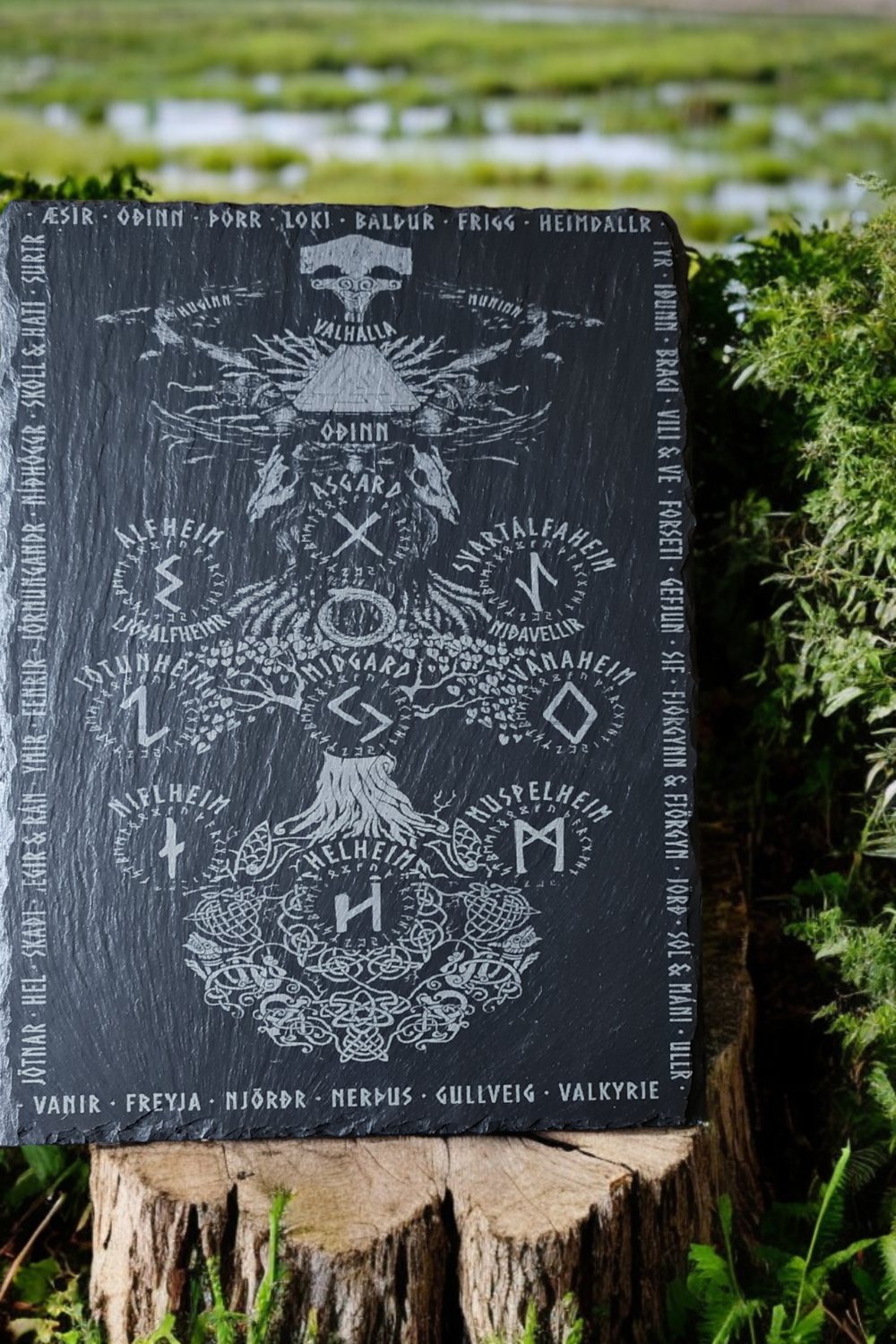
When we engrave motifs from the creation story into slate in our workshop in Alsdorf, we notice again and again how different this beginning is from the images many people carry in their heads. No thunder, no battle. At the start of the Norse world stands nourishment. One being feeds another, and a third comes to light through patient work. Only then do the gods arrive – and with them the first killing.
It is also striking that Audhumla provides for both sides of the later world. She feeds Ymir, ancestor of the giants. And she uncovers Búri, ancestor of the gods. John Lindow has pointed out that the cow thereby links the two groups who will fight each other all the way to Ragnarök. Before all the enmity, there was a shared nursemaid.
Whether Snorri drew this picture from old belief, from Icelandic folk tales or from his own imagination, we will probably never know for sure. But it suits a society in which a cow meant wealth, food and a future. Anyone who has stood in a steaming cowshed on a freezing morning will understand it. For how the worlds were built afterwards, see our overview of the nine worlds.
Who is Audhumla in Norse mythology? Audhumla is the primeval cow who, according to Snorri's Prose Edda, formed from thawing rime in Ginnungagap. She fed the primordial giant Ymir with four rivers of milk and licked the first god, Búri, out of a salty stone.
What does the name Audhumla mean? It is usually explained as "rich hornless cow", from Old Norse auðr ("wealth") and *humala ("hornless"). The second element is considered secure; the first is debated.
Is Audhumla in the Poetic Edda? No. Her story is told only in Snorri Sturluson's Gylfaginning (c. 1220), and she is named in a þula as the oldest of cows.
How is Audhumla related to Odin? Audhumla licked Búri free; Búri's son Borr married the giantess Bestla, and their son was Odin. The primeval cow therefore stands at the head of Odin's family tree.
Are there similar cows in other mythologies? Yes – the primeval bovine of Iranian tradition, the Indian wish-granting cow Kāmadhenu or the Egyptian cow goddess Hathor. Whether Audhumla reflects a shared Indo-European heritage is a scholarly hypothesis, not a proven fact.
What happened to Audhumla after creation? No source tells us. Snorri does not mention her again after Búri is freed.
For courage. For remembrance. For legends that live on.
Ymir & the making of the world · Ginnungagap · Niflheim · Ask & Embla · Odin.
All The Nine Worlds articles →
Deep below, beyond a dark river and a gold-roofed bridge, lies Helheim – the realm of the dead. Not the shining hall of …
Read more →Beyond the wall, beyond the roaring rivers, lies Jötunheim – the land of the giants. It is the world of the untamed …
Read more →When the sun is devoured, when fire and flood have taken the world – then not all is over. Two humans survive Ragnarök …
Read more →At the centre of the nine worlds lies Midgard – the ‘middle enclosure’, the fenced homestead of humankind. Not a …
Read more →