Hardly a tale from the old North gets by without animals. Wolves chase the sun, ravens whisper into the Allfather's ear, an eight-legged steed carries Odin through the worlds, and the world-tree houses a whole menagerie of eagle, harts, squirrel and dragon. This overview gathers the most important animals in myth and everyday life – each introduced briefly, with a pointer to the full article. And because this topic attracts a lot of modern kitsch, we separate things cleanly, as always: what the sources really say, and what is later interpretation.
The people of the Viking Age lived with animals, not beside them. Horse, cattle, sheep, goat, pig, dog, cat and fowl were the basis of survival – draught power, meat, milk, wool, fur and company. A farm without livestock was no farm, and wealth was measured directly in animals; the Old Norse word fé means both „cattle" and „property, money". It is no surprise, then, that the same animals populate the tales of the gods. In the mythic texts animals are rarely mere scenery: they are companions, messengers, adversaries and sometimes kin of the gods themselves. A god without his animal – Odin without ravens, Thor without goats, Freyja without cats – would be almost unthinkable.
The source situation matters. Most of what we „know" about the mythic animals comes from the Poetic Edda (a 13th-century manuscript, with some poems older) and from Snorri Sturluson's Prose Edda (around 1220). Snorri first arranged and embellished much that the older poems only hint at. Where we can, we say so. For between what an image on a rune stone shows and what a prose text relates about it two hundred years later there is often a long road – and many of the pretty „facts" of today's self-help literature appear in no old source at all.
Harts there are four, who the highest twigs
gnaw with necks thrown back:
Dáinn and Dvalinn, Duneyrr and Duraþrór.Grímnismál 33, after the translation of Henry Adams Bellows (1923), public domain
No animal in the North is as double-edged as the wolf. On one side stands Fenrir, the bound giant wolf who devours Odin at Ragnarök; alongside him the wolves Sköll and Hati, who chase sun and moon across the sky until they catch them at the end. On the other side lie at Odin's feet the two faithful wolves Geri and Freki, to whom he gives all his food, while he himself lives on wine alone. The wolf is thus both an image of doom and a companion – threat and loyalty in one pelt.
This tension fits everyday reality: the wolf was the human's rival for livestock and game, and at the same time the emblem of the warrior. A man cast out of society was called vargr – „wolf", that is, an outlaw. More on all of this in the full article The Wolf in the North and in the individual portraits of Fenrir and Geri and Freki.
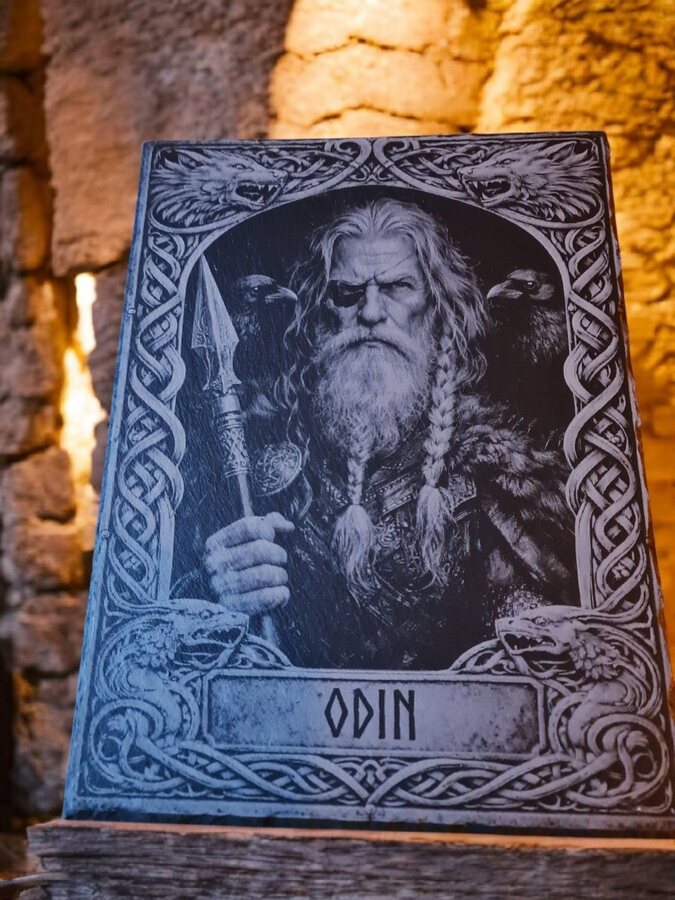
Odin's ravens Huginn („thought") and Muninn („memory") fly over the world each morning and report to the god in the evening what they have seen. The raven is thus the animal of knowledge and far-sight – but also a bird of battle that circles above the fallen. Both belong together: Odin is god of wisdom and of war, and the clever, all-observing raven embodies precisely this connection.
Historically, Viking armies carried a raven banner that appears repeatedly in the sources and was meant to foretell victory. The raven was at the same time a real, strikingly curious bird that sailors released to point the way to land. Everything further in the article The Raven in the North and in the portrait Huginn and Muninn.
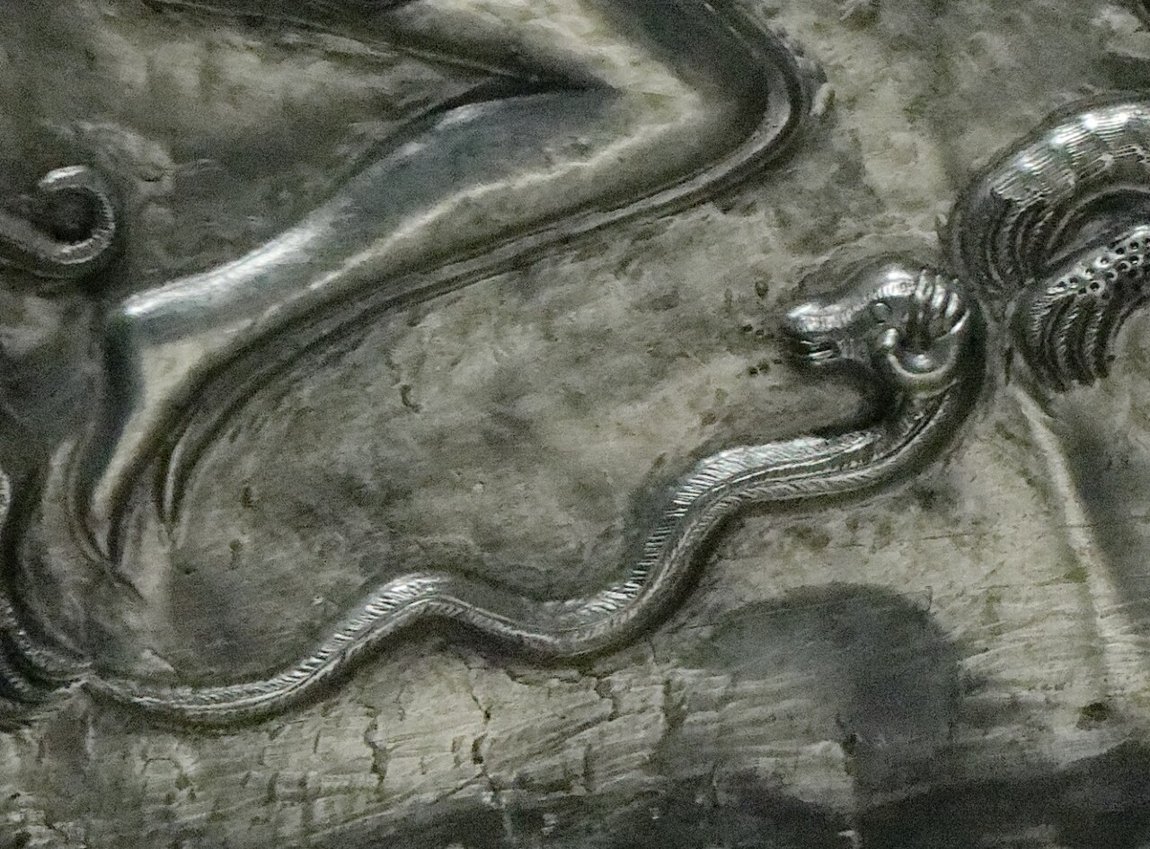
The great serpent or dragon is, in the North, a power at the edge of order. Jörmungandr, the Midgard Serpent, encircles the whole world and is Thor's arch-enemy – the two kill each other at Ragnarök. Níðhöggr gnaws below at the root of Yggdrasil and so feeds on the whole. And Fáfnir is the hero-turned-dragon of the Völsung saga, whom Sigurd slays – originally a man whom greed for the Nibelung hoard transformed into a worm.
Dragon and serpent thus stand for greed, chaos and the forces that threaten the cosmos. In Viking-Age art, for instance in the Ringerike and Urnes styles, the serpent becomes a drawn-out ribbon-beast winding in endless loops – one of the most beautiful and common ornaments of all. Explored in the article The Dragon in the North and in Jörmungandr and Níðhöggr.
The horse was the most valuable domestic animal and at the same time the mount of the gods. Odin's eight-legged steed Sleipnir is the swiftest of all horses and carries its rider even into the realm of the dead, Hel; it is a child of Loki, who had turned himself into a mare. In daily life the hardy Norse horse – the ancestor of today's Icelandic horse – was both a status symbol and a working animal.
Horse fights (hestavíg), in which stallions were driven against one another and which often ended in quarrels among their owners, were part of the culture. The horse also played a role in sacrifice and burial: horse skeletons are among the common grave goods of wealthy burials. More in the article The Horses of the Vikings, in the portrait Sleipnir and in the piece on sacred horses.
The boar belongs to the Vanir, the gods of fertility. Freyr rides the golden-bristled boar Gullinbursti, forged by the dwarfs Brokk and Sindri, which runs faster than any horse through air and water and shines in the dark. Freyja, in turn, has the boar Hildisvíni, on which she rides in one tale. The boar was both a beast of the feast and of battle.
At solemn oaths one laid a hand on the consecrated sacrificial boar (sonargöltr) and swore upon it – one of the most striking scenes of Viking-Age feast culture. The wild boar was also regarded as an especially defiant, brave animal, which is why boar images adorned helmets and weapons too. In detail in the article The Boar in the North and in the portrait Gullinbursti.
The bear was the most powerful predator of the North and stood for raw fighting strength. The word „berserker" is often read as „bear-shirt" – warriors who worked themselves into a battle-frenzy with the ferocity of the bear; though the meaning of the word (bear, or „bare", i.e. without a mail-shirt) is not finally settled. In the saga world Böðvar Bjarki embodies the bear-hero who appears in the decisive battle as a mighty bear, while his body lies behind as if asleep.
Bear claws and pelts are found in Viking-Age graves; the bear was thus not only an image but a real trade and status good from the forests of Scandinavia. More on this in the article The Bear in the North.
Freyja, goddess of love and of seiðr magic, drives a wagon drawn by two cats. This is one of the most memorable images of Norse mythology – and at the same time one to be careful with: the cats appear only in Snorri, and the text does not say what kind of cats are meant. To speak of „large grey cats" or even lynxes is already the embellishment of later storytellers.
In everyday life the cat was a valued pet that protected stores from mice and was therefore welcome on ships and farms. Cat bones and even evidence of a trade in cat fur are archaeologically attested; the animals demonstrably grew larger over the course of the Viking Age. Explored in the article The Cat in the North.
Thor's wagon is drawn by two goats: Tanngrisnir and Tanngnjóstr. The remarkable thing: Thor can slaughter and eat them and bring them back to life the next morning with his hammer – as long as no bone is broken. In a famous tale the farmer's son Thjálfi does break a bone to get at the marrow, and must enter Thor's service in payment.
In Valhalla, meanwhile, stands the goat Heiðrún, from whose udder mead flows for the fallen warriors while she nibbles the foliage of the tree Léraðr. In daily life the goat was a frugal, important animal for milk, meat and hide. More in the portraits Tanngrisnir and Tanngnjóstr and Heiðrún.
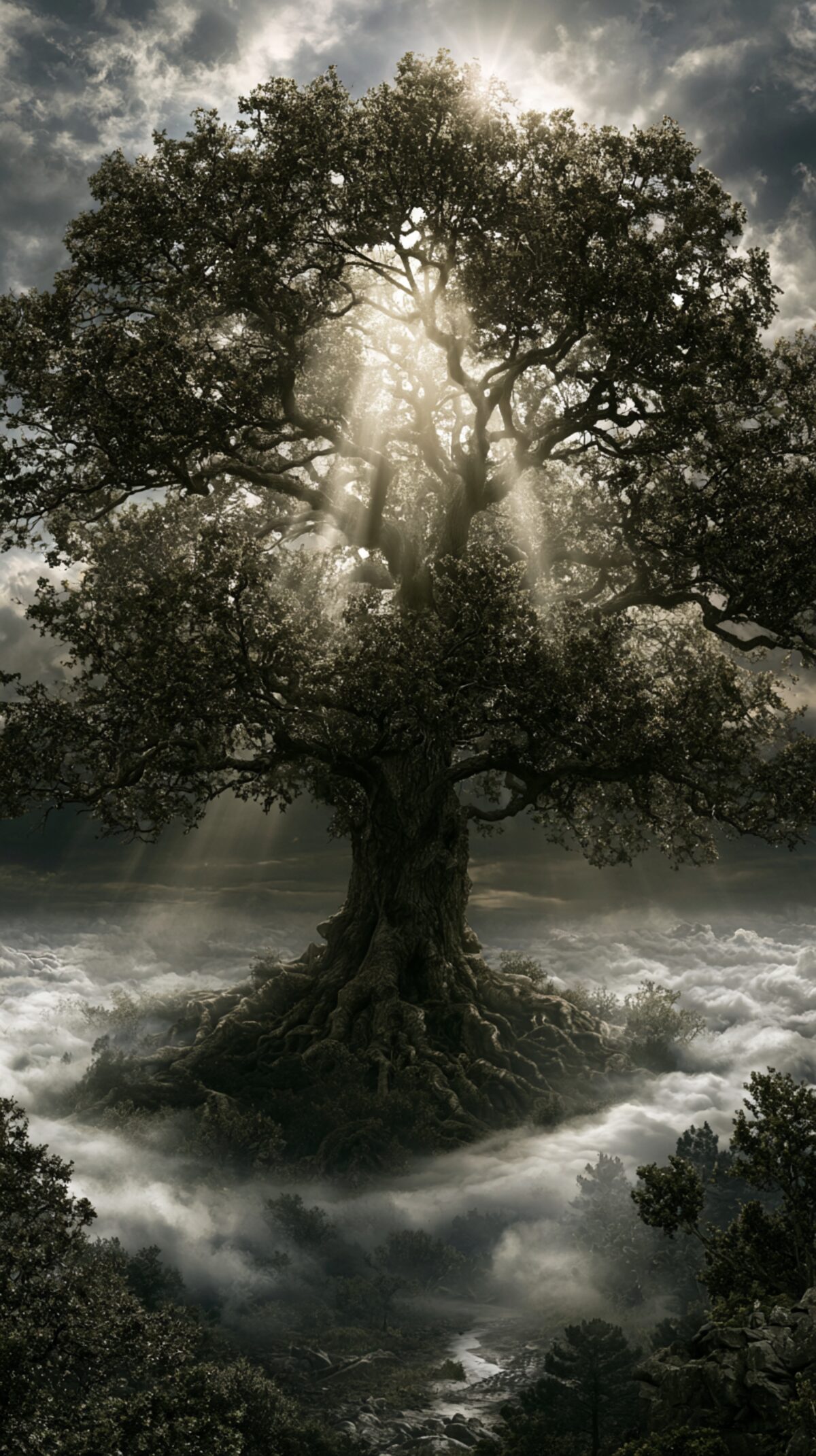
The world-tree Yggdrasil is itself a small ecosystem. In its crown sits a nameless eagle, between whose eyes perches the hawk Veðrfölnir. Four harts – Dáinn, Dvalinn, Duneyrr and Duraþrór – gnaw at the shoots and branches. The squirrel Ratatoskr scurries up and down the trunk, carrying insults between the eagle above and the dragon Níðhöggr below.
Thus the tree is a constant scene of growth and decay: it is gnawed from above, gnawed from below, and along its trunk the quarrel runs up and down – and yet it stands. The exact number and division of roles of these creatures we know above all from Grímnismál and Snorri's summary. More in the articles Eagle and Veðrfölnir and The Four Harts of Yggdrasil.
At the beginning of creation stands a bovine: the primeval cow Auðumbla, who came into being from the melting rime. From her udder flowed four rivers of milk that nourished the primeval giant Ymir. And by licking the salty rime-stones for three days she freed the first god – Buri, the ancestor of Odin.
So it is, of all things, a domestic animal, the cow, that lies at the root of the whole world of the gods. This suits a society in which cattle meant wealth and food and dairying was vital to survival. More in the portrait Auðumbla.
Beside the great mythic beasts stand the quiet companions of daily life. The dog was a hunting, guarding and herding helper and so close a companion that it was placed in the grave with the dead – dog skeletons are among the regular grave goods of Viking-Age burials. Odin's realm of the dead, too, is guarded by such an animal, the hound Garmr. Sheep and cattle, in turn, carried the whole economy: wool for sails and clothing, milk for cheese and skyr, meat and hides for everything else.
So an arc runs from the domestic animal to the myth and back again. Almost every animal assigned to the gods was at the same time part of daily life – and it is precisely this closeness that makes the Norse animal world so vivid and believable. The line between the farm and the hall of the gods was a permeable one.
For our engraved pieces this means: we show the animals as the sources and Viking-Age art know them – the raven as messenger, the wolf between threat and loyalty, the horse as a status animal, the world-tree with its inhabitants. We do not mix invented „power-animal" symbolism with genuine motifs, and on request we are happy to explain what is historically attested and what is modern interpretation. That way a motif is not only beautiful but also honest – a piece of the North that holds up to a closer question.
The Wolf in the North · The Raven in the North · Dragons of the North · Horses of the Vikings · The Boar in the North · The Bear in the North · The Cat in the North.
All Beings & Creatures articles →
Two black birds perched on the shoulders of a one-eyed god - few images are as tightly bound to Odin as this one. Their …
Read more →Before Brokkr and Sindri forged the hammer, others were at work: the sons of Ívaldi. Three wonders came out of their …
Read more →Few animals combine tenderness and stubbornness like the cat – and of all the gods, it is the warlike, passionate …
Read more →