
High up in the crown of the world-ash Yggdrasil, where the topmost branches sway in the wind, something happens that is easy to overlook: four harts stretch their necks and nibble at the tenderest shoots. Their names are Dáinn, Dvalinn, Duneyrr and Duraþrór — and although they take the stage in only a single stanza of the Poetic Edda, they belong to the most mysterious dwellers in the Norse image of the world.
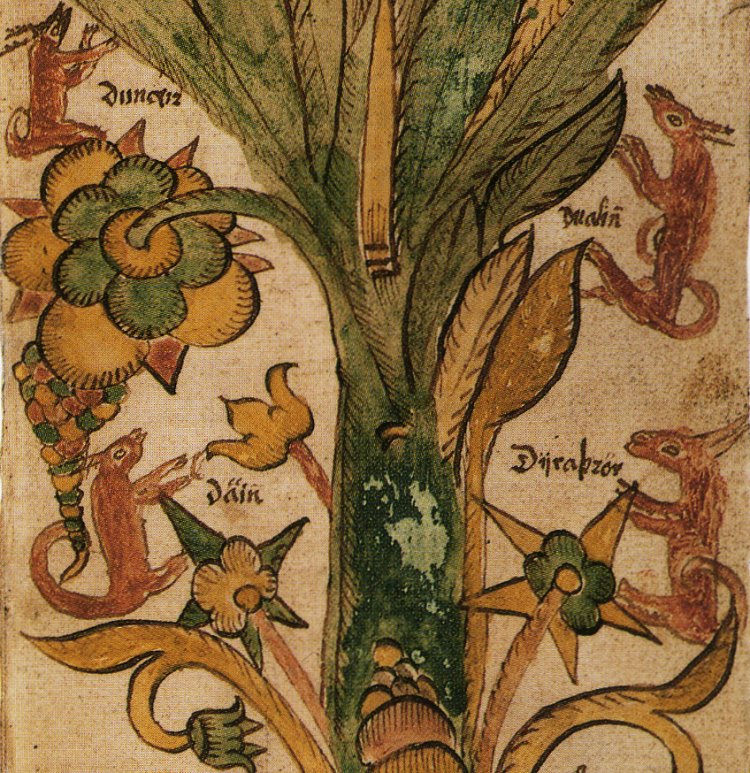
The source is brief, but unmistakable. In the Grímnismál — the lay in which the bound Odin, seated between two fires, reveals the secrets of the world to young Agnar — we read:
Four harts there are, that the highest twigs nibble with heads thrown back; Dáin and Dvalin, Duneyr and Durathror.Grímnismál 33, after Henry Adams Bellows (1923)
Four beasts, then, browsing upward „with heads thrown back" — not on the foliage within reach, but on the very highest buds of the greatest of all trees. It is a quiet, almost passing picture, and yet it holds the whole tension of the Norse cosmos: even the tree that carries the nine worlds is forever being gnawed.
Anyone who tries to translate the names is stepping onto uncertain ground — and honesty demands we say so. Dáinn most likely means something like „the dead one" or „the departed", derived from the Old Norse word for dying. Dvalinn can be read as „the drowsy one", „the slumberer" or „the one who tarries" — from a word for lingering, delaying, hesitating. With Duneyrr and Duraþrór it grows genuinely dark: Duneyrr has been linked with „din-ear" or „the one roaring in the downpour", Duraþrór with „door-sleeper" or „thriving slumber" — but the only truly honest sentence is: we do not know for certain. Scholars still disagree, and the Edda itself is silent on every interpretation.
What stands out are the echoes of rest and of passing away. „The dead one", „the slumberer" — a weary, dusk-like tone lies over these names, as though what browses here were not merely game, but something bound up with sleep and with ending.
Here it grows truly interesting: Dáinn and Dvalinn are by no means only names of harts. Both appear in the famous roll of dwarves in the Völuspá as names of dwarves — Dvalinn is in fact one of the best-known dwarves of all, named in several sources as a rune-master and smith. The same sound, an entirely different shape.
This is neither a contradiction nor a copyist's slip, but typical of Old Norse tradition: names here are not fixed labels attached to exactly one being. A name can stand over a hart, over a dwarf, over an ancestor. Whoever reads the Edda must get used to the fact that the world of the Norse is full of such echoes — the same syllables ringing through different corners of the cosmos.
The four harts do not stand alone. Yggdrasil is literally alive with beings: an eagle sits in its branches, the squirrel Ratatoskr darts up and down the trunk, the dragon Níðhöggr gnaws at the roots, and on the roof of Valhalla the hart Eikþyrnir stands beside the goat Heiðrún — both likewise browsing the branches of the tree, and giving in return mead and the wellspring of all rivers. Again and again the same motif: creatures that live off the world-tree and consume it at the same time.
Herein lies the real force of the image. The tree that carries everything is not invulnerable. It is nibbled from above, gnawed from below, chafed at the bark — and still it goes on growing. If you like, you may read in this an honest Norse sense of the world: everything that stands endures constant consumption, and yet it holds. Time feeds on the cosmos as four harts feed on the topmost buds — unhurried, unceasing.
What is attested: The four harts are named in stanza 33 of the Grímnismál in the Poetic Edda and taken up by Snorri Sturluson in the Prose Edda (Gylfaginning). The names Dáinn and Dvalinn also appear in the roll of dwarves in the Völuspá as well as in the Þulur — the Old Norse lists of names. The sources say no more than this: no action, no interpretation, only the four names and the picture of the browsing beasts.
Myth check: You will often read that the four harts are „the four winds", the „four seasons" or the „four phases of the moon". It sounds pleasingly neat — but it does not come from the old sources; it comes from the Icelandic scholar Finnur Magnússon in the early 19th century. It is a later interpretation, a learned speculation, not the knowledge of the Viking Age. The Edda itself gives four names and nothing more. Anyone passing on the four-winds explanation should say honestly: that is reading-in, not evidence.
To understand why the four harts are handed down so briefly and so cryptically, one has to know the poem they stand in. The Grímnismál is no quiet lesson by the hearth but an outburst of knowledge under duress. Odin, disguised as the grey wanderer Grímnir, comes to the hall of King Geirröðr. Warned against a dangerous sorcerer, the king has the stranger seized and set between two fires — for eight nights, without food, without drink. Only Agnar, the king's young son, secretly hands the tormented man a full horn. And only then, with a scorched cloak and a parched throat, does the bound one begin to speak.
What follows is one of the densest recitations of Norse world-knowledge that survives. Odin names the dwellings of the gods, the rivers of the underworld, the hall of the fallen, the many names he himself bears. In the midst of this flood the world-tree comes up — and with it its inhabitants: the goat Heiðrún and the hart Eikþyrnir on the roof of the hall, the serpent Níðhöggr at the root, the swarm of worms beneath the ash. Right here, embedded in a long chain of stanzas, the four harts appear. They are granted a single line. No sentence explains what they mean; the poem names them and moves on to the next wonder of the cosmos.
This manner of composition is neither an accident nor a failing. The Grímnismál belongs to that kind of mnemonic verse the Old Norse tradition knew as enumeration, as a catalogue of names — kin to the þulur, the versified lists that skalds learned by heart. Knowledge here is not explained but named. Whoever knows the names possesses the thing. The bound Odin does not surrender interpretations but names, and in exactly that lies his power: he calls the order of the world by name, piece by piece, until at last the disguise falls and the king realises that he has tortured the Allfather himself. For the four harts this means: we have them without explanation not because the tradition is defective, but because the poem works this way on principle. It is a catalogue of what is, not a commentary.
Keep that in mind and the stanza reads differently. The four harts are no forgotten detail to be skimmed past. They are a fixed entry in Odin's inventory of the nine worlds — named as matter-of-factly as the rivers, the halls and the gods. Only that their entry consists of four names and a single image: animals browsing at the highest crown with necks bent back.
One can take each of the four names apart as far as linguistics will carry — and one must honestly say where it stops carrying. Old Norse onomastics here is a field of well-founded conjecture and open questions. What follows is the state of knowledge, not the state of certainty.
Dáinn is the most tangible of the four. It belongs to the Old Norse verb deyja, to die, and is formed like a past participle: the dead one, the one who has died. The same root lies in English dead and German tot. A hart called simply the dead one is a strong image — and it does not stand alone, for as we shall see a famous dwarf bears this name too, and in one saga passage even a man lying as if dead in a burial mound is so called. Death is unmistakably present in this syllable.
Dvalinn hangs on the Old Norse dvöl, delay, and on the verb dvelja, to linger, to tarry, to delay. Literally, then, the tarrier, the one who lingers, the delayer — or, put more softly, the dozing one. Here too a note of stillness and rest lies over the name. And Dvalinn too is a name that echoes far beyond the hart through the tradition; the whole next section belongs to him.
With Duneyrr the ground turns soft. The second element is usually connected with eyra, the ear. On the first, opinions divide: some read dúnn, down, the soft plumage, and so arrive at a reading like the down-ear — perhaps an animal with softly haired hearing. Others draw on dynr, din, roar, and read the name as the roaring one or the one with the droning ear. Both derivations are possible, none is provable, and the translations found in popular books — from down-ear to the one thundering in the downrush — are guesses rather than secure knowledge.
Duraþrór, finally, almost wholly withdraws. The second part, þrór, is an old word associated with thriving, growing, being vigorous; it also appears as one of Odin's many by-names. The first part remains disputed: dyrr, door, would be one possibility, dúrr, slumber, another. So the readings waver between door-thriver, thriving slumber and similar makeshifts — and honest is only the sentence that we do not know. Duraþrór is the name at which linguistics must most plainly concede its limit.
What is secure: Dáinn can be reliably connected with the verb for dying, Dvalinn with the word for lingering. For Duneyrr and Duraþrór there are well-founded but competing derivations and no scholarly consensus. Any smooth translation of all four names that gets by without a question mark goes beyond what the sources and the linguistics allow. What remains striking is only the shared undertone: in the first two names, which can be read with confidence, death and sleep resound — not hunting, not strength, not the sun.
None of the four hart-names leads so far into the depth of the tradition as Dvalinn. For Dvalinn is at the same time one of the best-known dwarves in the whole Norse world — and through him one can show how Old Norse thought handles names.
In the Hávamál, the Sayings of the High One, there is a famous stanza about how the runes came among the different kinds of beings: Odin carved them for the Æsir, another for the elves, and Dvalinn — so it says expressly — for the dwarves. Dvalinn, then, is no random dwarf but the one to whom the tradition credits the rune-lore of his people. That places him in the ranks of the great culture-bringers of myth: one through whom a whole race came to writing and to the magic of signs. For a workshop that works with runes this is a pleasing footnote — the dwarf whose name also stands over one of the harts of Yggdrasil is held to be the master of runes among the dwarves.
A second thread is even more telling. In the poetic language of the skalds there are the encoding paraphrases, the kennings. One of them calls the sun Dvalins leika — literally Dvalinn's plaything or, more aptly, Dvalinn's deluder, his deceiver. Behind it lies a firm rule of the Norse conception of dwarves: dwarves live beneath the earth and in stone, and whichever of them daylight surprises turns to rock. The rising sun is thus for a dwarf like Dvalinn no blessing but a deadly deception — it lures him from the shadow and turns him to stone. That of all names his should serve as a cipher for the sun shows how deeply he was anchored in the poetic imagination.
In the North dwarves are above all the master smiths of the cosmos; from their forges come the most precious things of the world of the gods. Dvalinn appears in this role as well. In one late tale he is among the four dwarves who make Freyja's famous necklace, and in other sources he appears in the circle of the treasures and the artful works ascribed to the dwarves. Whether rune-teacher, cipher of the sun or smith — Dvalinn is everywhere a being of knowledge, craft and transformation.
How can the same name stand over an animal in the tree's crown, over a rune-wise dwarf beneath the earth and — in a further source — even over a kind of fate-knowing beings? The answer lies in the nature of Old Norse naming. Names here are no identity cards designating exactly one being. They are a shared hoard of sound from which poets and storytellers drew. One and the same sequence of syllables could turn up in wholly different corners of the cosmos without anyone seeing a contradiction in it.
With the four harts a concrete reason comes in that is often overlooked: alliteration. Old Norse verse is bound not by end-rhyme but by the matching of initial sounds. Dáinn and Dvalinn, Duneyrr and Duraþrór — all four begin with the same sound. This is no accident but a building principle. The names are chosen so that they join into pairs within the verse line: the dead one and the lingerer, then the two dark names. A good part of the overlap with the dwarf-names is explained simply by this: the poet needed names that matched in sound — and for that he reached into the very hoard from which the dwarf-lists were filled. Here the name follows the ear, not the register of persons.
Why harts, of all creatures? The sources do not say — but the hart was anything but a random animal in the Germanic North. It appears at several points of the world-structure and of material culture, and whoever wishes to place the four harts does well to know this setting.
The very word binds the Germanic languages together. Old Norse hjörtr, the hart, is cognate with English hart and German Hirsch; all go back to a shared root associated with the horned one. The hart, then, bears its name from what marks it out: the antlers, that branching, tree-like structure upon the head. That this animal of all animals should browse at the crown of the world-ash is thus no wholly random pairing — the antler-bearer beneath the crown-bearing tree, two forms of branching that meet in the one image.
The nearest counterpart stands in the same stretch of verse. On the roof of Valhöll the hart Eikþyrnir browses on the branches of the tree, and from its antlers drips down into the spring Hvergelmir, from which — so the image goes — all the rivers of the world spring. Here the hart is thus a source: what it takes from the tree it passes on as water that runs through the whole of creation. The four harts of the crown and the one hart of the roof therefore belong together to a larger motif — the hart as a being at the seam between the tree and what issues from it.
Beyond the North the hart was throughout the Germanic world a sign of rank and dignity. The most famous example stands in Old English heroic poetry: the great royal hall of the Danish king is called Heorot — the Old English word for hart. A hall that bears the name of the antler-bearer says much about how highly this animal stood in esteem. The hart with its branching antlers, recalling a tree, a crown, was an obvious image for the exalted, the far-reaching, the royal.
A second, often-cited example belongs to the realm of finds and calls for caution: from the famous Anglo-Saxon ship burial of Sutton Hoo comes an enigmatic whetstone in the form of a sceptre, crowned at the top by a small bronze figure — on a widespread interpretation, a hart. It is readily read as a token of rulership, an emblem of royal dignity. But honesty matters here: Sutton Hoo is Anglo-Saxon and roughly two centuries older than the Viking Age, and that the figure is a hart and what it means is itself already interpretation, not certainty. As direct evidence for the four harts of Yggdrasil the find is of no use. It shows only that in the wider Germanic world the hart could be a sign of rank — a setting into which the tree-harts fit, without one being allowed to forge a chain from it.
Quite soberly, the hart was also a supplier of raw material. Antler is tough, elastic and easy to carve; in the trading towns of the Viking Age, such as Haithabu, the artful combs that belonged to daily life were made from hart and reindeer antler. The hart was thus at once far and near: a kingly emblem in poetry and a familiar working material in the craftsman's hand. Perhaps part of its power as an image lies precisely there — it was before everyone's eyes and yet remained bound up with the exalted.
Hardly an image of Norse mythology has been so often prettily interpreted as the four harts — and hardly one shows so clearly how learned conjecture becomes apparent knowledge. It is worth following this path more closely, because it lays bare a pattern one meets at every turn with the Edda.
The starting point is the number. Four — that almost calls of its own accord for order: the four cardinal directions, the four seasons, the four winds, the four phases of the moon. Where four things stand side by side, the ordering mind readily reaches for a ready-made fourfold scheme and lays it over them. That is exactly what happened with the harts. Because there are four of them browsing at the crown, the temptation lay near to read them as four forces gnawing at the cosmos from the four corners of the world.
This idea was stated and broadly painted above all by the Icelandic scholar Finnur Magnússon in the early 19th century. In his great works on Eddic lore he interpreted the four harts as the four winds, or the forces of the cardinal directions, that bring about growth and decay in nature. That fitted excellently the spirit of his age: the 19th century loved so-called nature-mythology, that school of thought which suspected behind almost every mythic figure an encoded force of nature — gods as sun and storm, monsters as winter and darkness, trees and animals as emblems of the turning year. Within this frame four harts had all but to be the four winds.
Recent scholarship handles such equations with reserve, and for good reasons. First, there is not a single foothold for it in the sources themselves: neither the Grímnismál nor Snorri, neither the þulur nor any Old Norse text connects the harts with winds, seasons or cardinal directions. Second, the four names cannot be sensibly distributed over a fourfold scheme — there is no north, south, east and west hart, no assignment that would follow from the names themselves. Third, nature-mythology as a method has long been superseded: it read into the myths what it expected to find, and turned every image into a weather- or season-allegory. What comes out of that often says more about the 19th century than about the Viking Age.
It is telling, too, that even the earliest attempt to order Norse mythology into a system offers no interpretation. When Snorri Sturluson gathered the old lore into his Prose Edda in the 13th century, he took over the four harts from the Grímnismál — and simply lists them, exactly as the poem does, without a word about what they might mean. If the meaning had still been common knowledge in Snorri's day, one would expect the great systematiser to note it. His silence is itself a small piece of evidence: already in the high Middle Ages the four harts were a bare handful of names, not an allegory anyone could unfold.
Sober reference works of Germanic mythology therefore hold fast: the meaning of the four harts is unresolved, and the nature-mythological readings are speculation. This is no cold refusal of the beautiful image — it is merely the honest boundary between what stands in the sources and what later scholars laid into them. One may gladly tell the four-winds reading. One should only add whose pen it came from.
Myth-check, in depth: The equation “four harts = four winds / seasons / phases of the moon / cardinal directions” is not a tradition of the Viking Age but a learned interpretation going back above all to Finnur Magnússon in the early 19th century and standing wholly in the spirit of the nature-mythology of that time. No Old Norse text supports it; the names cannot be distributed over a fourfold scheme; and the method behind it is today regarded as superseded. The honest position is: the sources name four names and one image — no more. Everything else is interpretation.
Clear away the readings that later centuries laid over the four harts, and the image itself remains — and it is strong enough to stand on its own. Four animals browse with necks bent back at the topmost buds of the tree that carries the nine worlds. They do not eat the foliage within reach but the tenderest, highest shoots: the new, just breaking out. And they do it constantly, unhurriedly, without end.
With that they belong to a basic motif of the Norse world-view which the Grímnismál elsewhere states unmistakably. Only two stanzas after the harts it says of the tree itself:
The ash Yggdrasil / hardship suffers, / more than men do know; / a hart bites it above, / and in its side it rots, / and beneath Níðhöggr gnaws.Grímnismál 35, after Henry Adams Bellows (1923)
That is the real message. The world-tree, the backbone of creation, suffers more than men suspect. It is nibbled above, dissolved by rot at its flank, gnawed below by the dragon. From every side something feeds on it — and still it stands. The ash does not fall; it goes on bearing while it is eaten, rotted and gnawed at. In this coexistence of ceaseless consumption and enduring persistence lies one of the most honest truths of Norse thought.
The four harts are the quiet, almost gentle part of this image. The dragon at the root is the lurid, the threatening; the browsing of the harts in the crown is the soft, the everyday. So time consumes the cosmos: not in a single blow, but in the constant, quiet nibbling of the newest, of what has only just grown. What springs up young today is browsed away tomorrow. And yet the tree grows back. One need see no mood of doom in it. One can just as well read the opposite: that persistence and consumption are not opposites but belong together — that the tree's life consists precisely in being forever gnawed and forever growing on.
For a people that showed no fear of passing, that held the good death and lasting renown higher than mere survival, this is a fitting image. The cosmos is no monument cast for eternity but a living tree under a constant tooth — vulnerable, gnawed, and for that very reason truly alive.
Four names, one line, one image — the old sources give no more of the harts of Yggdrasil. And yet the path from this one stanza leads astonishingly far: to the mnemonic art of the Grímnismál, to the limits of onomastics, to the dwarf Dvalinn with his runes and his petrifying sun, to the hart as a token of rank in the Germanic world, and finally to a learned legend of the 19th century that must honestly be marked as such. In the end there is no finished solution-word to the riddle, but something better: a clear view of what is handed down and what was read into it. The four harts go on browsing at the highest crown — unhurried, unexplained, and precisely in their sparseness of great power.
Yggdrasil – the world tree · Niðhöggr – the gnawer at the root · The nine worlds · The Norns · Heiðrún – the mead-goat.
All Beings & Creatures articles →
Without the giants there would be no Norse world – in the most literal sense. Out of a giant it arose, against the …
Read more →In Valhalla an eternal feast holds sway – provided by a single animal that never runs out: the boar Sæhrimnir.
Read more →Two wolves race across the firmament – one after the sun, the other after the moon. It is the oldest chase in the …
Read more →Eight legs, a one-eyed rider and a road that leads all the way down into the realm of the dead: Sleipnir is no ordinary …
Read more →