Few animals stand at once for raw strength and for fertility the way the boar does. In Norse tradition a goddess rides one, a god owns a gold-bristled specimen, and in Valhalla a boar is eaten anew every evening. Add the boar on the helmet, in the field and in the cooking pot. We sort out what the sources actually say – and what later centuries added.
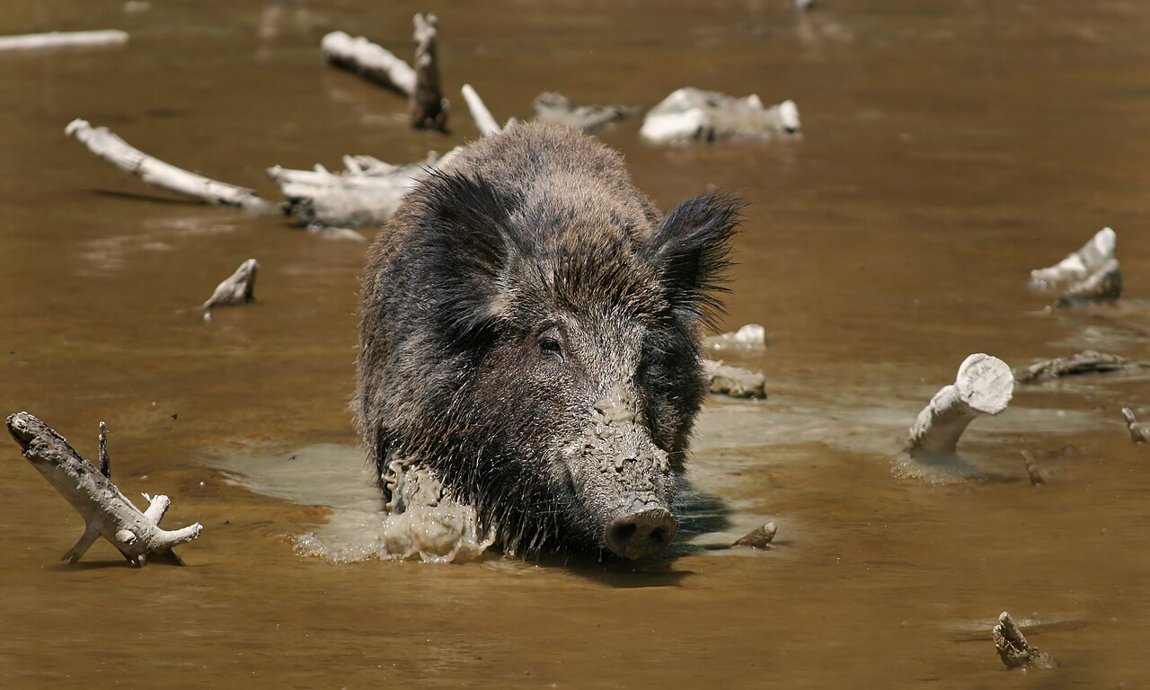
The wild boar was both familiar and dangerous to the people of the North. A full-grown boar weighs well over a hundred kilograms, defends itself with honed tusks and rarely flees once cornered. Hunting it meant taking a risk. Exactly this mixture of ferocity, toughness and unchecked breeding made it a symbol that, in the North, is strikingly often linked to the Vanir – the group of gods responsible for fertility, wealth and good growth. The boar therefore does not belong to the camp of pure war symbols; it stands at the seam of life, growth and defence.
Two of the three most famous boars in the tradition belong, of all deities, to the sibling pair Freyr and Freyja, the most prominent Vanir. That is no accident: the pig was the most productive farm animal of everyday rural life, and an animal that provides food, offspring and prosperity fits gods invoked for „ár ok friðr" – for a good year and peace.
This connection is moreover old and widespread. Long before the Viking Age the boar appears in the Germanic stock of symbols as a sign of strength and protection, and among the Celtic neighbours too it was a frequent war and status animal. The North did not invent this heritage but reshaped it in its own way – binding it especially closely to the Vanir. So when we speak of „the" Norse boar, we mean a whole bundle of ideas: mount, feast, helmet sign and farm animal all at once.
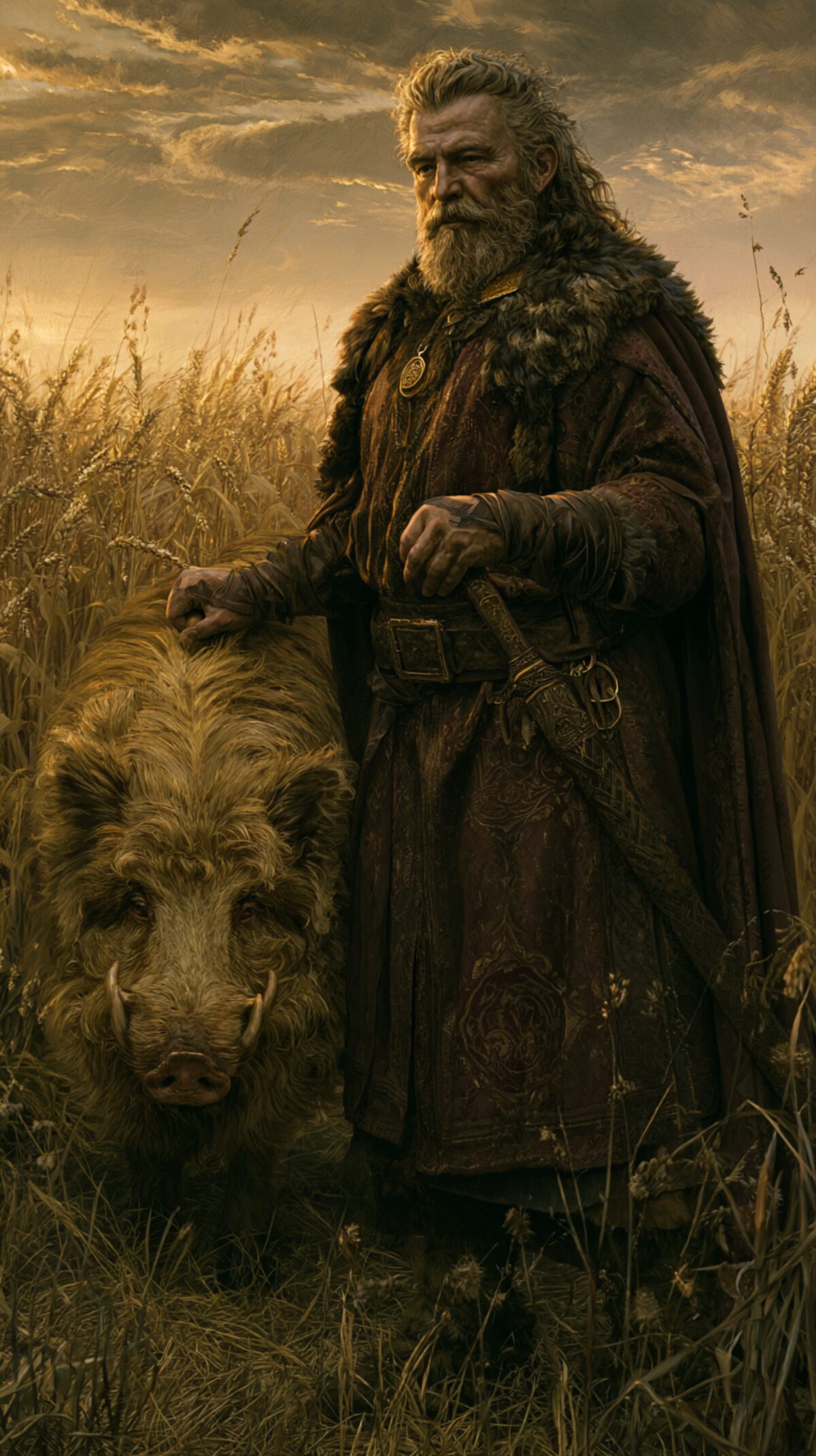
The best-known boar of Norse mythology is Gullinbursti, „Golden-bristle". Snorri Sturluson tells in the Prose Edda how it came to be: the cunning Loki had goaded the dwarf brothers Sindri and Brokkr into a craftsmen's contest, wagering his own head. From their forge came three masterpieces – the ring Draupnir, the hammer Mjölnir, and Gullinbursti. The boar was made from a pigskin in the fire; its bristles glow in the dark and let it run faster than any horse, through air and over water.
Gullinbursti (also called Slíðrugtanni) draws the wagon of the god Freyr. The image is complete: the shining, tireless boar carries the god of fertility through the world – light and growth, embodied in one animal. In the same account of Baldr's funeral, Snorri names the boar explicitly as Freyr's mount to the pyre. For us it is worth noting: the detailed story comes from Snorri's pen (13th century), but the older core – Freyr's association with the boar – is supported by other evidence too.
The detail of the glowing bristles is remarkable. A boar that lights up the night while running over air and sea is more than a strong animal – it is a bearer of light and sun. Some scholars have seen in this an old solar aspect of the Vanir god, who was in any case linked to sunshine, rain and the growing of the fields. Whether one wants to go that far or not: the image of the golden-shining boar that drives away the darkness and promises the harvest sums up Freyr's role in a single animal.
The second boar belongs to Freyja. In the eddic poem Hyndluljóð the goddess rides her boar Hildisvíni, „Battle-swine", to the giantess Hyndla in order to trace the ancestry of her protégé Óttar. Tellingly, the poem itself reveals that the „boar" is in truth Óttar, transformed into animal shape – a device that shows how closely mount and rider, human and heraldic beast were imagined.
Honour now my boar, / the gold-bristled one, / Hildisvíni, whom / the skilful dwarfs / once fashioned for me, / Dáinn and Nabbi.Hyndluljóð 7; rendering from the Old Norse: Glanz & Gravur
Notably, Hildisvíni too is gold-bristled and likewise made by dwarves – here Dáinn and Nabbi. Freyr and Freyja, the divine Vanir siblings, thus each possess a gold-bristled dwarf-made boar. This is less a contradiction than a motif: the shining boar is the Vanir animal par excellence.
The third great boar bears the name Sæhrimnir. It is the never-failing feast of the Einherjar, the chosen fallen in Valhalla. The cook Andhrímnir boils it day after day in the cauldron Eldhrímnir – and evening after evening the boar is whole again, ready to feed the dead host anew the next day. An image of almost paradisiacal plenty: meat without end, war without hunger.
Interestingly, Snorri clearly describes Sæhrimnir as a boar (göltr), while the older poem Grímnismál only speaks of Andhrímnir cooking it, without pinning down the species. Snorri orders and interprets here – a pattern we meet with him often. That, of all animals, a boar should feed the hall of the dead fits seamlessly into the wider picture: the boar is the food animal above all others, and in Valhalla it is elevated to an eternal source of nourishment.
The clustering is striking: three mythic boars, two of them with the Vanir, one as a heavenly feast. The reason lies in the world of the Norse people. The domestic pig was cheap to keep, bred quickly and supplied the crucial meat and fat reserve for winter in the autumn. An animal that so directly decided over being fed and surviving became a symbol of thriving. At the same time its wild relative, the boar, was a model of ferocity. In this dual nature – nourishing and defensive – lies exactly what people hoped for from the Vanir: prosperity that one also knows how to defend.
A further thread leads to the ancestors: in the Ynglingar tradition Freyr, under the name Yngvi, is regarded as the forefather of a royal line. The boar as a sign of fertility and unbroken descent fits a god from whom ruling houses trace themselves. So the animal binds the thriving of the fields to the survival of the family – a thought that clamps the sober farmstead together with the high politics of the kings' sagas.
The link between boar and protection is not only mythical but archaeologically tangible – yet above all in the Germanic and Anglo-Saxon sphere, not specifically among the Vikings. The Anglo-Saxon epic Beowulf mentions several times helmets with boar figures meant to protect the wearer. The word eofor („boar") appears there both as an animal symbol on the helmet and in personal names such as Eofor.
The boar on the helmet was thus a genuine Germanic motif that invoked both fighting strength and divine protection. One should only not hastily declare it the „typical Viking helmet" – more on that below.
From the North a wedge battle formation is recorded that bears the name svínfylking – „swine array" or „boar snout". The warriors formed a wedge whose point was to break through the enemy line. Later Icelandic sources such as Knýtlinga saga and the great Ólafs saga even attribute the invention of this formation to Odin himself.
As vivid as this sounds: the wedge as a tactic is ancient and no Norse peculiarity – Roman authors already describe the cuneus, the „wedge". The picturesque name svínfylking and the attribution to Odin, by contrast, appear only in high- and late-medieval literature, long after the Viking Age. About the exact execution on the battlefield the sources say little concrete.
In the sagas we meet the sonargöltr, the „atonement" or „sacrificial" boar, brought forward at the Yule feast. According to tradition, those present laid their hands on the animal and made solemn vows – the heitstrenging, the pledged promise for the coming year. The boar thus becomes witness and seal of an oath which in turn is bound to Freyr.
Here too honesty is due: these scenes stand in literary texts such as Helgakviða Hjörvarðssonar and the Icelandic sagas, written down centuries after the heathen era. That boars played a role at Yule is plausible and fits the Freyr cult; the precise shape of the ritual, however, is literary embellishment, not covered by contemporary reports.
Beyond all the symbolism the pig was simply vital. Farms kept domestic pigs that fattened on acorns and beech mast in the woods and were slaughtered in late autumn. Bone finds from settlements such as Hedeby show how large the share of pork was in the diet. Salted and smoked pork carried people through the winter.
Hunting the wild boar, in turn, counted as a test of courage and a noble pastime. It demanded spear, nerve and often dogs – and was dangerous enough to earn a place of honour in heroic tales. In this real experience – the boar defending itself with its tusks – lies the root of the mythic image of the invincible, protecting boar.
Language too betrays the animal's rank. The pig appears in bynames, place-names and kennings, those artful circumlocutions of the skalds. In poetic imagery a fighter could become the „boar of the battlefield", and the helmet was occasionally named after the animal that sat upon it. The boar was thus not only prey and roast but a word with which one named courage and ferocity without having to spell it out.
The boar motif appears throughout Germanic small-scale art: as a plastic helmet figure, on die-stamped foils, as a pendant and in animal ornamentation. The compact body with its marked neck crest and tusks lent itself well to stylisation and could be fitted into the interlaced animal styles. Wherever a boar appears, almost always both notes sound: martial ferocity and the reference to fertility and protection.
For an engraved piece the boar is therefore a rewarding motif: it is immediately legible, it carries a documented meaning, and it can be rendered reduced or ornamental without looking arbitrary. Whoever chooses it, however, should know what they are invoking – a Vanir animal of thriving that is only secondarily a war sign. Precisely this depth is what separates an honest historical motif from mere fantasy styling.
The boar is one of the most layered animals of the North: shining companion of the Vanir, never-failing feast of the dead, defensive sign on the helmet and at the same time the sober farm animal that helped through the winter. Exactly this range – from divine mount to slaughter beast – is what makes it so honest. Whoever chooses a boar motif today reaches not for a hollow war symbol, but for an image that for over a thousand years has meant strength, thriving and protection all at once.
Gullinbursti · Freyr – god of fertility · Freyja · Sæhrimnir – Valhalla's boar.
All Beings & Creatures articles →
When you picture the roof of Valhöll, you probably think of shields and the golden gleam of Odin's hall. Yet above the …
Read more →At the feet of the father of the gods lie two wolves: Geri and Freki – both names mean „the greedy one". In the hall of …
Read more →The end of the world does not begin with thunder but with a rooster's crow — and it sounds three times over. Three …
Read more →On the roof of the hall of the slain stands a goat, and from her udder flows not a drop of milk but clear, bright mead …
Read more →