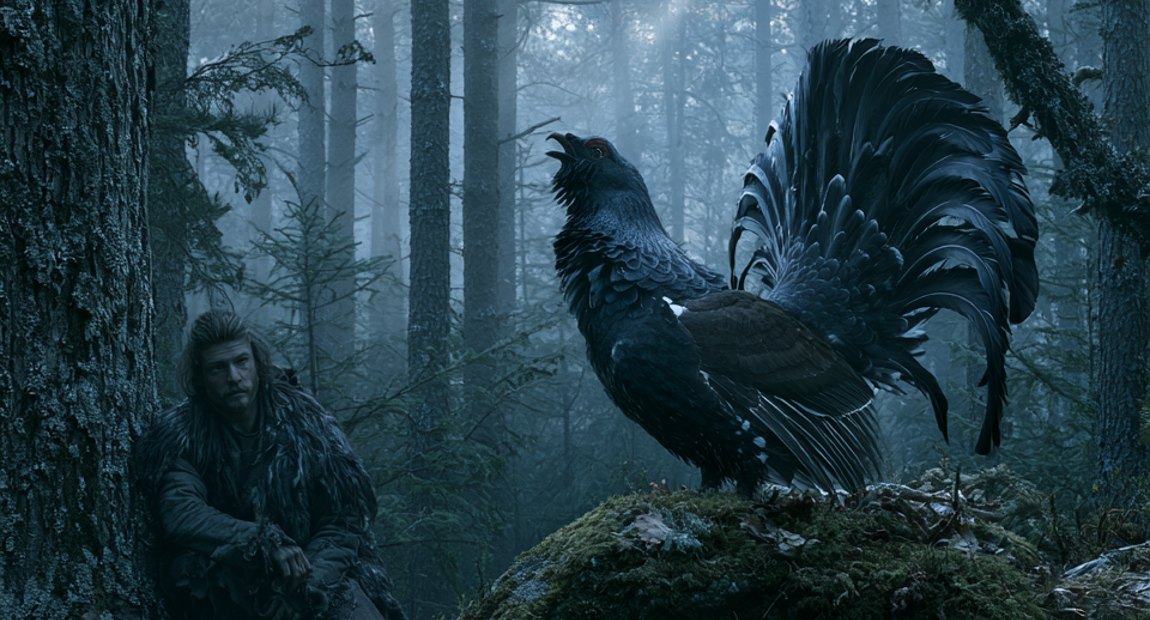
Gullinkambi, “Gold-Comb”, is the rooster who, according to the Old Norse poem Völuspá, crows among the Æsir and wakes Odin’s warriors for the last battle. He is not alone. In the same breath the fair-red Fjalar crows in the Gallows-Wood among the giants, and a nameless soot-red rooster crows beneath the earth in the halls of Hel. Three wake-up calls in three worlds, and then the hound Garm howls. Here is what the stanzas actually say, what later writers added, and which real roosters crowed in the Viking Age.
Anyone who has spent a night on a farm knows the sound. Long before dawn, somewhere behind the barn, a rooster tears the darkness open. No thunder, no trumpet, just that hoarse, shameless crowing that says: sleep is over. The poet of Völuspá took exactly this everyday noise and set it at the opening of the end of the world. Ragnarök does not begin with an army or a wall of fire. It begins with three roosters.
It is one of the quietest and most unsettling moments in the whole of Eddic poetry. The seeress has just described the old giantess in the Iron-Wood raising the brood of wolves, the darkened sun and the summers full of storms. Then she cuts away, like a film split across three screens: a mound in giant country, the hall of the Host-Father, the world beneath the earth. The same sound in every one of them. Somebody wakes up everywhere.
Völuspá, “the prophecy of the seeress”, is the opening poem of the Poetic Edda. It survives mainly in the Codex Regius, written around 1270, and in the slightly earlier compilation Hauksbók, with further stanzas quoted by Snorri Sturluson. In the standard editions (Neckel and Kuhn, Guðni Jónsson) the rooster stanzas are numbered 42 and 43; older translations that rearrange the poem put them elsewhere. In Old Norse they read:
Sat þar á haugi ok sló hörpu / gýgjar hirðir, glaðr Eggþér; / gól of hánum í galgviði / fagrrauðr hani, sá er Fjalarr heitir.
Gól of ásum Gullinkambi, / sá vekr hölða at Herjaföðrs; / en annarr gelr fyr jörð neðan / sótrauðr hani at sölum Heljar.Völuspá 42–43, Old Norse text after the edition of Guðni Jónsson
Henry Adams Bellows put them into English verse in 1923:
On a hill there sat, and smote on his harp, / Eggther the joyous, the giants’ warder; / Above him the cock in the bird-wood crowed, / Fair and red, and Fjalar his name.
Then to the gods crowed Gollinkambi, / He wakes the heroes in Othin’s hall; / And beneath the earth does another crow, / The rust-red bird at the bars of Hel.Völuspá 42–43, transl. Henry Adams Bellows (1923, public domain)
Bellows is lovely, but he smooths a few things. “In Othin’s hall” is his interpretation of at Herjaföðrs, “at the Host-Father’s”, and “at the bars of Hel” renders at sölum Heljar, “at the halls of Hel”. That is the entire scene: eight long lines, three roosters and a giant playing the harp. Immediately afterwards comes the refrain that runs through the end of the poem: Garm howls loudly before Gnipahellir, the fetter breaks and the wolf runs free. The roosters are the last thing that happens before the monsters break loose. They are the waking; what follows is the war.
The name is transparent. Gullinn means “golden”, kambr means “comb”. Gullinkambi is the “Gold-Comb”, the golden-crested one. A rooster with a comb of gold fits a divine world in which almost everything precious gleams: Freyr’s boar Gullinbursti (“Gold-Bristle”), Sif’s golden hair, the golden gaming pieces the surviving gods find again in the grass after Ragnarök.
It pays to read the line closely. Gullinkambi crows of ásum, “over” or “among the Æsir”, and he wakes the hölðar – a word for free, high-born men, here simply heroes – at Herjaföðrs, at the Host-Father’s. Herjafǫðr is one of Odin’s many names. That this means Valhalla, and that the sleepers are the Einherjar, the slain warriors in Odin’s hall, is the obvious reading and the one scholars generally take. Strictly speaking, though, the word Valhalla does not occur in the stanza.
The logic is still compelling. According to Grímnismál and Snorri, Odin gathers the best of the dead in Valhalla so that they will stand with him at the end. Every day they fight in the courtyard, fall, rise again and drink together at night. They are waiting, and someone has to tell them that the waiting is over. In Snorri’s version a horn does it: Heimdall blows the Gjallarhorn. Völuspá has the horn too, a few stanzas later, but the very first signal is a bird.
Gullinkambi does have a likely relative. The second lay of Helgi Hundingsbani contains one of the most moving scenes in the Edda: the dead hero Helgi returns from his burial mound and spends one night with his wife, the valkyrie Sigrún. At dawn he has to go. In stanza 49 he says, in effect, that he must be west of the sky-bridge before Salgofnir wakes the victory-host – áðr Salgofnir sigrþjóð veki. We tell the whole story in Helgi and Sigrún.
Salgofnir is clearly a rooster, and the “victory-host” are the dead in Odin’s hall. The first part of the name, salr, means “hall”; the second part, -gofnir, is obscure, so renderings like “hall-crower” are educated guesses rather than secure translations. Because Salgofnir does the same job as Gullinkambi, many handbooks treat the two as one bird. That is entirely possible – but it is a scholarly identification. No medieval text says “Gullinkambi, who is also called Salgofnir”.
Back to Völuspá. The second rooster does not sit with the gods but with the giants. His name is Fjalarr, and he is fagrrauðr, “fair-red” or “bright red”. He crows í galgviði, in the “Gallows-Wood”. Bellows’ “bird-wood” follows a variant reading with gagl-, a word for goose or bird; most modern editions keep the gallows. Gallows and forest: it sounds like a place at the edge of the world where nobody wants to spend the night.
Above the rooster, on a mound, sits Eggþér striking his harp. He is called gýgjar hirðir, “herdsman” or “keeper of the giantess”. The stanza does not say which giantess; many readers think of the old one in the Iron-Wood from stanza 40 who rears the wolf-brood. Eggþér appears nowhere else. Bellows compared him to Heimdall, watchman of the gods, and to Surt, who guards the fire-world: a sentinel on the other side. And he is glaðr, glad. While the gods have to be shaken awake, someone on the giants’ side is already sitting outside, cheerfully making music. It is one of the coldest touches in the poem.
Then there is the name Fjalarr, which the Edda uses with remarkable enthusiasm:
None of these figures has anything to do with the rooster beyond the name. What Fjalarr means is disputed; a sense like “hider” or “deceiver” has been suggested, but it is not certain. So if you read that the Ragnarök rooster is “the same Fjalar who killed Kvasir”, you are looking at a mix-up.
The third rooster has no name at all. He is sótrauðr: sót is soot, rauðr red. Bellows wrote “rust-red”, the German translator Karl Simrock “black-red”. The colour seems to be a dark, burnt red, the counterpart to the shining comb of the gods’ rooster and to Fjalar’s bright red. He crows fyr jörð neðan, “beneath the earth”, at sölum Heljar, “at the halls of Hel”.
In the Edda, Hel is both a place and a person: the realm of the dead and Loki’s daughter who rules it. Those who did not fall in battle went there, at least in Snorri’s later and tidier scheme. Hel’s dead have a part to play at Ragnarök: according to Völuspá 51 a ship comes over the sea carrying “the people of Hel”, with Loki at the helm. The soot-red rooster does not simply wake sleepers. He wakes an army that will march against the gods.
Which gives us the image you will find in nearly every retelling: three roosters, three worlds – the gods above, the giants out on the edges, the dead below. The poem does not spell that out, but it is a fair reading. Fjalarr crows in giant country, Gullinkambi among the Æsir, the third beneath the earth. The poet clearly built the scene as a triad, and the colours underline it: golden, bright red, soot-red. There is no need to load it with more symbolism than that.
A fourth rooster of Norse poetry is often blended with Gullinkambi: Víðófnir, also spelled Víðópnir. He comes from Fjölsvinnsmál, part of the poem cycle now usually called Svipdagsmál. The young hero Svipdag stands before an enchanted fortress and questions its watchman, Fjölsviðr. One of his questions concerns the rooster high in the tree Mímameiðr, glittering with gold. The watchman names him Víðófnir and says he shines like lightning on the branches. Mímameiðr, “Mímir’s tree”, is generally identified with Yggdrasil.
What follows is a wonderful chain of impossibilities. The fortress hounds can only be distracted by throwing them the wing-meat of Víðófnir. The rooster can only be killed with the weapon Lævateinn, which the giantess Sinmara keeps in a chest with nine locks. Sinmara will only hand it over in exchange for a bright “sickle” – a tail feather of the rooster. To kill the bird, in other words, you must already have killed it. Bellows aptly called it a circle of impossibilities.
Two caveats. First, Fjölsvinnsmál survives only in paper manuscripts, none older than the seventeenth century, and many scholars consider it a late medieval composition. It is not a witness to Viking Age belief. Second, whether Víðófnir is “really” Gullinkambi or Fjalarr, as Bellows wondered, cannot be proven. All we can say is that a later poet took the idea of a golden rooster in the World Tree and ran with it. In the older sources, the crown of Yggdrasil belongs to an eagle and the hawk Veðrfölnir – more on that in the eagle in Yggdrasil’s crown.
A poet could have chosen any number of signals for the end of the world. This one chose a rooster, and that is no accident. The rooster is the bird of the threshold. It crows before it gets light, at the exact moment when night is still there but day is already certain. For a poem about the end of an age, that is a powerful image: the night of the old world is over, but the new day has not yet arrived.
It is worth looking beyond the North here. Christianity, too, knew the rooster as a herald of day and a warning voice. In the Gospels it crows after Peter’s denial. The late Roman poet Prudentius opens a hymn for cockcrow with the bird as “messenger of the day”, a figure for Christ who rouses the sleepers. Since Völuspá was only written down in the thirteenth century, and Christian influence is debated for parts of the poem, some scholars have wondered whether the roosters owe something to Christian imagery too. It cannot be proven. A rooster announcing the day is so obvious an image that any farming culture can arrive at it independently. Our verdict: possible, but open.
Let us leave mythology and walk into the farmyard. Chickens were not a Viking novelty in Scandinavia; in the south they were around in the Iron Age before. But they were never a main livestock animal. Cattle, sheep, goats and pigs carried Viking agriculture; chickens scratched around on the side.
And in the great ship burials? At Gokstad, alongside horses and dogs, there were even remains of a peacock, an exotic luxury bird. A rooster in the Oseberg or Gokstad graves is not something we can document; anyone who claims it should name the source. The most important evidence for roosters in ritual does not come out of the ground. It comes from written accounts by outsiders.
The most famous of these comes from Ahmad Ibn Fadlan. An envoy of the caliph in Baghdad, he travelled to the Volga in 921–922 and watched the funeral of a chieftain of the Rus, the Scandinavian-rooted traders and warriors of the East. His report is brutal and vivid, and in the middle of it two chickens appear.
First comes a scene at a door-frame. The slave girl who is to die with her master is lifted three times above the frame and says she can see her dead parents and her master in paradise. Then she is handed a hen. In James Montgomery’s translation the line is terse: she cut off its head and threw it away, and the hen itself was thrown onto the ship. Later, as the ship is prepared, the men slaughter a dog, two horses and two cows, and also a cock and a hen, and cast them onto the ship beside the dead man.
Ibn Fadlan does not say what any of this meant. He did not speak the language; he describes what he saw. In his notes Montgomery points to the possible role of the cock and hen as mediators with the spirit world – an interpretation, not a statement from the source. What is certain is this: at one tenth-century funeral, a cock and a hen were among the animals that went with the dead, and a hen had its own part in the ritual at the threshold of the otherworld.
Ibn Fadlan is not alone. Around 1015 Bishop Thietmar of Merseburg wrote about a sacrificial festival at Lejre on Zealand: every nine years, in January, the Danes supposedly sacrificed ninety-nine people and as many horses, together with dogs and roosters – the roosters, Thietmar notes, offered “in place of hawks”. Thietmar never went to Lejre; he wrote from hearsay and with an obvious Christian agenda. The National Museum of Denmark points out that his account was long dismissed as invention, though finds from places such as Trelleborg and Tissø have made sacrificial practices at least more plausible.
The third witness is the Byzantine emperor Constantine VII Porphyrogenitus. In his “De administrando imperio”, written around 950, chapter 9 describes the Rus travelling down the Dnieper. On an island he names after Saint Gregory, he says, they made offerings beneath a gigantic oak: live roosters, along with arrows, bread and meat. They cast lots over the roosters to decide whether to slaughter them, eat them, or let them go alive.
Three outside observers, then – an Arab diplomat, a Saxon bishop, a Byzantine emperor. None explains the belief behind the act, and each sees through his own lens. Taken together, though, they show that roosters belonged among the animals the Norse world sacrificed, and precisely at moments of passage: death, a dangerous journey, the turning of the year.
Perhaps the strangest rooster story in the North comes from Saxo Grammaticus, writing around 1200, in the first book of his Gesta Danorum. The legendary king Hadingus is led underground by a mysterious woman who carries fresh green plants in the middle of winter. They pass through mist, cross a raging river full of weapons and see two armies locked in endless battle. At last they reach a high wall that cannot be climbed.
The woman wrings the neck of a rooster she has brought along and tosses it over the wall. In Oliver Elton’s English translation the bird immediately came back to life and crowed merrily. Whatever lies beyond that wall, it is a land where death is not final.
Saxo was a Christian scholar who retold old material very freely, and we should not set his scene beside Völuspá as if they came from one mould. But the parallel is hard to miss. A rooster is killed and crows on in the otherworld. In Ibn Fadlan a hen is beheaded and thrown into the death-ship. In Völuspá a soot-red rooster crows in the halls of Hel. In the North the rooster seems to have been a bird that could cross between worlds.
One question reaches our workshop again and again: is the rooster on top of the church tower a hidden Gullinkambi?
Nor is there any Viking Age carving or painting that can be shown to depict Gullinkambi. The Swedish scholar Ebbe Schön suggested that the bird at the top of the tree on the Överhogdal tapestries might be Gullinkambi. It is a stimulating idea, but a single scholar’s proposal, not an established interpretation.
Gullinkambi does not wake you for breakfast; he wakes you to stand up when it matters – a fine motif for a fresh start. If you like your motifs close to the sources, here is what we suggest:
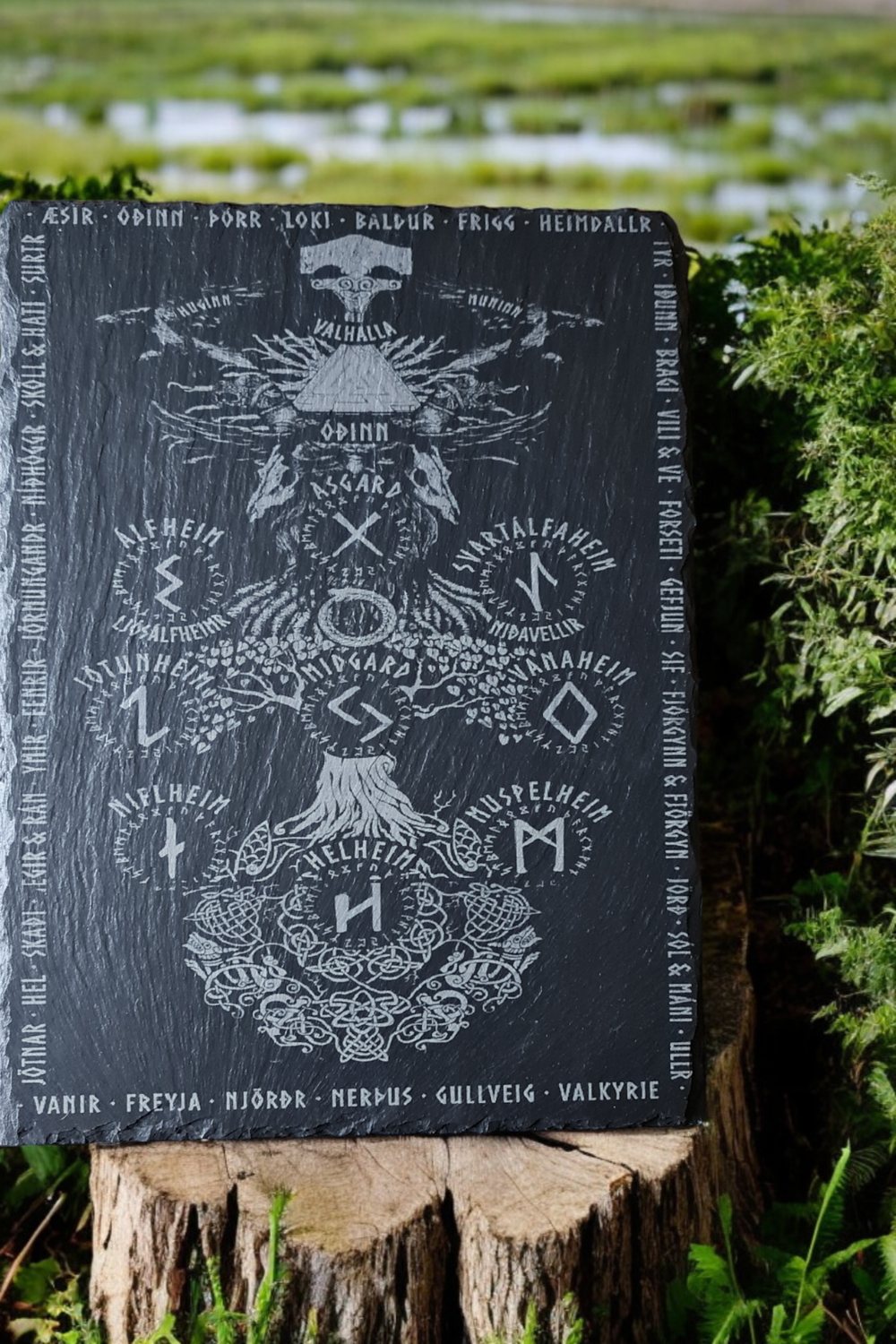
On natural slate, the dark ground suits the soot-red rooster of Hel; on glass, the golden comb comes alive when light falls through it. If you have your own idea, send it to us via a custom engraving request. We will tell you honestly what is attested and what is modern design.
Who is Gullinkambi in Norse mythology? Gullinkambi (“Gold-Comb”) is a rooster who, according to Völuspá 43, crows among the Æsir and wakes the heroes at the Host-Father Odin’s. This marks the start of Ragnarök; the heroes are almost certainly the Einherjar in Valhalla.
What are the names of the three roosters of Ragnarök? Gullinkambi among the gods, Fjalarr in the Gallows-Wood among the giants, and a nameless soot-red rooster in the halls of Hel. All three appear in Völuspá 42–43.
Is Fjalar the rooster the same as Fjalar the dwarf? No. The name occurs several times in the Edda – for a dwarf who killed Kvasir, for a giant in Hávamál, and for the rooster. They only share the name.
Does Snorri mention Gullinkambi in the Prose Edda? No. Snorri retells Ragnarök in detail in Gylfaginning but leaves the roosters out. Völuspá is the only source.
What is the difference between Gullinkambi and Víðófnir? Víðófnir is a golden, shining rooster in the tree Mímameiðr from the late poem Fjölsvinnsmál. Whether he is the same bird as Gullinkambi is unproven.
Did the Vikings sacrifice roosters? Several outside accounts suggest so: Ibn Fadlan saw a cock and a hen killed at a Rus funeral on the Volga, Thietmar of Merseburg mentions roosters at the sacrifice in Lejre, and Constantine VII describes live roosters offered by the Rus on the Dnieper.
For courage. For remembrance. For legends that live on.
Sköll & Hati · Fenrir – the wolf · Niðhöggr – the gnawer at the root · Valhalla · Heiðrún – the mead-goat.
All Beings & Creatures articles →
On the roof of the hall of the slain stands a goat, and from her udder flows not a drop of milk but clear, bright mead …
Read more →Two black birds perched on the shoulders of a one-eyed god - few images are as tightly bound to Odin as this one. Their …
Read more →Before Brokkr and Sindri forged the hammer, others were at work: the sons of Ívaldi. Three wonders came out of their …
Read more →Far below, where the roots of the World Tree reach down into cold and darkness, lies a creature that never rests …
Read more →