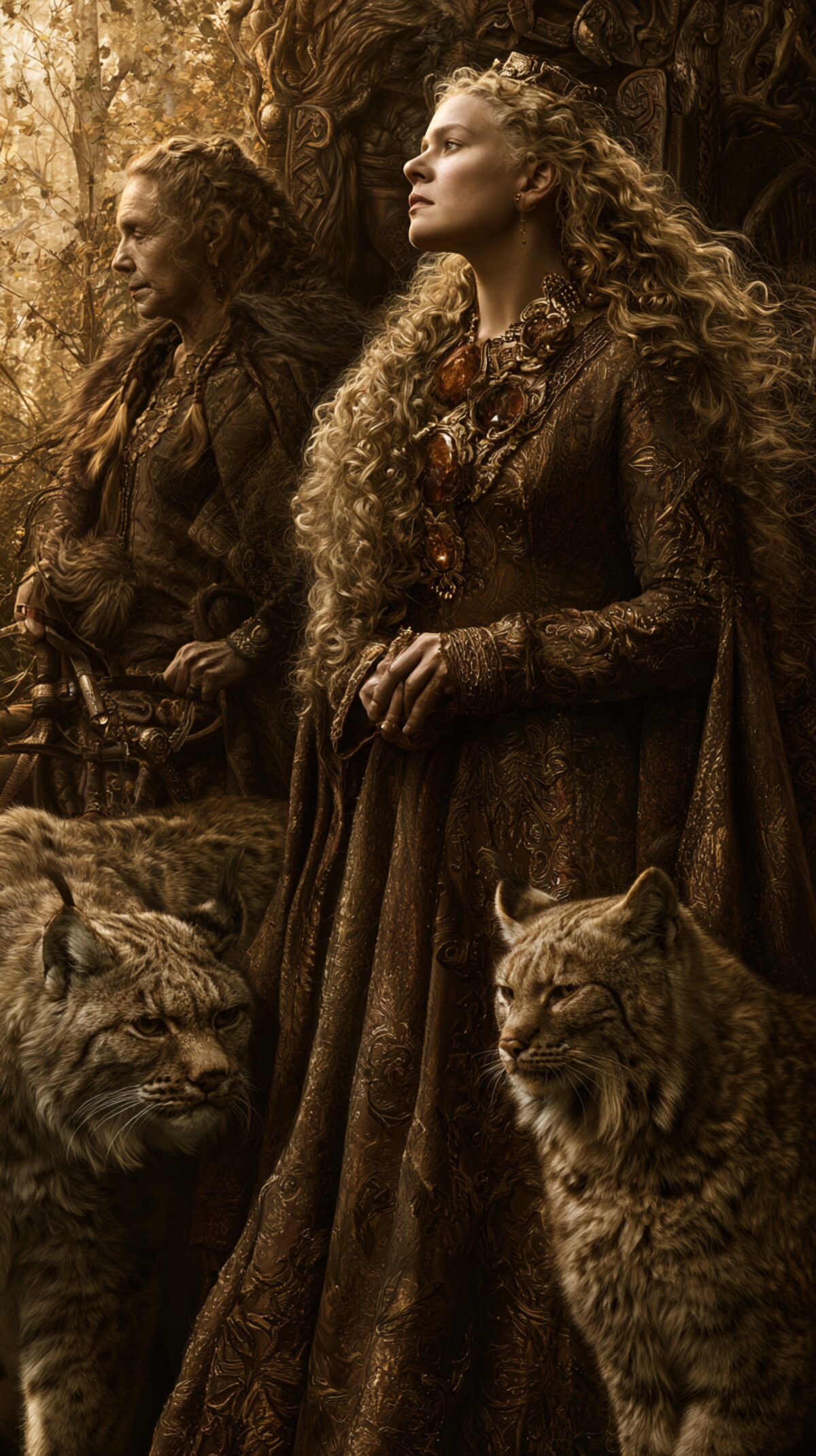
Few animals combine tenderness and stubbornness like the cat – and of all the gods, it is the warlike, passionate Freyja who lets two of them draw her across the sky. Yet beside the myth stands hard daily life: cats hunted mice on farm and ship, and their pelts were traded. We look honestly – what the sources say, what lies in the ground, and what is modern invention.
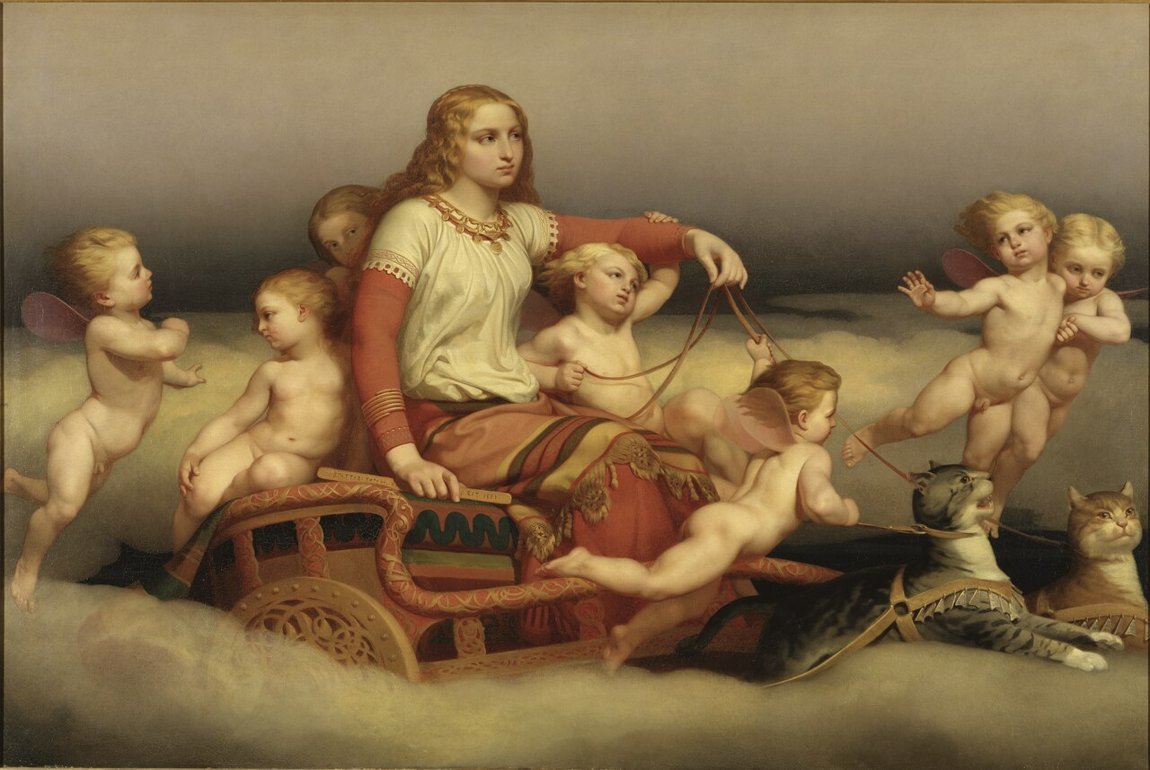
When the North speaks of cats, one thinks first of Freyja. Freyja, the goddess of love, fertility, of seiðr and – often forgotten – of death, travels in a chariot drawn by two cats. It is one of the most singular images in all Norse tradition: no horses, no goats as with Thor, but two cats in harness.
The source is Snorri Sturluson. In his Prose Edda (Gylfaginning) he describes how Freyja rides to Baldr's funeral, and he names her cat team more than once as a fixed attribute. For Snorri the cats belong to Freyja as naturally as the ravens belong to Odin. The charm of the image lies in its contradiction: a mighty goddess drawn not by wild beasts, but by animals one can hardly force to do anything. Anyone who has ever tried to carry a cat somewhere it did not want to go can guess what authority Freyja must have had.
Then Odin rode on Sleipnir, and Freyja drove in her chariot with the cats.after Snorri Sturluson's Prose Edda (Gylfaginning), public-domain translation
What the cats mean, Snorri does not tell us. Interpretations abound – from a link to fertility and the domestic sphere to the cat's nearness to magic. But all of that is interpretation, not tradition. Only one thing is certain: Freyja drives with cats, and the text leaves us with one of the loveliest riddles of the North.
That Freyja in particular is given a cat team suits her nature. She is no tame goddess: she claims half of the slain, she commands seiðr, the form of sorcery even Odin learns from her, and she is at once the goddess of love and longing. The cat – tender and aloof, purring and clawed – is a creature of the same in-between world. It can be stroked, but not owned.
In many cultures the cat is the animal of women, of the home and of the hidden. Whether the Norse felt the same we cannot be sure – but the choice of team is remarkable. Thor thunders with goats, Freyr sails and rides the boar, Odin has horse, ravens and wolves. Freyja, however, guides an animal that cannot be guided. That is no accident, but a portrait of character painted in images.
Beside the goddess stands daily life, and there the cat was above all one thing: useful. A Viking-Age farm lived off its stores – grain, flour, malt, dried fish. And stores draw mice and rats. Without a reliable hunter, a granary could be quietly plundered over the winter. The cat was the most practical solution people knew: independent, low-maintenance, always on duty.
For that reason cat bones turn up wherever people lived and stored goods – in settlements, in towns, in refuse pits. The cat was part of the farm's economy, not an exotic creature. It was not equally common everywhere, and for a long time it was nowhere near as ubiquitous as today. But where grain lay, a mouser was worth its weight in gold.
What held on the farm held on the ship too. Anyone travelling for weeks with provisions wanted no rodents aboard eating stores, gnawing ropes and carrying disease. The ship's cat is an old and widespread custom of seafaring, and it is likely the Norse took cats along.
Here honesty is called for: a direct, unambiguous find of a "Viking ship's cat" is hard to produce, because a ship rarely ends up in the ground with its living inventory. But the spread of the cat across the North Atlantic to Iceland and beyond argues that cats travelled with people – otherwise they would not have arrived there. The ship's cat of the Viking Age is therefore well founded, even if we read it more from the animal's spread than from a single grave.
Archaeology shows the cat more soberly than the myth suggests. Cat bones appear in Viking-Age settlement and town layers, in refuse pits, and occasionally in connection with burials. In some graves animals were placed as grave goods, and cats are among them – a hint that the animal held a certain significance, though we cannot securely interpret every single case.
The distinction matters: not every cat bone is a cult or grave find. Most come simply from daily life – from kitchen waste, from a town's rubbish, from the remains of fur processing. And it is precisely these unspectacular finds that most honestly reveal the cat's real place: a practical one.
Here an honest look pays off, even if it stings: in the Viking Age cats were kept not only as mousers but also killed for their fur. The Danish material, with its cut and skinning marks, leaves little doubt. Cat fur was a warm, soft material – for trim, lining, small pieces of pelt. In a world without surplus, whatever brought use was used.
That does not fit the image of the purring lap cat, and it should not be glossed over. In the Viking Age the cat stood closer to a working animal than to a family member. Only gradually – as the increase in size suggests – did it rise from tool to cared-for companion. Anyone who takes the Norse world seriously must hold both faces together: the animal of the goddess, and the animal whose fur was sold.
This should not be pictured as cruelty but as the matter-of-course of an age that let no animal die unused. The same cat that caught mice in life still gave, in death, a warm piece of fur for a collar or hood. That we find this strange today says more about our comfort than about the hardness of the Norse. And it makes the cat's place of honour in myth all the more striking: an animal that was used for its pelt was at the same time given a place before the chariot of the mightiest goddess.
A second time the cat meets us in one of the most famous stories of all. On his journey to the giant's stronghold of Útgarða-Loki, Thor must pass a series of trials. One of them sounds absurdly easy: he is to lift the king's great grey house cat. Thor grips it – and barely manages to raise a single paw from the floor. The strongest god in the world is defeated by a cat.
Later he learns the truth: it was no cat at all. Útgarða-Loki had deceived Thor through illusion, and the animal was in reality the Midgard Serpent, which lies coiled around the whole world. That Thor lifted one of its paws had terrified the giants to the core – for he had nearly dragged the World Serpent out of the sea. Here the cat is no ordinary animal but a mask for the greatest monster of the cosmos. It is telling that the giants chose, of all creatures, a cat to make something monstrous look harmless.
The cat is not a native wild animal of the North but a newcomer. Its wild ancestor comes from the Near East and North Africa, and from there it spread with farmers, traders and seafarers across the world. When the Norse, in the early Middle Ages, built out their routes across the Baltic, the Atlantic and the rivers of Eastern Europe, the cat was taken along almost as an afterthought – a mouser that caught its own food.
Genetic studies of ancient cat bones show that certain cat lineages spread along the great trade and sea routes; one of these lineages has even been identified at an early-medieval harbour site in the Baltic region. The people who carried silver, furs and slaves overseas carried cats too. That cats reached Iceland is the best indirect proof: no animal arrives on a treeless island in the North Atlantic by itself. Whoever found a cat there had an ancestor who had come by ship.
As familiar as the cat is to us today, it was far from the most important animal on a Viking-Age farm. Cattle, sheep, goats, pigs and horses stood at the centre of the economy, and the dog was a hunting, herding and guard companion. The cat was rather the quiet specialist in the background: not the animal one lived off, but the animal that protected what one lived off – the stores.
One should therefore not imagine the Viking-Age cat as a pet strolling about everywhere, but as a useful, half-independent creature that people tolerated, fed, occasionally placed in graves, and whose fur they used. It is precisely this in-between position – between wild and domestic, between tool and companion – that gives it its particular appeal. It never fully submitted to humans, and probably for that very reason it ended up in myth not as a beast of burden, but before the chariot of a goddess.
Beyond the Viking Age the cat runs through Norse folk belief. It is seen as an animal between the worlds, a weather-sign, a creature with a will of its own that one had better not offend. Much of this is younger than the Viking Age and cannot simply be projected back – the folk belief of later centuries is not the same as the belief of the Norse around the year 1000.
Even so, the line is remarkably stable: the cat remains the animal that cannot be wholly tamed. This double nature – near and far, useful and aloof – is probably the real reason the cat was tied over the centuries to goddesses, to sorcery and to the hidden. Not because some old doctrine prescribed it, but because the animal itself is like that.
Draw the threads together and an honest picture emerges. The cat came to the people of the North as a mouser, earned its place at the stores and aboard ship, and was at the same time used for its fur. Over the centuries its relationship to humans changed: from a tolerated working animal it became – measurable in the growing bones – a better-fed, more cared-for companion. The myth gave the same cat a place of honour in the sky, before Freyja's chariot.
This coexistence makes the cat one of the most honest animals of the Norse world: not a pure symbol, not a mere tool, but both. That is exactly why it is worth resisting the temptation to sentimentalise Freyja's team, and instead to think of it together with daily life – the hunter in the grain house, the cat aboard, the pelt in the chest.
Freyja · Utgarda-Loki · The Wolf in the North.
All Beings & Creatures articles →
Far below, where the roots of the World Tree reach down into cold and darkness, lies a creature that never rests …
Read more →Few animals are as closely bound to the North as the raven. It perches on Odin's shoulders, circles above the …
Read more →Between crown and root of the World Ash Yggdrasil scurries a small, restless creature: Ratatoskr, the squirrel. It …
Read more →