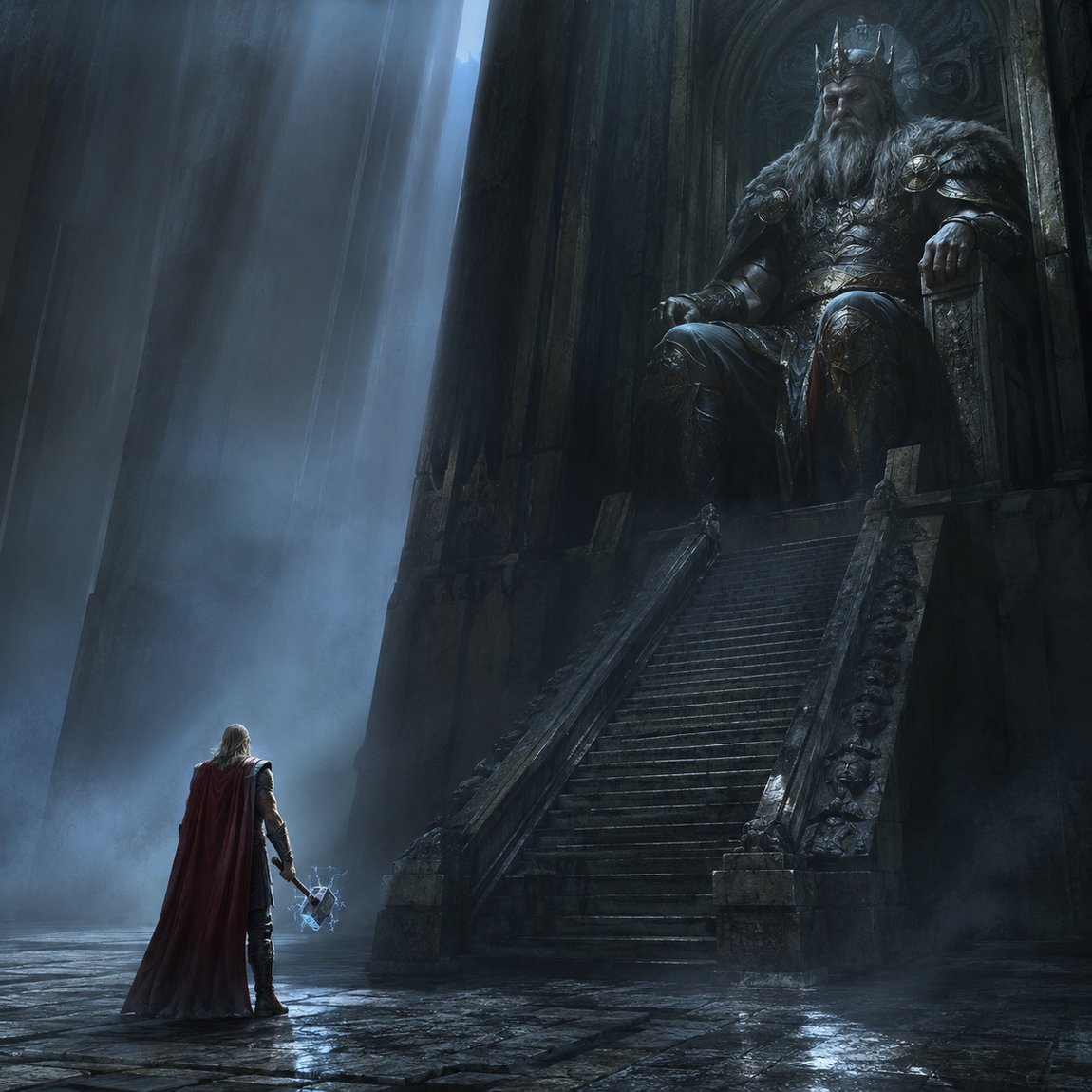
Utgard-Loki is the giant king of Útgarðr who humiliates Thor with illusions in Snorri Sturluson's Gylfaginning (chapters 44–47, c. 1220). First the thunder god sleeps inside the glove of the giant Skrymir, fails to open a food bag and lands three useless hammer blows; then, in the giant's hall, he loses a drinking contest, cannot lift a cat and is forced to one knee by an old woman. Next morning comes the twist: Skrymir was Utgard-Loki, and Thor's opponents were the sea, the Midgard Serpent and old age itself. Here is the full story, its older echoes and what scholars make of it.
Picture the mightiest god in the northern world. Giants flee from his hammer; mountains crack when he strikes. Now picture him in a stranger's hall, gulping at a horn that refuses to empty, straining to lift a house cat, and finally pinned to one knee by a wrinkled old nurse while a hall full of giants smirks. That is Thor at the court of Utgard-Loki – the longest, and arguably the funniest, Thor story to survive from the Middle Ages. And the punchline is that Thor never actually lost. He simply could not see what he was up against.
One thing first, because it trips up almost everyone: Utgard-Loki (Old Norse Útgarða-Loki, roughly "Loki of the Outer Enclosures") is not the Loki of the Æsir. The familiar trickster is actually travelling with Thor in this tale and competes against the giants himself. Whether the two figures were once connected is a genuine open question, and we will come back to it.
Our older post "Thor and Skrymir" has now been folded into this article, so the Skrymir episode – the glove, the knotted food bag, the three hammer blows – is told here in full. It belongs here anyway, because, spoiler alert from the thirteenth century, Skrymir and Utgard-Loki turn out to be the same person.
We know the complete story from a single text: Gylfaginning ("the deluding of Gylfi"), the first main part of the Prose Edda written by the Icelander Snorri Sturluson around 1220. It is framed as a dialogue: the Swedish king Gylfi, disguised as "Gangleri", enters a splendid hall and questions three mysterious figures about the gods. The Utgard episode fills chapters 44 to 47 in Anthony Faulkes's edition.
It is triggered by Gangleri asking whether Thor ever met anything that overpowered him by strength or by magic. The reply comes with a wink: few would care to tell that story – but some things certainly proved hard for him.
Thor is travelling in his goat-drawn chariot, with Loki along for the ride. One evening they stop at a farmer's house. With little to eat, Thor slaughters his two goats – named elsewhere by Snorri as Tanngrisnir and Tanngnjóstr – has them cooked and invites the family to share the meal. His only condition: every bone must be thrown onto the goatskins spread beside the fire.
The farmer's son Þjálfi ignores it. He splits a thigh bone with his knife to get at the marrow. At dawn Thor raises his hammer over the skins and the goats spring back to life – but one is lame in a hind leg. Thor knows at once that someone has been careless. His brows sink over his eyes, he grips the hammer shaft until his knuckles whiten, and the family begs for mercy. As compensation they hand over their two children, Þjálfi and his sister Röskva, who serve Thor from then on.
Snorri calls Þjálfi "the fastest-footed of all men" – keep that in mind. Intriguingly, the eddic poem Hymiskviða also knows the lame goat and the children given as compensation, but in the usual reading blames Loki for the damage. The goat story clearly circulated in more than one version.
The goats stay with the farmer. Thor, Loki, Þjálfi and Röskva continue east on foot towards Jötunheim, the land of the giants. They cross "the deep sea", go ashore and enter a vast forest.
At nightfall they look for shelter and find an odd building: a large hall whose doorway is as wide as the whole gable, with a narrow side room. Around midnight the ground shakes violently. The companions retreat into the side room while Thor sits in the doorway, hammer in hand. Until morning they hear a tremendous rumbling and groaning.
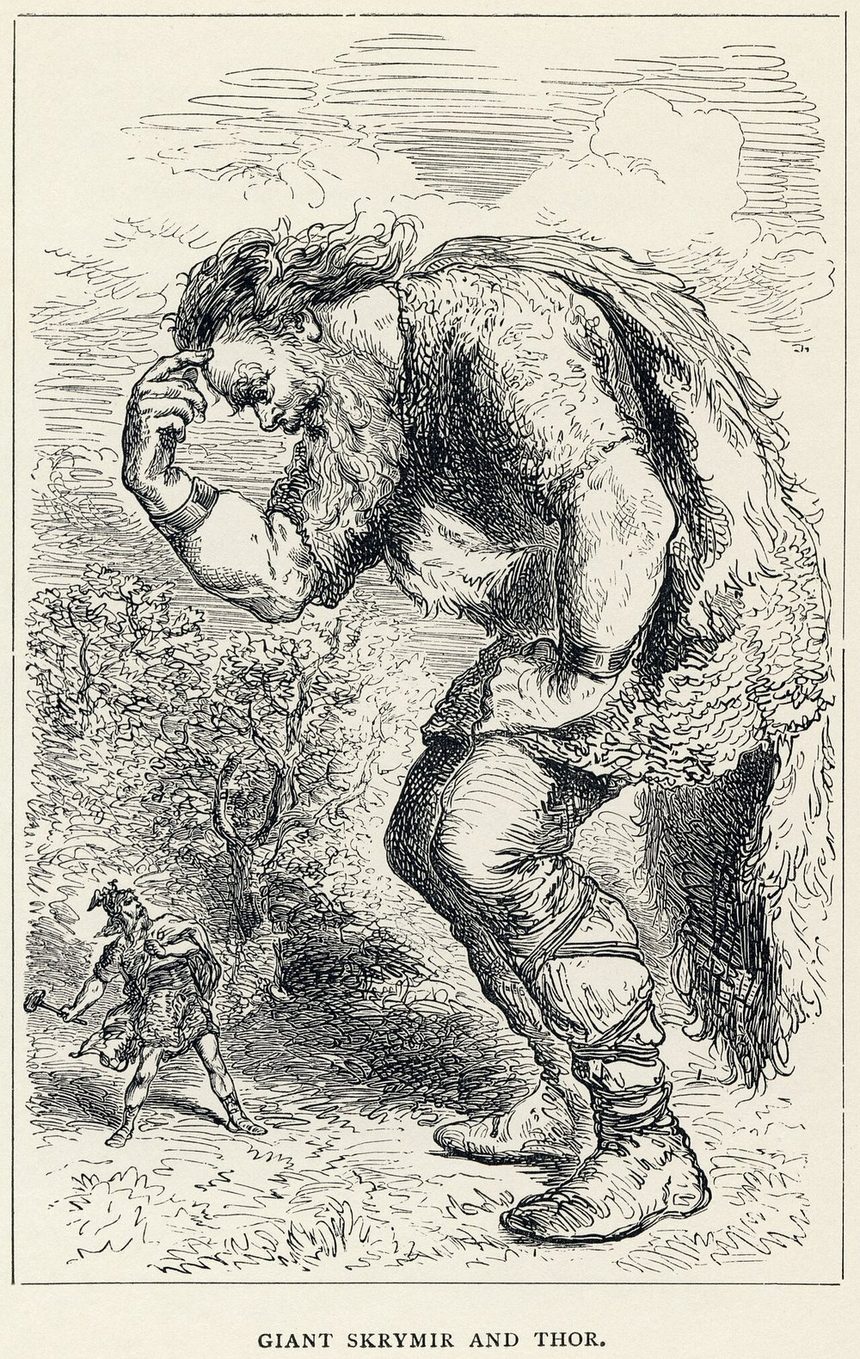
Daylight solves the mystery. Lying nearby in the forest is a man of colossal size, snoring – that was the earthquake. The giant wakes, and Snorri notes that on this one occasion Thor did not dare to strike with his hammer. He asks the stranger's name instead.
The giant is called Skrymir (Old Norse Skrýmir), usually explained as "show-off" or "braggart", though the etymology is not certain. He already knows who Thor is, and then asks whether Thor has been dragging his glove around. The "hall" was Skrymir's mitten, and the side room its thumb.
Skrymir offers to travel with them and suggests they pool their provisions. Thor agrees. The giant ties everything into his own bag, slings it over his shoulder and strides ahead. In the evening he lies down under a great oak, tells the others to help themselves from the bag, and falls asleep.
Thor sets to work on the knots. He pulls and twists – and cannot loosen a single strap. Furious, he grabs Mjöllnir and strikes the sleeper on the head.
Skrymir wakes and drowsily asks whether a leaf has fallen on his head, and whether they have eaten yet. Thor mutters something and lies down under another oak. At midnight, with the giant snoring again, Thor strikes a second time, so hard that the hammer sinks deep into the skull. Skrymir: did an acorn just drop on him? Shortly before dawn comes the third blow, with all Thor's strength, driving the hammer up to the shaft into the giant's temple. Skrymir sits up, strokes his cheek and supposes there must be birds in the tree above him dropping bits of twig on his head.
The hammer, symbol of divine striking power, seems to achieve nothing. Skrymir gets up and offers advice: in Útgarðr there are bigger men than he, and Thor had better not talk big there – Utgard-Loki's retainers will not put up with boasting from such little fellows. Best to turn back; if not, head east, while his own road leads north. He shoulders the food bag and vanishes into the forest. Snorri adds drily that there is no report of the gods wishing him a happy reunion.
Around midday the four see a stronghold on a plain, so tall they have to crane their necks to see over it. Thor cannot open the barred gate, so they squeeze between the bars – gods wriggling through a fence like children.
Útgarðr means "outer enclosure": what lies beyond the ordered, fenced-in world. Its counterpart is Midgard, the "middle enclosure" of humankind. Modern scholars have built a whole inside-versus-outside world model on this pair – stimulating, but debated, because the sources do not use the terms that systematically. For the larger picture, see our post on the nine worlds.
Inside, huge men sit on two benches. King Utgard-Loki takes his time to greet them, then asks with a sneer whether this little lad is really the famous Öku-Þórr, "Charioteer Thor". House rule: no one stays here who is not better than everyone else at some skill.
Loki goes first. Nobody, he claims, can eat faster than he can. Utgard-Loki summons a man called Logi. A long trough full of meat is set on the floor, Loki sits at one end, Logi at the other, and both eat as fast as they can, meeting exactly in the middle. Loki has stripped all the meat from the bones. Logi has eaten the meat, the bones and the trough. Lost.
Next Þjálfi wants to race. Utgard-Loki calls a young man named Hugi. In the first run Hugi is so far ahead that he reaches the end, turns round and meets Þjálfi coming the other way. In the second, a long bowshot still separates them at the finish. In the third, Hugi has already turned at the end when Þjálfi is only halfway down the course.
Anyone with a little Old Norse can already smell a rat. Logi means "flame". Hugi is related to hugr, "mind, thought" – the same word as in Odin's raven Huginn. Snorri hides the solution in plain sight, and the audience gets to feel cleverer than Thor.
Now it is the guest of honour's turn. Thor chooses a drinking contest. A cupbearer brings a long horn: a good drinker empties it in one draught, some need two, and nobody is so feeble that it takes three.
Thor is very thirsty and drinks until he runs out of breath. When he looks in, the level has barely moved. The second draught achieves even less. After the third, with everything he has, there is at last a visible difference – but the horn is nowhere near empty. Thor hands it back.
Utgard-Loki ups the ante: the young lads here lift his cat off the floor for fun. A large grey cat leaps in. Thor puts his hand under its belly and heaves, but the cat simply arches its back as high as he lifts. When he stretches as far as he possibly can, one paw leaves the floor. Just one.
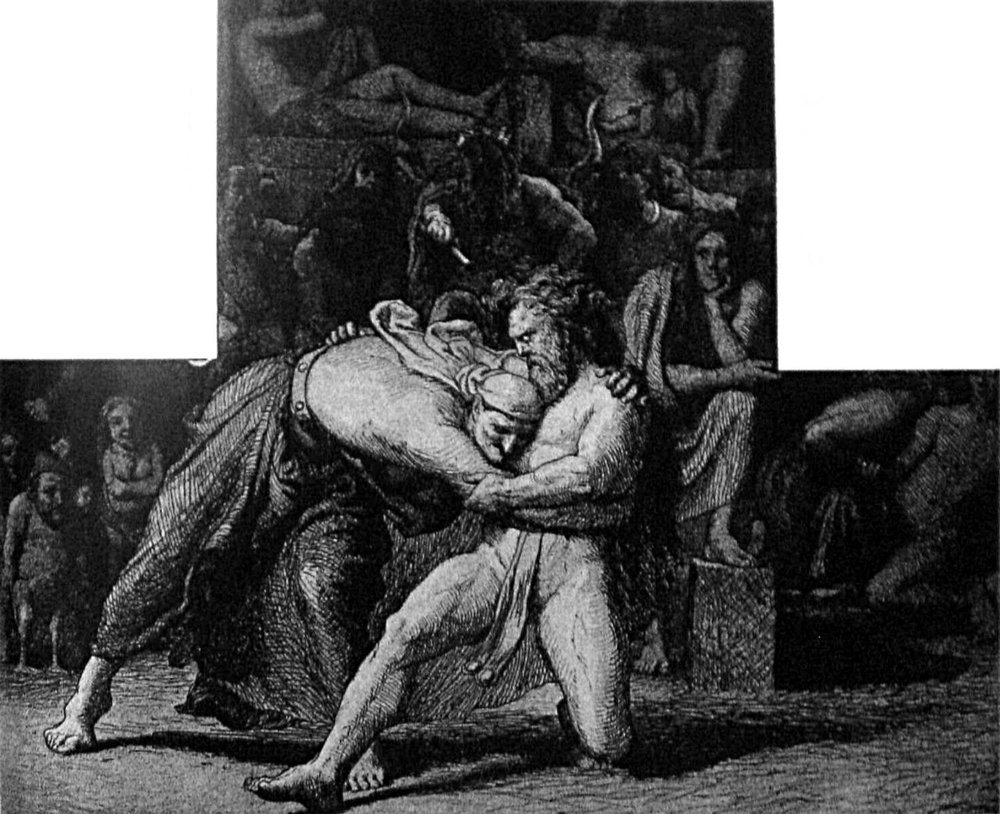
By now Thor is angry enough to wrestle anyone. Nobody here would stoop to wrestling him, says Utgard-Loki – but they can call his old nurse Elli. The tighter Thor grips, the firmer the old woman stands. Then she starts using holds, Thor loses his footing, and after a hard struggle he goes down on one knee. The match is stopped, and the guests are treated well for the night.
Next morning Utgard-Loki escorts his guests out of the stronghold himself and asks Thor how he found the trip. Thor is honest: he has suffered great disgrace. Now that Thor is outside, the giant tells him the truth – and if he has any say in it, Thor will never get in again. Had he known how much strength Thor had, he would never have let him in at all.
Then comes the reveal, piece by piece:
Thor hears this, seizes his hammer and swings. But Utgard-Loki is gone. When Thor turns to smash the stronghold, he sees only broad, fair plains – no fortress at all. He heads home to Þrúðvangar, determined to settle accounts with the Midgard Serpent. That leads straight into the next story in Gylfaginning: Thor's fishing trip with the giant Hymir, where he hooks Jörmungandr.
The reveal makes Thor smaller in nothing and immense in retrospect: he visibly lowered the sea, lifted the world serpent and lost only one knee to old age itself.
Two poems of the Poetic Edda – usually considered older than Snorri's prose, though their dating is uncertain – already mock Thor with this story.
In Lokasenna ("Loki's Flyting") Loki insults the gods one after another at a feast. When Thor threatens him with the hammer, Loki jeers in stanza 60, roughly: you had better never tell anyone about your journeys east, since you crouched in the thumb of a glove, champion – hardly feeling like Thor then. In stanza 62 he adds that Skrymir's straps must have seemed hard to Thor; he could not get at the food and nearly starved, hale and hearty (our renderings). Here Skrymir is named outright.
In Hárbarðsljóð, a slanging match between Thor and a ferryman called Hárbarðr (generally taken to be Odin), stanza 26 says, roughly: Thor has strength enough but no heart; out of fear he stuffed himself into a glove and dared neither sneeze nor break wind lest Fjalarr hear it. So here the giant is called Fjalarr, not Skrymir. Either several names were in circulation or Fjalarr is simply one giant name among many.
At almost the same time as Snorri, the Danish historian Saxo Grammaticus (c. 1200) was writing his Gesta Danorum. In Book 8 he tells of the voyages of the adventurer Thorkill (Latin Thorkillus) on behalf of a Danish king Gorm. The first leads to Geirrøth, a figure who recalls Thor's visit to Geirröd. The second leads to Utgarthilocus.
The king wants to know what becomes of the soul after death, and Thorkill's enemies suggest sending him to ask Utgarthilocus. Thorkill sails to a land without sun or stars and reaches a cavern where Utgarthilocus lies: huge, foul, his hands and feet weighed down with enormous chains. Thorkill tears a hair from his beard, as big as a spear, and flees from the stench and the snakes; only a few of his men survive. On the way home he turns to the god who made the world and becomes a Christian. In the end King Gorm dies of horror at his report, and the stench of the hair kills bystanders.
Apart from the name, this chained giant has little in common with Snorri's shape-shifting host. He looks much more like the bound Loki after Baldr's death (see Loki's punishment). Gabriel Turville-Petre therefore suggested that Utgarthilocus is Loki himself, banished to the outer world, and that Snorri's host goes back to an older version in which the host really was Loki. That is a hypothesis, not a finding. Anatoly Liberman examined the Snorri–Saxo relationship in a dedicated study in 1992.
As early as 1910 the Swedish folklorist Carl Wilhelm von Sydow proposed Celtic models for all three parts. For the goats he pointed to a legend of St Germanus in the Historia Brittonum; for Skrymir, to a Gaelic tale that was only written down in 1889–90. Matthias Egeler, re-examining the case, finds the goat parallel striking but the Skrymir parallel hardly convincing.
Taken more seriously is Rosemary Power's 1985 comparison with an Irish Fenian tale linked to Feis Tighe Chonáin. Fionn mac Cumhaill and his men lodge with an old man whose house also holds a young woman and a lamb that none of the heroes can tie up. In the end the lamb proves to be Life, the woman Youth, the old man Death. Same pattern: overwhelming opponents who are really allegories. Power thought borrowing from Ireland likely, though the Irish manuscripts are much later than Snorri.
John Lindow stresses that the Utgard journey is the fullest Thor myth we have and shows many hallmarks of oral storytelling: patterns of three, escalation, a final twist.
Illusion. The key word in the reveal is sjónhverfing, "a turning of sight", an optical illusion. And here Snorri gets clever: the whole of Gylfaginning is such an illusion. At the end of the dialogue Gylfi hears a great noise, finds himself on an empty plain, and the hall has vanished – exactly like Útgarðr before Thor's eyes. Snorri mirrors his frame story inside it: whoever listens to the old gods is deceived just as Thor was among the giants.
Humour. Thor is often a comic figure: in a bridal veil in Þrymskviða, mocked in Hárbarðsljóð, crouching in a glove. The comedy makes him approachable. The audience laughs with him, not at him – at least once the twist lands.
Origin story. Along the way the tale explains the ebb tide – and three valleys. Explanations like these are typical of folktale.
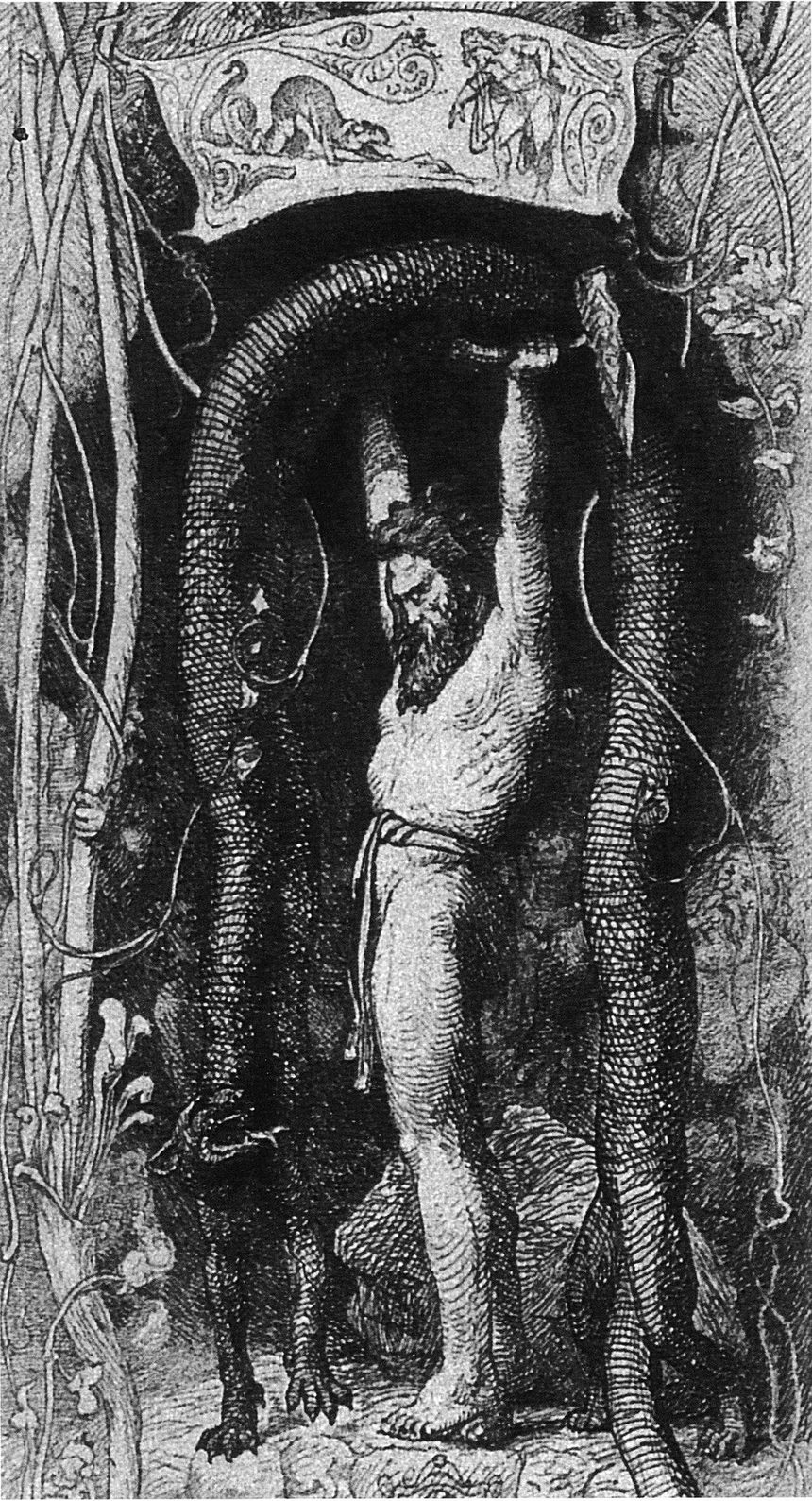
The limits of strength. No hammer helps against fire, thought, sea or age. Old age points forward: Thor too will fall at Ragnarök, fighting the very serpent he could not lift off the floor as a cat.
Snorri's workshop. The wordplay, the triple structure and the mirrored frame show an author with a sure feel for suspense. How much he invented and how much he inherited is the real debate.
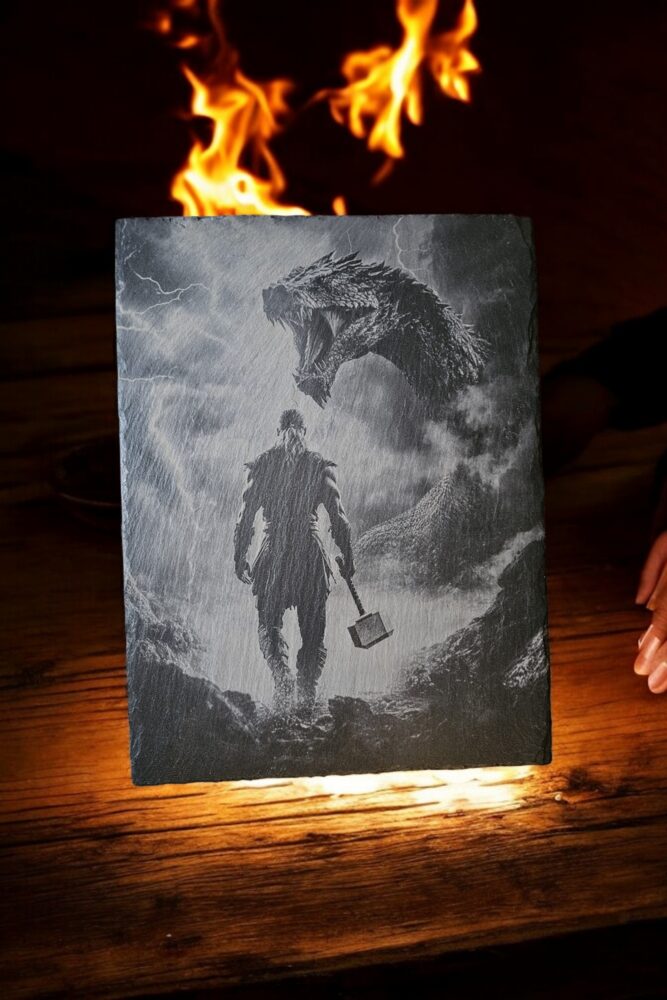
For our workshop, the Utgard tale is a treasure chest of images you rarely see. Thor lifting a grey cat whose shadow coils around the world as a serpent. Thor wrestling old Elli – a motif about strength and mortality with a lovely double meaning for milestone birthdays. Or four travellers spending the night in the thumb of a giant's glove.
On slate, the laser draws pale lines into dark stone, like the carvings on an old picture stone. Add an ornamental Viking Age border and, if you like, a line in runes: "Nobody beats old age – but you can force it to one knee."
Who is Utgard-Loki? A giant king, lord of the stronghold Útgarðr in Jötunheim, who tricks Thor with illusions in Snorri's Gylfaginning (ch. 44–47). He is not the same as the Æsir's Loki, who appears in the same story as Thor's companion.
Is Skrymir Utgard-Loki? Yes. In the reveal Utgard-Loki admits that he appeared as the giant Skrymir, in whose glove Thor slept and whom he struck three times in vain with his hammer.
What contests does Thor lose at Utgard-Loki's hall? Apparently a drinking contest, lifting a cat and wrestling an old woman. In truth he drank from the sea, lifted the Midgard Serpent and wrestled old age (Elli). Loki lost to fire (Logi), Þjálfi to thought (Hugi).
Where is the story of Thor and Utgard-Loki found? In full only in Snorri Sturluson's Prose Edda, Gylfaginning ch. 44–47, c. 1220. Older eddic poems (Lokasenna 60 and 62, Hárbarðsljóð 26) allude to Thor in the glove and the impossible food bag.
What causes the tides in Norse mythology? According to Snorri, the horn Thor drank from at Utgard-Loki's hall reached into the sea. He drank so much that the sea level dropped – and that is the ebb.
For courage. For remembrance. For legends that live on.
Thor (Donar) · Thjálfi & Röskva · The Midgard Serpent · The Giants · Loki.
A poet who fears for his reward, and a lord who lets himself be celebrated: the Vellekla („gold-lack“) by the skald …
Read more →Valhalla is no resting-place for weary souls. It is a barracks of the fallen: a vast hall where the bravest dead fight …
Read more →They are far more than the winged warrior-maidens of the opera: the valkyries decide who falls in battle – and who is …
Read more →Before the gods of the North were one family, they waged the first war of the world – against each other. The War of …
Read more →