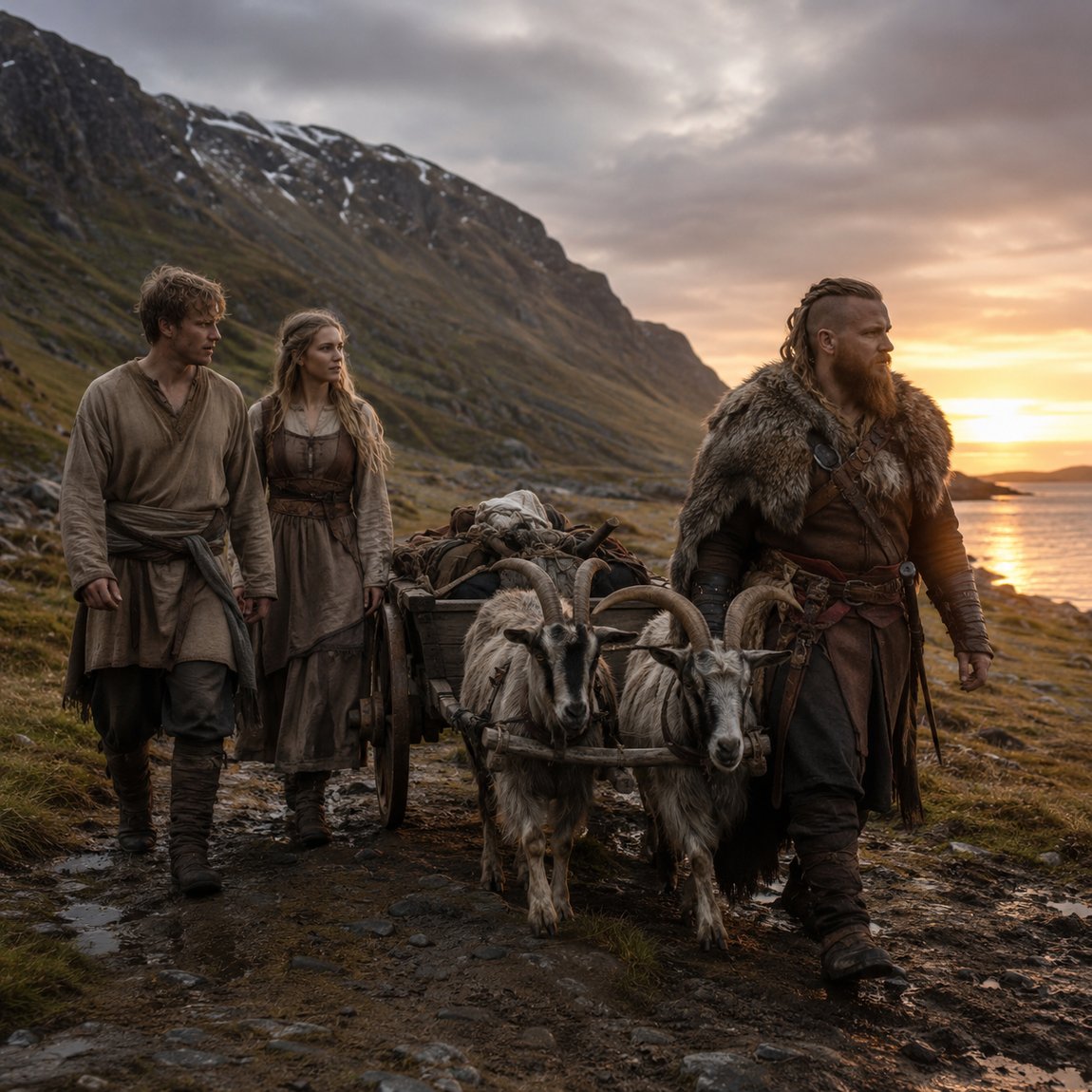
Thjálfi and Röskva (Old Norse Þjálfi and Rǫskva) are a brother and sister from a poor farmhouse who become servants of the thunder god Thor – as compensation, because Thjálfi cracked open the thighbone of one of Thor's goats for its marrow and the animal rose lame the next morning. That is how Snorri Sturluson tells it around 1220. Thjálfi goes on to be the fastest of all humans, races against Thought itself in Utgard and brings down a clay giant at the duel with Hrungnir. Of Röskva, little survives but her name. Here is what the sources actually say.
A lonely farm at dusk. Smoke from the hearth, not much in the pot. A wagon pulls up outside, drawn by two billy goats, and two travellers ask for a bed for the night. One of them is red-bearded, broad as a door and surprisingly gracious: he slaughters his own goats, boils the meat and invites the whole hungry household to eat. He has only one rule. Every bone goes onto the goatskins spread by the fire. A boy at the table thinks about the rich marrow inside a thighbone. He reaches for his knife. And that one small cut will change his life.
The guest is Thor. The boy is Thjálfi, and his sister is Röskva. From the next morning on, both belong to a god's retinue – a real rarity, because mortals who travel permanently at a god's side hardly exist in the myths. Let's follow the trail and keep track of what early poetry attests, what Snorri tells us and what is modern interpretation.
Thjálfi and Röskva are the children of a farmer (Old Norse búandi, a settled householder). Thor takes them as servants after one of his two goats is lamed through Thjálfi's fault. Thjálfi then accompanies the god on several journeys into giant country; he is called "the swiftest-footed of all men" and carries Thor's provisions bag. Röskva appears in just two brief sentences in Snorri and in a couple of poetic circumlocutions.
The source base is small but layered. The fullest version is in Gylfaginning, the first main part of the Prose Edda by the Icelander Snorri Sturluson (c. 1220). The eddic poem Hymiskviða has a shorter and noticeably different version. The fight against the clay giant comes from Snorri's Skáldskaparmál, his handbook of poetic language. And tenth-century skaldic verse – composed while Scandinavia was still pagan – already knows Thjálfi as Thor's brave companion. For an overview of where all these texts come from, see our article on the Edda.
The legendary king Gylfi has asked whether Thor ever met anything stronger than himself. The answer begins quietly. Thor the charioteer is travelling with his goats and with Loki, and at nightfall they stop at a farmer's house.
Thor slaughters both goats, Tanngnjóstr and Tanngrisnir, skins them and puts the meat into the cauldron. The farmer, his wife and their two children are invited to share the meal. Thor lays the goatskins out beside the fire and tells everyone to throw the bones onto them. Then comes the crucial sentence, here in our own translation from the Old Norse:
"Þjálfi, sonr búanda, hélt á lærlegg hafrsins ok spretti á knífi sínum ok braut til mergjar."
Thjálfi, the farmer's son, took the goat's thighbone, slit it with his knife and broke it open to the marrow.Snorri Sturluson, Gylfaginning 44 (our translation)
That is hunger, not malice. Marrow was a prized, fatty morsel in the northern farm kitchen, and split long bones are among the most ordinary finds in Viking Age rubbish pits. We describe meals like this in detail in What did the Vikings eat?. Thjálfi does exactly what any child on a poor farm would have done. He just does it at the wrong table.
Before dawn Thor gets up, dresses, raises the hammer Mjölnir and hallows the skins with it. The goats stand up. But one of them is lame in a hind leg. Thor notices at once and concludes that someone in the house has not treated the bones with proper care.
What follows is one of the strongest images in the whole Prose Edda. Snorri doesn't describe Thor's rage with thunder and lightning but with one physical detail: he grips the hammer shaft so hard that his knuckles turn white ("svá at hvítnuðu knúarnir"). His brows sink over his eyes, and the family feels they might collapse under his gaze alone.
The farmer and his household cry out, beg for mercy and offer everything they own. Thor sees their terror, and his anger subsides. In settlement he takes the children, Thjálfi and Röskva. Snorri calls them skyldir þjónustumenn, servants bound to service, and adds that they have followed Thor ever since. Thor leaves the goats at the farm and sets off east on foot, towards the land of the giants.
For a medieval audience this was more than a fairy-tale turn. It reflects the logic of compensation: whoever causes damage owes redress, and whoever has nothing pays in labour. Children entering someone else's service this way was not unthinkable in the real North; debt bondage and unfreedom were part of society, as we show in our article on slavery in the Viking Age. Snorri, however, doesn't paint the arrangement as misery. Thjálfi becomes Thor's companion, not his victim.
Snorri isn't the only one who knows about the lame goat. The eddic poem Hymiskviða ("The Lay of Hymir") tells how Thor fetches a gigantic brewing kettle from the giant Hymir and fishes for the World Serpent along the way. Right at the end, on the way home, comes a terse, almost offhand note. In stanzas 37–38 of the Old Norse numbering (38–39 in some translations) the poet says, in substance: they hadn't gone far when one of Thor's goats lay half-dead, lame in the leg – and the cunning Loki had caused it.
Then the poet turns directly to his audience: you have all heard what compensation the god received from the hraunbúi, who gave him both his children for it. Hraunbúi literally means "lava-field dweller" or "rock dweller" – a word that sounds more like a giant than an ordinary farmer. The poem names no one.
The stanzas show two things: the story isn't Snorri's invention, since the poet assumes his audience knows it, and there were competing versions. The poem survives in the Codex Regius from the later thirteenth century; its own age is disputed, and many consider it fairly late.
Straight after the farmhouse scene, Snorri launches the great journey to Utgard (chapters 45–47). Thor, Loki, Thjálfi and Röskva cross the sea and walk into a vast forest. Here Snorri introduces Thjálfi with a single sentence that fixes his role forever: "Þjálfi var allra manna fóthvatastr" – Thjálfi was the swiftest-footed of all men. He carries Thor's food bag, though at that moment there is nothing good to eat in it.
On the way the four of them spend the night in a strange hall with a side chamber that turns out, in the morning, to be the glove of the giant Skrýmir. Röskva is on this journey, but she says and does nothing Snorri thinks worth recording. The full story of Skrýmir, the knotted food bag and the three hammer blows is in our article Thor at Utgard-Loki's hall.
In the stronghold of the giant king Útgarða-Loki, every guest must show off a skill. Loki enters an eating contest; Thjálfi enters a footrace. His opponent is a young man called Hugi. The race is run on level ground, three times over:
Útgarða-Loki still praises him: no one faster has ever come to his hall. Only at the end, as the guests leave, does the giant reveal the trick. Hugi was his thought – Old Norse hugr means "mind, thought, spirit" – and no one could expect Thjálfi to match the speed of thought. The same word sits in the name of one of Odin's ravens, as we explain in our article on Huginn and Muninn.
The second big scene is in Snorri's Skáldskaparmál. Thor has agreed to fight the stone giant Hrungnir at a place called Grjótúnagarðar on the border of giant country. The giants fear for their champion and build him a second: a giant of clay, nine leagues tall and three broad beneath the arms. A league here translates Old Norse rǫst, a distance measure of several kilometres. The one thing they can't find is a heart big enough, so they give him the heart of a mare. His name is Mökkurkálfi, roughly "mist calf" or "cloud calf".
Thjálfi runs ahead of Thor and plays a decisive part. He calls out to Hrungnir that he is standing carelessly with his shield in front of him; Thor has seen him and will come at him from below, out of the earth. Hrungnir drops the shield to the ground and stands on it. A moment later Thor arrives from the front in thunder and lightning, and the hammer shatters Hrungnir's skull. What happens next – the whetstone splinter lodged in the god's head and Thor's little son Magni lifting the giant's leg off his father – is told in our articles Thor versus Hrungnir and Magni and Modi.
And the towering clay giant? When he sees Thor, he is so terrified that he wets himself – or so "it is said", as Snorri carefully puts it. Thjálfi attacks him, and Mökkurkálfi falls "við lítinn orðstír", with little glory. The mortal fells the artificial giant. That is all the text gives us.
The philologist Anatoly Liberman suspects an older motif behind the comic tone: a serious duel between Thjálfi and an opponent called Kálfi, later turned into farce. That is a hypothesis, not a finding.
The most impressive early reference comes from Þórsdrápa, a praise poem for Thor composed in the late tenth century by the skald Eilífr Goðrúnarson for the Norwegian Jarl Hákon – a ruler who deliberately championed the old religion. The poem tells of Thor's journey to the giant Geirröðr. Thjálfi is there: he clings to Thor while they wade a raging river and then fights the giants alongside him. In his intricately coded language Eilífr calls him, among other things, "Röskva's brother".
That's remarkable, because in Snorri's prose version of the same story Thor's companion is Loki, not Thjálfi. The whole tale – and why Thor has to manage without his hammer – is in our article Thor at Geirröd's hall. What matters here is this: a pagan court poet around the year 1000 knew Thjálfi as the god's brave fighting companion. The farmer's son is not a creation of the Christian thirteenth century.
Another brief appearance comes in Hárbarðsljóð, the flyting in which Thor trades boasts with the ferryman Hárbarðr (Odin in disguise). Thor says that on the island of Hlésey he fought wild "brides of berserks" who attacked his ship and drove Thjálfi off. For once, the loyal servant looks like someone who runs away.
Finally, in Skáldskaparmál Snorri lists the poetic circumlocutions (kennings) for Thor. One of them is "master of Thjálfi and Röskva". The siblings were part of the poetic vocabulary with which a skald could name the god.
With Röskva the sources fall silent. Snorri names her when the children are handed over and lists her among Thor's companions as the Utgard journey begins. Then she disappears from the story. No contest, no speech, no deed. Add the kenning "master of Thjálfi and Röskva" and the phrase "Röskva's brother" for Thjálfi in skaldic verse, and you have everything.
Her name, at least, is transparent. It belongs to the Old Norse adjective rǫskr, "quick, vigorous, capable, brave", which survives in modern Danish and Swedish rask ("fast, brisk"); English "rash" is a distant relative. Röskva is "the quick one" or "the capable one" – a neat match for a brother who is the fastest runner in the world.
Thjálfi is much harder, which is what makes him interesting. Liberman gathered the long history of proposals in 2009. The main ones:
To be honest, the etymology is unsolved. What is certain is that Þjalfi was a real man's name in the Viking Age. On the Swedish runestone Sö 194 near Strängnäs, from the second half of the eleventh century, Ingimundr and Þjalfi raise a stone for their father Þorketill; the runes spell the name þalfi. The name turns up on other Swedish runestones as well. Parents clearly gave it to their sons without hesitation – whether they had Thor's servant in mind, we can't know.
At the heart of the story is a motif that reaches far beyond Scandinavia: an animal is slaughtered and eaten, then brought back to life from its bones – and if a bone is missing or damaged, a flaw remains. In 1910 the Swedish folklorist Carl Wilhelm von Sydow, in his essay Tors färd till Utgård, collected dozens of parallels, mostly from Christian saints' legends in the British Isles, France and the Alpine region.
The most striking comes from the Historia Brittonum, a Latin history of the Britons compiled in Wales in the ninth century – well before Snorri. Saint Germanus of Auxerre is travelling through Britain. A ruler refuses him shelter, but a poor man takes him in. He owns just one cow and a calf; he slaughters the calf and serves it to his guests. Germanus orders his companions not to break a single bone of the calf. Next morning it is standing alive and unharmed beside its mother.
The parallels are uncanny: a powerful guest, a night with poor people, a slaughtered animal, a ban on breaking bones, a resurrection at dawn. Von Sydow concluded that the motif was Celtic and only entered Norse myth in the Viking Age. In 2013 the scholar of religion Matthias Egeler re-examined that claim. He criticises von Sydow for paying almost no attention to dating, noting that much of his material is very late. Yet Egeler takes a borrowing from the Historia Brittonum in particular seriously – and offers an intriguing reading: perhaps pagans of the conversion period adopted a Christian miracle motif to show that their god could do the same. Much as tenth-century silver Thor's hammer amulets are often read as a pagan answer to the cross.
The North has its own relatives: the boar Sæhrímnir, eaten every evening by the einherjar in Valhalla and whole again by morning – Rudolf Simek sets Thor's goats right beside it – and folk legends of witches who magically multiply herring, so long as nobody breaks the bones.
Another trail leads to the island of Gotland. The Gutasaga, a short origin story of the Gotlanders written down in the thirteenth century and preserved in a manuscript from around 1350, begins with a man called Þieluar (Tjelvar). Gotland was enchanted in those days: it sank beneath the sea by day and only lay dry at night. Tjelvar was the first to bring fire to the island, and after that it never sank again. He is remembered as the Gotlanders' first ancestor.
Because the names Þjálfi and Þieluar sound alike, many scholars have equated the two. Liberman is sceptical but sees a thin thread: claiming land by carrying fire around it required a fast runner – exactly what Thjálfi is famous for. His conclusion is pleasantly sober: the names are probably related, but the identification should be neither denied nor overstated. That's as far as honest scholarship can go. For how closely Gotland is bound up with the imagery of the myths, see its famous picture stones.
The honest answer: no Viking Age image has so far been securely identified as Thjálfi or Röskva. The well-known stone carvings of Thor – the Altuna runestone in Uppland, the Gosforth fishing stone in Cumbria, the Hørdum stone in Thy – show Thor fishing for the World Serpent, not his servants. If you find "Thjálfi on a picture stone" online, ask for the source.
In Scandinavia, Thjálfi and Röskva are best known today from Peter Madsen's Danish comic series Valhalla. There "Tjalfe" and "Røskva" are the real protagonists, two human children through whose eyes we experience the world of the gods. The 1986 animated film and a 2019 live-action film brought the siblings to a wide audience. Much of it is free invention – affectionate, but free.
Thialfi also has a supporting role in Marvel's comics; what matches the Edda there and what doesn't, we check in our Marvel Thor fact check. And speed-skating fans know the name anyway: the Thialf arena in Heerenveen takes it via a Frisian skating club founded in the nineteenth century. For a rink where people try to go as fast as humanly possible, you could hardly find a better namesake.
Almost always, the siblings serve as the audience's way in – the humans through whose eyes we see the gods. Snorri already set that up. For the older, continental form of their master, read on about Donar, the thunder god of the Germanic peoples.
In our workshop in Alsdorf, one image from this story keeps calling to us: two goats in front of a wagon, one of them holding up a hind leg. A single small detail, and anyone who knows the tale understands at once. On slate this kind of motif is especially striking, because the laser engraving rises pale out of the dark stone – like bones on a hide beside the hearth.
Pair it with the name in runes, spelled exactly as it stands on runestone Sö 194: ᚦᛅᛚᚠᛁ (þalfi) in the Younger Futhark, with no invented extra signs. For runners, sports clubs or simply to honour the fastest person in the house, it's a motif with real history. And for siblings who stick together, too.
Who are Thjalfi and Roskva in Norse mythology? They are a brother and sister, the children of a farmer, whom Thor takes as his servants. Snorri says in Gylfaginning that they have followed him ever since.
Why did Thjalfi and Roskva become Thor's servants? Thjálfi split one of Thor's goat's thighbones to get at the marrow. When Thor revived the goats next morning one was lame, and the parents gave their children as compensation.
Who did Thjalfi race in Utgard? Hugi, who turned out to be Útgarða-Loki's own thought. Thjálfi lost all three heats, yet was still the fastest of all humans.
What does the name Roskva mean? It comes from Old Norse rǫskr, "quick, capable, brave", so roughly "the quick one". The meaning of Thjálfi, by contrast, is still unresolved.
Does Thjalfi appear in the Poetic Edda? Yes, briefly in Hárbarðsljóð. Hymiskviða tells of the lame goat and the two children but names no one and blames Loki.
Who killed Mökkurkálfi? Thjálfi. According to Snorri's Skáldskaparmál, the clay giant with the mare's heart fell "with little glory" fighting him while Thor slew Hrungnir.
For courage. For remembrance. For legends that live on.
Thor (Donar) · Thor at Utgard-Loki · The Midgard Serpent · The Giants.
This is the tale in which the immortal gods turn grey for the first and only time. An eagle on an ox, an extorted oath …
Read more →Before Thor is humbled in the stronghold of Utgard, he meets on the road a giant so vast that the gods spend the night …
Read more →Her name is Þrúðr („strength, power") and she is the daughter of Thor and Sif. Around her turns one of the craftiest …
Read more →The funniest and at the same time most profound Thor story is a string of defeats – that are none at all. On his …
Read more →