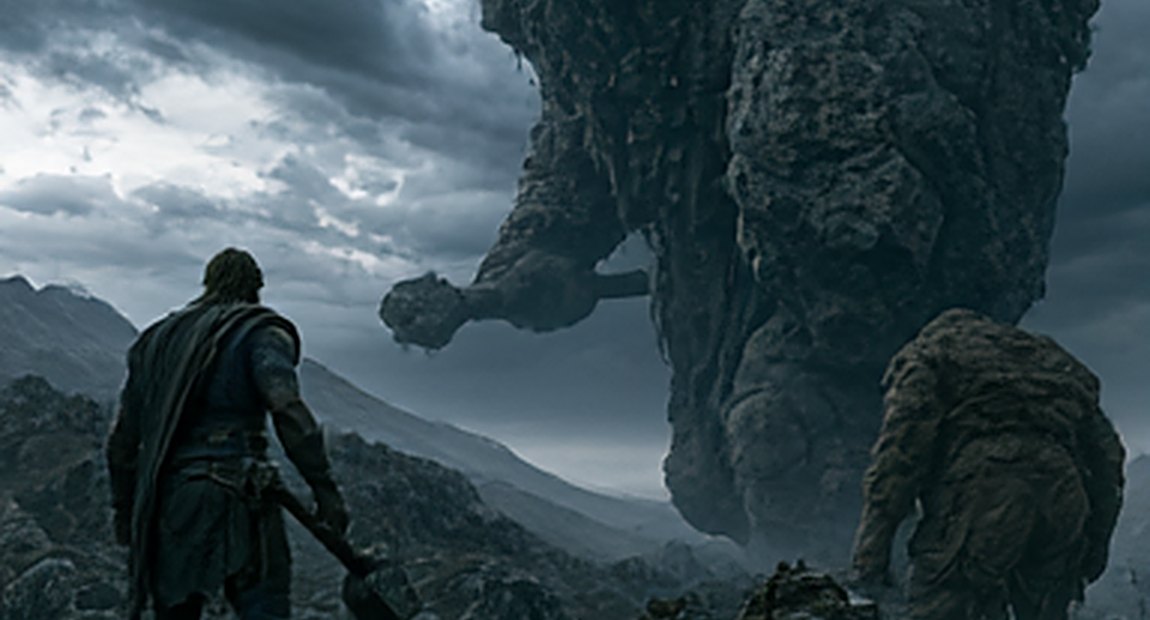
Hrungnir is the strongest of the giants in Norse mythology, a being with a head, heart and shield of stone, whom Thor kills with Mjölnir in a duel at Grjótúnagarðar – at a price: a shard of Hrungnir's whetstone lodges in Thor's skull and never comes out. Snorri Sturluson tells the full story in the thirteenth century, but its core is far older and already appears in skaldic poetry around 900. Here is the whole tale, from horse race to star, with the sources kept carefully apart.
Some myths open with the creation of the world. This one opens with two riders showing off. A stranger in a golden helmet gallops through sky and sea, a giant admires the horse, one boast leads to another – and by the end the god of thunder lies pinned under a dead giant's leg with a stone stuck in his head, unable to get up. The tale of Hrungnir is one of the richest stories we have about Thor. It has a wager, a drinking bout, a formal duel, a trick, a toddler hero, a sorceress, a new star in the sky and even a household rule. For us in the workshop it has an extra appeal: its villain is made of stone. When you spend your days engraving slate, you read a story like this with a certain professional respect.
First, a quick word on what you are actually reading. The complete plot survives only in Skáldskaparmál ("The Language of Poetry"), the second part of the Prose Edda written by the Icelander Snorri Sturluson around 1220. Snorri tells it to explain poetic circumlocutions called kennings – compressed metaphors such as "Hrungnir's slayer" for Thor. Older witnesses exist: two poems by skalds, the court poets of the Viking Age. One is Haustlöng by Þjóðólfr of Hvinir (around 900), the other is Ragnarsdrápa by Bragi Boddason (ninth century). Both describe pictures painted on shields. Further down we will sort out which parts are genuinely old and which look like Snorri's embroidery.
According to Snorri, Odin rides Sleipnir, his eight-legged stallion, into Jötunheim, the land of the giants, and arrives at Hrungnir's home. The giant asks who this is with the golden helmet, riding through air and water, and praises the stranger's horse. Odin replies with a line worth remembering: he will wager his head that no horse in all of Jötunheim is as good. Hrungnir disagrees. His own horse is called Gullfaxi ("Gold-mane"), and it takes far longer strides.
Stung, the giant leaps onto Gullfaxi and chases Odin. Odin rides so fast that Hrungnir never catches him, yet the giant has worked himself into such a rage that he no longer notices where he is going. Suddenly he is inside the gates of Asgard, the stronghold of the gods.
What the gods do next is telling. They do not reach for weapons. They invite him in for a drink. That is not naivety but the law of hospitality: a guest under a host's protection must not be harmed, and Hrungnir will later argue exactly that – Odin invited him.
Hrungnir strides into the hall and demands drink. The gods bring him the bowls Thor usually drinks from, and the giant drains them one after another. In the 1916 translation by Arthur Brodeur, "those flagons were brought in from which Thor was wont to drink." From here on the evening goes the way such evenings tend to go. Drunk, Hrungnir boasts that he will lift up Valhalla and carry it off to Jötunheim, sink Asgard into the ground and kill every god – except Freyja and Sif, whom he plans to take home with him.
Only Freyja dares to keep pouring. He announces that he will drink up all the ale the gods possess. At that point the Æsir have had enough, and they do what they always do in a crisis: they speak Thor's name. The next moment Thor is standing in the hall, hammer raised, furious. Who allowed a giant to drink here? Who granted Hrungnir safe-conduct? And why is Freyja serving him as if this were a feast of the gods?
The scene is no throwaway detail. Threats to carry off goddesses run through the whole mythology: the builder of Asgard's wall wants Freyja, Þrymr wants Freyja, the giant Þjazi abducts Iðunn. Hrungnir's boasting places him in a long line of giants whose desire always targets what makes the divine world work – fertility, beauty, youth, the order of the household.
Hrungnir stays surprisingly calm. He looks at Thor and says that Odin invited him to drink and that he is under Odin's protection. Thor answers that the giant will regret that invitation before he gets out of the door. Now comes Hrungnir's cleverest move. There would be little glory for Thor, he says, in killing an unarmed man. It would be braver to meet him on the border, at Grjótúnagarðar – a name that means something like "the fences of the stone homestead". It was foolish of him to leave his shield and whetstone at home; if he had his weapons, they could settle it right now. But if Thor kills him unarmed, Hrungnir will brand him a níðingr, a man without honour.
In the Old Norse value system, being a níðingr was worse than losing a fight. Thor accepts, and Snorri adds that he was eager for the duel because nobody had ever challenged him to single combat before. Think about that for a moment: the god every giant fears receives his very first formal challenge from a drunk guest who has just emptied his drinking bowls.
Hrungnir rides back, and Snorri stresses that this journey became famous among the giants. A great deal was at stake for them. Hrungnir was the strongest of their kind, and if he fell they could expect the worst from Thor. So they prepared.
At Grjótúnagarðar the giants build a man out of clay. According to Snorri he stands nine leagues tall and is three leagues broad under the arms. The Old Norse unit is the röst, a long distance between two resting points; the point of the number is that this creature resembled a mountain more than a man. They could not find a heart big enough for him – until they gave him the heart of a mare. That turned out to be the weak spot. The heart did not hold steady when Thor arrived.
The clay giant is called Mökkurkálfi, usually translated as "mist-calf" or "cloud-calf". Snorri grants him one of the earthiest lines in the whole Edda: when the colossus caught sight of Thor, it is said, he wet himself with fear. Here speaks a storyteller who knows how to make an audience laugh.
Hrungnir himself is built differently. His heart was of hard stone, sharp-edged and three-cornered, like the carved sign that was later called "Hrungnir's heart" (Hrungnis hjarta). His head was stone too, and so was his shield, broad and thick. He held the shield in front of him as he waited for Thor at Grjótúnagarðar, and for a weapon he carried a whetstone over his shoulder. A stone giant fights with stone; in its own way, that makes sense.
Thor does not come alone. With him is Thjálfi, his fleet-footed servant. Thjálfi runs ahead to Hrungnir and tells him: you are standing carelessly, giant, with your shield in front of you. Thor has seen you. He is travelling underground and will come at you from below. Hrungnir believes him, shoves the shield under his feet, stands on it, and grips the whetstone with both hands.
The next moment he sees lightning and hears a mighty crash of thunder, and then he sees Thor charging at him in divine fury. Thor swings the hammer and hurls it from far away. Hrungnir raises the whetstone with both hands and throws it back. The two weapons meet in mid-air. The whetstone shatters. One piece falls to the ground, and from it, says Snorri, come all the whetstone rocks in the world (heinberg). The other piece strikes Thor in the head, and he pitches forward onto the ground. Mjölnir, meanwhile, hits Hrungnir square in the head and smashes his skull into small fragments.
Hrungnir topples forward – right on top of Thor, so that his foot lies across Thor's neck. Thjálfi, in the meantime, attacks Mökkurkálfi, who falls, as Snorri puts it, with little glory. Both giants are dead. The winner, however, is stuck.
Notice how the victory works. Thor does not win by strength alone. Thjálfi's lie makes Hrungnir give up his cover. In other tales Thor is often the one who gets fooled; here the deception is on his side.
Thjálfi tries to lift the giant's leg off Thor and cannot. When the gods hear that Thor has fallen, they all come running – and they cannot move it either. Then Magni arrives, Thor's son by the giantess Járnsaxa ("Iron-knife"). Snorri says explicitly that he was three nights old at the time (þrínættr). The infant simply flings the foot off his father and says, roughly: what a pity, father, that I came so late. I think I would have killed this giant with my fist if I had met him.
Thor gets up, greets his son and predicts that he will grow into a great man. As a reward he gives him the horse Gullfaxi, which no longer has a rider. Now Odin speaks up. Thor is doing wrong, he says, in giving such a fine horse to the son of a giantess rather than to his own father. You can almost hear the origin of the whole story here: Odin wanted that horse. Snorri never says so outright, but the frame – a wager over a horse at the beginning, a quarrel over the same horse at the end – is too neat to be accidental.
According to Vafþrúðnismál, Magni is one of the gods who survive Ragnarök and inherit Mjölnir. The scene under Hrungnir's foot reads like a preview: the next generation lifts what the old one no longer can.
Thor goes home to Þrúðvangar, his estate, with the whetstone still lodged in his head. Then the seeress Gróa comes to him, the wife of Aurvandill the Bold. She chants her spells over Thor until the whetstone begins to work loose. Thor feels it and starts to hope. Wanting to reward her and give her some joy in return, he tells her a piece of news.
He had waded across the Élivágar from the north, the ice-cold primeval rivers, carrying Aurvandill on his back in a basket out of Jötunheim. And here was the proof: one of Aurvandill's toes had stuck out of the basket and frozen. Thor broke it off and threw it into the sky, where it now shines as a star called Aurvandils tá, "Aurvandil's toe". It would not be long, he said, before Aurvandill came home.
Gróa is so delighted that she forgets her spells. The whetstone loosens no further, and it is still stuck in Thor's head. Snorri closes with a rule. In Brodeur's words, "it is forbidden to cast a hone across the floor," because then the stone stirs in Thor's head.
That prohibition is the most down-to-earth detail in the whole tale. It sounds like a genuine household rule that Snorri found and explained through the myth. Whether the story explains the taboo or the taboo produced the story cannot be decided.
Gróa's name probably means "growth". In Svipdagsmál we meet a Gróa who sings nine charms for her son from her grave; whether the two are the same figure is an open question. Our article on Svipdagsmál has more.
In the North, Aurvandill is attested only in Snorri – but his name has relatives right across the Germanic world. In Old English the figure is Ēarendel. In the poem Christ I in the Exeter Book, Earendel is hailed as the "brightest of angels", a light sent to humankind; elsewhere in Old English the word glosses Latin terms for dawn or the morning star. Old High German records personal names such as Aurendil and Ōrendil, and later comes the Middle High German epic Orendel, though that poem tells of Christ's seamless robe arriving in Trier and has little in common with the Norse tale. The Lombards used the name Auriwandalo. And in Saxo's Gesta Danorum the father of Amleth – the later Hamlet – is called Horwendillus.
What is secure, then, is that the name is old and common Germanic, and that it is tied to light or dawn. Which star Snorri meant is not secure at all. Scholars have proposed Venus as the morning star, Sirius, and Rigel in Orion's foot. None of these can be proved. Whether Snorri invented the toe episode himself is also debated; Rudolf Simek considers it at least possible.
A modern twist to finish: in 2022 a team of astronomers led by Brian Welch gave the name Earendel to an extremely distant single star, magnified by gravitational lensing, after the Old English form. By a long detour, Aurvandil's toe has ended up with a real place in the sky.
Now for the source criticism – the most rewarding part. Haustlöng ("Autumn-long") was composed by the Norwegian Þjóðólfr of Hvinir around the beginning of the tenth century. It describes images on a shield that a man named Þorleifr had given him. Stanzas 1–13 tell how Þjazi in eagle shape abducts Iðunn – see our article on Þjazi – while stanzas 14–20 depict Thor's journey to the duel with Hrungnir. The poem survives only because Snorri quotes it in Skáldskaparmál.
Its tone is completely different from Snorri's. Where Snorri covers Thor's approach in a sentence, Þjóðólfr turns it into a cosmic event: Thor drives out in his chariot, the heavens burn, hail lashes the earth, rocks shatter and the ground seems to split apart. Then hammer and whetstone fly, Hrungnir falls, and a whetstone shard drives into Thor's skull. At the end the poet alludes to the fragment being removed.
The shield is especially revealing. In Snorri, Hrungnir shoves it under his feet because Thjálfi lies to him. In Haustlöng it happens because the higher powers willed it – usually understood as the divine female beings, the dísir. Snorri seems to have looked for an explanation and found it in a cunning sidekick.
Older still is Ragnarsdrápa by Bragi Boddason, the earliest skald known by name, from the ninth century. It too is a shield poem, and right at the start Bragi calls the shield the "sole-blade of the thief of Þrúðr". That kenning only works if the audience already knew the scene with the shield under Hrungnir's feet. Bragi also calls Hrungnir a thief of Þrúðr – and Þrúðr is Thor's daughter. Snorri knows nothing of any abduction.
The Eddic poems know Hrungnir as well. In Hárbarðsljóð Thor boasts to the ferryman Hárbarðr (Odin in disguise) that he fought Hrungnir, the haughty giant "whose head of stone was made", and felled him – Henry Adams Bellows' 1923 wording. In Lokasenna Thor twice threatens Loki with "Hrungnir's slayer", meaning Mjölnir. And in Grottasöngr the giant maidens Fenja and Menja boast of their kin: hard was Hrungnir, and his father too, yet Þjazi was stronger than both. Hrungnir was a fixture of northern tradition, not a footnote.
What follows are interpretations. Please read them for what they are: scholarly proposals, not statements found in the sources.
1. The thunderstorm. The most obvious reading sees the duel as an image of nature. Thor, the thunder god, meets a giant of stone; Haustlöng paints lightning, hail and splitting rock. A storm breaking over the mountains, lightning striking the cliff, shattered rock strewn across the landscape – the scene can be read that way, and Snorri's explanation of whetstone outcrops as fragments of a broken whetstone fits neatly. It is plausible, but it cannot be proved. Nature-myth readings were hugely popular in the nineteenth century and are framed more cautiously today, because they explain a lot and rule out very little.
2. The cosmic battle. In 1996 the Scandinavianist John Lindow stressed that Haustlöng presents the fight as a convulsion of the whole cosmos. On that view the duel is more than a brawl: it is a struggle over the order of the world. Lindow also suggested that the original motive may have been the abduction of Thor's daughter Þrúðr, based on Bragi's kenning. That would be an older version of the story which Snorri either did not know or replaced with the horse race.
3. The warrior's initiation. The French scholar of religion Georges Dumézil saw in Thjálfi's victory over the clay giant the echo of an initiation: a young warrior proves himself against an artificial opponent and is thereby admitted into the company of fighters. Dumézil compared this with other Indo-European traditions. The idea is stimulating but disputed, like much of Dumézil's work.
4. The whetstone as a symbol. Why a whetstone, of all things? In 1979 the English folklorist Jacqueline Simpson asked in the journal Antiquity why the famous sceptre from the Sutton Hoo ship burial is made of whetstone – a heavy, awkward material, neither rare nor especially beautiful. The usual explanation is that it marks the war-leader who "sharpens" his followers' swords. Simpson drew on Old Icelandic texts in which whetstones appear in mythical or ritual-looking contexts, Hrungnir's weapon among them. Whether there is a direct line from the sceptre to the myth remains open.
Comparisons beyond Scandinavia are tempting. In Hurrian and Hittite tradition the storm god Teššub fights the stone giant Ullikummi. In the Irish Ulster Cycle, King Conchobar mac Nessa is left with a sling-stone lodged in his head that his physicians dare not remove. Such parallels show that the storm god against a being of stone is a widespread motif. They do not prove any direct borrowing.
Step away from myth and the archaeology is worth a look, because a whetstone was nothing exotic in the North. Anyone who owned a knife, a scythe or a sword needed one. A team led by Irene Baug of the University of Bergen examined more than 400 whetstones from Ribe in Denmark, the early trading town on the North Sea coast. Their analysis showed that as early as the beginning of the eighth century, whetstones from quarries in Trøndelag in central Norway were reaching Ribe across roughly 1,100 kilometres. In the early ninth century, large-scale production began at the quarry of Eidsborg in Telemark.
That changes how the story reads. When Snorri says that all the whetstone rocks come from one broken fragment, he is explaining a raw material his listeners knew from daily life, one whose outcrops people sought out deliberately. A myth that comes to mind while you sharpen your scythe: everyday religion at its best.
If you want to tell the story in one sentence, try this: a guest drinks too much, promises too much and loses his head – and his host carries a piece of him around forever. Thor wins, but he is wounded. That may be the most human side of this god. He does not come out unscathed. He carries his scars.
For courage. For remembrance. For legends that live on.
Who is Hrungnir in Norse mythology? Hrungnir is a giant made of stone and, according to Snorri, the strongest of all giants. He has a stone head, a three-cornered stone heart and a stone shield, and he fights with a whetstone.
How does Thor defeat Hrungnir? Thjálfi tricks Hrungnir into standing on his shield. Thor hurls Mjölnir and Hrungnir throws his whetstone; the hammer shatters the giant's skull and the whetstone breaks apart.
Why is there a whetstone in Thor's head? A fragment of Hrungnir's whetstone hits Thor during the duel. The seeress Gróa loosens it with her chants, but she forgets her spells for joy, so it stays stuck.
What is Aurvandil's toe? A star: according to Snorri, Thor broke off Aurvandill's frozen toe and threw it into the sky. Nobody knows for certain which star is meant.
Who is Mokkurkalfi? Mökkurkálfi is a huge clay giant that the giants build to help Hrungnir, fitting him with a mare's heart. He panics at the sight of Thor and is felled by Thjálfi.
Where is the story of Thor and Hrungnir told? In full in Skáldskaparmál in Snorri Sturluson's Prose Edda. Older evidence comes from Haustlöng (around 900), Ragnarsdrápa (ninth century) and allusions in Hárbarðsljóð, Lokasenna and Grottasöngr.
Thor · Thor at Geirröd's · Magni & Modi – Thor's sons · Thor's goats · The Norse pantheon.
In their grief for the shining god Baldr, even the gods reach their limits. His funeral ship stands fast in the sand …
Read more →Idun keeps the gods’ greatest secret in a simple box: the apples that keep them young. Without them even Odin and Thor …
Read more →She is so vast that she encircles the whole world and bites her own tail: Jörmungandr, the Midgard Serpent. Between her …
Read more →No god of the North is without his treasure: Thor without his hammer would be only an angry giant, Odin without spear …
Read more →