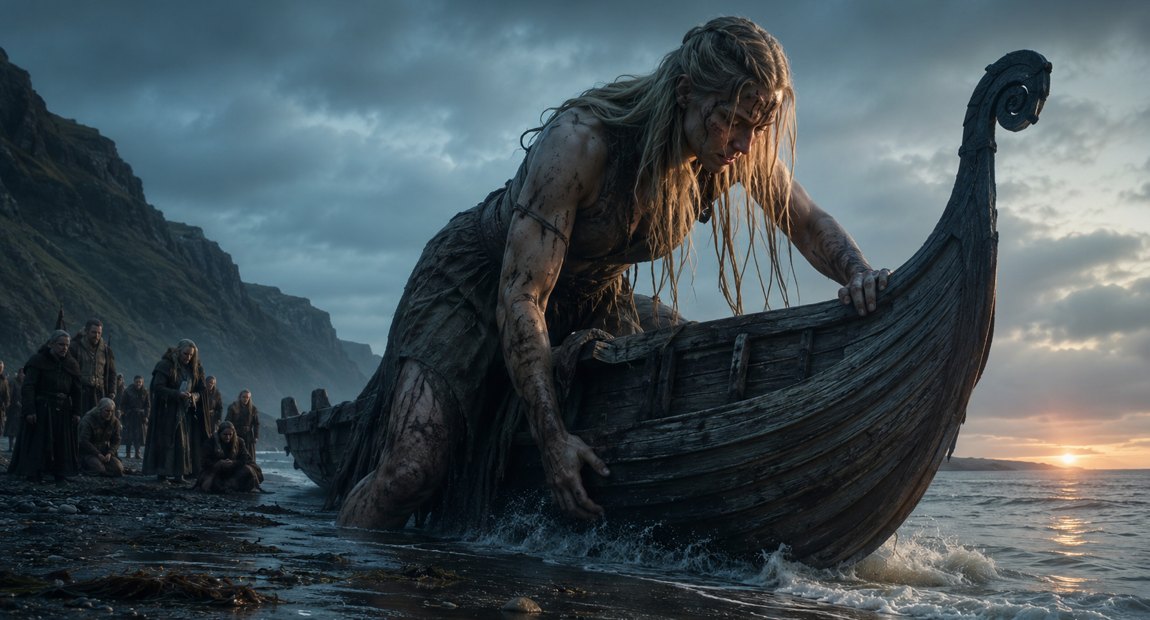
In their grief for the shining god Baldr, even the gods reach their limits. His funeral ship stands fast in the sand, and for all their divine strength it will not stir. So they fetch, of all beings, a giantess out of Jotunheim - and what happens next is among the most striking images in all of Norse tradition.
The scene takes place at the funeral of Baldr, fairest and gentlest figure among the gods. His body is to be burned on his own enormous ship Hringhorni - the greatest of all ships, as Snorri stresses. But when the gods try to push it down to the water to kindle the fire, something humiliating happens: the ship does not move a finger's breadth. The gathered power of the gods is not enough.
This is a remarkable moment. Usually it is the gods who overcome giants, bind monsters, and cross seas. Here, though, they stand helpless on the shore. And so they send a messenger to Jotunheim, the land of the giants, to fetch help - help from precisely those beings who are otherwise their adversaries in the myths.
The one summoned is named Hyrrokkin, which may be read roughly as the one shrivelled by fire or blackened by smoke. And her entrance is unforgettable. She comes neither on foot nor on horseback but rides in on an enormous wolf, bridled with vipers instead of reins. Four berserkers - Odin's chosen, battle-hardened warriors - are set to hold her mount as she dismounts. And even these four bring the wolf to rest only after throwing it to the ground.
This image alone - a giantess on a serpent-bridled wolf who keeps four berserkers busy - shows the class of power in which Hyrrokkin moves. She is no minor figure asked for a small favour. She is a force of nature, called upon when even the gods fail.
Then came the giantess Hyrrokkin, riding on a wolf, and she had twisted serpents for a bridle. Odin called four berserkers to hold the steed; yet they could not master it until they had thrown it down.after the Prose Edda, Gylfaginning, public-domain translation tradition
Then comes the reason Hyrrokkin was called at all. She steps up to the prow of the ship and shoves it with a single push. And what the combined strength of the gods could not do, she achieves in an instant: the ship shoots off so violently that fire springs from the rollers over which the keel slides, and all the lands - the whole world - tremble. One heave, a shower of sparks, an earthquake. No more is needed, and Hyrrokkin's work is done.
One has to picture it: where dozens of gods pushed and heaved, a single motion of the giantess suffices. This is no polite assistance, this is raw, overwhelming force - and the old tellers knew exactly what effect such an image has.
The contrast is set on purpose. Moments before, the gathered gods stand helpless on the shore; now a single figure out of the land of giants comes and solves the problem in passing. In this way the tellers throw the greatness of the loss into relief once more: even the most powerful funeral the North knows needs outside help just to get moving. Baldr's death weighs so heavily that for a moment it turns the usual order of gods and giants on its head.
But not everyone is pleased. Thor, the thunder god, grows angry at the force of the shove - and at the giantess herself. On his first impulse he reaches for the hammer Mjöllnir and means to slay Hyrrokkin on the spot, as he has slain many a giant. Only the intervention of the other gods holds him back. He is asked to keep the peace; Hyrrokkin has, after all, come as a helper, not as a foe.
This small touch is typical of Thor: his first answer to giant-strength is the hammer. That he lowers it this time underlines the extraordinary nature of the moment. Hyrrokkin is a giantess whom even the thunder god lets depart in peace - a rare concession in a mythology where Thor's hammer otherwise scarcely ever holds still.
Hyrrokkin appears in this one episode only, and yet she lingers. She is a perfect single image: the grim rider on the wolf, the bridle of serpents, the shower of sparks, the trembling land. In a few sentences the tradition sketches a figure of enormous presence - and sets her, of all things, in the service of the mourning gods. The whole scene belongs to the death of Baldr, the saddest chapter of the myth, and within it Hyrrokkin is the moment of raw natural force amid the lament.
Perhaps that is exactly her appeal: she shows that the line between gods and giants is not always a front. Sometimes even Asgard needs the strength of Jotunheim. Hyrrokkin comes, does her work, and vanishes again - a giantess one does not forget, precisely because she appears so briefly and so powerfully.
The entire Hyrrokkin episode - her ride on the serpent-bridled wolf, the four berserkers, the single mighty push that strikes sparks and shakes the earth, and Thor's dampened wrath - is recorded by Snorri in the Gylfaginning (ch. 49). The name Hyrrokkin also appears in name-lists (thulur) of giantesses, and the skaldic poem Husdrapa by Ulfr Uggason depicts Baldr's funeral with a wolf-riding female figure, which supports Snorri's account.
As powerful as the image is, one should not overload it. Hyrrokkin is no attested cult goddess around whom a worship existed; we know her essentially from this one funeral scene and from brief name-mentions. Interpretations that turn her into a great goddess of death or fire go beyond the sources. She is a striking literary image - that is enough, without inflating it into an entire theology.
The death of Baldr · Hringhorni – Baldr's funeral ship · Nanna – Baldr's faithful wife · Thor · The giants of the Edda.
Idun keeps the gods’ greatest secret in a simple box: the apples that keep them young. Without them even Odin and Thor …
Read more →She is so vast that she encircles the whole world and bites her own tail: Jörmungandr, the Midgard Serpent. Between her …
Read more →No god of the North is without his treasure: Thor without his hammer would be only an angry giant, Odin without spear …
Read more →Where does poetry come from? The North had an uncannily beautiful answer to this: from the blood of a wise being …
Read more →