Baldr dies when his blind brother Höðr throws a sprig of mistletoe at him – the one plant Frigg never made swear an oath – and, according to Snorri Sturluson, Loki guides his hand. Every attempt to bring the god back then fails: Hermóðr rides all the way to Hel, but a giantess called Thökk refuses to weep. We follow the event step by step, from the ominous dreams to the ship funeral and Váli's revenge, compare the Eddas with Saxo's very different version, and show why this death counts as the first omen of Ragnarök.
Plenty of beings die in Norse myth. Giants fall to Thor's hammer, warriors go to Valhalla, heroes bleed out on battlefields. But only one death changes the course of the whole world: the death of Baldr, the fairest and gentlest of the Æsir. Snorri Sturluson, writing in Iceland around 1220, calls it flatly, in Brodeur's 1916 translation, “the greatest mischance that has ever befallen among gods and men.”
If you want to meet Baldr as a god – his hall Breiðablik, his name, his traces in place-names – read our portrait Baldr, the bright god. This article is about the event itself. And about the question every good murder mystery raises: which witness says what, and how far can we trust them?
The complete, connected story survives in one place only: Gylfaginning, the first part of Snorri's Prose Edda. Snorri was a Christian writing two centuries after Iceland's conversion, but he drew on older poetry, part of which survives.
One thing matters for everything that follows. The poems assume their audience already knows the story; they do not narrate, they remind. Snorri fills the gaps. Frigg's oath, the throwing game, Loki's disguise and the world's weeping are found only in his account. That does not make them false, but it means we hear them in the voice of a thirteenth-century author.
It begins with dreams. Snorri puts it briefly: Baldr dreamed great dreams, perilous to his life. Baldrs draumar opens with the gods in council, asking “why baleful dreams to Baldr had come”, as Bellows translated it in 1923. Odin saddles Sleipnir and rides “down to Niflhel deep”. A blood-spattered hound bays at him. East of Hel's door lies the grave of a seeress, a völva, and Odin raises the dead woman with a corpse-spell, valgaldr, forcing her to speak.
He does not give his real name. He calls himself Vegtamr, “Way-tame”, the wanderer: “Vegtam my name, I am Valtam's son.” He asks for whom the benches in Hel are strewn with rings. The seeress answers: “Here for Baldr the mead is brewed.” Höðr will kill his brother. And Rindr will bear a son in the western halls who, one night old, will bring the killer to the pyre.
Then Odin asks a strange last question about maidens who will weep – and gives himself away. You are not Vegtamr, she says, you are Odin. He snaps back that she is no wise-woman but “of giants three the mother”. She sends him home: no one will visit her again until Loki breaks loose from his bonds and the gods are destroyed. Right at the start, then, Baldr's death is already tied to the end of the world.
Two details deserve a second look. First, Baldrs draumar never names the mistletoe: Höðr brings “the far-famed branch”, literally a lofty tree of glory. Second, Loki plays no part in the killing here. He appears only as a bound figure whose release will herald the end.
Now Snorri takes over. Frigg, Baldr's mother, takes out insurance against the entire world. She makes everything swear: fire and water, iron and all metals, stones, earth, trees, diseases, beasts, birds, poison and serpents. All promise not to harm Baldr. Once that is known, it becomes a pastime. Baldr stands in the middle of the assembly while the gods throw at him, strike at him, shoot at him. Nothing hurts him. An eerie picture: the gods celebrating their safety by aiming at the one they love most.
Loki dislikes the game. He takes the shape of a woman and visits Frigg in her hall, Fensalir. The stranger mentions the sport, and Frigg says proudly that neither weapons nor wood will harm Baldr – she has taken oaths from everything. Everything? Not quite, Frigg admits. A shoot called mistletoe grows “westward of Valhall”, and it seemed too young to demand an oath from. (Simrock's old German translation says “east” here; the Old Norse reads fyrir vestan Valhöll, west of Valhalla.) More about Baldr's mother in our article on Frigg.
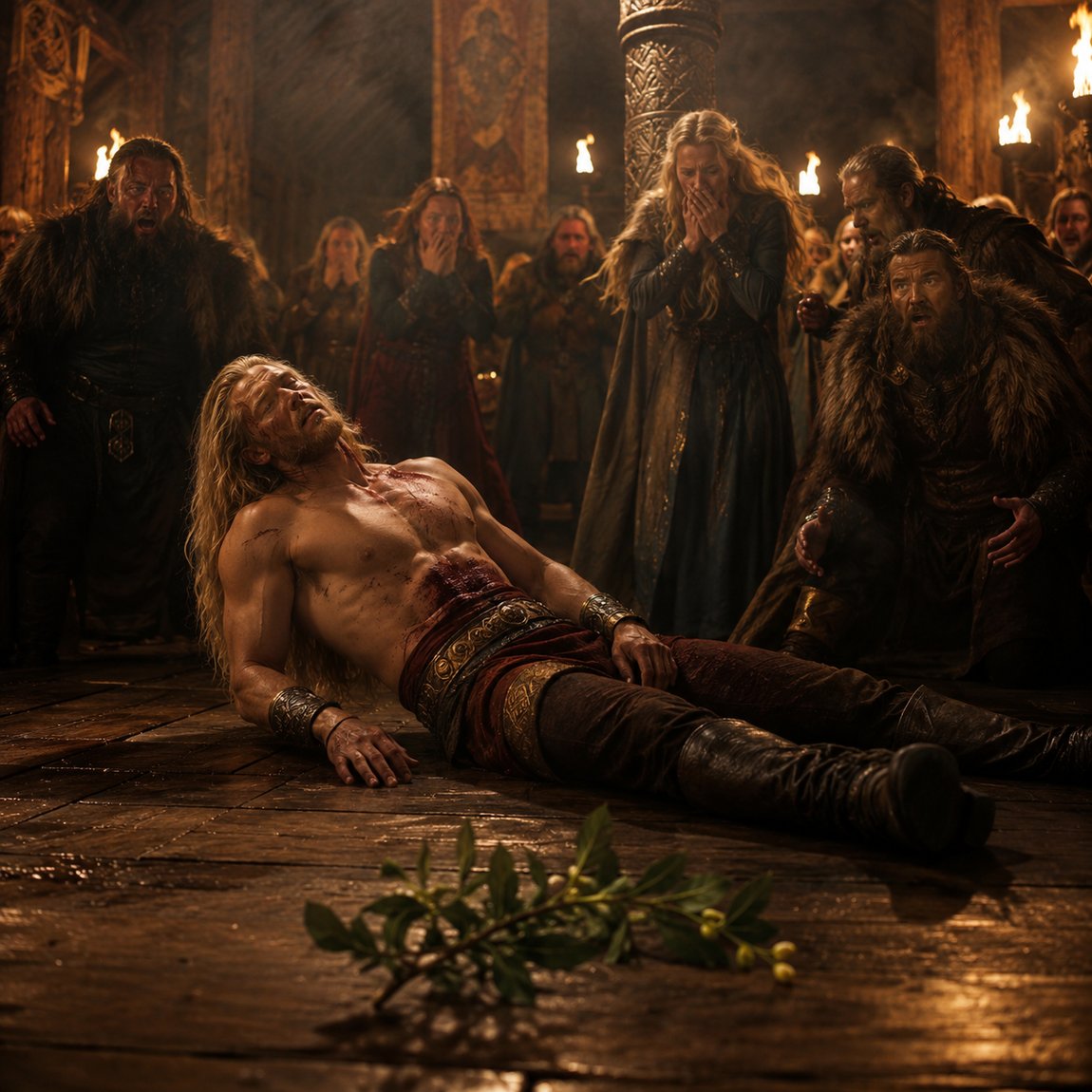
Loki goes off, pulls up the mistletoe and brings it to the assembly. At the edge stands Höðr, Baldr's brother. He is blind and takes no part; he cannot see where Baldr is, he says, and has nothing to throw. Loki hands him the sprig and directs his arm. Höðr throws, the mistletoe pierces Baldr, and he falls dead.
The gods are struck dumb; none can lift a hand. No one may take revenge, because the place is a sanctuary. When they can speak at last, only weeping comes. And Odin, says Snorri, bore the loss hardest, because he understood best how great a harm it was for the Æsir.
Völuspá compresses the moment into a handful of lines. Bellows: “I saw for Baldr, | the bleeding god, / The son of Othin, | his destiny set: / Famous and fair | in the lofty fields, / Full grown in strength | the mistletoe stood.” From that slender branch “came a harmful shaft | that Hoth should hurl”. For Loki's double role as helper and destroyer, see Loki – Helper and Destroyer.
The gods carry the dead god to the sea. Baldr's ship is called Hringhorni, in Snorri's words the greatest of all ships, and the pyre is to burn on board. But the ship will not budge. So the gods send to Jötunheim for a giantess called Hyrrokkin, a name usually explained as “fire-smoked” or “fire-shrivelled”.
She arrives riding a wolf, with a viper for a bridle. Odin calls four berserks to hold her mount; they can manage it only by throwing the beast to the ground. Hyrrokkin goes to the prow and launches the ship with her first push, so hard that fire flies from the rollers and the earth trembles. Thor grows angry and grips his hammer to smash her skull, until the gods beg peace for her. Oddly, a verse by the skald Þorbjörn dísarskáld, quoted elsewhere by Snorri, lists Hyrrokkin among the giants Thor killed. The tradition was not uniform.
Then Baldr is carried aboard. His wife Nanna sees it, collapses and dies of grief; she is laid on the pyre beside him. Thor hallows the fire with Mjöllnir. A dwarf named Litr runs in front of his feet; Thor kicks him into the flames, and he burns too. Odin lays the ring Draupnir on the pyre, and Baldr's horse is burned with all its harness.
The mourners include Odin with Frigg, valkyries and ravens; Freyr in a chariot drawn by the boar Gullinbursti; Heimdall on Gulltoppr; Freyja with her cats; and frost and mountain giants. Exactly these images – Freyr on the boar, Heimdall on horseback, Odin with valkyries and ravens, the giantess shoving the ship, Odin's champions felling her mount – appear in stanzas of Húsdrápa. So Snorri had a tenth-century model for this scene, composed before Iceland's official conversion. The ship itself, and its archaeological parallels, are covered in Hringhorni – Baldr's Funeral Ship.
Frigg asks who will win her favour by riding to Hel and offering a ransom for Baldr. Hermóðr the Bold, Odin's son, volunteers. He is given Sleipnir and sets off. His portrait: Hermod.
For nine nights Hermóðr rides through dark, deep valleys where he sees nothing, until he reaches the river Gjöll and crosses the bridge Gjallarbrú, roofed with gleaming gold. The bridge-warden Móðguðr tells him that yesterday five companies of dead men rode over the bridge, yet it thunders no less under him alone – and he does not have the colour of a dead man. The road to Hel, she tells him, runs down and to the north. See The Road to Hel.
At Hel's gate he tightens the girth and Sleipnir clears it without touching. Inside, Baldr sits in the seat of honour. In the morning Hermóðr asks Hel to let Baldr ride home with him.
Hel wants to test whether Baldr is truly as beloved as people say. If everything in the world, living and dead, weeps for him, he may return to the Æsir. If anything speaks against him and will not weep, he stays with her. Before Hermóðr leaves, Baldr gives him Draupnir to take back to Odin as a keepsake. Nanna sends Frigg a linen robe and other gifts, and a gold finger-ring for Frigg's handmaid Fulla.
The Æsir now send messengers through the whole world, asking everything to weep Baldr out of Hel. And everything weeps: people and beasts, the earth, the stones, the trees and all metals. Snorri adds an observation that sounds almost like natural history – just as you will have seen these things weep when they come out of the frost into the warmth. Anyone who has carried a cold slate from the store into a warm workshop knows those tears well.
The messengers are already on their way home when they find a giantess sitting in a cave. Her name is Thökk – Old Norse Þökk, which of all things means “thanks”. Asked to weep Baldr out of Hel, she answers with a verse. In our own close rendering:
Thökk will weep with dry tears for Baldr's burning. Alive or dead, the old man's son was no use to me. Let Hel keep what she has.Gylfaginning, own translation from the Old Norse
Then comes a sentence that is often overlooked. Snorri does not say Thökk was Loki. He says þess geta menn – “people suppose” – that it was Loki Laufeyjarson, who had done the Æsir so much harm. It fits the plot perfectly, but even in the source it is a conjecture.
A return from death that needs the consent of all creation: a single no is enough. More about the ruler of that realm in our article on Hel.
A killing demands vengeance. But the killer, Höðr, is Odin's own son – who can kill him without committing kin-slaying in turn? Odin fathers a new son, specifically to take revenge.
Völuspá and Baldrs draumar agree. Rindr bears Váli, and at one night old he goes to battle. In Bellows' translation of Völuspá: “His hands he washed not, | his hair he combed not, / Till he bore to the bale-blaze | Baldr's foe. / But in Fensalir | did Frigg weep sore / For Valhall's need.”
A verse by the skald Kormákr, quoted by Snorri, says in effect that Odin won Rindr by sorcery. For Váli and his silent half-brother Víðarr, who later kills Fenrir, see Víðarr and Váli – the Silent Avengers.
The folklorist John Lindow put this thread of vengeance at the centre of his study Murder and Vengeance among the Gods (1997). His thesis: the Baldr story is at heart a story of feud – a killing within the kin group for which there is no “clean” avenger. An interpretation, not a fact in the sources – but it explains why Váli has to exist.
In Book III of the Gesta Danorum, written in Latin around 1200, Saxo Grammaticus tells a story with the same names and an entirely different plot. His Hotherus is no blind god but a gifted young prince, son of Hothbrodd, brought up at the court of King Gevarus. He loves Gevarus' daughter Nanna. Balderus, a son of Othinus, sees Nanna bathing and wants her too. Rivalry in love becomes war.
Balderus is a demigod whom ordinary steel cannot wound. Only a sword owned by the forest satyr Mimingus can kill him; Hotherus captures the satyr and extorts the sword and a wealth-bringing arm-ring.
Battles follow in which the gods fight on Balderus' side – Thor among them – yet Hotherus wins Nanna. Balderus is strengthened by food prepared by three maidens and mixed with venom from the mouths of three snakes; Hotherus slips in disguised as a lute-player and later receives a belt of victory from the forest maidens. In the end he strikes Balderus in the side with the sword. Proserpina – Saxo's classical name for the goddess of death – appears to Balderus in a dream and promises him her embrace, and on the third day he dies of the wound.
The revenge runs differently too. A Finnish seer called Rostiophus tells Othinus that he will father an avenger on Rinda, daughter of the king of the Ruthenians. Othinus courts her in disguise, last of all as a healing-woman called “Wecha”, and gets the child by deceit and force – deeds for which, in Saxo, the gods temporarily expel him from their company. The son is called Bous. Bous kills Hotherus in battle and dies of his own wounds the next day.
Saxo even gives Balderus a burial mound: when a certain Harald had it dug open by night for treasure, a magical torrent burst out and the robbers fled. Which real mound he meant, Saxo never says.
In Snorri, Baldr's death is the first domino. Loki flees, turns himself into a salmon and is caught. The gods bind him to three rocks with the entrails of his son; Skaði hangs a venomous snake over his face, and his wife Sigyn catches the venom in a bowl. See Loki's Punishment.
There he lies until Ragnarök. With these two events – Baldr's death and Loki's binding – the road to the end is set. Baldrs draumar hints at it; Völuspá puts it in sequence: first Baldr, then the bound Loki, later brothers killing brothers and Fenrir running free. When Loki gets loose, Völuspá has him steering a ship full of Muspell's host against the gods; Snorri adds the Fimbulwinter as a prelude. The death of the invulnerable god proved that gods can die. For the end of the world itself, see Ragnarök – Doom of the Gods.
But the story does not end in fire. After the catastrophe, says Völuspá, a new green earth rises from the sea. In Bellows' words: “Then fields unsowed | bear ripened fruit, / All ills grow better, | and Baldr comes back; / Baldr and Hoth dwell | in Hropt's battle-hall.” Killer and victim together in a new world – see What Comes After Ragnarök?
What follows are scholarly theses – none is proven, and some have largely been abandoned.
Thesis 1: the dying god. The Scottish anthropologist James George Frazer made Baldr the centrepiece of the final part of The Golden Bough (“Balder the Beautiful”, 1913). He saw in him an embodiment of vegetation that dies and returns, linked the mistletoe to an oak cult and Baldr's pyre to midsummer bonfires. Today Frazer's model is regarded as outdated: the Norse sources know nothing of a yearly cycle. Baldr dies once and returns only after the end of the world.
Thesis 2: Christian influence. From 1881 onwards the Norwegian philologist Sophus Bugge argued, in his Studier over de nordiske Gude- og Heltesagns Oprindelse, that much of the Baldr story took shape under the influence of Christian and classical narratives. The parallels are striking: an innocent son of the highest god, killed by a seemingly harmless piece of wood; a blind killer – medieval legend made Longinus, the soldier who pierced Christ's side, a blind man; a journey to the underworld; a return in a renewed world. Against this: Húsdrápa shows the funeral already in the tenth century, and Baldr redeems nobody. Many scholars now assume a pagan core that Christian-educated narrators such as Snorri may have recoloured – how strongly remains disputed.
Thesis 3: the mistletoe puzzle. Mistletoe is a semi-parasite growing on trees, not a tree in its own right. Yet Völuspá has it standing tall above the fields. On top of that, mistletoe did not grow in Iceland and in Scandinavia occurs only in the south. Perhaps the poet had never seen the plant. Perhaps mistilteinn was originally a weapon name – in Hrómundar saga Gripssonar it is a sword, and in Saxo, too, Baldr is killed by a sword. Or the humble little plant is exactly the point: the weak spot lies where nobody looks. None of these solutions is certain.
Set the theories aside and a strikingly modern story remains: a mother who overlooks the smallest thing; an innocent turned into a weapon; a rescue that fails on a single refusal; a revenge that heals nothing. In our workshop, too, farewell and remembrance are the themes that demand the greatest care. That Baldr comes back in the end is no cheap comfort in the Edda. It is a promise that is only kept after the world has ended.
For courage. For remembrance. For legends that live on.
How did Baldr die? According to Snorri's Prose Edda he was struck by a sprig of mistletoe thrown by his blind brother Höðr, with Loki handing over the sprig and guiding his arm. Mistletoe was the only thing Frigg had not made swear an oath.
Did Loki kill Baldr? Höðr made the throw. Loki's role as instigator is told in full only by Snorri; in Lokasenna Loki boasts of the blame, while Völuspá names only Höðr.
Why couldn't Baldr come back from Hel? Hel demanded that everything in the world weep for him. Only the giantess Thökk refused – and Snorri says people suppose she was Loki.
Who avenged Baldr's death? Váli, a son of Odin and Rindr. At one night old he killed Höðr, without first washing his hands or combing his hair.
How is Saxo's version different? In Saxo, Balderus and Hotherus are rivals for Nanna; Hotherus kills Balderus with a special sword, and the avenger is called Bous.
Does Baldr return after Ragnarök? Yes. According to Völuspá, Baldr returns to the renewed world and lives there together with Höðr in Odin's old halls.
Balder – the Shining God · Loki’s Punishment · Hel · Frigg · What comes after Ragnarök?.
Warriors who fought in bear pelts and wolf-skins, bit their shields and feared neither fire nor iron. The berserker is …
Read more →Valhalla was only one of many realms of the dead. The ideas of the afterlife were as varied as the burial customs …
Read more →The most beautiful piece of jewellery in the world belongs to the most beautiful of the goddesses: Brísingamen, the …
Read more →We like to imagine valkyries as noble riders escorting the fallen to Valhalla. The Darraðarljóð shows them quite …
Read more →