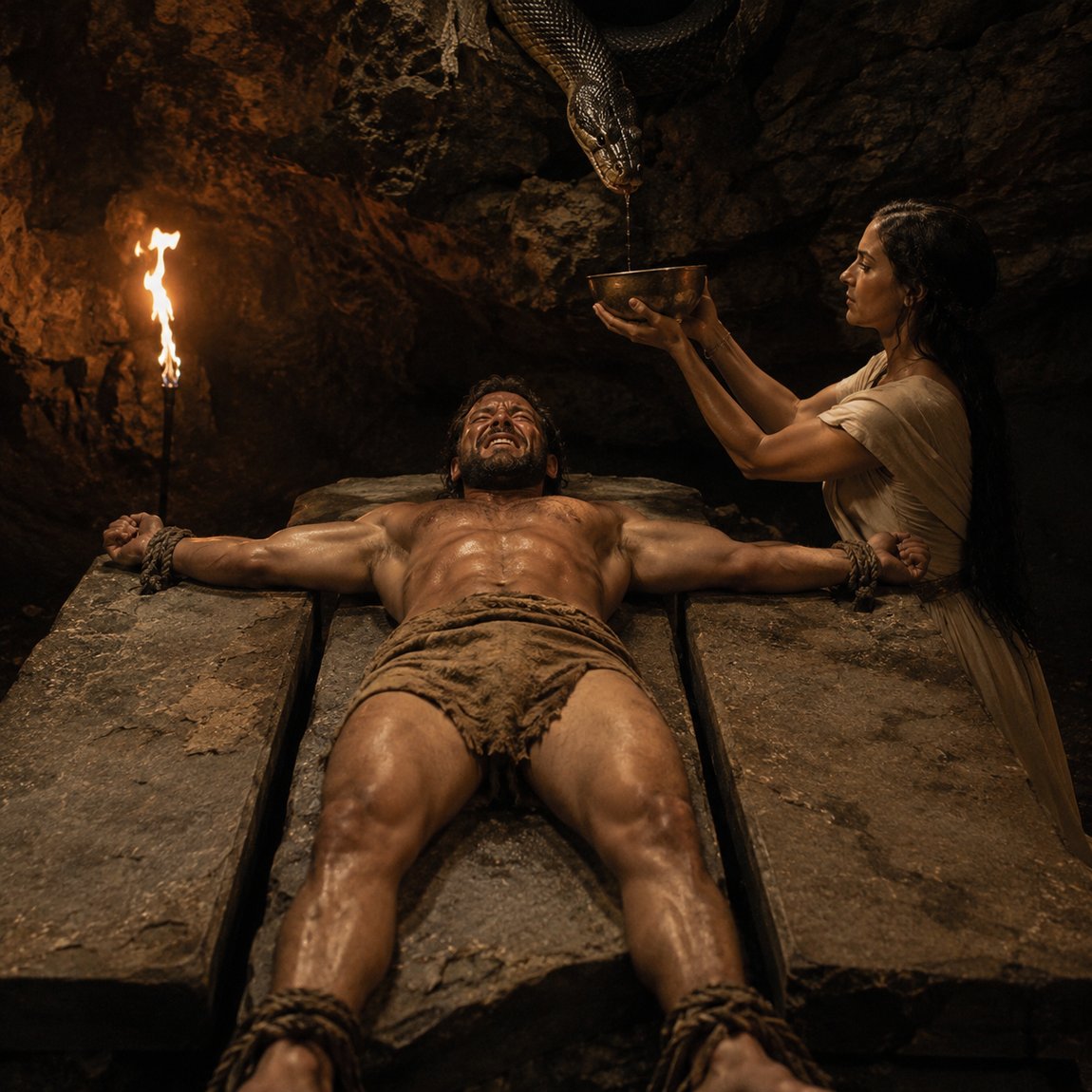
Loki's punishment goes like this: the gods catch him while he hides as a salmon in a waterfall, bind him in a cave across three stone slabs with the entrails of his own son, and Skaði hangs a venomous serpent above his face. Only his wife Sigyn stays, catching the venom in a bowl. Whenever she leaves to empty it, the venom strikes him, he writhes – and the earth quakes. There he lies until Ragnarök. Here is exactly what each source says, and where they disagree.
Some punishments end in death. Loki's is worse: it does not end at all. No verdict, no executioner, no final blow – just a condition meant to last until the world itself breaks. No other scene in Norse myth is quite so physical, so cruel and at the same time so quiet: a bound god in a cave, a drop of venom, a woman with a bowl.
If you want to meet Loki as a character – Odin's blood-brother, helper and wrecker, father of Fenrir, Jörmungandr and Hel – head over to our article Loki – helper and destroyer. This page sticks to one question: how, why and according to which sources was Loki punished? And which parts are genuinely old, which did Snorri embroider, and what do the stone crosses of northern England actually show?
The fullest account sits in Gylfaginning, the first major part of the Prose Edda, written by the Icelander Snorri Sturluson around 1220 – well over two centuries after Iceland became Christian. A shorter version, differing in some details, survives as the prose ending of Lokasenna, a mythological poem in the Poetic Edda preserved in the Codex Regius (c. 1270). On top of that come allusions in the poems Völuspá and Baldrs draumar, and tenth-century stone carvings in Cumbria, whose interpretation is not equally certain in every case.
In Snorri, the punishment opens with a getaway. After the death of Baldr and the failed attempt to bring him back from Hel, the gods are – as the text puts it in effect – exactly as angry with Loki as you would expect. Loki knows it. He runs off and hides on a mountain, where he builds a house with four doors so he can look out in every direction from inside. Whoever comes, Loki wants to see them first.
By day he takes the shape of a salmon and hides in a waterfall called Fránangrsfors, "Fránangr's falls". No source tells us where it is; it is a place in a story, not on a map. Shape-shifting is nothing new for Loki – mare, falcon, fly and seal are all on his record.
And then comes the moment when Loki's own cleverness turns against him. Snorri says Loki sat brooding over what trick the gods might use to catch him in the water. He took linen yarn and knotted meshes – the way nets have been made ever since. In this story, Loki is the inventor of the fishing net. He is sitting by the fire working on it when he sees the gods are almost upon him; Odin has spotted him from his high seat Hliðskjálf. Loki throws the net into the fire and leaps into the river.
The first to enter the house is Kvasir, whom Snorri here calls the wisest of them all. In the fire he sees the white ash of the burnt net – the mesh pattern still visible. Kvasir works out that this must be a device for catching fish and tells the others. The gods knot their own net after the pattern in the ashes.
A small detail for the sticklers: elsewhere in the Prose Edda, in Skáldskaparmál, Snorri tells how Kvasir was killed by two dwarfs who brewed the mead of poetry from his blood. Here, in the Loki story, Kvasir is alive and well and the sharpest mind in the hunting party. Snorri set different traditions side by side without always reconciling them – a useful reminder that Norse mythology was never a tidy, contradiction-free textbook.
Then the hunt begins. The gods drag the net through the river, Thor holding one end and all the other gods the other. On the first pass, Loki swims ahead and lies down between two stones; the net slides over him. On the second pass, the gods weight the net so nothing can slip underneath. Loki swims ahead of it, realises the sea is close, leaps over the top of the net and darts back upstream to the falls.
On the third pass, the gods split up. They haul the net on toward the sea while Thor wades along in midstream. Loki now has two options: out to sea, which means mortal danger, or over the net once more. He jumps as fast as he can. Thor grabs at him; the slippery fish slides through his hand – but Thor catches hold of the tail and does not let go.
And here Snorri slips in a little explanation that is easy to miss: that, he says in effect, is why the salmon tapers so sharply toward the tail. This is an aetiology, an origin story explaining a feature of the real world – in this case the narrow "wrist" of a salmon's tail, which anglers still like to grip today. Right in the middle of the darkest punishment scene in the mythology sits a wink that any fisherman will understand.
Now Loki is caught, and Snorri stresses that there is no mercy and no truce. The gods take him into a cave. They take three flat slabs of stone, set them on edge and bore a hole through each. Then they fetch Loki's sons, whom Snorri calls Váli and Nari or Narfi. The gods turn Váli into a wolf, and he tears his brother Narfi apart. With Narfi's entrails the Æsir bind Loki across the three stones: one under his shoulders, one under his loins, one under the backs of his knees. And those bonds turn to iron.
It is worth pausing on just how brutal this is. The punishment does not only hit Loki; it destroys his family. One son is made into a beast, the other dies by the teeth of his brother, and his body becomes the instrument of the binding. The gods, who usually appear as guardians of order, act here with a harshness that smells of blood feud. Yet the image is carefully built: the thing closest to Loki, his own flesh and blood, becomes the fetter that holds him. And the turn to iron makes something organic unbreakable.
Binding alone is not enough for the gods. Skaði, the giantess and huntress, takes a venomous serpent and fastens it above Loki so that its venom drips onto his face. It is no accident that this part falls to Skaði. Her father Thjazi died through a trick in which Loki played a part, and in Lokasenna Loki even boasts that he was first and foremost at Thjazi's killing. Skaði's serpent is a personal score being settled.
Then the only figure in the story who shows pity steps in. Sigyn, Loki's wife, stands beside him and holds a bowl under the dripping venom. When the bowl is full she has to go and pour it out, and in that short time the venom falls unhindered on Loki's face. He jerks so violently that the whole earth shakes – and that, says Snorri, is what people call an earthquake. There Loki lies bound until Ragnarök.
The earthquake explanation is the story's second aetiology. For Iceland, sitting on the boundary of two tectonic plates and shaken regularly, this was no abstract matter. Whether Snorri was drawing on a popular explanation or adding a neat punchline of his own cannot be settled. It is worth noting, though, that the prose ending of Lokasenna mentions the earthquakes too, so the motif was not Snorri's invention alone.
Lokasenna, "Loki's quarrel" or "Loki's flyting", describes a feast in the hall of the sea giant Ægir at which Loki insults one god and goddess after another until Thor threatens him out of the hall with his hammer. In the Codex Regius, the poem is followed by a short prose passage telling what happened next. Loki hides in salmon shape in Fránangrsfors, where the Æsir catch him. He is bound with the entrails of his son Nari, and his son Narfi becomes a wolf. Skaði fastens a venomous serpent above his face; Sigyn sits there holding a bowl under the venom. When she carries the full bowl out, the venom drips on Loki and he shudders so hard that the whole earth shakes. That, the passage ends, is now called an earthquake.
The differences from Snorri are small but telling. In the Lokasenna prose there is no Váli at all. The son who becomes a wolf is Narfi; the son whose guts form the fetter is Nari. Snorri has it the other way round, or rather shifted: Váli becomes the wolf, Narfi dies, and "Nari or Narfi" is for him one name in two spellings. How the prose writer ended up with two sons of almost identical names, he does not explain. Some older editions and translations – Henry Adams Bellows' English version of 1923, for instance – brought the text into line with Snorri and put Váli in here. If you compare translations, that is why you will run into different names.
This may be the most interesting difference of all. In Snorri, the reason is unambiguous: Baldr's death. Loki put the mistletoe into the hand of the blind god Höðr, who killed Baldr with it, and when every being is meant to weep Baldr out of Hel, a giantess called Þökk refuses – and people believe, Snorri says, that she was Loki. Then comes the punishment. Cause and effect, neatly lined up.
The Lokasenna prose sets a different accent. It begins, in effect, with "after this" – that is, after the flyting at Ægir's. Read on its own, it could suggest Loki is bound for his insults. But it is not that simple. Within the poem itself, Loki boasts to Frigg that it is his doing she will never again see Baldr ride home to the hall. Baldr's death already lies behind Lokasenna. And Skaði threatens Loki in the poem that the gods will bind him on rocks with the guts of his ice-cold son. The punishment is announced in the poem – from the mouth of the very goddess who later hangs up the serpent.
So the two versions fit together well: Baldr's death is the real guilt, and the flyting is the moment Loki publicly admits it and burns every bridge. For you as a reader that means: say Loki was bound "because of Baldr" and you are right. Say "because of Lokasenna" and you have the order of one manuscript on your side, but not the whole story.
The oldest layer of what we know is not a narrative at all but a handful of terse allusions in the poems. In Völuspá, "the prophecy of the seeress", there is a stanza – number 35 in the Codex Regius numbering – that freezes the scene in a few lines. In our own translation:
A captive she saw lying beneath the grove of hot springs, in shape like the mischief-loving Loki. There sits Sigyn, by no means glad of her husband. Do you know yet more – or what?Völuspá 35 (Codex Regius), our own translation from Old Norse
The Old Norse hveralundr – roughly "grove of cauldrons" or "grove of hot springs" – is a puzzling place name. Some scholars think of Icelandic hot springs, which would sit nicely with the earthquake punchline; but that remains interpretation. What stands out is how reticent the seeress is: a bound figure who looks like Loki. She mentions neither serpent nor bowl – only Sigyn, who is not happy. Anyone who knew the story needed nothing more.
Immediately before this, the tradition preserves a half-stanza about bonds made of guts: Váli twisted "battle-bonds", and those fetters made of entrails were hard indeed. These lines are not transmitted identically in all manuscripts, and placing them is tricky. The name that matters is Váli. Elsewhere in the mythology, Váli is a son of Odin, born for the sole purpose of avenging Baldr – Baldrs draumar says he is ready for vengeance just one night after his birth. Many scholars therefore consider it possible that originally it was this avenger Váli who bound Loki, and that Snorri – or his source – turned him into a son of Loki named Váli. That is a well-argued hypothesis, not a certainty.
The poem Baldrs draumar ("Baldr's dreams") contributes one more important line. Odin has woken a dead seeress to ask about Baldr's fate. At the end she sends him away, declaring that no one will visit her again until Loki comes loose from his bonds and the destroyers arrive for the doom of the gods. Here, Loki's binding is already a fixed time-marker: it holds until the world ends. That link between Baldr's death, Loki's fetters and Ragnarök is therefore older than Snorri's detailed telling, even if we cannot date the Eddic poems precisely.
Are there pictures of Loki's punishment from a time when people still knew the old gods first-hand? The most important candidate stands not in Scandinavia but in north-west England: the Gosforth Cross in the churchyard of St Mary's, Gosforth, Cumbria. It is a slender red sandstone cross about 4.4 metres tall, usually dated to the first half of the tenth century, often around 920 to 950. It was raised in an area settled by Scandinavians who had by then become Christian.
The cross shows a Crucifixion scene, but alongside it a whole series of images associated with Ragnarök: a man tearing open a monster's jaws (often read as Víðarr against Fenrir), a figure holding a horn (Heimdallr?), and on the west face a bound figure with a woman holding a vessel beside him and a serpent above. The obvious and widely accepted reading: Loki in fetters, Sigyn with her bowl. The British archaeologist Richard Bailey, whose work on Viking-age sculpture in northern England remains fundamental, is among the scholars who have discussed the cross's Norse motifs in detail.
Why would a Christian cross carry a pagan punishment scene? The usual explanation is that the carver set the end of the old divine order against the victory of Christ. The bound Loki could be understood as a counterpart to the bound Satan of Christian tradition – for instance in the Book of Revelation, where an angel binds the dragon for a thousand years before it is loosed once more. The resemblance to a bound Loki who lies until Ragnarök and then breaks free is plain. Whether the carver meant to equate the two or simply set two stories side by side, we do not know. You can read more about this and related stones in Gosforth & Thorwald's Cross.
Some 35 miles from Gosforth lies Kirkby Stephen, also in Cumbria. Its parish church keeps a fragment of a tenth-century stone cross in reddish sandstone showing a bound figure. Locally it is known as "The Bound Devil", and often as the "Loki Stone"; the town even holds a Loki festival.
Caution is needed here, though. The tell-tale signs of Loki's punishment – the serpent and the woman with a bowl – are missing. What used to be read as horns or chains may, according to more recent interpretations, be something else, such as attacking beasts. The figure could just as well represent the bound Satan of Christian art, a common early medieval image of evil overcome by Christ. The honest answer is that a Loki reading is possible but not secure. When you see online that the stone "shows Loki", you are reading an interpretation, not a finding.
A bound transgressor, a creature tormenting him, an end that only comes with the end of the world: that instantly recalls the Greek Prometheus, chained to a rock in the Caucasus while an eagle devours his liver every day. Some legends from the Caucasus itself come even closer. In Georgian myth the hero Amirani is chained inside a mountain for his arrogance; his dog licks the chain thin, but just before it breaks, smiths strike their anvils and the chain grows strong again. Similar stories are known from Armenia, where a bound king lies in a cave on Mount Ararat.
The Danish folklorist Axel Olrik, in his early-twentieth-century studies of Ragnarök, compared such Caucasian tales of the bound giant with Loki and considered possible connections. Later scholars have responded in very different ways. The key point: a comparison shows a related motif, not proof of borrowing. Whether similarities come from a shared ancient origin, travelled through contact, or are simply obvious images that can arise anywhere is almost impossible to decide on such patchy evidence.
Within the Norse world itself there are closer relatives. Loki's son Fenrir is bound with the magical fetter Gleipnir and likewise lies captive until Ragnarök. And the Danish historian Saxo Grammaticus, writing around 1200, tells of a voyage to a being called Ugarthilocus who lies chained in a dark cave. Whether Saxo knew a version of Loki's punishment is debated, but the resemblance is striking. A basic pattern of Norse myth shows through: the most dangerous beings are not killed but bound. Chaos is tamed, not eliminated.
Loki's punishment is not an ending but a waiting period. At Ragnarök the fetters snap. Völuspá says a ship comes from the east across the sea carrying the people of Muspell, and Loki steers it. Elsewhere it refers to him by a kenning as "Býleistr's brother", travelling with the monsters. Snorri fills in more: Loki comes with all of Hel's host, and in the final battle Loki and Heimdallr kill each other. Fenrir tears loose as well, and the Midgard Serpent Jörmungandr rises from the sea. The gods bought themselves time by force, but the bill falls due in the end.
Read the scene as a whole once more and three things stand out. First, the gods are not kind here. They turn one child into a wolf and use the body of the other as a fetter. Norse myth has no morally spotless winners, and that is a large part of why it still feels credible. Second, the punishment is built to last, not to settle accounts in a single moment. That fits a world in which the gods see the end coming and can only postpone it. Third, in the middle of all that harshness stands Sigyn. She cannot lift the punishment, but she makes it bearable. She cannot prevent the end of the world, but every time she holds up the bowl, the earth shakes a little later.
Why was Loki punished? According to Snorri's Prose Edda, for Baldr's death, which Loki engineered, and for refusing – as the giantess Þökk – to weep Baldr out of Hel. The prose ending of Lokasenna places the punishment after the flyting at Ægir's hall, but there too Loki admits his guilt for Baldr's death.
What was Loki bound with? With the entrails of his son, which turned to iron. In Snorri they are the entrails of Narfi, torn apart by his brother Váli in wolf shape; in the Lokasenna prose they are Nari's, while Narfi becomes a wolf.
Who holds the bowl over Loki? His wife Sigyn. She catches the venom of the serpent that Skaði fastened above Loki's face. When she empties the full bowl, the venom strikes Loki and he writhes so hard the earth quakes.
Why did Loki turn into a salmon? To hide from the gods in the waterfall Fránangrsfors. Thor finally caught him by the tail, and according to Snorri that is why the salmon tapers at the back.
How long does Loki stay bound? Until Ragnarök. Then he breaks free, steers a ship against the gods according to Völuspá, and, in Snorri, kills Heimdallr in the final battle while Heimdallr kills him.
Are there early images of Loki's punishment? The tenth-century Gosforth Cross in Cumbria very probably shows the bound Loki with Sigyn and her bowl. For the Kirkby Stephen stone, by contrast, the Loki reading is disputed.
For courage. For remembrance. For legends that live on.
Loki · Sigyn – the Faithful · Lokasenna – the Flyting of the Gods · Baldr’s Death · Ragnarök.
A stranger offers the gods an unbreachable wall around their stronghold - in a single winter. His price is outrageous …
Read more →Most people know Ragnarök only as a world-fire: gods die, the sun goes out, the earth sinks. Yet the great world-poem …
Read more →Norse cosmology knows not heaven and earth but nine worlds – strung along the world tree Yggdrasil, which runs through …
Read more →Above the gods stands something to which even Odin bows: fate. And fate has three shapes – the Norns, who sit at the …
Read more →