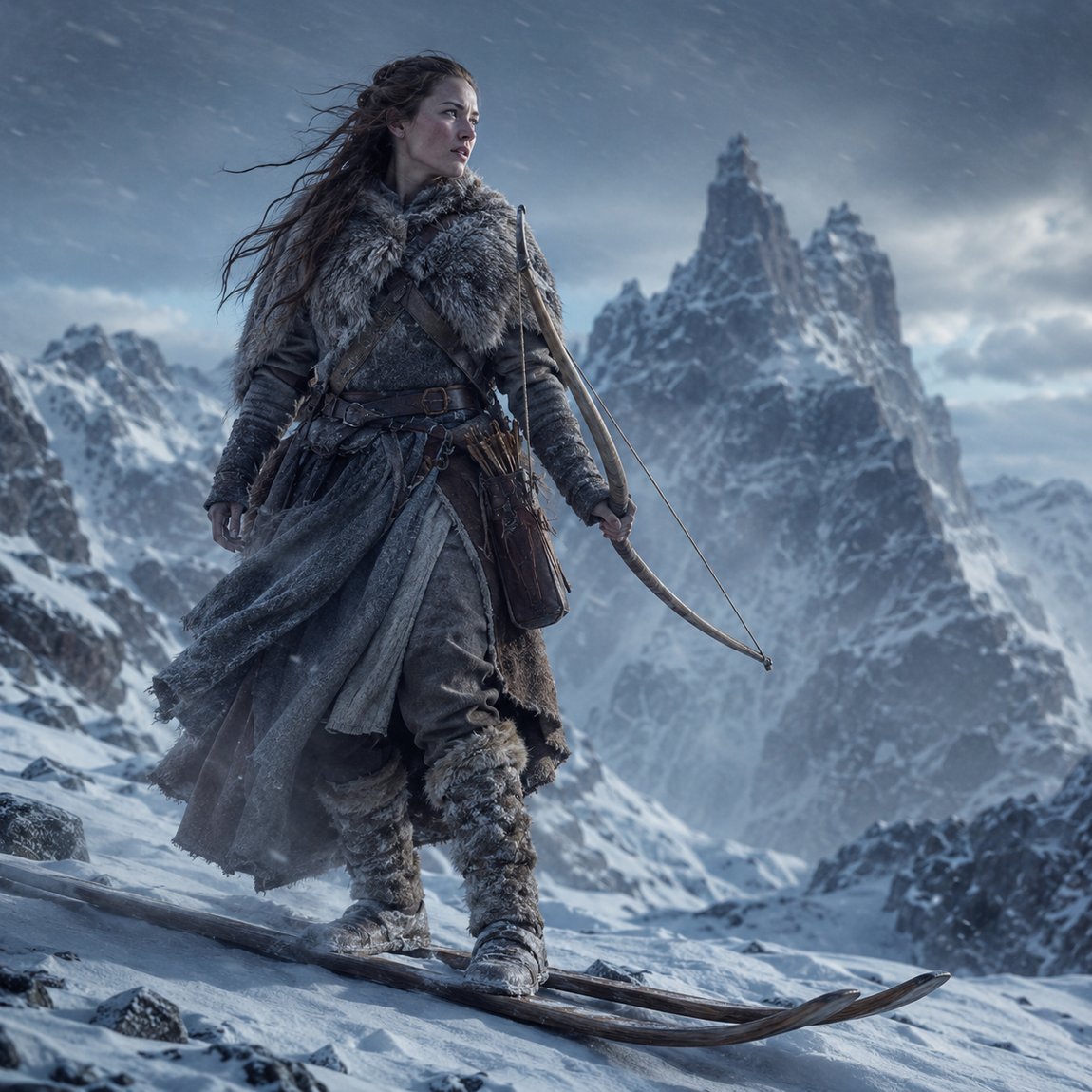
The Norse goddess of winter and the hunt is Skadi, Old Norse Skaði: a giant's daughter who travels the mountains on skis, hunts with a bow, and marched on Asgard in full armour after the gods killed her father. To be honest about it, "goddess of winter and the hunt" is a modern summary. The sources call her öndurdís, "ski-goddess", and Snorri writes in Gylfaginning 23 that she goes about on skis with her bow and shoots animals. Here is what the texts really say, from choosing a husband by his feet to the serpent above Loki.
If you are looking for the Norse goddess of winter, skiing and the hunt, the name you want is Skadi – in Old Norse Skaði, often anglicised as Skathi or Skade. She is the daughter of the giant Thjazi, lives in the mountain stronghold of Þrymheimr, travels on skis, hunts with a bow, and is admitted to the company of the Æsir after a legal settlement over her father's death.
One honest caveat belongs right at the top. No Old Norse text calls her "goddess of winter" or "goddess of the hunt" in so many words. That label is a modern summary – a fair one, but a summary. Evidence first, then the story: revenge, a beauty contest judged on feet, a goat, and a venomous snake.
The key passage comes from Snorri Sturluson, the Icelandic scholar who wrote the so-called Prose Edda around 1220 as a handbook for poets (more in our piece on Snorri Sturluson). In chapter 23 of Gylfaginning, "The Deluding of Gylfi", after her marriage has failed, Skaði goes up into the mountains, settles in Þrymheimr, and "travels much on skis and with a bow, and shoots animals". The next sentence reads Hon heitir öndurgoð eða öndurdís – "She is called ski-deity or ski-dís".
Öndurr is an Old Norse word for a ski; a dís is a female supernatural being, a goddess or guardian woman. "Ski-goddess" is therefore close to a literal translation, not a modern flourish.
Nor did Snorri invent the epithet. In his Skáldskaparmál, "The Language of Poetry", he quotes a stanza attributed to Bragi, traditionally the earliest skald known by name and usually placed in the ninth century. Bragi speaks of the one who threw the eyes "of the father of Öndurdís" into the sky. That is centuries before Snorri.
And winter? It lives in the landscape rather than the title: mountains, snow, skis, wolves. No source calls Skaði mistress of winter, and none tells of anyone praying to her for a good hunt.
Her home is attested in the Poetic Edda too. In Grímnismál, Odin in disguise lists the halls of the gods, and the sixth is Skaði's:
"The sixth is Thrymheim, where Thjazi dwelt, / The giant of marvelous might; / Now Skathi abides, the god's fair bride, / In the home that her father had."Grímnismál 11, tr. Henry Adams Bellows, 1923
She sits in a list of divine halls beside Odin, Freyr and Baldr – yet lives in the house of her giant father. She became a goddess without leaving her origins behind. The name Þrymheimr means something like "Din-home" or "Thunder-home" – probably the roar of storm and rockfall.
Her story begins with a kidnapping. Thjazi, in the shape of an eagle, seized Loki on a journey and let him go only after Loki swore to deliver the goddess Idun and her apples – the fruit that keeps the gods young. Loki lured Idun out of Asgard, the eagle snatched her, and the Æsir began to grey and wither.
Under threat, Loki flew to Þrymheimr in Freyja's falcon cloak, turned Idun into a nut and carried her off. Thjazi gave chase as an eagle. At Asgard's wall the gods lit wood shavings, the flames caught his feathers, he fell, and they killed him.
This is not Snorri's invention either. The skaldic poem Haustlǫng by Þjóðólfr of Hvinir, usually dated to around 900, describes the same events. Snorri adds that Thjazi's father Ölvaldi was so rich that his sons shared out his gold by mouthfuls. Skaði comes from an old, wealthy house, not a cave full of monsters.
Snorri puts it with Icelandic economy: Skaði took helmet, mail-coat and all her weapons of war and went to Asgard to avenge her father. Alone. Against a fortress full of gods.
The gods do not fight. They offer her sætt ok yfirbætr – "settlement and compensation": when a killing is paid for, nobody else has to die.
Retellings often muddle the terms. There are three, from different sides. First, the Æsir offer that she may choose a husband from among them – but by his feet alone. Second, it is part of her own terms that the gods must make her laugh, which she believes impossible. Third, Odin adds a further compensation of his own by setting Thjazi's eyes in the sky. That last item is a bonus, not one of her demands.
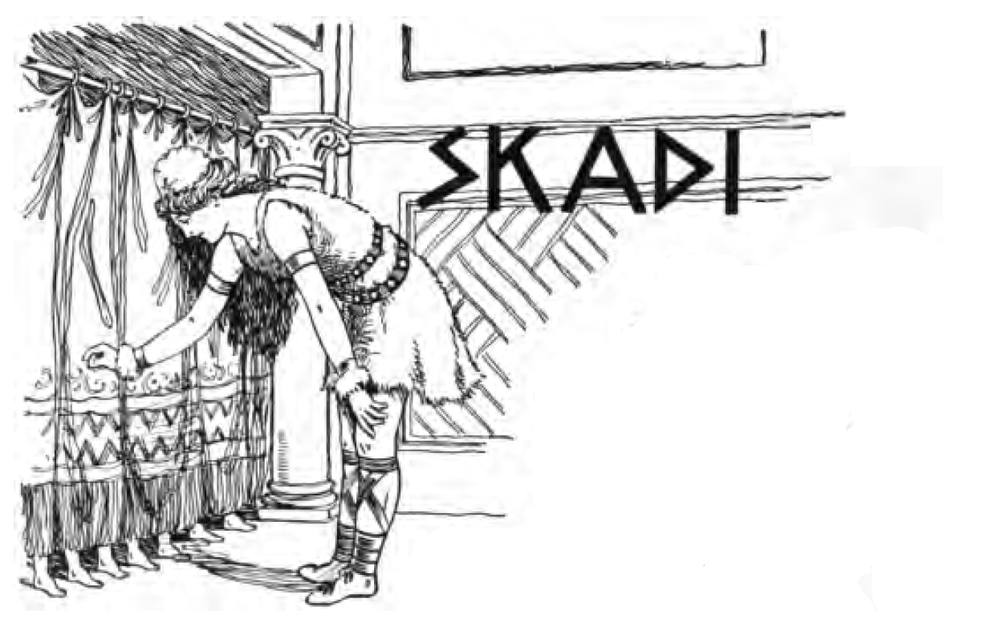
The gods line up and Skaði sees nothing but feet. She picks the most beautiful pair and, according to Snorri, says: Þenna kýs ek. Fátt mun ljótt á Baldri – "I choose this one. Little about Baldr can be ugly."
The feet belong to Njörðr, the sea god, kept spotless by the sea that washes them. The scene is meant to make you smile, but it also turns the marriage into a matter of chance: the gods did not fob her off, and she did not choose foolishly. The feet decided. She gets what she is owed, and still not what she wanted. A settlement is not a wish list.
Loki solves the second term in the crudest way imaginable. He ties one end of a cord to the beard of a goat and the other to his own testicles. Each pulls, both shriek, and finally Loki lets himself fall into Skaði's lap. She laughs, and the settlement is complete.
Crude, yes, but laughter in front of witnesses marks the end of the feud, much as a handshake ends a negotiation. And there is a sting in it: the one who makes her laugh is Loki, who helped bring about her father's death. That comes back to bite in Lokasenna.
The third element is Odin's. Snorri says he took Thjazi's eyes, threw them up into the heavens and made two stars of them.
The motif is old: Bragi's stanza speaks of the one who flung the giant's eyes onto the "bowl of the winds", the sky above the dwellings of many men. In Hárbarðsljóð, however, Thor claims the deed for himself: he killed Thjazi and hurled the eyes of Alvaldi's son into the heavens. Two sources, two heroes – a good reminder that Norse myth is not a tidy system but a bundle of competing traditions.
Which stars are meant, no source says. Any identification you may read – Castor and Pollux, or any other pair – is later guesswork, not evidence.
Njörðr is no Áss by birth either. He belongs to the Vanir, the second family of gods, and came to Asgard as a hostage when the war between the two families ended. He rules the coast: seafaring, fishing, wind and the wealth that arrives by ship. His hall Nóatún means "ship-enclosure" – a harbour. So the marriage joins two outsiders, both brought into Asgard by treaty: she by compensation, he as a hostage.
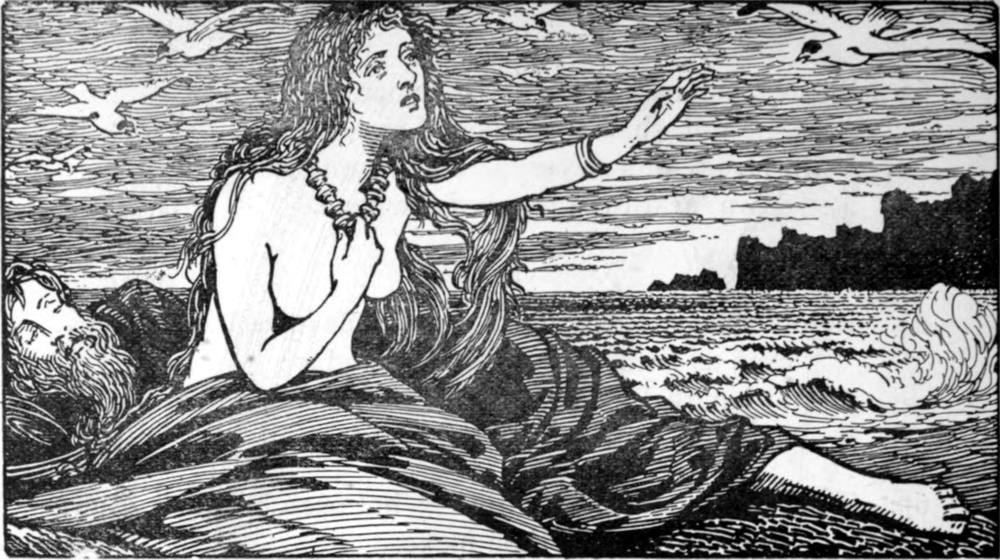
Skaði wants to live where her father lived; Njörðr wants to be near the sea. According to Snorri they agree on nine nights in Þrymheimr, then nine at Nóatún. It works for neither. Snorri gives each of them a short verse, and they are among the most human lines in Old Norse literature:
"Hateful to me are the mountains – I was not long there, only nine nights; the howling of wolves seemed ugly to me beside the song of the swans."Njörðr, Gylfaginning 23, our own rendering
"I could not sleep on the sea's bed for the screaming of the bird; he wakes me, coming in from the water, every morning: the gull."Skaði, Gylfaginning 23, our own rendering
Yet the poetry also shows them as a couple. At the opening of Skírnismál (see Skírnismál – how Freyr lost his sword), Njörðr and Skaði appear as worried parents. Freyr is brooding and will speak to nobody, and it is Skaði who sends the servant Skírnir to ask "our son" what is wrong. Whether she is his mother or stepmother, the poem does not say.
In the end they separate. Skaði goes back to the mountains, skis and hunts. No betrayal, no villain, no guilt – just two landscapes that cannot share a bed.
Do not file Skaði under tragic losers. When Loki is finally bound, it is she who fastens a venomous serpent above his face. His wife Sigyn catches the dripping venom in a bowl; whenever she turns away to empty it, the poison strikes him, he writhes, and the earth shakes.
The prose at the end of Lokasenna needs a single dry sentence: "Skathi took a poison-snake and fastened it up over Loki's face, and the poison dropped thereon" (Bellows). The full scene is in our piece on Loki's punishment. No motive is stated, but Loki had handed Idun to Thjazi and set the chain in motion.
In Lokasenna, the great flyting at Ægir's feast, Loki insults every guest in turn. In stanzas 49 to 52 he meets Skaði, and the temperature drops.
"Light art thou, Loki, but longer thou mayst not / In freedom flourish thy tail; / On the rocks the gods bind thee with bowels torn / Forth from thy frost-cold son."Lokasenna 49, tr. Bellows, 1923
Loki is unimpressed: even so, he says, he was first and last at the deadly fight when they seized Thjazi. Skaði answers: "From my dwellings and fields shall ever come forth / A counsel cold for thee." Loki has the last word, claiming she spoke more kindly when she invited him to her bed.
That claim appears nowhere else. Far more interesting is Skaði's own phrase. The Old Norse is frá mínum véum ok vöngum – literally "from my sanctuaries and meadows". A goddess speaks of her own vé, her own holy places. It is one of very few lines in the poetry that hint at real worship of Skaði.
After the separation the Edda loses sight of her, but Snorri's Ynglinga saga knows more. It retells the gods as early kings, and chapter 8 (chapter 9 in Samuel Laing's 1844 translation) says that Njörðr took a wife called Skaði, but she would not live with him and afterwards married Odin. They had many sons; one of them was named Sæmingr.
Snorri bases this on two stanzas of Háleygjatal, a praise poem composed in the late tenth century by the skald Eyvindr skáldaspillir for Hákon jarl. Hákon and his family, the powerful Earls of Lade, traced their descent from Sæmingr – and through him from Odin and Skaði.
That is less mythology than politics: for a dynasty rooted in Hålogaland in the far north, a divine ancestress of rock and snow fitted far better than any sea goddess.
The genealogical poem Hyndluljóð confirms the family: it calls Thjazi a giant fond of shooting and states that Skaði was his daughter.
As an ordinary noun, Old Norse skaði means "harm, damage" – the same word as English scathe, as in "unscathed". Others connect her name with Gothic skadus and Old English sceadu, "shadow". Both are possible; neither is proven.
The tempting idea is another. "Scandinavia" and Scania (Swedish Skåne, Old Norse Skáney) are traced to a Germanic compound reconstructed as *Skaðin-awjō, whose second part means roughly "island, land by water". One camp reads "dangerous island", after the treacherous sandbanks off Scania. The other suggests "Skaði's island". The Old Norse scholar John McKinnell thought Skaði might once have personified the region; Georges Dumézil argued the reverse, that the goddess took her name from the land.
None of this can be demonstrated. The oldest witness to the place name is Pliny the Elder in the first century AD, who mentions an island called Scatinavia. We find "Skaði's island" more attractive and "dangerous island" more likely – and we would rather say so than sell you the prettier story.
Place names are harder to fake than myths: where a god's name is joined to vé, "sanctuary", worship is likely (see gods in place names).
For Skaði, reference works point mainly to Swedish names; Skedevi in Östergötland, interpreted as "Skaði's sanctuary", is the one most often cited. Individual names allow competing readings, so caution is needed. Taken together with her "sanctuaries" in Lokasenna, though, a careful picture emerges: Skaði was probably more than a character in stories, and had cult sites at least in some regions. What happened there, no source tells us.
In the autumn of 1924, men digging a ditch through a bog near Kalvträsk, close to Skellefteå in northern Sweden, found two skis and a shovel-shaped pole. The surviving ski is 204 cm long. Radiocarbon dating put it at around 3200 BC. Now in the Västerbottens museum in Umeå, it ranks among the oldest skis anywhere. On the island of Rødøy in northern Norway, a Stone Age rock carving shows a figure on long runners.
The glaciers take us closer to Skaði's world. At Digervarden in Norway, the Secrets of the Ice programme found a ski with its binding in 2014; in September 2021 its partner turned up about five metres away. The pair is roughly 1,300 years old, from just before the Viking Age, bindings and all.
A goddess who hunts on skis is therefore not a pretty metaphor but a skill thousands of years old, raised to the level of the divine.
The same goes for Ullr. Snorri calls him so good an archer and skier that nobody can compete with him. Search for the Norse god of the hunt and you find Ullr; for the goddess, Skaði. A marriage between them, found in some modern retellings, is in no source.
Gods and giants are supposed to be mortal enemies, yet the line was never sharp. Odin's mother Bestla is a giant's daughter, Thor's mother Jörð is counted among the giantesses, and across the fence between the two worlds people marry, bargain and kill, often in that order. Skaði comes from outside, is taken in, and stays exactly who she was. Her hall is still called Þrymheimr.
No text describes a sacrifice to her, a feast day or an image. There is no myth of her own, only episodes in which she appears beside others. No source describes her looks. Even the question of children stays open: Skírnismál has her call Freyr "our son", while Ynglinga saga makes Njörðr's sister the mother of Freyr and Freyja. And at Ragnarök she is simply absent. She disappears into her mountains – which suits her.
Her afterlife began with the translations. W. G. Collingwood illustrated Olive Bray's 1908 English edition of the Poetic Edda, including the picture shown above. Today a small moon of Saturn carries her name, Skathi, named like its neighbours after figures from Norse tradition.
Skaði came to kill and left with a husband, a laugh and two new stars. She lost the marriage and kept her place.
Who is the Norse goddess of winter and the hunt? Skadi (Old Norse Skaði), daughter of the giant Thjazi. Snorri describes her skiing and hunting with a bow in the mountains and calls her öndurdís, "ski-goddess"; "goddess of winter and the hunt" is a modern summary of that picture.
Who was Skadi married to? To the sea god Njörðr, whom she chose by his feet while hoping for Baldr. According to Ynglinga saga she later lived with Odin and bore him sons, among them Sæmingr.
Why did Skadi hang the snake over Loki? The sources give no explicit reason. But Loki had made Idun's abduction possible, which led to her father's death, and he boasted of his part in Lokasenna.
Is Scandinavia named after Skadi? Possibly, but it cannot be proven. Many scholars read the first element of *Skaðin-awjō as "danger, harm", referring to the dangerous sandbanks off Scania.
Is Skadi a giantess or a goddess? Both. She is a giantess by birth, is received into Asgard through the settlement, and Snorri lists her among the Ásynjur.
For courage. For remembrance. For legends that live on.
Njörd & the Vanir · Idun & the Apples of Youth · Loki · The Norse pantheon · Frigg.
All Gods & Goddesses articles →
In the North, the sun is female. Sunna – Sól to the Norse – races across the sky day after day, pursued by a wolf who …
Read more →He stood at the beginning and he stands at the end: Surtur, the fire giant, has guarded the border of the burning world …
Read more →No god was so beloved by ordinary people as Thor. With hammer, strength-belt and thunder-chariot he holds the powers of …
Read more →Tyr is the god who knew what order costs – and was willing to pay it with his own hand. Once perhaps the highest …
Read more →