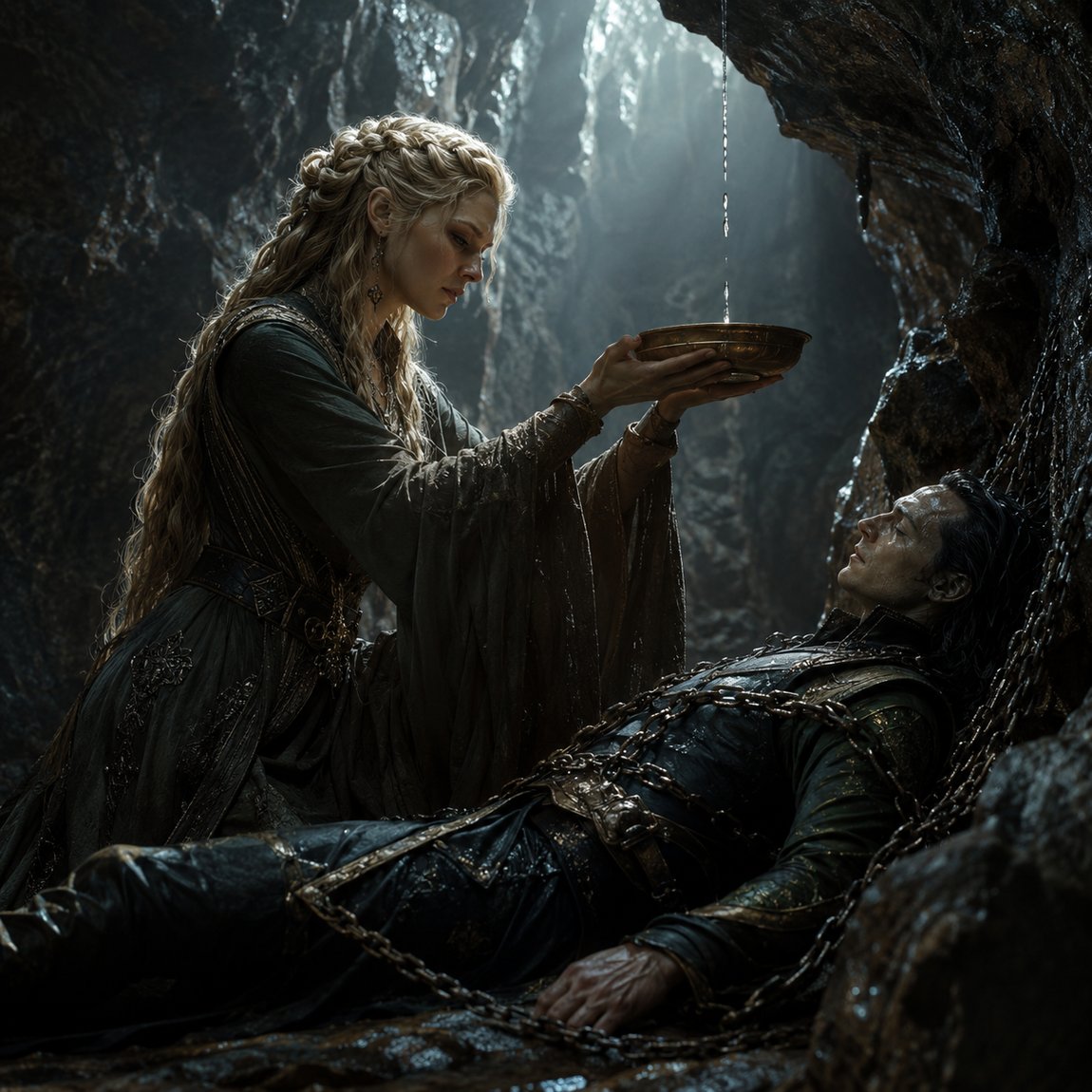
Sigyn is Loki’s wife in Norse mythology: when the gods bind him in a cave as punishment, she holds a bowl beneath the serpent’s venom dripping onto his face. Only when she has to empty the bowl does the venom strike him – then he writhes and the earth quakes. Snorri counts her among the goddesses, and a skald around 900 already calls Loki “the burden of Sigyn’s arms”. Here is what the sources really say about her.
A cave. Cold rock, three stone slabs, a man bound across them. Above his face hangs a serpent, and venom drips from its jaws. Beside him stands a woman with a bowl in her hands, catching every drop. Hour after hour. The medieval sources tell us almost nothing else about her – and yet this single image has survived for more than a thousand years.
Her name is Sigyn. Search for her online and you will quickly meet labels like “goddess of loyalty” or “Loki’s devoted wife”. We want to look closer: which texts actually mention her, what each manuscript says, where the sources contradict each other, and what is modern interpretation, however appealing.
Sigyn is the wife of Loki in Norse mythology. In the thirteenth century Snorri Sturluson counts her among the ásynjur, the goddesses of the Æsir. Her one narrated scene is her vigil after Loki has been bound: she holds a bowl beneath the serpent’s venom.
That really is nearly everything. She has no story of her own, no parents, no origin, no cult, no place-names, no amulets. But she has something rarer: she appears across very different kinds of source – an Eddic poem, skaldic verse considerably older than the manuscripts, Snorri’s prose and, possibly, a stone cross in England. For a figure with so little action, that is a remarkably wide trail.
The Völuspá, “the Prophecy of the Seeress”, opens the Codex Regius of the Poetic Edda. The manuscript dates to around 1270; the poem itself is older, and many scholars place it around the year 1000, though no exact date is possible. A seeress surveys the creation, guilt and ruin of the world – and among the omens of doom she sees a bound figure.
Hapt sá hon liggja / und hvera lundi, / lægjarns líki / Loka áþekkjan; / þar sitr Sigyn / þeygi of sínum / ver vel glýjuð.
A captive she saw lying beneath the grove of hot springs, in shape like mischief-loving Loki. There sits Sigyn, by no means glad about her husband.— Völuspá 35 (Codex Regius), our own rendering
Three things stand out. First, the seeress does not call the captive Loki; she says he is “like” Loki. That is the Völuspá’s veiled style – it hints rather than narrates. Second, the setting is not a rock prison but a hvera lundr, a “grove of cauldrons” or “of hot springs”. Anyone who has been to Iceland thinks immediately of steaming fissures. Third, the stanza tells us only one thing about Sigyn: she is þeygi … vel glýjuð, “not at all happy”. There is no bowl here.
The line does not say she loves him or helps him. It can be read as grief at her husband’s fate – or as displeasure with him. The Old Norse leaves both open, and we think it is more honest to leave it that way.
Lokasenna, “Loki’s Quarrel”, is set at the feast of the sea-giant Ægir. Loki bursts in and insults god after god, and the goddesses too. Anyone hoping for Sigyn will be disappointed: she does not appear in the stanzas. She does not speak, nobody addresses her, and Loki does not mock her.
Only the prose added at the end tells what happens next. Loki hides as a salmon in the waterfall of Fránangrsfoss; the gods catch and bind him. Skaði hangs a venomous snake above his face. Then comes the sentence that brings Sigyn into the picture: Sigyn, kona Loka, sat þar ok helt munnlaug undir eitrit – Sigyn, Loki’s wife, sat there and held a basin under the venom. When the basin is full she carries the venom away, and meanwhile it drips onto Loki. He writhes so violently that the whole earth shakes – “that is now called an earthquake”.
The word for the vessel is telling. A munnlaug (Snorri writes mundlaug) is quite literally a washbasin, the kind of hand-washing bowl that stood in any well-off household. Not a ritual vessel, not a magic cauldron. Sigyn saves her husband from the worst with a piece of household equipment, and that is exactly what makes the scene so tangible.
The closing prose is an explanatory addition from the thirteenth century. It largely agrees with Snorri, but it differs on the names of the sons – more on that shortly.
The most complete version comes from Snorri Sturluson and his Prose Edda, written around 1220. In Gylfaginning, “the Tricking of Gylfi”, chapter 50 tells of Loki’s capture after Baldr’s death. We have covered the punishment in full in Loki’s Punishment; here we follow Sigyn.
According to Snorri, the gods catch Loki, who has hidden in the water as a salmon. They take him to a cave, set three stone slabs on edge and bore a hole through each. Then they fetch Loki’s sons, Váli and Nari or Narfi. Váli is turned into a wolf and tears his brother apart. With the dead son’s entrails the gods bind Loki across the three stones – one under his shoulders, one under his loins, one under the backs of his knees – and the bonds turn to iron. Skaði takes a venomous serpent and fastens it above him so the venom drips onto his face.
And then, paraphrasing Snorri: Sigyn, his wife, stands beside him and holds a basin under the drops of venom. When the basin is full, she goes away to pour it out, and in the meantime the venom drips onto his face. Then he jerks so violently that the whole earth shakes; that is what you call an earthquake. There he lies bound until Ragnarök.
In Snorri, Sigyn stands; in the Völuspá she sits. A small detail, but it shows the versions are not simply copied from one another; each tells the same scene in its own way. Snorri turns the image into an aetiology, an origin story: earthquakes happen because a bound god writhes under a drop of venom. For an Icelandic audience, living on ground that really does shake, this was no abstract idea.
In the second part of his Edda, Skáldskaparmál (“the Language of Poetry”), Snorri teaches would-be poets how to refer to gods and things artfully. Right at the start he describes a feast the gods hold for Ægir and lists the goddesses present. Sigyn is in that list of ásynjur, alongside Frigg, Freyja, Iðunn and others. The appended Nafnaþulur, versified name lists, also include her among the goddesses.
That matters. Loki himself is, in Snorri, the son of the giant Fárbauti and stands between worlds. His other partner, the giantess Angrboða, is the mother of Fenrir, the Midgard Serpent and Hel. Sigyn, by contrast, belongs to the goddesses. Snorri never says where she came from, so the romantic courtship stories in modern retellings are invention, not tradition.
In the same work Snorri lists ways to refer to Loki. Among them: verr Sigynjar, “Sigyn’s husband”, and “father of Nari”. A listener who heard “Sigyn’s husband” in a skaldic poem knew who was meant. That is the whole point of a kenning – it only works if the audience knows the story behind it.
Now it gets really interesting, because here we are dealing with poetry older than any surviving manuscript. The Norwegian skald Þjóðólfr of Hvinir composed Haustlöng, “Autumn-long”, around the year 900 by current dating. The poem describes pictures on a shield the poet had been given: the abduction of Iðunn by the giant Þjazi, and Thor’s duel with Hrungnir. It survives because Snorri quotes long passages of it in Skáldskaparmál.
In the Iðunn episode Þjóðólfr calls Loki farmr arma Sigynjar: “the burden” or “the cargo of Sigyn’s arms”. This is a kenning, a poetic circumlocution, and it means Loki – the man Sigyn holds in her arms.
Why does this matter so much? Because it shows that Sigyn and her bond with Loki were not Snorri’s invention. Some three hundred years before the Prose Edda, a poet in Norway could drop her name without explanation. His audience knew her. Rudolf Simek notes in his dictionary that this early mention has led some scholars to suppose Sigyn is an old figure, older than the role Snorri gives her.
Whether Þjóðólfr already had the bowl scene in mind is not certain. “The burden of her arms” may be tender, a man in his wife’s embrace, or it may mean a weight one carries because one cannot let go. The kenning presupposes a close bond, not necessarily the whole story of the binding.
In few places do the Norse sources contradict each other as openly as over Sigyn’s sons. If you have learned that “Narfi is killed and Váli becomes a wolf”, it is worth laying the texts side by side.
Snorri, Gylfaginning: When Loki is introduced, we are told briefly that his wife is called Sigyn and their son Nari or Narfi – one son with two possible names. In chapter 50 he names two sons, Váli and Nari or Narfi. Váli becomes a wolf and tears his brother apart; the entrails become the fetters.
Closing prose of Lokasenna: Here Loki is bound with the entrails of his son Nari, and his son Narfi becomes a wolf. Váli does not appear at all. Nari and Narfi are two different sons here – or a scribe has created a doubling. The transformation into a wolf is not explained. Some editors, including Henry Adams Bellows in his 1923 English translation, brought the text into line with Snorri and put “Váli” in. So if you compare translations, you will find different names.
Völuspá, Hauksbók: The phrase Vála vígbǫnd, “Váli’s slaughter-bonds”, can be understood in two ways: as bonds made from the entrails of a Váli, or as bonds twisted by a Váli. And there is a second, better-known Váli: Odin’s son, who according to the Völuspá avenges Baldr when only one night old. Whether the line originally meant him is an open question. We tell his story in Víðarr and Váli.
There is one more trace in older verse. In Ynglingatal, also attributed to Þjóðólfr of Hvinir, Hel appears in a kenning as the sister of the wolf and of Narfi. So a Narfi among Loki’s children is attested early; the exact division of roles between the brothers is not.
For Sigyn herself, every version is equally hard. If the sons are hers – and in Snorri, Nari or Narfi explicitly is – she loses both in this one scene: one to death, one to the wolf’s shape. And she stays with Loki. The sources do not comment on this with a single word. No lament, no accusation, no conversation. Only the bowl.
The standard explanation runs: Sigyn from Old Norse sigr, “victory”, plus vina, “female friend” – hence “friend of victory”. That is what Rudolf Simek and many reference works give, often with a cautious “probably”.
That “probably” deserves respect. The first element, sig-, is beyond dispute; it appears in countless names from Sigurd to Sigrún. The second is less tidy. The ending -yn is rare. It also occurs in Fjörgyn, Thor’s mother, whose name is likewise not fully explained. Whether -yn really goes back to a word for “friend” or to an old formative element for female names cannot be said with certainty. “Friend of victory” is plausible and widespread, but it remains an interpretation.
And then there is the contradiction everyone notices: a “friend of victory” whose only scene takes place in a cave where there is nothing to win. Bitter irony? A trace of an older role we no longer know? Both are speculation. Victory was simply a very popular name element in the North.
In the churchyard of St Mary’s, Gosforth, in Cumbria in north-west England, stands a slender cross of red sandstone, about 4.4 metres tall. It is dated to the first half of the tenth century, usually around 920 to 950 – a time when settlers of Scandinavian origin lived in the region (see The Vikings in England). Alongside a Crucifixion it bears scenes linked to Norse myth, such as a figure with a horn usually identified as Heimdall.
At the bottom of the west face lies a bound figure. Above it kneels a long-haired woman holding an object over him, while a knotted serpent twists nearby. Since the late nineteenth century this group has been read as Loki and Sigyn with her bowl. The Reverend William Slater Calverley described the Norse references of the cross at length in the 1880s, after lichen had been removed from the stone.
Is that certain? No. The cross carries no inscription naming its figures, so every identification is an interpretation of the image. But the combination of a bound figure, a serpent and a woman with a vessel matches the story so closely that the reading is still widely accepted. If it is right, the image is roughly three centuries older than Snorri’s text – and it stands on a Christian monument, where the bound Loki may have served as a counterpart to the bound evil of the Christian end of days. How Christian carvers used Ragnarök themes is the subject of our post on Gosforth and Thorwald’s Cross.
The gaps are part of the picture, and they are large.
No source names Sigyn’s parents. None tells how she and Loki came together. None mentions her in any other adventure of the gods. In Lokasenna, where Loki spares no goddess, he says nothing about her – and she nothing about him. At Ragnarök, when Loki breaks free and joins the enemies of the gods in the final battle, she vanishes from the text. What becomes of her, whether she survives, whether she stays or goes: nothing is recorded.
There are no traces of cult either: no place-names, no dedicatory inscriptions, unlike Freyja or Frigg. Whether Sigyn was ever worshipped, we simply do not know. For an overview of the better-attested goddesses, see The Goddesses of the North.
In the nineteenth century Scandinavian Romanticism claimed the scene. Nils Blommér painted “Loke och Sigyn” in 1850, Mårten Eskil Winge a painting of the same name in 1863, and Oscar Wergeland his version in 1879. Romanticism read Sigyn as the epitome of the self-sacrificing wife – an ideal of its own era projected onto the old scene.
That reading has stuck. In modern heathenry Sigyn is often honoured as a goddess of loyalty, compassion and endurance, especially by people who care for relatives or hold out in hard situations. Since 1978 she has appeared in Marvel comics as Loki’s wife. And a Swedish special-purpose ship named Sigyn has carried spent nuclear fuel since the 1980s – a nod to the woman who catches the poison so that it does no harm. Swedish dry humour at its finest.
Turning Sigyn into an allegory of virtue smooths the scene out. The Völuspá does not say she is happy at his side; it says she sits there and is not glad. That is harder and more human than any ideal: a woman in a hopeless situation doing what is left to her – out of love, duty or defiance, the sources do not say. That openness is exactly why so many people recognise themselves in her.
Sigyn cannot free Loki, and she cannot stop the venom, only catch it. Every time the bowl is full she has to turn away, and that is precisely when it strikes him. Her service is incomplete from the start. It does not rescue; it relieves.
Some read this as an image of disaster deferred: as long as the bowl is held, the world only shakes instead of ending. That is a modern interpretation, not a statement of the sources – but in a mythology that knows its own end from the beginning, Sigyn’s bowl is one of the few gestures that does not prevent the inevitable but makes it bearable. It is not a story about victory. It is a story about people who stay when there is nothing to win.
Because Sigyn has no inherited iconography with fixed attributes, it pays to stay close to the sources. A few ideas with historical footing:
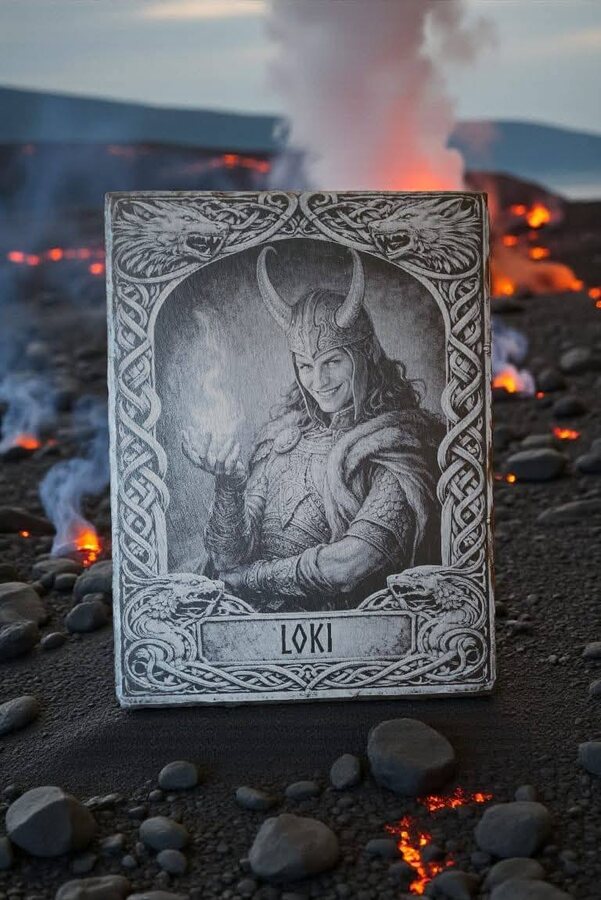
Natural slate works particularly well, because the laser draws pale, almost chisel-like lines on the dark stone – a fitting echo of the Gosforth Cross. We explain the technique in How Does Laser Engraving on Natural Slate Work?, and which motifs are attested and which are modern in Authentic Viking Motifs for Engraving and Tattoos.
For courage. For remembrance. For legends that live on.
Who is Sigyn in Norse mythology? Sigyn is Loki’s wife, counted by Snorri Sturluson among the goddesses of the Æsir. She is known from a single scene: holding a bowl over the bound Loki to catch a serpent’s venom.
What does the name Sigyn mean? It is usually explained as “friend of victory”, from sigr “victory” and a word for “female friend”. The first part is certain; the second is not fully settled.
Who are Loki and Sigyn’s children? Snorri names Váli and Nari or Narfi; Váli becomes a wolf and kills his brother. The Lokasenna prose names Nari and Narfi instead, so the sources disagree.
Why does the earth shake in the myth? When Sigyn empties the full bowl, the venom drips onto Loki and he writhes so hard that the earth quakes. Snorri’s Gylfaginning and the closing prose of Lokasenna both give this explanation.
Is Sigyn the goddess of loyalty? No medieval source gives her that title. It is a modern interpretation of her vigil at Loki’s side.
Where is Sigyn depicted? The oldest possible depiction is on the Gosforth Cross in Cumbria (c. 920–950): a woman above a bound figure. Reading her as Sigyn is common but cannot be proven.
Loki · Hel · Ragnarök · The Norse pantheon · Frigg.
All Gods & Goddesses articles →
She came to Asgard to take revenge – and stayed as a goddess. Skadi is the mistress of the mountains, of winter, of the …
Read more →In the North, the sun is female. Sunna – Sól to the Norse – races across the sky day after day, pursued by a wolf who …
Read more →He stood at the beginning and he stands at the end: Surtur, the fire giant, has guarded the border of the burning world …
Read more →No god was so beloved by ordinary people as Thor. With hammer, strength-belt and thunder-chariot he holds the powers of …
Read more →