Angrboða (Angrboda) is the giantess with whom Loki fathered three children in Norse myth: the wolf Fenrir, the Midgard Serpent Jörmungandr and Hel, ruler of the dead. Beyond that, the sources say almost nothing. Her name appears in exactly two medieval texts – Snorri's Prose Edda and a single stanza of the “Short Völuspá” – and she never speaks a word. Everything else – the old one in the Iron Wood, the dead seeress, the half-burnt heart – are trails that may lead to her, or may not. We follow each one and tell you how much weight it can bear.
Imagine writing the biography of a woman about whom you have exactly two sentences. In both, she appears only as a mother; in both, the father takes the spotlight. That is the state of the evidence for Angrboða. And yet she ranks among the most consequential figures in all of Norse mythology, because her three children stand in the front line at the end of the world.
Precisely because so little is written, Angrboða is a perfect case study in how we read myth today. Guesses, identifications and – more recently – novels and video games have crowded into the gaps, turning a silent giantess into a protagonist with an inner life. There is nothing wrong with that. But it helps to know where the source ends and the modern story begins. That line is what this article draws, sentence by sentence.
One thing up front: every text discussed here was written down in Christian Iceland in the thirteenth and fourteenth centuries. They preserve older poetry, but they are not documents from the Viking Age itself, and no archaeological find depicts Angrboða.
Old Norse Angrboða has two parts. Angr means “grief, sorrow, distress” – the same word that gave English anger. The second element, -boða, belongs to the verb bjóða, “to offer, to announce”, from Proto-Germanic *beudan, the root behind English bid and German bieten and Bote, “messenger”.
Standard translations therefore run “she who brings grief”, “sorrow-bringer” or “harm-bidder”. Rudolf Simek's dictionary glosses it along the same lines. A telling name, then – suspiciously well matched to the role. That matters for dating: Simek considers the name in its recorded form to be fairly late, probably no earlier than the twelfth century, while the idea of Loki fathering monsters on a giantess may well be much older. The mother of monsters may have gone without a fixed name for a long time.
You will see her spelled Angrboda, Angrbotha (Bellows' spelling) or, in older German books, Angerboda. It is always the same figure. The letter ð is pronounced like the voiced th in “the”.
The fullest passage comes from Gylfaginning, the first narrative part of the Prose Edda, written by the Icelandic scholar and politician Snorri Sturluson around 1220. Snorri was no heathen priest but a Christian chieftain with a deep love of old poetry; we explain how his book came about in our article on the Edda.
Chapter 34 begins plainly: Angrboða hét gýgr í Jötunheimum – “Angrboða was the name of a giantess in Jötunheim.” Arthur Gilchrist Brodeur's public-domain translation of 1916 continues:
Angrboda was the name of a certain giantess in Jötunheim, with whom Loki gat three children: one was Fenris-Wolf, the second Jörmungandr—that is the Midgard Serpent,—the third is Hel.Snorri Sturluson, Gylfaginning 34, trans. A. G. Brodeur, The Prose Edda (1916)
Then the story moves on, and this is where it gets interesting. The gods learn that the three siblings are being raised in Jötunheim. Prophecies foretell great harm from them, and Snorri adds a striking explanation: everyone expected evil from them, first because of their mother and worse still because of their father. Their descent alone makes the children suspect. Angrboða is a giantess, Loki is Loki – nothing more is needed.
Odin sends gods to fetch the children. What becomes of them is the real fate of this family, and we will come to it shortly. Angrboða herself does not reappear. No resistance, no lament, no revenge. She vanishes from the text the moment her children enter it.
The second mention is older in form but younger in manuscript. It sits in Hyndluljóð, the “Lay of Hyndla”, which survives only in Flateyjarbók, a great Icelandic compilation of the late fourteenth century. Wedged into that poem is a fragment scholars call Völuspá in skamma, the “Short Völuspá”. Snorri quotes a stanza from it under that very title, so he knew it as a poem in its own right. It is usually dated to the twelfth century, and Henry Adams Bellows in 1923 thought it a late and rather weak imitation of the great Völuspá.
Bellows translated the key stanza (numbered 42 in his edition, 40 in most others) like this:
The wolf did Loki with Angrbotha win, / And Sleipnir bore he to Svathilfari.Hyndluljóð (Völuspá in skamma), trans. H. A. Bellows, The Poetic Edda (1923)
In Old Norse: Ól úlf Loki við Angrboðu, en Sleipni gat við Svaðilfara. Right next to the giantess, the poet places Loki's other famous offspring: the eight-legged stallion Sleipnir, whom Loki, in the shape of a mare, conceived by the giant's stallion Svaðilfari. In a single stanza Loki is once a father and once a mother. The poem then says that one ogress (skass) was thought the worst of all, and that she came from “the brother of Býleistr” – that is, Loki. Who is meant? Bellows suggested the Midgard Serpent; but skass usually denotes a female being, so others think of Hel. The question stays open.
Notice, too, that only the wolf is mentioned here. That Angrboða also bore the serpent and Hel is stated explicitly only by Snorri. Perhaps the poet knew the trio, perhaps Snorri was the one who arranged it. Neither can be proven.
The sources are silent about Angrboða, but they talk at length about her children. Few parents in mythology have produced so much Ragnarök. Each child has its own long article on our site; here is the essential outline, following Snorri.
Fenrir is kept among the gods at first. Only the god Týr dares to feed him. The wolf grows every day, and because the prophecies mark him as a future destroyer, the gods decide to bind him. He snaps two chains with ease. The third, Gleipnir, is a ribbon soft as silk, made by dwarves from impossible things – the sound of a cat's footfall, the beard of a woman, the roots of a mountain. Fenrir agrees to wear it only if one god puts a hand in his mouth as a pledge. Týr does, and loses the hand. At Ragnarök the wolf breaks free and swallows Odin; Odin's son Víðarr avenges him and kills the beast. Read more in our article on Fenrir.
Jörmungandr is flung by Odin into the ocean that surrounds all lands. There the serpent grows until it encircles the whole earth and bites its own tail – hence the name Midgard Serpent. Thor almost hauls it aboard while fishing with the giant Hymir. At Ragnarök the two kill each other; Thor walks nine steps and falls dead from the venom. The full story is in our piece on Jörmungandr.
Hel is cast down by Odin into Niflheim and given authority over nine worlds. She is to receive everyone who dies of sickness or old age. Snorri describes her as half blue-black and half flesh-coloured, grim and gloomy to look at. Later she keeps Baldr when the gods try to bring him back. Her own role at Ragnarök remains oddly faint in the sources. Learn more about the goddess in Hel and about her realm in Helheim.
The pattern is telling. The gods do not kill the children; they banish and bind them – sea, underworld, fetter. Each one is sent to a place where it should do no harm, and where it nonetheless keeps growing until the end. The mother loses all three at once. Snorri does not spare her a single sentence. That gap is precisely where modern writers have stepped in.
To understand Angrboða's position, look at Loki's second family. Among the gods he lives with Sigyn, a goddess, with whom he has the sons Narfi (or Nari) and Váli. This family belongs to the world of the gods, and its fate is tied to Loki's punishment: according to Snorri, Váli is turned into a wolf and tears his brother apart, and Loki is bound with his son's entrails. Sigyn then holds a bowl over him so that the serpent's venom does not strike his face.
The contrast is sharp. Sigyn is the faithful wife inside the gods' world, Angrboða the giantess out in Jötunheim. One stays at Loki's side to the very end, the other disappears after giving birth. It fits the double nature we explore in our article on Loki: himself the son of a giant, he lives among the Æsir as both their helper and their undoing.
The jötnar, by the way, are no mere monsters but an ancient, often wise kin into which gods marry. Angrboða is not automatically “evil” – only her name points that way. More in our article on the giants.
Now we step onto thin ice, because this is where interpretation begins. The great Völuspá, the seeress's poem on the beginning and end of the world, contains one of the darkest stanzas in the whole Edda. In Bellows' public-domain rendering:
The giantess old in Ironwood sat, / In the east, and bore the brood of Fenrir; / Among these one in monster's guise / Was soon to steal the sun from the sky.Völuspá 40, trans. H. A. Bellows, The Poetic Edda (1923)
The Old Norse opens Austr sat in aldna í Járnviði ok fœddi þar Fenris kindir. Literally, “the old one” – feminine, but the word “giantess” is the translator's. The verb fœddi can mean “bore” or “fed, raised”, so the text leaves open whether she gives birth to the wolf-brood or merely rears it. And the thing that is stolen, tungl, can mean the moon or any heavenly body.
Járnviðr, the Iron Wood, lies in the east, the direction from which giants and trouble come in these myths. Snorri takes the stanza up in Gylfaginning, chapter 12, and paints it out: east of Midgard lies a forest called Ironwood, home of troll-women called Járnviðjur. The old giantess bears many giants for sons, all in the shape of wolves. From this race comes the mightiest of all, Mánagarmr, the “Moon-Hound”, who gorges on the flesh of the dying, swallows the moon and splatters blood across the sky. Just before, Snorri has named the two wolves Sköll and Hati, who chase the sun and moon.
So the key question: is this old one Angrboða? Many reference works and almost every popular retelling say yes, and there are good arguments. Both are giantesses, both are linked to wolf offspring connected with Fenrir, both belong to the prehistory of Ragnarök. Mythologists were already proposing the identification in the nineteenth century.
But no source says so. Völuspá gives no name. And Snorri, who knew both passages and retold both, conspicuously does not connect them. His Angrboða lives “in Jötunheim”; his old one in the Iron Wood remains nameless. Had he thought them the same figure, saying so would have been the obvious move. Our earlier version of this article got that wrong and credited Snorri with the identification – consider this our correction.
There is a further snag. The old one rears “Fenrir's kin”, the wolf's descendants. If she were Angrboða, she would be raising her own grandchildren. Not impossible – mythic family trees are rarely squeamish – but it is a construction you have to add.
One more clue for trackers: two stanzas later in Völuspá, Eggþér, the giantess's warden, sits on a mound striking his harp. Peter Salus and Paul Taylor (1969) read him as the herdsman of the wolf-flock in the Iron Wood. That, too, is interpretation.
The second trail leads to Baldr. In Baldrs draumar, “Baldr's Dreams”, a short Eddic poem preserved in the manuscript AM 748 I 4to, Baldr is tormented by evil dreams. Odin rides Sleipnir down towards Hel and, at the eastern gate, raises a long-dead seeress from her grave. Calling himself Vegtamr, “the Way-Wont”, he questions her. Reluctantly she foretells Baldr's death, names Höðr as the killer and Váli as the avenger.
In the end each sees through the other. She recognises Odin, and he hurls back at her: Ertattu völva né vís kona, heldr ertu þriggja þursa móðir. Bellows translated:
No wise-woman art thou, nor wisdom hast; / Of giants three the mother art thou.Baldrs draumar 13, trans. H. A. Bellows, The Poetic Edda (1923)
She answers that no one will seek her out again until Loki slips free of his bonds and the destroyers ride to the last battle. Three giant children, and Loki's name straight afterwards: small wonder that many readers think of Angrboða. Edward Pettit, in his 2023 dual-language edition of the Poetic Edda, notes her as a possible identification (“perhaps the giantess Angrboða”), while pointing out that even Loki himself has been suggested. Others read Odin's line as a simple insult: a monster's mother rather than a wise woman.
Our verdict: a hypothesis, and not a bad one. It would give the silent giantess a scene – as a dead woman who knows more than the All-Father and throws Loki's coming release in his face. It cannot be proven. The poem names neither her nor her three children, and nowhere else is Angrboða called a völva, a seeress.
The most puzzling trail sits directly after the Angrboða stanza in the Short Völuspá. Bellows rendered it:
A heart ate Loki, — in the embers it lay, / And half-cooked found he the woman's heart; — / With child from the woman Lopt soon was, / And thence among men came the monsters all.Hyndluljóð (Völuspá in skamma), trans. H. A. Bellows, The Poetic Edda (1923)
The Old Norse is stranger still: Loki át af hjarta lindi brendu, fann hann hálfsviðinn hugstein konu. The heart was burnt, most likely on linden-wood – the exact sense of lindi is debated – and it is called a hugsteinn, a “thought-stone”, a poetic word for the heart. Lopt is another name for Loki. Every flagð, every troll-woman on earth, is said to descend from that pregnancy.
Whose heart? The text does not say. Bellows remarked dryly that nothing further is known of the myth. Since the nineteenth century, interpreters have linked the heart to various women. The favourite candidate is Gullveig, who in Völuspá is burnt three times and three times reborn – a half-burnt heart would fit. Others think of Angrboða herself, since the stanza follows her name. The Swedish writer Viktor Rydberg built a whole chain of identifications out of such links in the nineteenth century; current scholarship rarely follows systems of that kind.
Honestly, the connection is open. The stanza tells us that Loki becomes pregnant through a woman's heart and that the ogresses of the world spring from it. Whether that woman is Angrboða, whether the child is one of the famous three or a whole different breed of troll-wives – that cannot be decided. Bellows thought it unlikely that the serpent was meant, precisely because Snorri assigns all three children to Angrboða.
A mother whose three children are taken from her – one to the sea, one to the underworld, one into fetters – and the source does not waste a word on it. For modern readers, that silence begs for a story. And the story has been written. The best known is The Witch's Heart by the American author Genevieve Gornichec, published in 2021. It tells Angrboða's life from her own point of view, as witch, lover and mother, freely weaving together several of the trails discussed here: the burnt heart, the seeress, the lost children. The novel turns a name into a heroine with an inner life. That is good modern fiction – but not a report of what Viking Age people believed.
In God of War Ragnarök (2022), a young giantess named Angrboda appears as a companion to the protagonist Atreus, who in that game series is himself identified with Loki. Her personality, look and backstory are entirely the developers' invention.
None of that is a problem – Snorri retold old material too. What matters is the label. If you read that Angrboða was a powerful seeress, truly loved Loki, defended her children against Odin or took revenge at Ragnarök, you are reading modern fiction or modern speculation. The medieval texts know nothing of it.
Archaeologically, Angrboða is invisible. No picture stone, no runic inscription, no amulet shows her or bears her name. Her children, on the other hand, do appear in stone. Thor's fishing trip for the Midgard Serpent is carved on the Altuna runestone in Uppland and on a stone fragment from Gosforth in northern England. On Thorwald's Cross on the Isle of Man, a man with spear and raven has a wolf at his foot – usually read as Odin and Fenrir. More about these monuments in our article on Gosforth and Thorwald's Cross.
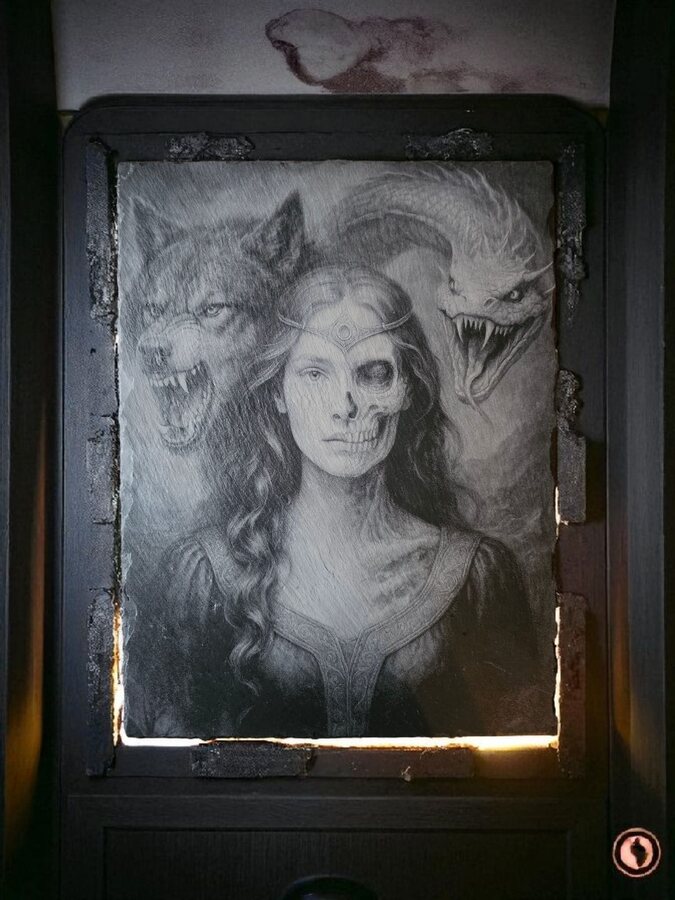
These images date from the tenth and eleventh centuries, the Viking Age and the age of conversion. They show that the stories of the wolf and the serpent were known long before Snorri. The mother of these creatures, though, was carved by no one – or at least nothing has survived. When customers ask us to engrave Loki's brood on slate, it is always Fenrir, Jörmungandr and Hel at the centre. Angrboða remains the invisible one here too.
Let us pull the threads together. Certain: medieval Icelandic tradition knows a giantess called Angrboða with whom Loki fathered the wolf; Snorri also assigns her the serpent and Hel. Likely: the idea of a giant mother of monsters is older than the name itself. Possible but unproven: that she is the old one in the Iron Wood, the seeress of Baldrs draumar or the woman with the half-burnt heart. Invented: anything that gives her a voice of her own, a love story or a campaign of revenge.
That sounds like little. In fact it is a lot, once you see how these myths are built. Angrboða is the point of origin where the three great enemies of the gods enter the world. Her name announces what follows: grief. And the story of her children leads straight to Ragnarök, where wolf and serpent play out their roles to the end.
How little the Völuspá actually says about the old one in the Iron Wood, you can check for yourself in our Völuspá reading text.
Who is Angrboda in Norse mythology? A giantess with whom, according to Snorri's Prose Edda, Loki fathered three children: Fenrir, the Midgard Serpent Jörmungandr and Hel. Apart from Gylfaginning, she is named only in one stanza of the “Short Völuspá” within Hyndluljóð.
What does the name Angrboda mean? Roughly “she who brings grief” or “sorrow-bringer”, from Old Norse angr “grief” and bjóða “to offer, announce”. The name itself is probably fairly late, likely no earlier than the twelfth century.
Is Angrboda the giantess of the Iron Wood? This is often claimed, but no source says it. The old one in Járnviðr in Völuspá is nameless, and Snorri does not link the two passages. The identification is widespread but disputed.
What happened to Angrboda's children? The gods took them from Jötunheim: Jörmungandr was thrown into the sea, Hel banished to Niflheim, Fenrir bound with Gleipnir. At Ragnarök the wolf kills Odin and the serpent kills Thor.
Is Angrboda the seeress in Baldrs draumar? Possibly. Odin calls the dead seeress “mother of three giants”, which makes many readers think of Angrboða. But the poem gives no name, so it remains a hypothesis.
Is Angrboda in God of War and The Witch's Heart the real myth? No. Both feature her, but in each case the character is a modern creation. Her personality, love story and deeds come from today's authors, not from the Edda.
For courage. For remembrance. For legends that live on.
Loki · Fenrir – the wolf · Jörmungandr – the World Serpent · Hel – goddess and realm of the dead · The Norse pantheon.
All Gods & Goddesses articles →
He was the fairest, the gentlest, the purest – and yet it was he whom death struck. The legend of Balder is the most …
Read more →In the halls of the gods sits one who would rather turn a fine phrase than swing an axe: Bragi, the long-bearded lord …
Read more →Every great deity of the North has a dwelling. That of Frigg, the highest of the goddesses, is called Fensalir – „the …
Read more →Where there is strife, one is needed who settles it. The North gave that idea a face: Forseti, the god of law. Whoever …
Read more →