In Germanic thought vengeance was no blemish but a duty – and the North gave it two gods. Víðarr, the silent god who at the world's end kills the wolf that swallowed Odin. And Váli, the one-night-old, who sets out on the very day of his birth to atone for Baldr's death. Two quiet figures whose hour strikes only late – and who outlast the end of the world.
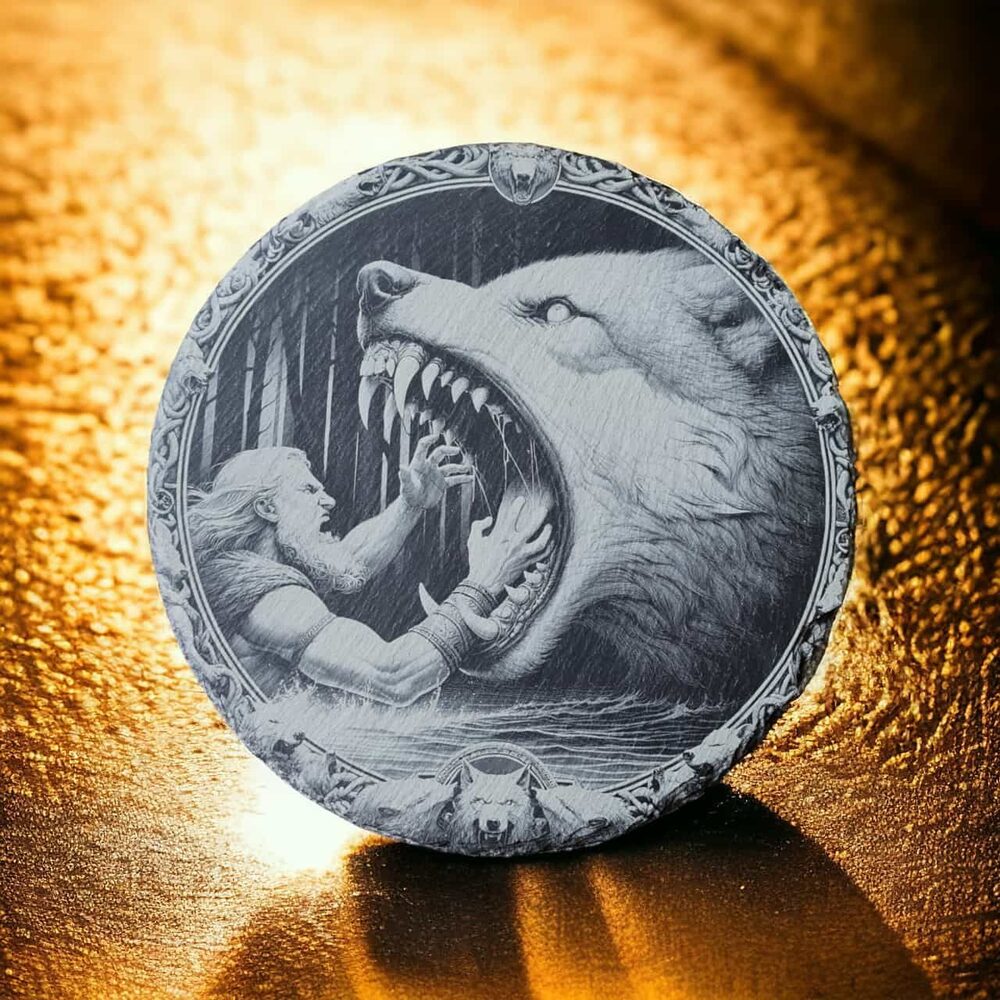
Víðarr's name means “the wide-ruling”. He is, says Snorri, “after Thor the strongest, and all the gods rely on him in every difficulty”. His great deed comes at the end: when the Fenris-wolf swallows Odin at Ragnarök, Víðarr hastens up and avenges his father.
“Then comes the mighty son of the Father of the Slain, Víðarr, to fight the wolf; he thrusts the sword into the heart of Loki's son – and the father is avenged.” Völuspá 55 (after Bellows 1923, public domain)
Snorri tells it a little differently: Víðarr sets his foot in the wolf's lower jaw and tears its maw apart. On that foot he wears a shoe made of all the leather-strips that people have ever cut from their shoes – which is why everyone who would help the gods should throw those scraps away. Exactly this scene – a man setting his foot in a wolf's jaws – is shown on the Gosforth cross in north-west England around 900.
Víðarr's dwelling is no golden hall but a woodland overgrown with brush and high grass (Grímnismál 17). That is no accident: the Hávamál says that on the path no one walks, brush and high grass grow – an image of neglected friendship. Víðarr has neglected all else and given himself wholly to the one task. His silence is like a vow, a gathering before the deed. The sagas know the same motif: in Droplaugarsona saga, Grímr laughs no more since his brother fell – until he has avenged him, then he suddenly laughs again.
Váli too is a son of Odin, his mother the giantess Rindr. He belongs to the Baldr myth: he avenges Baldr, whom blind Höðr shot with the mistletoe.
“Rindr bears Váli in the western halls; one night old, he slays the slayer. He washes not his hands, he combs not his hair, till he bears Baldr's foe to the pyre.” Baldrs draumar 11 (after Bellows 1923, public domain)
The unwashed, uncombed avenger who strikes as a one-day-old child belongs to an ancient myth of the divine child: the Greek Heracles too strangled two snakes as a baby, and Thor's son Magni lifts a giant's leg at three days old. The unwashedness has something of a vow about it, like that of Harald Fairhair, who would not cut his hair until he had subdued all Norway.
And here lies the finest thing: Víðarr and Váli are among the few who survive the world's end. When Surt's fire dies down, the two half-brothers again dwell at the seat of the gods, so Vafþrúðnismál reports. The silent avengers are also those who carry the old over into the new world. Their patience, their long silence was no hesitation – it was the waiting for the hour in which everything depends on them.
Víðarr's slaying of the Fenris-wolf stands in Völuspá 55, Vafþrúðnismál 53 and Gylfaginning 50; the shoe of leather-scraps and the associated folk custom are attested in Snorri, and the scene is shown on the Gosforth cross (c. 900). Víðarr's overgrown land is named in Grímnismál 17. Váli's revenge as a one-night-old stands in Baldrs draumar 11 and Völuspá 32/33. That both survive Ragnarök is stated in Vafþrúðnismál. Theophoric place-names (Viðarshof, near Valaskjálf) point to a local cult in south-east Norway (de Vries).
Both gods are thinly attested; some scholars see in them above all poetic personifications of the idea of vengeance. Saxo's elaborate wooing of Rindr by Odin is late, euhemerised tradition. Whether Víðarr and Váli had a cult of their own is disputed – the few place-names suggest it but do not prove it. What is certain is the mythic core: Víðarr avenges Odin on the wolf, Váli avenges Baldr, and both outlast the end.
What comes after Ragnarök · Magni & Modi – Thor's sons · Hringhorni – Baldr's funeral ship · Hel – goddess and realm of the dead · How the Germanic peoples honoured their dead.
Beyond Snorri's Edda, little is recorded about Víðarr – much of what is told today comes from later interpretation. Three strands are known:
Because of the similarity between Víðarr and the Christian martyr Vitus (d. c. 304), modern Germanic neo-paganism dedicated the Veitstag on 15 June to him, near the summer solstice. There is no Viking-age evidence for this – it is a modern association.
Snorri explains Víðarr's strong shoe as made from the leather scraps people cut away when shaping their shoes – whoever wishes the gods well should throw such scraps away. It echoes the ship Naglfar, which grows from the nails of the dead: in both, something fateful is made from what was carelessly discarded.
In some retellings the silent Víðarr refills the gods' drinking horns in Valhalla – even Loki's, whom he despises. This scene is narrative embellishment, not part of the core sources.
All Gods & Goddesses articles →
For a seafaring people the sea was both: lifeline and maw. No wonder the North gave it a divine couple. Ægir, the vast …
Read more →For a seafaring people the sea was both at once: road and grave, riches and death. In the North this double nature took …
Read more →She appears rarely and never speaks a single recorded word – yet the greatest catastrophe of Norse myth springs from …
Read more →He was the fairest, the gentlest, the purest – and yet it was he whom death struck. The legend of Balder is the most …
Read more →