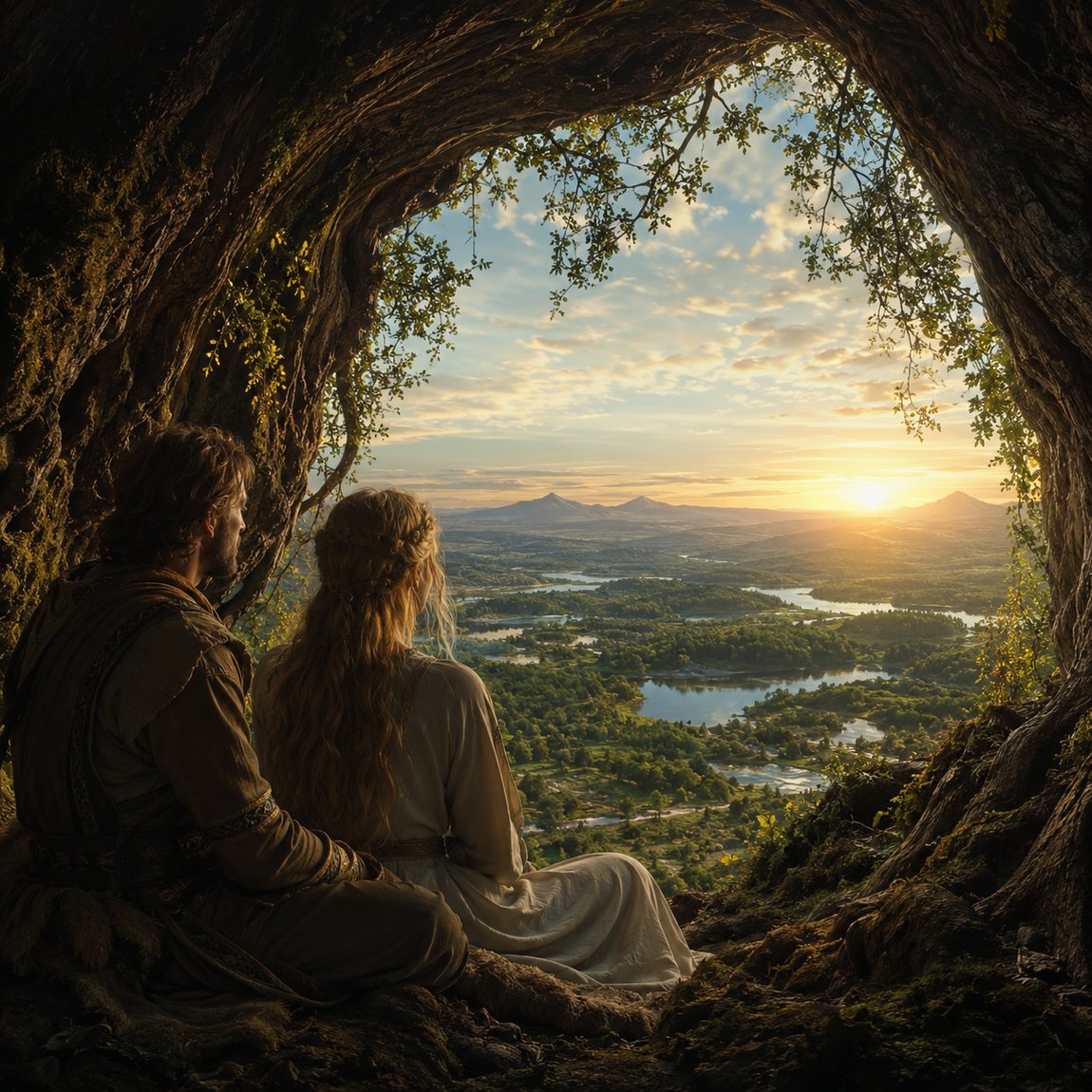
Lif and Lifthrasir (Old Norse Líf and Lífþrasir) are the two humans who, according to the Edda, survive Ragnarök, the end of the world: they hide in Hoddmímis holt, the wood of Hoard-Mímir, live on morning dew and become the ancestors of a new humanity. The only evidence is two stanzas of the Eddic poem Vafþrúðnismál and Snorri's prose retelling. Here is what the sources really say, what the names mean, whether their shelter is the World Tree, and why they are not a Norse Adam and Eve.
Before we interpret anything, let us count. Everything we know about Lif and Lifthrasir fits into a handful of lines. No rune stone names them, no picture stone shows them, no skaldic verse or saga mentions them.
The entire tradition consists of two texts. The first is the Eddic poem Vafþrúðnismál, preserved in the Codex Regius of the Poetic Edda (written around 1270; the poem itself is older, though how much older is debated). Stanzas 44 and 45 contain the whole story: one question, one answer. The second is Gylfaginning, part of the Prose Edda written by the Icelandic scholar Snorri Sturluson around 1220. In chapter 53, Snorri describes what happens after the end of the world, names the pair, and then quotes that very stanza from Vafþrúðnismál.
So Snorri is not an independent second witness. He knew the poem and built on it, adding one detail of his own that turns out to matter. Anything beyond these lines is interpretation, including everything you are about to read here. Precisely because the text is so short, every single word deserves to be turned over.
To understand the stanzas, you need to know where they sit. Vafþrúðnismál is a wisdom contest with a head as the stake. Odin, travelling under a false name, visits the giant Vafþrúðnir, reputed to be the wisest of his kind. They question each other about the world: its beginning, its order, its end. Whoever fails to answer loses his head.
Towards the end of the poem Odin turns to the future. Each of his questions opens with the same refrain: much have I travelled, much have I tried, much have I tested the powers. In stanza 44 he asks which humans will live when the famous fimbulvetr passes among men. Fimbulvetr means "mighty winter"; Snorri later describes it as three winters in a row with no summer in between.
Vafþrúðnir answers in stanza 45. In Old Norse, following the normalised edition:
Líf ok Lífþrasir, en þau leynask munu
í holti Hoddmímis;
morgindöggvar þau sér at mat hafa,
en þaðan af aldir alask.Vafþrúðnismál 45, Old Norse text (normalised)
In Henry Adams Bellows' public-domain translation of 1923:
"In Hoddmimir's wood shall hide themselves
Lif and Lifthrasir then;
The morning dews for meat shall they have,
Such food shall men then find."Vafþrúðnismál 45, trans. H. A. Bellows (1923)
Bellows smooths the last line. Read more literally, it says something closer to "and from there the generations will grow". The stanza is not just about survival but about descent: a new humanity springs from these two.
Four lines, a whole worldview. The question is not about gods but about people. The answer gives two names, a place, a food and a future. Notice, too, who is speaking: a giant. Knowledge of humanity's survival does not belong to the Æsir but to one of the oldest beings in the world.
Right afterwards Odin asks where the new sun will come from and who inherits the rule of the gods. Lif and Lifthrasir are one piece in a series of questions about the future, not a stray fairy-tale fragment.
Some fifty years before the Codex Regius was written, Snorri retold the story in prose. In his version, a figure called Hárr ("High") tells the Swedish king Gylfi what follows Ragnarök: the earth rises from the sea, green and fair, crops grow unsown, the surviving gods gather. Then comes the sentence about humankind, here in our own translation:
In the place called Hoddmímis holt, two people will hide during Surtr's fire. They are called Líf and Leifþrasir, and they will have the morning dews for food. From these people will come so great a lineage that the whole world will be inhabited.Gylfaginning 53, our own translation from the Codex Regius of Snorra Edda
Read closely and you will spot a shift. In the poem, the pair survive the fimbulvetr, the great winter that comes before Ragnarök. In Snorri, they hide during the world-fire kindled by the fire giant Surtr. Those are two different catastrophes in the sequence: first the cold, then the battle, then the flames.
Why Snorri changed this we do not know. Perhaps he simply placed the scene where it would hit hardest in his carefully staged narrative, right inside the blaze. Either way, a wood that shelters life through a world-fire is a bolder image than a forest that keeps out frost, and it matters for how we read the place.
One more small detail: Snorri calls them menn tveir, "two people". Old Norse maðr means "human being" first and "man" only second. It tells us nothing about gender.
Líf is transparent. It is identical with the Old Norse noun líf, "life, bodily life", related to English "life" and "live" and German Leib.
Lífþrasir is harder. The first element is "life" again. The second, -þrasir, is rare and explained in different ways. You will often see "the one who strives for life" or "the one who clings to life"; Sveinbjörn Egilsson's dictionary of poetic Old Norse (Lexicon Poëticum, 1860) offers readings along the lines of "lover of life" or "zest for life". No translation is certain. Tellingly, the same element appears once more in the same poem: stanza 49 mentions Mögþrasir, over whose hill three throngs of maidens pass. That name is just as obscure, but it shows that -þrasir was at home in the poem's vocabulary.
Then there is a variant that popular retellings almost never mention. In the main manuscripts of Snorri's Edda (Codex Regius, Codex Trajectinus, Codex Wormianus), the name is not Lífþrasir but Leifþrasir, in the prose and in the quoted verse alike. Old Norse leif means "what is left, remnant, inheritance". Take that seriously and you get a second reading that fits just as well: the one who holds on to what remains, or the descendant of the remnant. For a human who survives as the last trace of the old world, that is hardly less apt. Which form is original cannot be decided; most editions and dictionaries use Lífþrasir as the standard form.
The later Uppsala manuscript of Snorri's Edda (Codex Upsaliensis, early 14th century) goes its own way. In its version of the verse, the ones who hide are meyjar, "maidens", and the place is Mímis holdi, which would mean "in Mímir's flesh". Scribal slip or separate tradition, we cannot tell; either way it shows how fluid these lines already were in the Middle Ages.
And gender? The habit of seeing Líf as the woman and Lífþrasir as the man is old and sensible, but it is not in the text. The pronoun þau in stanza 45 is the neuter plural, which Old Norse uses for mixed groups; but since líf is itself a neuter noun, that proves little. That "the generations" descend from them makes a couple the simplest reading, and that is as far as the evidence goes.
One more thing stands out. These names are so completely meaningful that they almost read like concepts: Life and Life-Striving. Many scholars therefore think the pair may not be old cult figures at all, but poetic personifications created for exactly this spot. That can be neither proven nor disproven. We like the idea anyway: when everything burns, what survives is not a particular hero but life itself.
The place is the real puzzle of the stanza. Hoddmímis holt has three parts: hodd, "hoard, treasure"; Mímir, a name; and holt, "wood, copse", in Old Norse also simply "timber". Literally: the wood of Hoard-Mímir.
Who is this Hoard-Mímir? Most scholars think of the well-known Mímir, the wise guardian of the well beneath one of the roots of the World Tree. According to Völuspá, Odin pledged an eye at that well. Mímir belongs closely to the tree, so a "wood of Mímir" could be a poetic way of naming Yggdrasil itself.
There is a second building block. The Eddic-style poem Fjölsvinnsmál, part of Svipdagsmál, describes a tree called Mímameiðr, "Mímir's tree". Few know from what roots it springs, the poem says, and neither fire nor iron will fell it. Its fruit is said to help women in childbirth. Rudolf Simek suggests in his dictionary that Mímameiðr, Mímir's well and Hoddmímis holt all point to the same World Tree; John Lindow likewise considers it likely that these places belong together.
If that holds, the brief stanza becomes a powerful image. A tree that no fire can fell is exactly the place to survive Snorri's world-fire. A tree whose fruit helps births suits two people from whom a new humanity will grow. And the last humans are not sitting somewhere in the woods, but inside the axis that holds the cosmos together.
But note: scholars built that bridge, not the sources. Fjölsvinnsmál survives only in early modern paper manuscripts and is often regarded as a comparatively late poem. And the Edda never says outright what happens to Yggdrasil at Ragnarök. Völuspá has the tree tremble and groan as the giant breaks loose, but does not have it fall. Whether it burns is left open.
The more cautious reading takes holt literally: a wood belonging to an otherwise unknown Hoddmímir. That is possible too. The name then points to a keeper of treasure, and the most precious thing left to keep after Ragnarök is these two people.
The third detail is easy to skim past: the two live on morgindöggvar, the morning dews. In Norse tradition, dew is surprisingly closely tied to the World Tree.
Völuspá (st. 19) says the ash Yggdrasil is drenched with shining wet loam (aurr), and from it come the dews that fall into the valleys. Snorri picks this up in Gylfaginning (ch. 16): the dew that falls from the ash to the earth is called honeyfall, and bees feed on it. The tree, then, is a source of dew, and dew is a food that comes from the tree.
If you read Hoddmímis holt as Yggdrasil, the picture is complete: the survivors are sheltered by the tree and fed by the tree, like children in the womb. If you reject the identification, the dew reads more starkly as a sign of utter scarcity: after winter and fire there is nothing left to eat but what lies on the leaves at dawn. Both readings fit the text, and both arrive at the same place: life gets through on the bare minimum until the earth can carry it again.
A common misconception says that after Ragnarök everything is dead except two humans. The sources say otherwise. Ragnarök leaves a small group behind, gods and humans alike.
Lif and Lifthrasir are the human part of a pattern. For every layer of the old order a seed is left: sons for the gods, a daughter for the sky, a couple for humankind. Ragnarök does not end the world; it ends an age.
The fullest picture of the renewed world comes not from Vafþrúðnismál but from Völuspá, the Prophecy of the Seeress. Lif and Lifthrasir are missing from it, but their setting is not. In the standard numbering of the Neckel and Kuhn edition, the seeress sees the earth rise from the sea a second time from stanza 59 on, evergreen; waterfalls plunge, and above them flies the eagle that hunts fish from the crags (st. 59).
The Æsir meet on Iðavöllr, talk about the mighty World Serpent and recall the great events of the past (st. 60). In the grass they find the wondrous golden gaming pieces they once owned (st. 61). Unsown fields bear grain, all harm is healed, Baldr comes back (st. 62). Hœnir chooses the lot-twigs (st. 63). The seeress sees a hall fairer than the sun, thatched with gold, at Gimlé, where faithful hosts will live in happiness (st. 64). Only the Hauksbók version adds a stanza about a "mighty one" who comes from above (st. 65), which many read as a Christian addition. And at the very end the dark dragon Níðhöggr flies in, corpses in his feathers (st. 66). Even the new world is not entirely free of shadow.
How much Christian thought lies in these stanzas has long been debated. The cleansed earth and the golden hall recall the Book of Revelation; others see the cycle of ruin and renewal as an old idea that was put into words so clearly only in the light of Christian neighbours. There is no simple answer. More in What comes after Ragnarök?
Here is the comparison that genuinely holds, and it lies within Norse tradition itself. According to Völuspá 17–18, the first humans, Ask and Embla, are two lifeless figures on the shore, given breath, mind and the warmth of life by three gods. Snorri says the sons of Borr found two trees by the sea and made people from them. Askr means "ash tree"; the meaning of Embla is disputed.
Rudolf Simek therefore calls the survival of Lif and Lifthrasir a reduplication of the creation of humankind, in keeping with the cyclical worldview of the Edda: at the beginning, humans are made from wood; at the end, humans survive inside wood. If Hoddmímis holt is Yggdrasil, the ash appears twice as the origin of the human race. Simek also points to related motifs: a Bavarian legend, cited by Friedrich R. Schröder in a 1931 essay on Germanic creation myths, about a shepherd who lived in a tree and whose descendants resettled the land after a plague; and the hero Örvar-Oddr, who in his saga spends a time living as a man in birch bark and returns as if renewed.
The difference is just as revealing. Ask and Embla are found and given life. Lif and Lifthrasir act: they hide, they endure, they step out again. Life is already in their names.
A human pair surviving a world catastrophe in a hiding place and then repopulating the earth is familiar from many cultures. For most readers today, Noah and the ark come to mind first; Greek tradition has Deucalion and Pyrrha. But resemblance does not prove dependence: the pattern of catastrophe, remnant and renewal can arise independently in many places.
One comparison has carried special weight in scholarship, because it shares not just the pattern but a detail: the winter. In the Vendidad, part of the Zoroastrian Avesta, the god Ahura Mazda warns the primeval king Yima of devastating winters with deadly frost and deep snow. Yima is to build an enclosure, the Var (Avestan vara), and shelter in it the best of humans, animals, plants and fire so that they outlast the cold (Vendidad, Fargard 2).
The Danish folklorist Axel Olrik drew on this comparison in his study of the Norse end-of-the-world legends (German edition 1922) and explained the match as a migration of legendary material. In a 1925 review essay, the Dutch Germanist Barend Sijmons found the resemblance remarkable but saw no compelling need for Olrik's explanation, since the connecting links between Iranians and Scandinavians are missing. That scepticism still holds. The comparison is useful because it shows that the winter version in Vafþrúðnismál is a motif in its own right, not simply the Flood in Norse dress. It does not show borrowing.
In our workshop in Alsdorf, couples regularly ask us for a Norse wedding motif that does not look like a battlefield. Lif and Lifthrasir are, frankly, almost too good for that. Two people who go through the worst together, hold out together and then build something new: the Edda has hardly a finer image for a marriage.
A few ideas:
More inspiration on our wedding engraving page. We will not label it an "ancient Viking wedding vow", because no such thing exists: the stanza comes from a wisdom poem about the end of the world. That is exactly what makes it strong. Choose it and you promise to endure.
Who are Lif and Lifthrasir in Norse mythology? Two humans who, according to the Edda, survive Ragnarök. They hide in Hoddmímis holt, live on morning dew and become the ancestors of a new humanity.
Where are Lif and Lifthrasir mentioned? Only in the Eddic poem Vafþrúðnismál (st. 44–45) and in Snorri's Gylfaginning (ch. 53), which quotes the same stanza. There are no other sources.
What do the names Líf and Lífþrasir mean? Líf means "life". Lífþrasir is usually read as "the one who strives for life"; the manuscripts of Snorri's Edda spell it Leifþrasir, which would fit leif, "remnant, inheritance".
Is Hoddmímis holt the same as Yggdrasil? Many scholars think so, because Mímir is closely tied to the World Tree. The sources never say so explicitly, so it remains an interpretation.
Who else survives Ragnarök? The gods Víðarr, Váli, Móði and Magni, Baldr and Höðr returning from Hel, Hœnir, and the daughter of the sun.
Are Lif and Lifthrasir the Norse Adam and Eve? No. The first humans are Ask and Embla. Lif and Lifthrasir are the survivors of the world's end and the start of a new age.
For courage. For remembrance. For legends that live on.
Ragnarök · What comes after Ragnarök? · Yggdrasil · Ask & Embla · The Nine Worlds.
All The Nine Worlds articles →
At the centre of the nine worlds lies Midgard – the ‘middle enclosure’, the fenced homestead of humankind. Not a …
Read more →In the south of the world-order blazes Muspelheim – the world of fire. Embers, sparks and flames, so hot that only its …
Read more →Far in the north of the world-order, in icy remoteness, lies Niflheim – the ‘mist-home’. Here reign cold, frost and …
Read more →Deep beneath the earth, in the half-dark of shafts and forges, lies Svartalfheim – the world of the black elves, as the …
Read more →