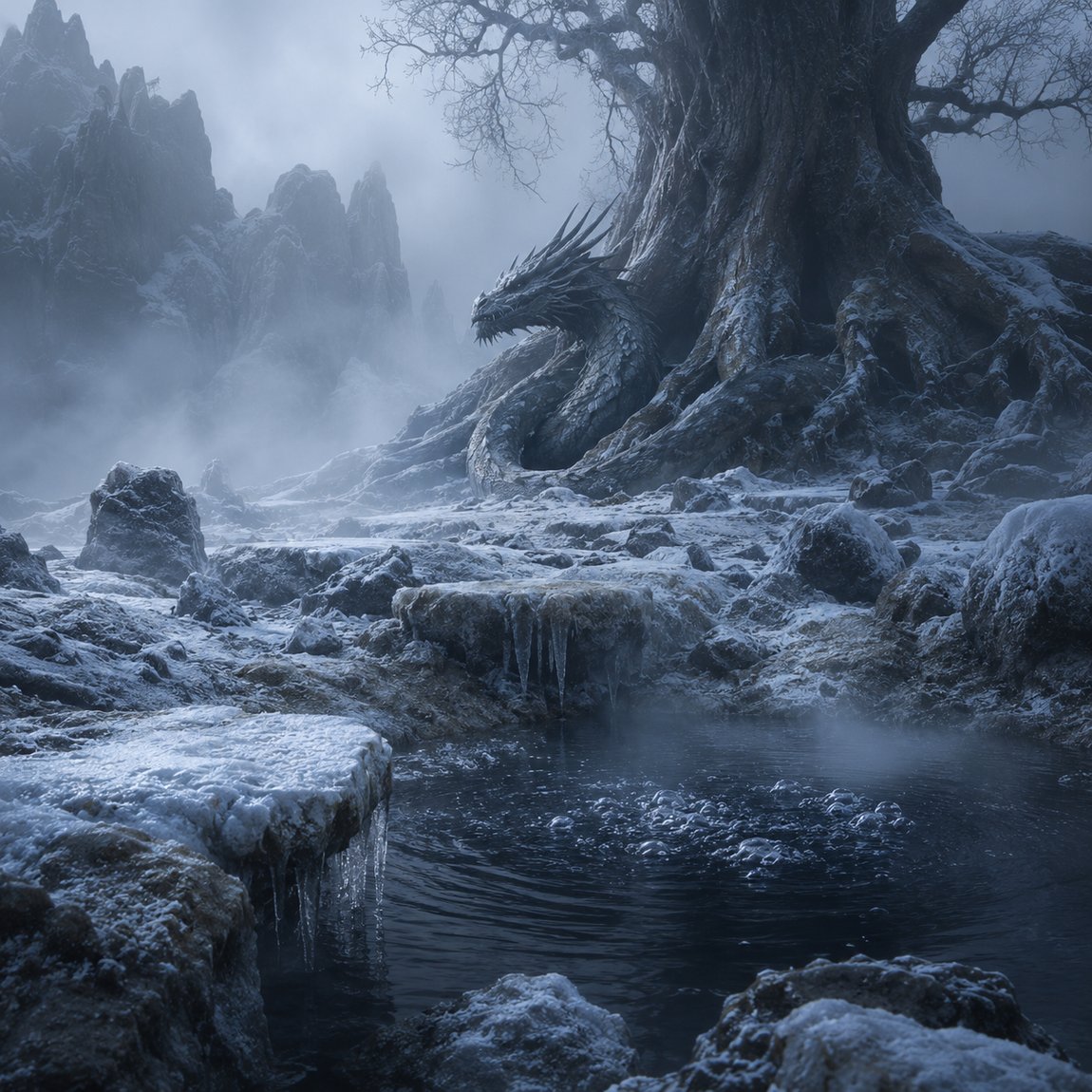
Niflheim is the cold, misty primeval world in the north of Norse cosmology, whose rime met the fire of Muspell and gave rise to the giant Ymir. The name means roughly “mist world” or “world of darkness”. Almost everything we know about it comes from one author, Snorri Sturluson, in his Gylfaginning of around 1220: at its centre lies the spring Hvergelmir, source of the primeval rivers, and later the death goddess Hel is cast down there. The older Eddic poems only know Niflhel, a dark depth beneath the realm of the dead. Here is how the three terms fit together.
Picture a world with no ground to stand on. No light, no horizon, just vapour thickening into frost, and somewhere below it the roar of a boiling cauldron that pours out rivers full of venom. That is how Snorri Sturluson paints the north at the beginning of everything. Niflheim is not a place heroes visit, not a kingdom with halls and kings. It is a condition of the world before there was a world: cold as raw material.
It is also one of the most misunderstood names in Norse mythology. It gets treated as the realm of the dead, as the “home of the frost giants”, or as one of nine neatly numbered worlds. The medieval sources are sparser and far less tidy. We will follow the mist world passage by passage: first the word, then Snorri’s creation story, then Hel and Niflhel, and finally the question of whether Niflheim is any older than Snorri’s own writing desk.
In Old Norse the name is Niflheimr. The second element is easy. Heimr means “world, abode, home” and appears in Jötunheimr and Vanaheimr as well. The first element is the interesting one. Nifl belongs to a widespread Indo-European family of words for mist and cloud: German Nebel, Dutch nevel, Latin nebula and Greek nephélē (“cloud”) are all relatives. Old English has a word nifol meaning “dark, gloomy”. So the mist in question is not the pleasant morning haze over a meadow. It is the kind that takes away your sight: murk, gloom, the impenetrable.
“Mist-home” or “mist world” are good renderings; “dark world” catches the tone too. When Arthur Gilchrist Brodeur translated Snorri’s Edda into English in 1916, he simply called it the Mist-World.
One point matters for everything that follows. The word Niflheimr itself is attested in medieval sources almost exclusively in Snorri. The mythological poems of the Poetic Edda use a different formation instead: Niflhel, literally “mist-Hel” or “dark-Hel”. Henry Adams Bellows translated it in 1923 as Dark-Hell. That tiny difference in the ending is the root of almost every confusion surrounding the mist world.
Online you will often read “Niflheim, also called Niflhel or Helheim”. It is not that simple.
| Term | Attested in | What it means |
|---|---|---|
| Niflheimr | almost only Snorri’s Gylfaginning | cold primeval world in the north, older than the earth; later the place Hel is banished to |
| Niflhel | Vafþrúðnismál 43, Baldrs draumar 2, Snorri’s Gylfaginning ch. 3 | the dark depth below or beyond the realm of the dead |
| Hel | everywhere in Eddic poetry, skaldic verse and prose | the realm of the dead, and also the goddess who rules it |
Hel is the default: the place most of the dead go to and the figure who presides over it. Niflhel is an intensification, a sort of cellar beneath the underworld. Niflheim, in Snorri, is first and foremost a cosmological term, a region of primeval time. The images only merge because Snorri later sends Hel there. The form Helheim, so familiar today, plays a much smaller role in the sources than in modern handbooks and games; see our article on Helheim.
Our earliest evidence comes from two Eddic poems. Both survive only in manuscripts of the later thirteenth century, though their material is probably older; how much older is debated.
In Vafþrúðnismál, the deadly contest of wisdom between Odin and the giant Vafþrúðnir, the giant boasts of his knowledge in stanza 43. He has come to every world, he says, and then follows the key line: níu kom ek heima fyr Niflhel neðan; hinig deyja ór helju halir.
“To nine worlds came I, to Niflhel beneath, / The home where dead men dwell.”Vafþrúðnismál 43, translated by Henry Adams Bellows (1923, public domain)
The Old Norse is sharper than Bellows makes it. Literally: “nine worlds I came to, down below Niflhel; there men die out of Hel” (our own literal rendering). The dead die once more, out of Hel, down into Niflhel. That is the heart of the term: a second, deeper level of death. Notice the geography as well. Here Niflhel lies beneath or beyond the nine worlds, not as one of them.
The second instance is in Baldrs draumar, a short poem about Baldr’s ominous dreams preserved not in the Codex Regius but in the manuscript AM 748 I a 4to. In stanza 2 Odin saddles Sleipnir and rides down, Niflheljar til, “to Niflhel”, to question a dead seeress. On the way he meets a blood-spattered hound coming “from Hel”. Again Niflhel is the lowest point of a downward journey. Neither poem says a word about ice, rime or primeval rivers. How that descent was imagined is the subject of The road to Hel.
Around 1220 the Icelandic scholar and chieftain Snorri Sturluson wrote his Edda, a handbook for poets. Its first part, Gylfaginning (“the beguiling of Gylfi”), is framed as a dialogue: the Swedish king Gylfi, calling himself Gangleri, questions three mysterious figures named Hár, Jafnhár and Þriði. Snorri was a Christian writing two centuries after Iceland’s conversion, and he arranged the old poems to his own plan – preserver and architect at once.
In chapter 4 (numbering as in Brodeur and the common editions; some editions differ slightly) Gangleri asks how things began. Hár first quotes Völuspá: in the beginning there was nothing, neither sand nor sea, only the yawning gap Ginnungagap. Then Jafnhár takes over with a sentence that fixes Niflheim in time: Fyrr var þat mörgum öldum en jörð var sköpuð, er Niflheimr var gerr.
“It was many ages before the earth was shaped that the Mist-World was made.”Gylfaginning 4, translated by Arthur Gilchrist Brodeur (1916, public domain)
That is a precise claim. Niflheim was made (gerr), many ages before the earth. Snorri does not say who made it. And Niflheim is not the very first thing. Immediately afterwards Þriði explains that even earlier there was a world in the south called Muspell, bright and hot, impassable to anyone not native to it, guarded by Surtr with his flaming sword. The order is therefore: first Muspelheim, then Niflheim, then everything else. Snorri’s primeval pair are not twins but an elder and a younger sibling.
What lies in Niflheim? Snorri names exactly one thing: í honum miðjum liggr brunnr sá, er Hvergelmir heitir, “in the middle of it lies the spring called Hvergelmir”. The name is usually explained as “roaring cauldron”: hverr is a cauldron, and in Iceland also a hot spring, while gelmir is understood as “the noisy, bellowing one”.
From Hvergelmir, Snorri says, flow eleven rivers: Svöl, Gunnþrá, Fjörm, Fimbulþul, Slíðr ok Hríð, Sylgr ok Ylgr, Víð, Leiptr, followed by an afterthought: Gjöll er næst Helgrindum, “Gjöll is nearest to the gates of Hel”. So even in the creation chapter, the realm of the dead shows through. Gjöll is the river later spanned by the bridge Gjallarbrú, which Hermóðr crosses on his ride to find Baldr.
Where did Snorri get these names? From Grímnismál. In stanza 26, liquid drips from the antlers of the hart Eikþyrnir on the roof of Valhalla down into Hvergelmir, “and thence all waters take their way”. Stanzas 27 and 28 then reel off long catalogues of river names. Stanza 27 includes Síð and Víð, Svöl and Gunnþró, Fjörm and Fimbulþul, and, a nice surprise for anyone in the Rhineland, Rín, the Rhine. Stanza 28 names Slíð and Hríð, Sylgr and Ylgr, Víð and Ván, Gjöll and Leiptr among many others, and closes by saying they flow “near to men” and “fall from here to Hel”.
“From his horns a stream into Hvergelmir drops, / Thence all the rivers run.”Grímnismál 26, translated by Henry Adams Bellows (1923, public domain)
So Snorri drew a selection from two sprawling catalogues and assigned it to the spring in Niflheim. In the poem itself, Hvergelmir is not placed in Niflheim at all. Bellows notes that stanzas 27 to 34 are probably later interpolations and that the names vary between manuscripts. For more on the springs beneath the world tree, read our article on the three wells beneath Yggdrasil.
In chapter 5 the cold starts to move. Hár speaks of the streams called Élivágar. The name combines él, “snow squall, hail shower”, with vágar, “waves, bays”; Brodeur renders it Ice-waves, and “storm-waves” catches the sense as well. When these rivers had travelled far enough from their source, the venom they carried hardened like the slag that runs out of a smith’s fire and turned to ice. Rime settled over it, layer upon layer, reaching out into Ginnungagap.
Snorri never says outright that the Élivágar are the same rivers that come out of Hvergelmir. The narrative invites the connection, and most retellings make it. The Élivágar themselves are older than Snorri. In Vafþrúðnismál (stanza 31) drops of venom spring from them and a giant grows from them, and in Hymiskviða the giant Hymir lives east of the Élivágar. Snorri welds these fragments into a chain: Niflheim, Hvergelmir, Élivágar, rime.
Then comes the sentence that sets the two primeval worlds against each other. Jafnhár says that just as cold rose out of Niflheim, “and all grim things”, so everything facing Muspell was hot and glowing, while Ginnungagap was as mild as windless air.
“Just as cold arose out of Niflheim, and all terrible things …”Gylfaginning 5, translated by Arthur Gilchrist Brodeur (1916, public domain)
“All grim things”, allir hlutir grimmir: in Snorri, Niflheim is not merely cold but hostile. That fits its later role as a place of banishment.
What happens next is the most famous moment in Norse creation myth. The southern part of Ginnungagap was lit by sparks and glowing masses flying over from Muspellheim. When the warm breath met the rime, it melted and dripped, and from the drops, by the power of whatever sent the heat, life arose in human shape: the primeval giant Ymir. Shortly afterwards the primeval cow Audhumla also emerged from the dripping rime, and Ymir fed on her milk.
“… when the breath of heat met the rime, so that it melted and dripped …”Gylfaginning 5, translated by Arthur Gilchrist Brodeur (1916, public domain)
Niflheim supplies the substance, Muspell the energy. Out of Ymir’s body Odin and his brothers later build the world: earth from his flesh, sea from his blood, sky from his skull. In Snorri’s logic, then, Niflheim is present in every stone of Midgard.
Snorri bases this account on older poems, above all Völuspá and Vafþrúðnismál. But the neat division of ice against fire, north against south, appears with this clarity only in his work. Whether lost tradition, learned natural philosophy or Iceland’s glaciers and volcanoes lie behind it cannot be proven; the last is a plausible but unsupported modern guess.
Niflheim returns when Snorri describes the world tree. In chapter 15 Hár explains that Yggdrasil has three roots: one among the Æsir, one among the frost giants where Ginnungagap once was, and in þriðja stendr yfir Niflheimi, ok undir þeiri rót er Hvergelmir, “the third stands over Niflheim, and under that root is Hvergelmir”. There the dragon Níðhöggr gnaws the root from below. In the next chapter Snorri adds that so many serpents are in Hvergelmir with Níðhöggr that no tongue can count them.
Once again the poems are worth a look. Grímnismál 31 names three roots and assigns them to Hel, to the frost giants and to humankind. Snorri turns Hel into Niflheim and humankind into the Æsir. That is not a slip but a rearrangement that suits his system: for him Niflheim is the region beneath everything. The fact that the poem says “Hel” exactly where Snorri writes “Niflheim” is strong evidence that he had already merged the two in his mind.
The most consequential Niflheim passage comes in chapter 34. The gods learn that Loki has three children by the giantess Angrboða: the wolf Fenrir, the Midgard Serpent and Hel. Odin has them brought to him and disposes of them: the serpent into the sea, the wolf into fetters, and Hel kastaði hann í Niflheim ok gaf henni vald yfir níu heimum.
“Hel he cast into Niflheim, and gave to her power over nine worlds …”Gylfaginning 34, translated by Arthur Gilchrist Brodeur (1916, public domain)
There she is to allot dwellings to those sent to her, namely those who die of sickness or old age. Snorri describes her estate with its high walls, her hall Éljúðnir, and telling names for her household goods, such as “Hunger” for her dish. With that, the short circuit is complete: the realm of the dead now lies in Niflheim. Anyone today who confuses Niflheim with Helheim is, in effect, following this very passage.
Still, keep the terms apart. In chapter 34 Niflheim is the place Hel is banished to, and Hel is its mistress. The realm of the dead she governs is still simply called Hel. And in chapter 3 Snorri also knows the poetic Niflhel: the righteous go to Gimlé or Vingólf, but the wicked go til Heljar ok þaðan í Niflhel; þat er niðr í inn níunda heim, “to Hel and thence to Niflhel, which is down in the ninth world”. Here Snorri is clearly following Vafþrúðnismál, a dependence Gabriel Turville-Petre pointed out. So Snorri works with levels: Hel for those who die ordinary deaths, Niflhel as a deeper punishment for evildoers – and Niflheim as the cosmic landscape that contains both.
How shaky the boundary between Niflheim and Niflhel already was in the Middle Ages shows up in chapter 42, the story of the building of Asgard’s wall. The giant who was to build the gods their fortress is killed by Thor at the end and sent down below. Down where? That depends on which manuscript you open. The online edition at heimskringla.no reads niðr undir Niflheim, while Brodeur’s translation follows a text with “under Niflhel”. John Lindow points out that the main manuscripts of Snorri’s Edda are split here: two read Niflheim, two Niflhel.
Even the medieval scribes copying Snorri, then, treated the two words as interchangeable or mixed them up. A sharp definition cannot be squeezed out of the sources. What we can say is this: Niflhel is the older, poetic word with a clear underworld meaning. Niflheim is Snorri’s word with a cosmological focus, which overlaps with the world of the dead.
That brings us to the most intriguing question. If Niflheimr does not occur in the older poems but Niflhel does, an obvious suspicion arises: Snorri may have coined the word himself, as a counterpart to Muspellsheimr and in line with Jötunheimr, Álfheimr and the other worlds ending in -heimr. The Viennese scholar of religion Rudolf Simek considers this quite possible in his dictionary of Northern mythology. Others more cautiously allow that Snorri may have known a word or an oral variant that has since been lost.
Three things support the idea: the distribution of the evidence (Niflhel in two poems, Niflheim only in Snorri); Snorri’s method, which turns hints into lists and lists into orders and loves symmetries like Muspellsheimr and Niflheimr; and the passage on the roots, where he replaces “Hel” with “Niflheim”. The main argument against it is that we know only a fraction of the oral poetry of the tenth to twelfth centuries. A word that happens not to survive in any extant stanza need not have been invented.
The system of nine worlds belongs here too. Modern lists dutifully present Niflheim as one of nine worlds alongside Asgard, Midgard and Jötunheim. No such list exists in the medieval sources. The Edda speaks of nine worlds but never enumerates them, and in chapter 3 Snorri himself makes Niflhel the “ninth world”, not Niflheim. How the modern schemes came about is explained in The nine worlds of Norse mythology.
Is there a mist world outside Iceland? The Danish historian Saxo Grammaticus, Snorri’s contemporary, never mentions Niflheim. In book 8 of his Gesta Danorum, however, he tells of the voyages of Thorkillus into the farthest north, into a region without sun or stars where there is nothing to make a fire with, all the way to the cave of the bound Utgarthilocus. That is a landscape of darkness and cold at the edge of the world. But be careful: Saxo uses none of the Eddic terms, and his account is a learned Latin travel narrative. Nothing more than a kinship of motifs can be inferred from it.
In popular culture Niflheim has had a second career. In God of War (2018) it is a realm choked with poisonous mist and built around a shifting maze; we compare it with the sources in our God of War fact check. Assassin’s Creed Valhalla also sent players into a version of Niflheim in a later expansion, and in Final Fantasy XV an entire empire bears the name, with no mythological connection beyond the sound. The pattern is nearly always the same: Niflheim becomes a travelable ice world with inhabitants, enemies and loot. In Snorri, nobody lives there apart from the banished Hel and the serpents in Hvergelmir. Frost giants as residents are a modern addition; the frost giants do descend from Ymir, but they live in the land of the giants.
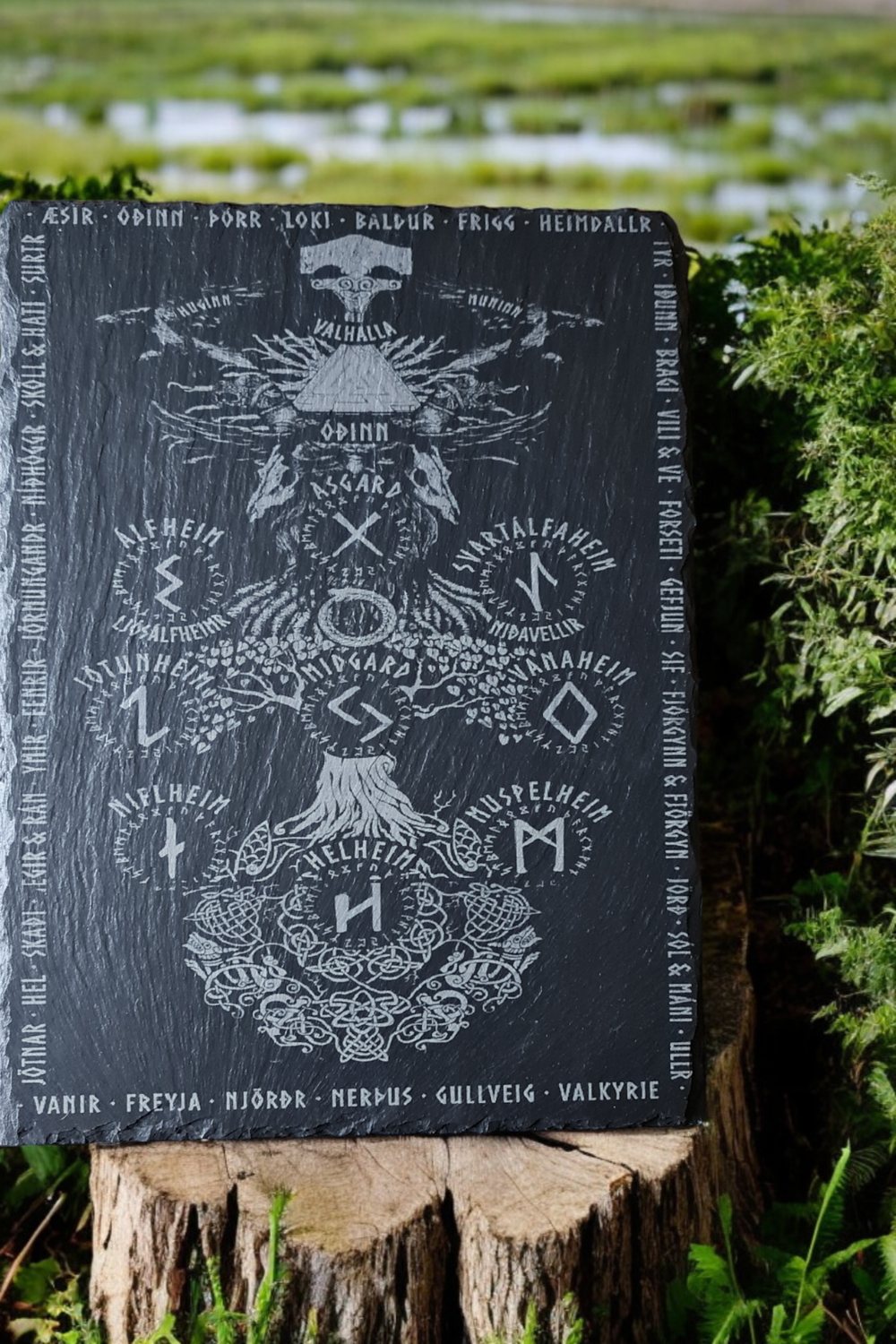
In the end we are left with an image more powerful than any map. Snorri did not imagine the beginning as light driving out darkness, but as the meeting of two opposites: stiffness and glow, rime and spark. Only their contact produces something new. Niflheim is the quiet, heavy half of that pair – the material, waiting. People who ask us to engrave the worlds of the north on slate usually want Yggdrasil and Asgard. But the mist world at the foot of the tree belongs to the picture too, and on dark natural slate the blurred parts of a design come across especially strongly. We would rather engrave an honest hint than an invented map.
For courage. For remembrance. For legends that live on.
What does Niflheim mean? Niflheim (Old Norse Niflheimr) means roughly “mist world” or “world of darkness”. The element nifl is related to German Nebel and Latin nebula; heimr means “world, home”.
What is the difference between Niflheim and Helheim? In Snorri, Niflheim is the cold primeval world in the north that supplied the rime from which Ymir arose. Hel is the realm of the dead and also its ruler. The two ideas only overlap because, according to Snorri, Odin banished the goddess Hel to Niflheim.
Is Niflheim the same as Niflhel? No, although medieval scribes sometimes swapped the words. Niflhel is the older word from the Eddic poems and refers to a deeper, darker level below Hel, where according to Snorri the wicked end up.
Where is Niflheim mentioned in the sources? Almost only in Snorri Sturluson’s Gylfaginning (around 1220), chiefly chapters 4–5 (creation), 15–16 (the root of Yggdrasil) and 34 (Hel). The Poetic Edda only knows Niflhel, for example in Vafþrúðnismál 43 and Baldrs draumar 2.
Is Niflheim one of the nine worlds? In modern lists, yes; the medieval sources contain no such list. In chapter 3 Snorri calls Niflhel, not Niflheim, the “ninth world”.
Ginnungagap – the yawning void · Muspelheim – the fire world · Ymir · Yggdrasil · Helheim.
All The Nine Worlds articles →
Deep beneath the earth, in the half-dark of shafts and forges, lies Svartalfheim – the world of the black elves, as the …
Read more →Apart from Asgard, in a world whose location the sources leave vague, dwell the Vanir – the other family of gods …
Read more →The world was ordered, the sun ran its course – but the shore lay empty. Then three gods found on the sea-strand two …
Read more →Before there were gods, before the world was formed, there were two beings in the frost: the primal giant Ymir and a …
Read more →