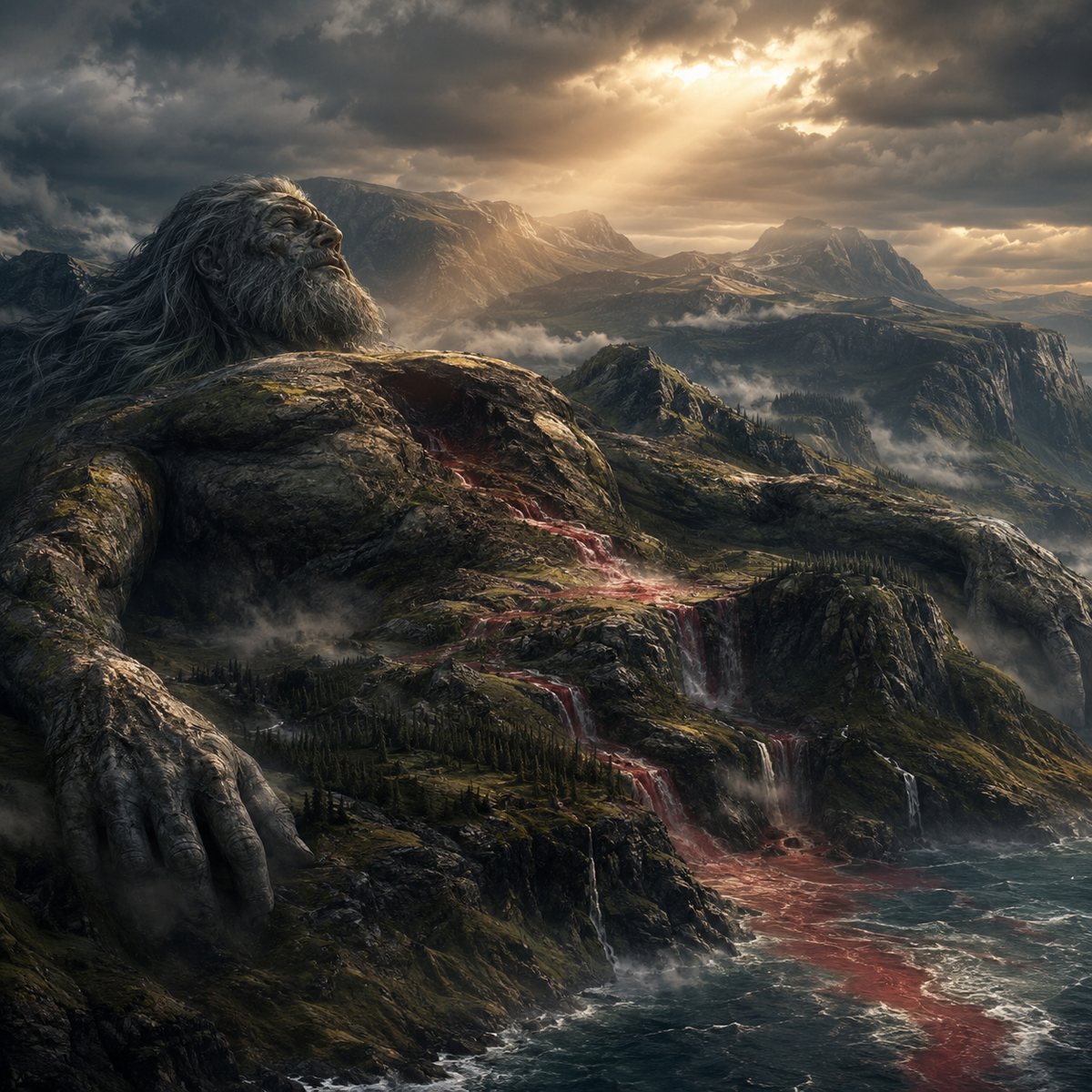
Ymir is the primordial giant of Norse mythology: the first living being, born from dripping venom-ice in the yawning void of Ginnungagap and ancestor of all the giants. Odin and his brothers Vili and Vé killed him and built the world from his body – earth from his flesh, sea from his blood, mountains from his bones, the sky from his skull. Here is what the Eddas actually say about Ymir, where the sources contradict each other, and why scholars trace his name all the way to India.
The Viking world is, quite literally, built on a corpse. Walk across a Norse meadow and, according to myth, you are walking on giant's flesh; look up and you are staring at the inside of a skull. In our piece on Ginnungagap we set the stage: the gaping void, the ice of Niflheim to the north, the fire of Muspelheim to the south. Now the first being walks on – and we will show you where the sources interrupt one another, because there is no single Ymir myth.
No rune stone names Ymir and no picture stone shows him. Everything we know comes from Icelandic manuscripts of the thirteenth century – a good two hundred years after Iceland accepted Christianity around the year 1000. That does not make the story an invention. It does mean you have to look closely at who is telling it.
The older layer is the mythological poetry of the Poetic Edda, collected in the Codex Regius (c. 1270); some stanzas may reach back into the Viking Age. Four poems mention Ymir:
The younger layer is Gylfaginning (“the tricking of Gylfi”), the first part of the Prose Edda by Snorri Sturluson, written around 1220. Snorri, a learned Christian and a politician, stitches the scattered stanzas into one continuous narrative and fills the gaps – partly from sources now lost, partly, it seems, from his own logic. Almost everything you read or watch about Ymir follows his version.
Before Ymir, says Völuspá, there was no sand, no sea, no cool waves – only the gaping chasm. Bellows renders the opening like this:
“Of old was the age when Ymir lived; / Sea nor cool waves nor sand there were.”Völuspá 3, Henry Adams Bellows 1923 (public domain)
Even here lies a small surprise. The Codex Regius reads “þar er Ymir bygði”, “when Ymir dwelt”. Snorri quotes the same stanza as “þar er ekki var”, “when nothing was”. Which reading is older is debated. In one, the world begins with a giant; in the other, with nothing at all.
How Ymir came to be is told tersely in Vafþrúðnismál: venom spattered out of the Élivágar, icy primeval rivers, and grew until a giant was formed.
“Down from Elivagar did venom drop … And thence arose our giants’ race.”Vafþrúðnismál 31, Henry Adams Bellows 1923 (public domain)
Snorri turns this into a little physics lesson. The Élivágar flow from the spring Hvergelmir in Niflheim; their venom hardens into rime that fills the northern half of Ginnungagap. From the south, warm air drifts over from Muspelheim. Where the two meet, the ice thaws and drips – and “by the power of the one who sent the heat” the drops quicken into a living thing in the shape of a man. Snorri never says who that sender is. What is clear: the first being of the Norse world is not a god but a giant, born of venom, frost and fire.
In Vafþrúðnismál the primordial giant is mostly called Aurgelmir. Snorri explains: the frost giants call him Aurgelmir, the gods call him Ymir. Whether the poets originally meant two separate figures cannot be settled; in the Nafnaþulur, medieval name-lists for poets, both names stand side by side among the giants.
Aurgelmir is usually linked to aurr, “mud, wet gravel”, plus -gelmir, “the noisy one, the roarer”. His son and grandson share the ending: according to Vafþrúðnismál 29, Aurgelmir fathered Þrúðgelmir, who fathered Bergelmir. Snorri drops Þrúðgelmir altogether.
Two more names appear in Völuspá: Brimir and Bláinn, from whose blood and limbs the dwarves are made. Snorri apparently takes both as names for Ymir, and most scholars follow him, but it is not certain. Brimir recalls brim, “surf”; Bláinn recalls blár, “blue, dark”.
Ymir begets without a partner. Vafþrúðnismál says it flatly: under the arm of the frost giant a girl and a boy grew, and one foot begot with the other a six-headed son (st. 33). From him comes the race of frost giants.
Snorri tidies things up: as Ymir slept he broke into a sweat, and under his left arm grew a man and a woman, while one foot begot a son with the other. The six heads are quietly dropped.
It sounds grotesque, and it is perfectly logical: before Ymir there is nobody to mate with. Incidentally, no source actually calls Ymir hermaphroditic or two-sexed. That is a reasonable inference, supported mainly by the etymology of his name.
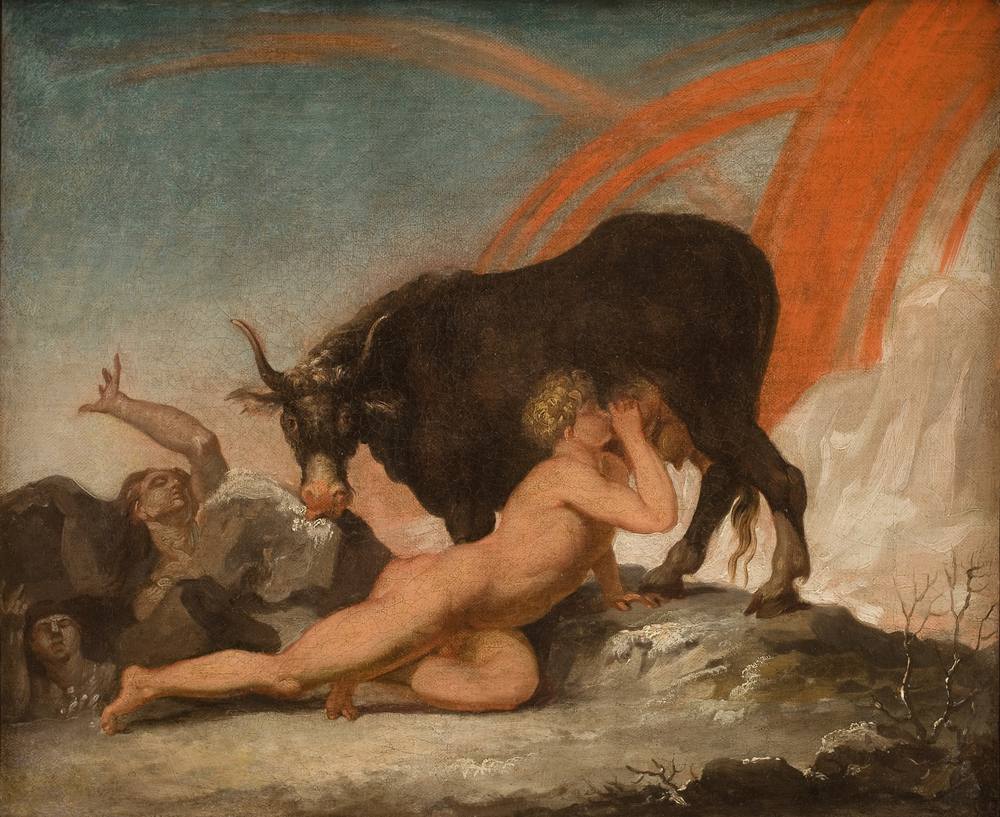
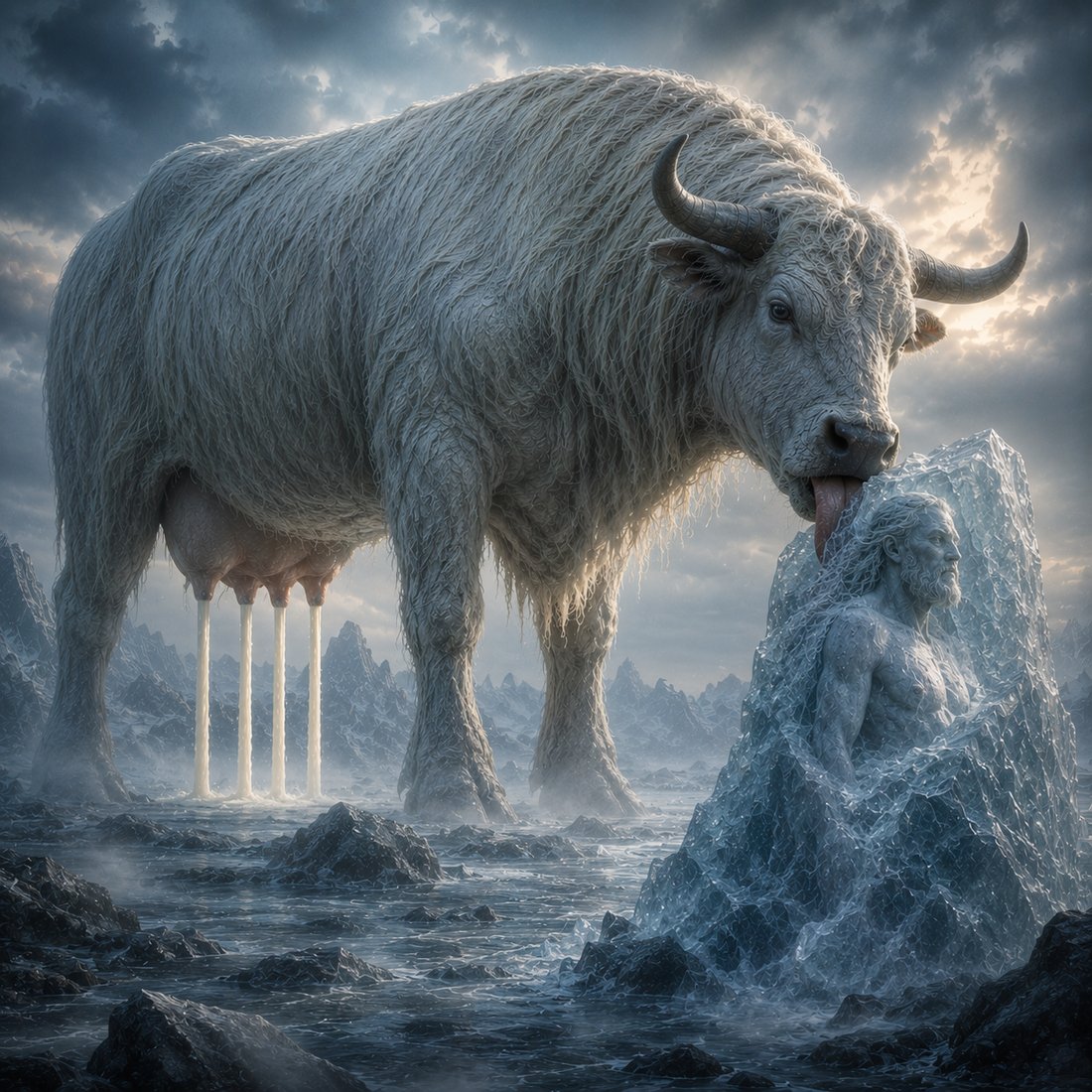
A giant alone in the ice has to eat. So Snorri lets a second being emerge from the same thawing rime: the primeval cow Auðhumla. Four rivers of milk run from her udder and feed Ymir. The cow herself licks the salty rime-stones – and uncovers the beginning of the gods. On the evening of the first day a man’s hair appears, on the second day a head, on the third a whole man, handsome, tall and strong. His name is Búri.
Búri has a son, Borr (also Burr). Borr marries Bestla, daughter of the giant Bölþorn, and they have three sons: Odin, Vili and Vé. Bölþorn is not Snorri’s invention: in Hávamál 140 Odin says he learned nine mighty songs from “the son of Bölþorn, Bestla’s father” – from his maternal uncle, a giant.
So giant’s blood runs in the veins of the highest gods from the very start – a keynote of Norse myth, in which gods and giants are kin, in-laws and enemies all at once.
The Eddic poems know neither Auðhumla nor Búri. Borr, however, they do: Völuspá 4 speaks of “Bur’s sons” who lifted up the lands and shaped Midgard. Where Snorri found his cow, we do not know.
Then it happens: the sons of Borr strike Ymir down. Snorri tells it in a single sentence, with no fight and no reason given. In the Eddic poems it is simply “the gods” who make the world from the giant; none of them says how he died.
Why did Ymir have to die? Snorri does have his narrator say that Ymir was no god but “evil, and all his descendants” – a description, not a motive. The plainest reading: no raw material, no world. Others see a founding act by which order carves up and measures out shapeless chaos; others again an ancient sacrifice (more on that below).
Either way, the Norse world begins with the killing of a kinsman: Odin slays his own mother’s ancestor. The feud between gods and giants runs from here all the way to Ragnarök.
As Ymir falls, so much blood pours from his wounds that the whole race of frost giants drowns in it. Only one escapes: Bergelmir. He climbs onto his lúðr with his wife and survives, and all later giants descend from him. That is Snorri’s account.
And this is where it gets interesting. Snorri’s source is Vafþrúðnismál 35: Bergelmir was born countless winters before the earth was made, and the first thing Vafþrúðnir remembers is that the wise giant was laid on a lúðr. There is no flood in the poem at all.
What lúðr means has been argued over for more than a century: it is attested for the box of a hand-mill, and cradle, coffin and boat have all been proposed. Snorri read “boat” – and got himself an ark story. Bellows followed him in 1923: “In a boat of old was borne.”
Now Odin, Vili and Vé build the world out of the dead giant. The older version is in Vafþrúðnismál and Grímnismál, which say almost the same thing:
“Out of Ymir’s flesh was fashioned the earth, / And the ocean out of his blood; / Of his bones the hills, of his hair the trees, / Of his skull the heavens high.”Grímnismál 40, Henry Adams Bellows 1923 (public domain)
Grímnismál 41 adds: from his eyebrows the gods made Midgard for the sons of men, and from his brain the dark clouds. The word Bellows translates as blood, sveiti, literally means “sweat”, but in poetic language it often stands for blood – and Snorri writes blood.
Snorri’s blueprint is the most complete. Ymir’s flesh becomes the earth, his blood the sea and lakes, his bones the mountains, his teeth and bone splinters the rocks and scree; an ocean rings the earth. From the skull the gods vault the sky and set four dwarves beneath its corners: Norðri, Suðri, Austri and Vestri – North, South, East and West. The brain they fling into the air, and it becomes the clouds. Sparks and embers blown over from Muspelheim they fix in the sky to light heaven and earth: the stars and lights. Finally, from the eyebrows they raise a wall against the giants and make behind it Midgard (“middle enclosure”), the sheltered world of humans.
There is a catch. Völuspá 4 tells the beginning differently: there Bur’s sons lift up the lands, and the sun shines on the stones until green leeks grow. That sounds more like land rising from the sea than a dismembered corpse. Perhaps two images of creation circulated side by side, and Snorri combined them.
The dwarves come from Ymir too. According to Snorri they first came alive in the giant’s flesh like maggots in a carcass; the gods then gave them understanding and human form. His basis is Völuspá 9, where the gods debate who should make the race of dwarves:
“Out of Brimir’s blood and the legs of Blain.”Völuspá 9, Henry Adams Bellows 1923 (public domain)
And there is a manuscript problem. The Codex Regius reads ór brimi blóðgu, “out of the bloody surf”, while Snorri’s text has ór Brimis blóði, “out of Brimir’s blood”. Depending on the reading, the dwarves come from a giant – or from a blood-red sea, which could of course be Ymir’s blood once again.
The gods’ greatest treasures – Mjölnir, Draupnir, Skíðblaðnir, Gleipnir – thus come from the workshops of beings that crawled out of a giant’s corpse. This mythology is not squeamish.
The world stood, but it was empty. In Völuspá three gods find two powerless figures on the shore, Ask and Embla:
“Soul gave Othin, sense gave Hönir, / Heat gave Lothur and goodly hue.”Völuspá 18, Henry Adams Bellows 1923 (public domain)
In Snorri it is the sons of Borr who find two tree trunks on the beach and make people from them. That they were driftwood is a plausible embellishment, not something the text says. A circle closes: Ymir’s hair became trees, and from trees come humans – in a world whose backbone is the ash Yggdrasil.
Read only Snorri and you get a seamless story. Put the poems beside him and you can see the stitching. Here are the main differences:
| Point | Eddic poems | Snorri, Gylfaginning |
|---|---|---|
| Beginning | “when Ymir lived” (Völuspá 3, Codex Regius) | “when nothing was” |
| Origin | venom-drops from the Élivágar (Vafþrúðnismál 31) | thawing rime meets warm air from Muspelheim |
| Name | mostly Aurgelmir | Ymir; Aurgelmir only among the frost giants |
| Offspring | girl and boy under the arm, six-headed son | man and woman under the left arm, son without six heads |
| Auðhumla, Búri | not mentioned | told in detail |
| Killers | “the gods” | Odin, Vili and Vé |
| Bergelmir | laid on a lúðr, no flood | survives the blood-flood on his lúðr |
| Sea | from Ymir’s sveiti (“sweat”/blood) | from Ymir’s blood |
| Dwarves | from Brimir’s blood and Bláinn’s limbs | like maggots in Ymir’s flesh |
Snorri is not “lying”. He collects, harmonises and fills gaps like any scholar of his day. But where a detail appears only in his work, read it as Snorri’s version, not as “the” Norse myth.
That Ymir’s world-building was more than thirteenth-century book learning is shown by skaldic poetry. Skalds, the court poets of the North, worked with kennings – poetic circumlocutions such as “raven’s food” for corpses. Snorri’s handbook for poets, Skáldskaparmál, lists them.
The sky can be called “Ymir’s skull” (Ymis haus), “giant’s skull”, “burden of the dwarves” or “helmet of Vestri, Austri, Suðri and Norðri”. Snorri backs this with a verse by the eleventh-century skald Arnórr jarlaskáld, who speaks of “Ymir’s old skull”. The earth is “Ymir’s flesh” (Ymis hold), the sea “Ymir’s blood” (Ymis blóð); for the latter Snorri quotes the skald Ormr Barreyjarskáld.
That matters. An eleventh-century poet could only say “Ymir’s skull” if his audience knew the sky had been made from a giant’s head. The core of the myth is older than Snorri, even if some of his embellishments are younger.
Many linguists trace Old Norse Ymir to an Indo-European root *yem-, “twin, paired”. Its relatives would be the Sanskrit Yama, the first mortal and king of the dead, and the Iranian Yima, the first king of humankind. For a being that produces a man and a woman out of itself, “twin” or “hermaphrodite” fits remarkably well.
It is not undisputed. Another explanation links the name with Old Norse ymja, “to howl, to roar” – making Ymir “the noisy one”, which would match Aurgelmir and Bergelmir. The twin theory is generally considered the better-founded, but it remains a theory.
A second witness comes from Rome. In his Germania (ch. 2, c. AD 98) Tacitus reports that the Germanic peoples celebrated in ancient songs Tuisto, a god born of the earth, and his son Mannus, the founder of their tribes. The name Tuisto (Tuisco in some manuscripts) is usually connected with a word for “two, double” – again a double being at the start.
Building the world from a dismembered primal being is no Norse invention. In the Indian Rigveda (10.90), far older than the Edda, the gods sacrifice the primal man Purusha: from his mind comes the moon, from his eye the sun, from his head the sky, from his feet the earth. The pattern – body part becomes world part – matches Ymir, though the individual assignments differ.
The historian of religions Bruce Lincoln built an influential theory on this: behind Ymir, Purusha and Yima lies a shared Indo-European myth in which a first man, *Manu (“man”), sacrifices his twin brother *Yemo (“twin”) and makes the world from his body. Ymir would then be a descendant of *Yemo, and Tacitus’ Mannus an echo of *Manu. Jaan Puhvel (Comparative Mythology, 1987) also discusses Ymir in this context.
It is elegant, but it is a reconstruction: no text actually tells the *Manu–*Yemo myth. And the world-body image exists outside the Indo-European sphere too. In China, a tradition recorded in the third century AD tells of Pangu, whose eyes became sun and moon and whose blood became the rivers. Pangu is not related to Ymir; he simply shows that people in different places arrived at the same idea.
When Scandinavia rediscovered the Edda in the eighteenth century, Ymir became a subject for painters. Around 1777 Nicolai Abildgaard painted Ymir suckling at the cow Auðhumla (shown above): a muscular giant, more classical hero than ice monster. For Karl Gjellerup’s Danish Edda translation (Den ældre Eddas Gudesange, 1895) Lorenz Frølich drew, right at the start, the sons of Borr attacking Ymir.
In pop culture Ymir lives on very loosely: in the anime “Attack on Titan” the ancestor of all Titans is called Ymir Fritz, in the game “Valheim” you gather “Ymir flesh” as a crafting material – taking the myth remarkably literally – and Marvel Comics has a frost giant named Ymir.
The Norse creation myth knows no spotless act of making. Out of venom comes life, out of a killing the world, out of dead wood the human being. That is not pessimism but a worldview: nothing comes from nothing, everything is transformed matter, and even death carries the seed of the new. The same attitude returns at the end of the world, when after Ragnarök a new, green world rises from the ruin.
We like one more thing about it: in this view every stone and every tree is a piece of the first being. Engrave a slate and you are, mythologically speaking, working on Ymir’s bones.
Who is Ymir in Norse mythology? Ymir is the primordial giant, the first living being in the Norse creation story and the ancestor of all giants. Odin, Vili and Vé killed him and built the world from his body.
What was made from Ymir’s body? His flesh became the earth, his blood the sea, his bones the mountains, his hair the trees, his skull the sky, his brain the clouds, and his eyebrows the wall around Midgard.
Is Ymir a god or a giant? A giant; Snorri stresses that he was not a god. Through their mother Bestla, however, the gods themselves descend from giants.
Who killed Ymir and why? In Snorri, Odin, Vili and Vé; in the Eddic poems simply “the gods”. No source gives a motive.
Is Ymir the same as Aurgelmir? According to Snorri, yes: the frost giants call him Aurgelmir, the gods Ymir. Whether the Eddic poems originally meant two figures is uncertain.
What does the name Ymir mean? Probably “twin” or “hermaphrodite”, related to the Indian Yama and the Iranian Yima. Another theory derives it from ymja, “to roar, to howl”.
For courage. For remembrance. For legends that live on.
Ginnungagap – the void before · Yggdrasil, the world tree · The Norse pantheon (Æsir & Vanir) · Ragnarök · What comes after? · The Edda as a source.
Once a year the gods brewed not mischief but beer. The sea-giant Ægir welcomed them into his hall on the sea-floor …
Read more →Few stories in Norse tradition trail so much ruin behind them as this one: a careless throw, a dead otter, an …
Read more →It is the moment when laughter vanishes from Asgard. The death of the shining Balder is the most moving legend of the …
Read more →Warriors who fought in bear pelts and wolf-skins, bit their shields and feared neither fire nor iron. The berserker is …
Read more →