 No game has brought Norse mythology to more people in recent years than God of War (2018) and its sequel God of War Ragnarök. But how much of it actually stands in the Eddas – and what is storytelling licence? We compare individual depictions soberly against the medieval sources. Fact versus fiction, without retelling the plot.
Let us start with the biggest "invention" that is not actually a distortion of the Norse material at all: Kratos himself. The bald Spartan comes from a Greek game series – he has nothing to do with Germanic-Norse tradition. There is no Eddic stanza, no saga and no runestone on which a wandering Greek travels through Midgard. This matters, because it reveals how the game is built: a foreign protagonist journeys through a carefully researched but freely arranged Norse backdrop. The gods, worlds and monsters around Kratos, by contrast, come overwhelmingly from genuine sources – only their arrangement, their personalities and their motives are the authors' invention. This very mixture makes the fact check interesting: much is surprisingly well attested, while other things are entirely newly composed.
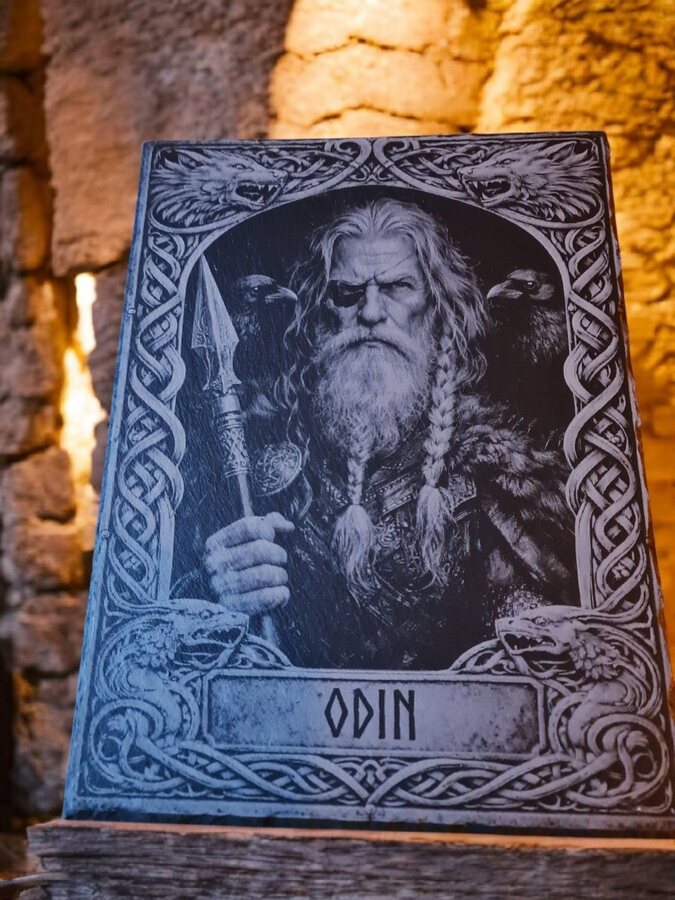
The God of War Odin is a manipulative, knowledge-hungry power broker – and thereby closer to the source than many fans assume. The Eddic Odin is precisely not the friendly grandfather of some pop culture, but a sinister god of ecstasy, poetry, death and above all knowledge. He sacrifices his eye at Mímir's well to gain wisdom, he hangs himself for nine nights on the world tree to win the runes, and he breaks oaths when it suits him. The ravens Huginn and Muninn, the spear Gungnir, the eight-legged horse Sleipnir – all of that is real and appears in the game. Where the game invents is the specific family history and the malice in detail: Odin's relationship with his sons, his role as a pure antagonist. The core, however – a god who craves knowledge and walks over corpses to get it – is startlingly faithful to the sources.
Here the game achieves something most films fail at: a Thor who looks like he does in the sources. Instead of the smooth Marvel hero, God of War Ragnarök shows a broad, bearded, red-haired giant of a man with a colossal thirst – and that is exactly how the Old Norse texts describe him. Thor has a red beard (hence the kenning "Redbeard"), he is the strongest of the Aesir, his appetite is proverbial, and in the Þrymskviða, disguised as a bride, he devours a whole ox and eight salmon. Mjöllnir, the hammer that always returns, is as real as Thor's eternal enmity with the giants and with the Midgard serpent. His children Magni, Modi and Thrud, who appear in the game, also stand in the Edda – Magni and Modi even inherit the hammer after Ragnarök. That the game's Thor is a broken, grieving father is the authors' characterisation; his appearance and his role as giant-slayer are textbook mythology.
The strongest proof of the authors' care is, of all things, the first game's main antagonist: Baldur and his invulnerability. In the Prose Edda, Baldr dreams of his death; his mother Frigg then makes all things in the world swear never to harm him – but forgets the young mistletoe, which seems too insignificant to her. Loki fashions from that very twig the missile that kills Baldr. God of War takes over this centrepiece almost word for word: Baldur's invulnerability has a single gap, and it is precisely the mistletoe that breaks it. This is no vague allusion but a precise adoption of the central myth. Where the game departs: the Eddic Baldr is the bright, gentle, universally beloved god whose death plunges the world into grief – in the game he is a joyless, sensation-deprived man tormented by his own spell. The mechanism is source; the personality is invention.
One of the game's cleverest – and most debatable – decisions concerns Freya. God of War makes her Odin's former wife and Baldur's mother. In the sources that is really Frigg's role: Frigg is Odin's spouse and Baldr's mother. Freya, by contrast, is a Vanir goddess of love, fertility and seiðr magic, mistress of the death realm Fólkvangr, where she receives half of the slain. The game thus merges two goddesses into one figure. Interestingly, this merger is not pulled out of thin air: scholars have long debated whether Frigg and Freyja go back to a shared older goddess (both are etymologically linked to "the lady / the beloved"). So the game seizes on a genuine scholarly blur – but makes a clear-cut choice that stands in no single source. Freya's magic, her falcon cloak and her Vanir connection, however, are real.
With the monsters the source base is especially solid. The Midgard serpent Jörmungandr, so vast that it encircles the whole world and bites its own tail, is core mythology – as is its deadly enmity with Thor, with whom it kills and is killed at Ragnarök. Fenrir, the wolf the gods bind with the magic fetter Gleipnir, devours Odin at Ragnarök and is avenged by Odin's son Vidar. Both creatures, incidentally, are Loki's children according to the Edda – a detail the game deliberately sidesteps. And Týr? In the game he is a peaceful, well-travelled god, a bridge-builder between cultures. In the Edda, Týr is above all a god of war and law who sacrifices his right hand: only he dares to place his hand in the maw of the distrustful Fenrir as a pledge while the gods fetter the wolf – and loses it when the deception comes to light. The peaceful, world-travelling note is invention; the handless god behind it is real.
The game's oddest "fact" sounds like pure invention but is genuinely attested: a talking, severed head as a wise companion. In Snorri's Ynglinga saga, Mímir is beheaded in the war between the Aesir and the Vanir; Odin takes the head, preserves it with herbs and chants spells over it so that it keeps talking and reveals hidden things to him.
Odin took the head, smeared it with herbs so that it should not rot, and sang incantations over it. Thereby he gave it the power that it spoke to him, and discovered to him many secrets.Snorri Sturluson, Ynglinga Saga, ch. 4, transl. Samuel Laing 1844 (public domain)
This very motif – Mímir as a severed, speaking adviser – is what the game uses. The world tree Yggdrasil and the nine worlds are real too … at least at their core. Caution is only needed with the tidy list: Snorri and the Poetic Edda do speak of "nine worlds", but nowhere are all nine cleanly enumerated and assigned to the tree. The familiar map of Asgard, Midgard, Jötunheim, Alfheim, Vanaheim, Muspelheim, Niflheim, Helheim and Svartalfheim is a modern ordering that the game (like many popular books) adopts – convenient, but not entirely watertight in source terms.
The Fimbulwinter, three consecutive winters without a summer preceding the end of the world, is real and comes from the Edda. Ragnarök itself – the final battle in which Odin is devoured by Fenrir, Thor and the serpent kill each other, and the world sinks in fire and flood only to rise anew – forms the backbone of the second game. What is freely invented is the specific sequence and connection: Baldur's death as a private drama long before the actual battle, the role of Kratos and his son as the trigger, and above all the great twist around Atreus. That Atreus is in truth Loki is a pure authorial invention – Loki in the sources is a giant and Odin's blood-brother, not the son of a Greek war god. Ironically, the real Loki is the father of Fenrir, Jörmungandr and the death goddess Hel; the game deliberately inverts this kinship. What remains, in the end, is a work that fetches its building blocks from the sources with visible care and then assembles them into a wholly original story.
Well attested are: Odin's hunger for knowledge, eye sacrifice and self-sacrifice on the tree; Thor's red appearance, appetite and hammer Mjöllnir along with his children Magni, Modi and Thrud; Baldr's death by mistletoe (Prose Edda); Mímir's talking head (Ynglinga saga); the Midgard serpent and Fenrir with their Ragnarök roles; Týr's hand sacrifice; the Fimbulwinter. These motifs appear as such in the Poetic Edda, the Prose Edda and Heimskringla.
God of War is an independent artistic adaptation, not a historical source. Freely invented are Kratos himself, the gods' family relationships, Freya's merger with Frigg's role, the peaceful wanderer reading of Týr, the Atreus-is-Loki twist and the entire chronology. The tidy list of "nine worlds" is also a modern ordering. Anyone who wants to get to know the Edda should take the game as lovingly researched inspiration – and then meet the gods again in the real texts.
Marvel's Thor fact-check · The Vikings series fact-check · Thor · The Norse pantheon · Ragnarök.
Most people know the Brothers Grimm as the two kindly gentlemen behind Little Red Riding Hood and Cinderella. But that …
Read more →She enters Odin's hall, is pierced with spears and cast three times into the fire – and rises three times again …
Read more →The god Freyr stood for fertility, harvest and peace. Two very different sources show what his cult could look like in …
Read more →Two curved horns, a fierce beard, a mead horn in the fist – that is the Viking of nearly every film, every carnival …
Read more →