Few characters have made the thunder god as famous as Marvel's Thor – and few have spread as many misunderstandings. Loki as a sulking brother, a hammer forged from space metal, blond hair and a gleaming winged helmet: it all works brilliantly on screen, but often has little to do with the Norse tradition. That is no complaint – Marvel tells its own, modern saga. We simply take a calm look at where the comic ends and the source begins. And here is the spoiler: the real Thor is every bit as good as the one from the cinema.
Almost everything we know about Thor comes from two medieval Icelandic works: the Poetic Edda (a collection of older mythological poems) and the Prose Edda written by Snorri Sturluson in the 13th century. Add to that skaldic verse, place names and amulet finds such as the little Thor's hammers. This is the material that feeds the historical Thor.
And this Thor was enormously popular in the North: he was the god of the common people, protector of farm, marriage and good weather. Witness the thousands of little Thor's-hammer amulets of silver and bronze found in graves from Scandinavia to England – worn as protective signs against all misfortune. His name still lives on in Thursday (Old Norse Þórsdagr). A hands-on god, then, long before he reached the screen.
Marvel draws on the same names but reshapes them freely for a superhero universe. A comic is allowed to do that – we just shouldn't confuse the two. So we compare individual claims, not film scenes, with what the sources actually say. Let's start with the biggest error of all.
In popular culture Loki is Thor's embittered, adopted brother – a family drama between two sons of Odin. In the tradition this relationship simply does not exist. Loki is not an Æsir by birth but a giant: his father is the jötunn Fárbauti, his mother is Laufey (also called Nál). His actual brothers are Helblindi and Býleistr – not Thor.
Also numbered among the Æsir is he whom some call the mischief-monger of the Æsir… Loki is fair and beautiful of face, but evil in spirit, and very fickle in habit. His father is Fárbauti the giant; his mother is Laufey or Nál.Snorri Sturluson, Prose Edda (Gylfaginning 33), public-domain translation by A. G. Brodeur 1916
What binds Loki to the Æsir is not blood kinship but an oath of fellowship: in the Poetic Edda (Lokasenna) Loki reminds Odin that the two once mixed their blood, and that Odin swore never to take a drink unless Loki were served too. Odin's blood-brother, then – not Thor's adopted sibling. The entire Marvel family model rests on sand.
Loki's nature, too, is more layered in the sources than the pure villain role. He is a trickster and a boundary-crosser, now the gods' helper, now their undoing. He wins them their greatest treasures – and at the same time sows the mischief that leads to Ragnarök. Neither a simple antagonist nor a tragic brother, but one of the most ambiguous figures in all of the mythology.
Popular culture gets Hel wrong as well. In modern adaptations she is often made a daughter of Odin or a mighty sister of Thor. In the sources Hel is something quite different: she is a daughter of Loki, born to the giantess Angrboða in the Iron Wood. Her siblings are the wolf Fenrir and the world serpent Jörmungandr.
Hel rules the realm of the same name beneath a root of the world tree, where those go who did not fall in battle. She is not a war goddess and no adversary of the thunder god, but a keeper of the dead. Anyone who mixes up „Hel" and „the realm of Hel" loses precisely that fine Old Norse double meaning – the name of the mistress and the name of the place at once.
These three children of Loki – Fenrir, Jörmungandr and Hel – are also the great adversaries of Ragnarök. The wolf devours Odin, the world serpent and Thor kill each other, and through Hel's realm runs the road of the dead to the final battle. To reduce this grim family to a single cinema villain throws away one of the strongest narrative arcs in all of Norse legend.
Marvel's hammer is made of the fabled metal „Uru" and carries the engraving that only one who is worthy may lift it. Both are invention. In the Prose Edda the dwarves Brokkr and Sindri (also called Eitri) forge the hammer – as part of a wager set off by Loki after he had cut off Sif's golden hair.
During the work a fly – none other than Loki in disguise – stings the dwarf Brokkr on the eyelid. He falters at the bellows for a moment, and that is why Mjölnir's handle turned out too short. That single „flaw" is the only thing that diminishes the otherwise perfect hammer. Of an engraved worthiness test the sources say nothing: the historical Thor wields Mjölnir because he is the thunder god – not because a spell entitles him to it. That he also needs iron gauntlets (Járngreipr) and the strength belt Megingjörð makes him even more down to earth.
The thunder god is more everyday than the cinema whirlwind suggests in other ways too. Thor rides in a cart drawn by two goats (Tanngrisnir and Tanngnjóstr); he can slaughter them and bring them back to life with the hammer, as long as the bones stay whole. In the Þrymskviða Mjölnir is stolen from him, and he has to dress up as a bride to get it back – a scene full of earthy humour that shows the old storytellers were quite willing to poke fun at their own thunder god.
The cinema Thor is radiantly blond. The Thor of the sources is red-bearded and hot-tempered – the sagas repeatedly describe him as a red-haired giant with flashing eyes. In the mythology it is not Thor who is blond but his wife Sif, whose famous golden hair Loki cut off.
And the elegant winged helmet? It does not come from the North at all. It is a 19th-century invention: the costume designer Carl Emil Doepler created winged and horned helmets for the premiere of Richard Wagner's „Ring of the Nibelung" in Bayreuth in 1876. From there the motif travelled into illustrations, advertising and finally the comic. Not a single Viking-age helmet find bears wings or horns – the best-preserved surviving helmet (Gjermundbu) is a plain iron cap.
Marvel builds a tidy royal court: Odin, his sons Thor and Loki, and assorted relatives. The tradition is richer and arranged differently. Thor's father is Odin, his mother the earth goddess Jörd. His wife is Sif; with the giantess Járnsaxa he has the son Magni („the strong"), plus the son Modi and the daughter Thrud.
Magni and Modi are more than minor figures: after Ragnarök, the doom of the gods, they are said to inherit Mjölnir and carry the hammer into a new world. As a three-year-old Magni is said to have been strong enough to lift the giant Hrungnir's leg off his father. This chain of generations – Thor, his children, the renewal after the end – is almost entirely missing from the comic, even though it belongs to the most moving parts of Norse legend.
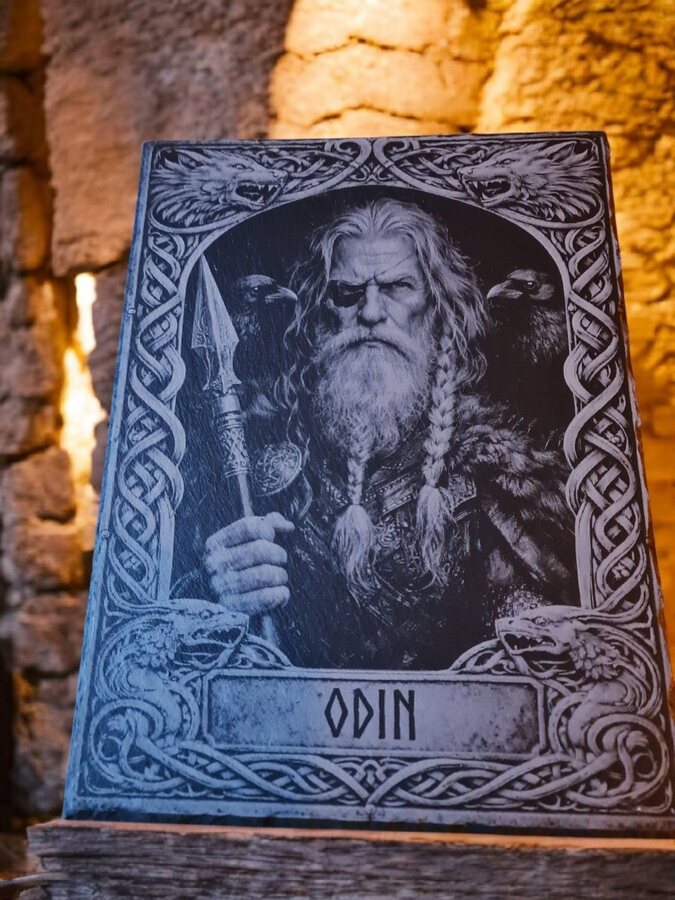
Around Thor both worlds gather the same names, yet the roles shift. In the sources Odin is the Allfather: god of wisdom, poetry, ecstasy and death, who sacrifices one of his own eyes at Mimir's well and hangs nine nights on the world tree to win the runes. An ambivalent, uncanny god – not a straightforward royal patriarch.
Frigg, Odin's wife, knows the fates but does not speak them; hers is the vain attempt to shield her son Baldr from death. Baldr, the shining, innocent god, dies by a sprig of mistletoe guided by Loki – and his death sets the road to Ragnarök in motion. Popular culture picks up these figures but reshapes them into supporting roles in a superhero family. In the Eddas it is precisely they who carry the deepest tragedy.
This shift is typical: what is a clear good-versus-evil order in the comic was, in the tradition, a web of guilt, fate and inevitability. No god is pure, none entirely safe – not even Odin, who sees his own end at Ragnarök coming and walks toward it all the same.
None of this is meant to belittle the cinema Thor. Superhero stories are our present-day saga craft, and the fact that millions of people even know the names Odin, Loki and Mjölnir is thanks to these tales. But Marvel is a reinvention, not a source: Loki belongs to the giants, Hel is his daughter, the hammer comes from a dwarves' forge, Thor wears a red beard and no winged helmet.
Knowing the differences costs you nothing – it gains you a second, older layer. And honestly: a thunder god who ends up with a too-short hammer handle because of a fly, and whose sons survive the end of the world, needs no adaptation to thrill us.
Loki is the son of the giants Fárbauti and Laufey and Odin's blood-brother (Prose Edda, Gylfaginning; Poetic Edda, Lokasenna). Hel is Loki's daughter with Angrboða, sibling to Fenrir and Jörmungandr. Mjölnir is forged by the dwarves Brokkr and Sindri (Skáldskaparmál 35). Thor is red-bearded, married to Sif; his children Magni, Modi and Thrud are attested, and Magni and Modi inherit the hammer after Ragnarök.
Loki as Thor's adopted brother, Hel as Odin's daughter, the metal „Uru" and the worthiness engraving on the hammer, Thor's blond hair and the winged helmet are modern additions. The winged helmet derives from Carl Emil Doepler's costumes for Wagner's „Ring" (Bayreuth 1876), not from Viking-age finds.
Thor · Thor's Hammer · The horned-helmet myth · The Norse pantheon.
Two short stanzas, scribbled onto a blank page of a church book – and yet the most precious record we have of the …
Read more →The market is full of "Norse" symbols: on pendants, T-shirts, tattoos and wall art. Many are sold as ancient and …
Read more →Every Easter she makes the rounds again: „Ostara, the Germanic spring goddess". Only – she is largely an invention of …
Read more →It is one of the most stubborn images of the „wild Viking“: the bearded warrior sipping his mead from the hollowed-out …
Read more →