Frija was the great goddess of the continental Germanic peoples, the same figure the Norse knew as Frigg, and Friday is named after her: it is the Germanic rendering of the Roman "day of Venus". She is attested in only a handful of sources – as "Friia" with her sister Volla in the Second Merseburg Charm, and as "Frea", the clever wife who outwits Godan in the origin legend of the Lombards. Here is what those texts actually say, what her name means, and why scholars still argue over whether Frija, Frigg and Freyja were once a single goddess.
Every week, millions of people say "Thank God it's Friday" without realising which god they are thanking. Friday is the day of a goddess: Old English frīgedæg, "Frīg's day". The same name hides in German Freitag, Dutch vrijdag and Swedish fredag. Of all the goddesses once worshipped by the Germanic-speaking peoples, she is the only one whose name still sits in every calendar on the shelf.
That is remarkable, because we know so little about her. There are no hymns to her from the continent, no temple descriptions, no inscribed images. What survives is a few lines in a healing charm, a tribal legend written down in Italy, a weekday name and a Norse namesake described in detail centuries later. Read carefully, those fragments still say a good deal – provided we keep apart what the sources state and what later generations read into them.
That is what we do here. We go through the evidence piece by piece, look at the name, test the link with the Norse Frigg and with Freyja, and tell you plainly where knowledge ends and interpretation begins.
Linguists reconstruct the goddess's name as Proto-Germanic *Frijjō. The asterisk means the form is never written down; it is worked out backwards from the later languages. From *Frijjō came Old High German Frīja (spelled "Friia" in the Merseburg manuscript), Lombard Frea, Old English Frīg and Old Norse Frigg. The hard gg in the Norse form is no accident but a regular sound change: a double -jj- hardened to -ggj- in North Germanic (and to -ddj- in Gothic), a development known as Holtzmann's law. Frija and Frigg are not merely similar names – they are one and the same word in two dialects.
You use its relatives every day. Gothic frijōn means "to love"; friend originally meant "one who loves"; German Friede ("peace") and English free belong to the same family. The Indo-European root seems to have meant "dear, one's own, belonging"; in Sanskrit priyā is "the beloved, the wife". Scholars explain the jump from "dear" to "free" through kin-based society: the free were those who belonged to the family, as opposed to the unfree. For the goddess, the most likely meaning is "the beloved" or "the (own) wife".
Freyja is a different story. Her name goes back to *frawjōn, the feminine of *frawjan "lord", found in Gothic frauja "lord" and Old High German frō. Freyja simply means "the Lady" – a close relative of German Frau, "woman, Mrs". That is the first hard fact in the whole debate: Frija/Frigg and Freyja carry etymologically different names. The similar sound is misleading.
The seven-day week with planetary names is not a Germanic invention. It spread through the Roman Empire: each day belonged to one of the seven "wandering stars" known in antiquity, and the sixth was dies Veneris, the day of Venus. When Germanic-speaking groups in contact with Rome – along the Rhine and Danube, in the army, through trade – adopted the week, they translated the gods into their own. Mercury's day became Woden's day (Wednesday), Jupiter's day became Thunor's day (Thursday), Mars's day became the day of Tiw (Tuesday). And Venus became Frija.
When exactly this happened cannot be pinned down. Most specialists think of the first centuries AD, long before any written texts in the Germanic languages. The process itself has a name: interpretatio germanica, the Germanic mirror of the Roman habit of equating foreign gods with their own. We explain the Roman side in our piece on the Interpretatio Romana, and the whole week from Sunday to Saturday in Germanic days of the week.
The choice is telling. Venus was no goddess of marriage but of love and desire. If you only know the later Norse Frigg, the dignified wife of Odin, you might have expected Juno. Choosing Venus, however, fits the meaning "the beloved" rather well. Perhaps the continental Frija had a stronger side of love and attraction than the late Norse texts reveal. That is plausible, not proven.
One more detail: in Old Norse, Friday was frjádagr. That form does not match Frigg neatly, whose genitive is Friggjar. Many linguists therefore regard the Norse weekday as a loan from West Germanic – the week apparently travelled north from the continent. In Iceland the day was later renamed by the Church and is still föstudagur, "fast day".
The single most important text for Frija is only a few lines long. In 1841 the historian Georg Waitz found two short Old High German spells written into a blank page of a theological manuscript in the cathedral library of Merseburg, entered there in the tenth century. Jacob Grimm published them in 1842. Ever since, they have been known as the Merseburg Charms – the only texts in the German language in which pre-Christian gods actually act.
The Second Charm is a horse-healing spell. It tells a tiny story: Phol and Wodan ride into the woods, and a foal (or horse) sprains its foot. One deity after another then tries to charm the injury away:
"thu biguolen Sinthgunt, Sunna era suister; thu biguolen Friia, Volla era suister; thu biguolen Wodan, so he wola conda …"
Then Sinthgunt charmed it, Sunna her sister; then Friia charmed it, Volla her sister; then Wodan charmed it, as well he knew how …Second Merseburg Charm, 10th-century manuscript, our own translation
Only Wodan succeeds, and the charm closes with the actual healing formula: bone to bone, blood to blood, limb to limbs, as if they were glued. First the mythic precedent, then the formula that transfers it to the patient – that is how such charms work. An Anglo-Saxon counterpart, in which Thor treats a wound, is the Canterbury Charm.
Three observations matter for Frija. First, she is taken for granted: the text never explains who Friia is, because its audience clearly knew. Second, she appears in a series of goddesses who can heal, though only Wodan succeeds – a rising sequence that belongs to the form of such texts rather than a ranking of the gods. Third, and most intriguing, she has a companion called Volla.
Volla means "fullness". And that very name turns up again in the North: Fulla is, in Snorri Sturluson's account (around 1220), Frigg's confidante. She carries Frigg's little box of ash wood, looks after her shoes and shares her secret plans. In the prose introduction to the Eddic poem Grímnismál, Frigg sends her servant Fulla to warn a king. A Friia with Volla in tenth-century Germany and a Frigg with Fulla in thirteenth-century Iceland is one of the strongest arguments that Frija and Frigg truly are the same goddess – not only by name, but by a shared mythic setting.
One mismatch remains: in Merseburg, Volla is a sister; in the North she is a servant. Whether that reflects a real difference in tradition or whether "sister" simply means a close companion cannot be decided. Equally open are the questions of who Phol is and whether "balderes" names the god Baldr or simply means "the lord's". The goddess Sunna from the same line has her own article: Sunna and Sól.
The second major witness comes from Italy. The Lombards, who invaded Italy in 568 and founded a kingdom there, told a story about where their name came from. It survives in a short Latin text of the seventh century, the Origo gentis Langobardorum ("Origin of the Lombard people"). Its king list runs to the reign of Perctarit (672–688), and it is preserved in manuscripts that mainly contain the Lombard law code of King Rothari (643).
The story runs like this. A small people called the Winnili lives on an island in the North, led by the brothers Ybor and Agio and their mother Gambara. The Vandals, under their leaders Ambri and Assi, demand tribute. The Winnili refuse, and war follows. The Vandals pray to Godan for victory. Godan replies that he will give victory to those he sees first at sunrise. Gambara, meanwhile, turns to Frea, Godan's wife.
Frea's advice is a trick. The Winnili women are to tie their hair in front of their faces like beards and appear with the men early in the morning, where Godan looks out of his window towards the east. Then Frea turns the bed in which her husband is sleeping so that his face points east, and wakes him. Godan sees the host and asks: who are these long-beards? Frea answers, in effect: since you have given them a name, give them victory too. Godan is bound by his own word; the Winnili win and are henceforth called Langobardi, "long-beards".
What makes the tale so precious is that Frea is no pale extra. She is the real strategist. She knows the rules her husband plays by and uses them against his original intention; the father of the gods is trapped by his own words. More on the people and on Wodan's name in our article on the Lombards.
And again there is a striking Norse parallel. In the prose introduction to Grímnismál, Odin and Frigg sit on the high seat Hliðskjálf and argue about their foster sons Agnarr and Geirröðr. Frigg intervenes secretly – through Fulla – and her intervention decides the outcome. In both stories the divine couple disagree about the fate of humans, and in both the goddess wins by cunning. Many scholars see an old shared narrative pattern here. That is interpretation, but well-founded interpretation.
The better-known version comes from Paul the Deacon, a Lombard monk and scholar who spent some years at the court of Charlemagne and wrote his Historia Langobardorum towards the end of the eighth century. In Book I, chapter 8, he retells the Godan and Frea story, very close to the Origo – but with a pointed remark: he introduces it as a "ridiculous fable" handed down by the ancients.
In the next chapter Paul explains that Godan is the same as Wodan, whom the Romans call Mercury and whom all the peoples of Germany worshipped as a god. He himself prefers a sober explanation of the Lombard name: they were called after their long, never-shaved beards.
That is a significant source situation. A Christian writer transmits a pagan story, distances himself from it – and preserves it precisely by doing so. For Frea it means that her name and her role as Godan's wife were still known in Lombard Italy in the seventh and eighth centuries, though as a tale about the distant past rather than living cult. Whether the Lombards ever honoured Frea at a sanctuary, no source says.
The Anglo-Saxons, whose ancestors crossed from the continent to Britain, knew the goddess too – but the traces are thin. Her name Frīg survives in the weekday frīgedæg, which became Friday. Old English also had an ordinary noun frīg, "love, affection", in poetry "embraces" – the "dear" family again.
No story about Frīg survives from England. What we do have are Christian explanations of the weekdays from around the year 1000. In one of Abbot Ælfric's saints' lives the devil appears in the shape of pagan gods, and the Latin names Mercury and Venus are rendered there as "Óþon" and "Fricg". Another Old English text explains that the sixth day is named after Venus, who is called Frycg "in Danish". These late forms with -cg already sound Norse – no surprise in an England where Danish settlers and kings lived. The old Anglo-Saxon goddess herself stays hidden behind the weekday.
Let us take stock of what binds Frija to the Norse Frigg. There is the name, identical by regular sound law. There is the role as wife of Wodan/Odin – in the South among the Lombards, in the North in the Edda and in Snorri. There is the companion Volla/Fulla. And there is the story pattern of a divine couple in which the goddess gets her way through cleverness. Taken together, these four points make Frija = Frigg one of the most solid results in the study of Germanic religion. Hardly any reference work doubts it.
What we know about the Norse Frigg, however, is far richer and far later. In Snorri she is the highest of the goddesses, knows the fates of all people though she does not speak them, and lives in her hall Fensalir. She is Baldr's mother, takes oaths from all things not to harm him, and weeps for him when he dies after all. These images were written down in thirteenth-century Iceland and cannot simply be projected back onto the continental Frija. Whether the Franks or Thuringians of the eighth century knew Frija as Baldr's mother, we simply do not know.
This is where it gets lively, because here begins a debate that has run since the nineteenth century. The North has two great goddesses: Frigg, Odin's wife from the family of the Æsir, and Freyja, daughter of Njörðr from the family of the Vanir (more in Æsir and Vanir). The sources keep them clearly apart. In Lokasenna both appear one after the other and are insulted separately by Loki. Snorri lists them as two different goddesses. And yet they are suspiciously alike.
The arguments for a common origin run roughly like this:
The counter-arguments are just as serious. The names, as shown above, are etymologically distinct: "the beloved" versus "the Lady". Freyja is closely bound up with the Vanir, with fertility, with her afterlife field Fólkvangr and with the magic of seiðr; Frigg with marriage, motherhood and foreknowledge. And the absence of Freyja's name on the continent proves little, because hardly any divine names at all survive from there. Building a merger on missing sources means building on silence.
The historian of religion Stephan Grundy gathered the arguments of both sides in an essay ("Freyja and Frigg", 1996) and expressly called the problem a difficult one. Britt-Mari Näsström argued in her book on Freyja that the Norse goddesses could be understood as manifestations of one great goddess – a reading others consider too far-reaching. The honest balance: Frija and Frigg are the same goddess. Whether Freyja goes back to the same root is open. Anyone who sells you a certain answer is selling opinion.
At this point a sober look at the gaps pays off. We know of no sanctuary expressly dedicated to Frija, no festival in her name, no description of sacrifice, no image bearing her name. The Old Saxon baptismal vow of the ninth century, in which converts had to renounce Thunaer, Woden and Saxnot, does not mention her. Tacitus, who described Germanic religion around AD 98, has no goddess of this name; he names others, such as Nerthus.
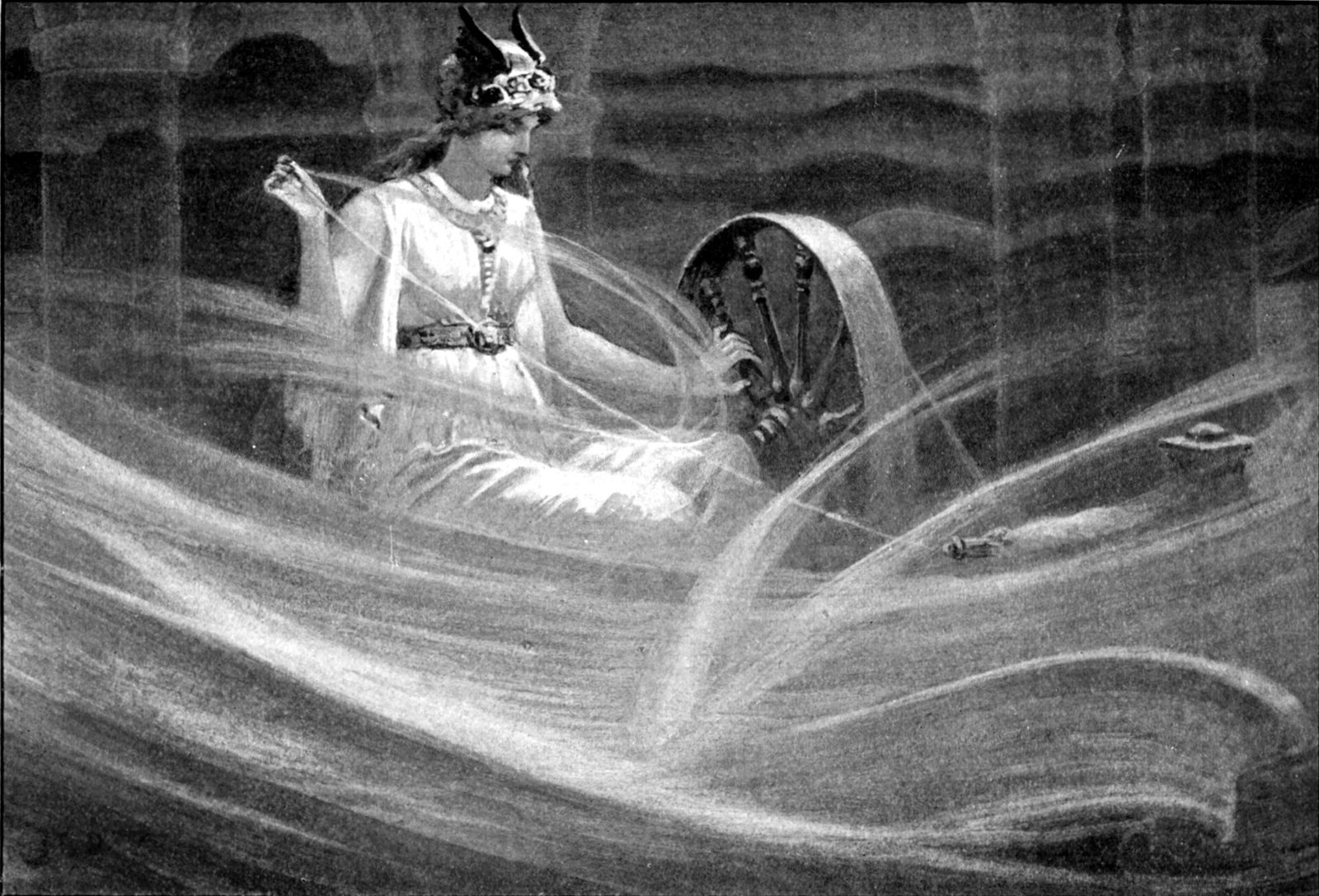
Since Jacob Grimm's "Deutsche Mythologie" (1835), scholars have tried to fill this gap with folklore. Figures such as Frau Holle or Perchta, who watch over spinning, household and winter, were long seen as late descendants of an ancient goddess like Frija. Research today is very cautious here: almost a thousand years lie between the Merseburg charm and the folk tales recorded in the nineteenth century, and no direct line can be demonstrated. The link between Frigg and the distaff is similar – John Charles Dollman's well-known painting of Frigg spinning is a twentieth-century image, and the motif rests more on modern readings than on old evidence.
The same caution applies to the Matronae of the Rhineland's votive stones: same region, same era in which the week was adopted, but not a single inscription names Frija.
That Frija means anything to anyone today is largely thanks to the nineteenth century. Jacob Grimm collected the evidence for Frigg, Frea and Frija in his "Deutsche Mythologie" and thereby established the idea of a common Germanic goddess. A few years later he published the newly found Merseburg charms – a sensation for the young discipline of German philology, which finally had a divine name in Old High German.
Richard Wagner drew on this scholarship. In his "Ring of the Nibelung", Wotan's wife is called Fricka – a goddess of marriage who holds her husband strictly to contracts and morals. The name form leans on Grimm; the character is Wagner's own creation. On the opera stage, then, you meet a blend of the Eddic Frigg, learned reconstruction and nineteenth-century theatre.
For us in the workshop in Alsdorf, Frija is especially appealing because she belongs to the continent, to the world of the continental Germanic gods. She lives on in a word everyone knows – which is more than most of her fellow gods can say.
Who was the goddess Frija? Frija was a goddess of the West Germanic peoples, the continental counterpart of the Norse Frigg. She is attested in the Second Merseburg Charm, in the Lombard origin legend (as Frea, Godan's wife) and in the weekday name Friday.
Is Friday named after Frigg or Freyja? After Frija/Frigg. Old forms such as Old English frīgedæg and Old High German frīatac presuppose the name *Frijjō; Freyja's name has a different origin.
What does the name Frija mean? It goes back to Proto-Germanic *Frijjō and most likely means "the beloved" or "the wife". It is related to friend, free and German Friede, "peace".
Are Frigg and Freyja the same goddess? In the Norse sources they are two different goddesses. Whether they descend from one older goddess is an unresolved scholarly question.
Who is Volla in the Merseburg Charm? Volla is named there as Frija's sister. Her name means "fullness"; in the North she corresponds to Fulla, Frigg's confidante.
What does Frija have to do with the Lombards? According to the Origo gentis Langobardorum and Paul the Deacon, Frea taught the Winnili a trick by which Godan gave them the name "long-beards" and victory in battle.
For courage. For remembrance. For legends that live on.
Wodan, Donar & Ziu · Germanic Weekdays · The Merseburg Charms · The Matronae · Germanic Religion.
All Gods & Goddesses articles →
Heimdall is the watchman who never sleeps – the god who hears the grass grow and the wool sprout on the sheep. Born of …
Read more →Not every dead man came to Valhalla. Most people – all who died of sickness and age – went to Hel. She is the mistress …
Read more →