Hercules Magusanus was the chief god of the Batavi, a Germanic people of the Rhine delta between the Rhine and the Waal, worshipped in Roman times under the name of Hercules. Around twenty inscriptions, the sanctuaries of Empel and probably Elst, and coins of the emperor Postumus bear witness to him. Whether he was the thunder god Donar in Roman dress remains a scholarly hypothesis. Here is what the stones actually say, and where interpretation begins.
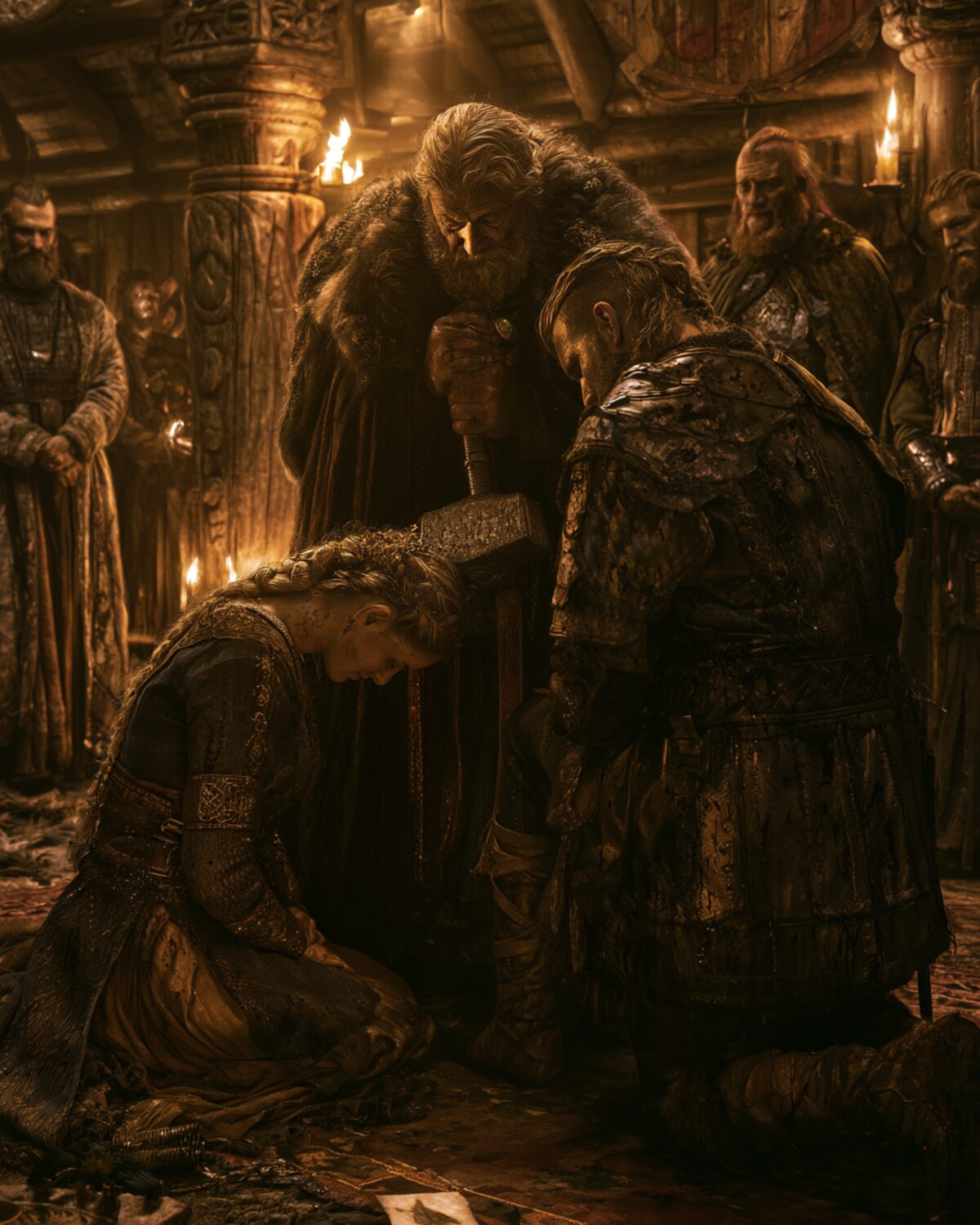
Picture an altar lifted out of the river clay of the Rhine delta. A naked strongman, club in hand, lion pelt slung over his arm, a neat Latin dedication below. Any classicist would call it at once: Hercules, son of Zeus, twelve labours, the Nemean lion. Then comes a word that appears in no Greek myth at all: Magusanus.
That one word changes everything. It tells us that the people who set up the stone were not thinking of the hero of Thebes but of a god of their own. Hercules Magusanus was the chief deity of the Batavi, a Germanic people settled between the Rhine and the Waal, roughly where Nijmegen, Tiel and the Betuwe lie today. From our workshop in Alsdorf near Aachen that is a short drive north, which makes him, for us, the strong god of the wider neighbourhood rather than a footnote in a textbook.
In this article we follow the evidence: inscriptions from the Betuwe to Scotland, the temples of Empel and Elst, a name that still puzzles linguists, the coins of an emperor who ruled from Cologne, and the big question everyone asks: is Donar hiding under that lion skin?
No Batavi, no Magusanus. Tacitus writes in his Germania (chapter 29) that they were originally a branch of the Chatti who, after a quarrel at home, moved to the "island" in the Rhine, meaning the land between the Rhine and the Waal. Archaeology cannot confirm that origin story. It rather points to a mixed population in which older inhabitants of the delta and newcomers grew together.
What is certain is their special deal with Rome. The Batavi paid no ordinary tribute. Instead they supplied soldiers, and lots of them. Tacitus describes them, loosely rendered, as weapons and armour that Rome kept in reserve for war. Batavian horsemen were famous specialists who could swim rivers with their mounts in full kit. They formed their own cohorts and alae (cavalry units) and for a long time made up a good part of the early emperors' Germanic bodyguard.
For religion this matters enormously. Almost every Batavian family had a son, brother or father in the Roman army. A man who served twenty-five years came home with pay, citizenship and memories from half of Europe, or he did not come home at all. A god of strength, protection and safe return suited that society the way a club suits Hercules. Their western neighbours, the Cananefates, lived under very similar conditions.
A Germanic god appearing under the name Hercules is neither an accident nor a mix-up. Romans translated foreign gods into their own pantheon. Tacitus actually uses the phrase interpretatio Romana, Roman interpretation, in Germania chapter 43. We explain the method in our article on interpretatio Romana.
Hercules turns up surprisingly often among the Germanic peoples. In Germania 3 Tacitus reports that they claimed Hercules had visited them, and that they sang of him as the first of all brave men when going into battle. In chapter 9 he says they worshipped Mercury above all, while Hercules and Mars were placated with animal sacrifices. And in the Annals (II, 12) the enemies of Germanicus gathered in AD 16 in a forest sacred to Hercules.
The Batavi went one step further and set their own god's name beside the Roman one. The result is a double name of the kind we also know from Mars Thingsus. The Roman name supplies the category: strength, protection, victory. The native epithet ties the god to one people and one landscape. Tellingly, on the oldest stone the native name even comes first.
Hercules Magusanus is one of the best-attested gods of Lower Germany. Depending on how you count, there are around twenty inscriptions. The archaeologist Karim Mata lists at least 21, fifteen of them from the Lower Rhine. On top of that come new finds from Herwen-Hemeling that have not yet been fully published. Most inscriptions date to the second and third centuries AD and were set up by soldiers, veterans, officials and families.
This altar is a stroke of luck in several ways. It shows that the cult belonged not only to ordinary soldiers but to the political leadership. It proves the pairing of Hercules and Magusanus as early as the first century. And with Flavus' father Vihirmas it gives us a native name no Roman would ever have invented. One correction to many popular accounts, our own earlier version included: Flavus does not call himself a priest but the chief magistrate. Among the Batavi, of course, religion and politics were never far apart.
More stones come from the Rhineland. At Bonn an optio of the First Legion Minervia dedicated an altar for the welfare of the imperial house in AD 226 (CIL XIII 8010), and a second Bonn dedication is known too. Cologne-Deutz produced CIL XIII 8492, Wardt-Lüttingen near Xanten another altar, and Xanten itself an inscribed limestone statuette. In the Netherlands there are stones from Waardenburg, Houten, Malburgen near Arnhem and Westkapelle on Walcheren, the same coast where the goddess Nehalennia had her altars.
The Malburgen stone (CIL XIII 8705) is touchingly human. A married couple dedicated it to Hercules Magusanus and a goddess called Haeva, pro natis, for their children. Here the strongman stands not on the battlefield but at the family table, next to a goddess whom scholars often link with fertility and family. It brings to mind the Matronae further south in the Rhineland, who likewise watched over house and offspring.
And then the god travelled with his soldiers. In Scotland, railway builders on the Edinburgh–Glasgow line found an altar in 1841 near Mumrills fort on the Antonine Wall (RIB 2140). It was set up by Valerius Nigrinus, duplicarius (a junior officer on double pay) of the Ala Tungrorum, and is dated roughly AD 140–165. Today it is in the National Museum of Scotland in Edinburgh. In Rome, CIL VI 31162 records a dedication from the circle of the equites singulares Augusti, the mounted imperial guard, dated by its text to AD 219. Several inscriptions come from Dacia in modern Romania, for instance from Gherla and Alba Iulia. Add to that four arm rings naming the god from Tongeren, Bonn, Cologne and Neuss.
In 1986 an amateur archaeologist noticed an unusual number of Roman and older metal finds on a field near Empel, today part of ’s-Hertogenbosch. From 1989 to 1991 a team from the Vrije Universiteit Amsterdam led by Nico Roymans and Ton Derks excavated the site. What came to light is now one of the key cult places of the Roman Netherlands.
The sanctuary stood on a low sand ridge above the river landscape of the Meuse. Long before the Romans it was already a place of offerings: Late Iron Age finds such as Celtic coins, belt hooks, brooches and sword fragments go back to the first century BC. In the Roman period a Gallo-Roman temple was built, a square core (cella) surrounded by a colonnade. According to the Dutch portal romeinen.nl the cella measured about 12 × 12 metres and the ambulatory about 19 × 21 metres, while a wall enclosed a precinct of roughly 50 × 50 metres with a gatehouse on the west side.
The finds run into the hundreds, among them hundreds of brooches and many Celtic and Roman coins, which Roymans and Jan Aarts examined in a separate study. One small bronze plaque stands out (AE 1990, 740): Iulius Genialis, a veteran of the Tenth Legion Gemina stationed at Nijmegen, dedicated it to Hercules Magusanus. There was also a bronze statuette of a drinking Hercules (Hercules bibax), finger rings, horse harness and a Roman cavalry helmet.
By Roman standards that is odd. Romans dedicated weapons mostly as spoils of victory, not their own kit on retirement. Weapon offerings look more like traditions from beyond the frontier. Think of the great army and weapon sacrifices in Denmark, though those are mostly later and follow a different logic, since what went into the bogs there was largely captured booty. Empel sits in between: a native custom, carried out by men in Roman service, for a god with a Roman name.
In the third century the temple burned down. Its stones were later removed, and according to vici.org parts were reused in a late Roman fortification at Kessel. Honesty requires one caveat: whether Empel belonged to Hercules Magusanus alone is now questioned by some, because Roman temples often housed several gods. The inscription, the statuette and the weapon offerings still make him the most likely main deity.
Elst lies in the Over-Betuwe between Arnhem and Nijmegen, right in the old Batavian heartland. When its Grote Kerk was badly damaged in the Second World War, the destruction unexpectedly opened a window into the ground. Post-war investigations uncovered the foundations of a large Gallo-Roman temple, which the archaeologist J. E. A. Th. Bogaers published in 1955 in his study of the Gallo-Roman temples at Elst.
There were at least two building phases. A first stone temple was built around the middle of the first century AD on a spot that, according to Roymans, had already been used for cult in the Late Iron Age. A much larger rebuild followed. Its dimensions are given as about 31 × 23 metres within a walled precinct, which puts Elst among the largest temples north of the Alps. Livius.org cites a dendrochronological date after AD 96 for the rebuild and suspects imperial sponsorship. Traces of destruction have been linked to the Batavian revolt of 69/70.
No inscription tells us whose temple it was. Finds include a fragment of a statuette with a club and animal bones interpreted as the remains of a suovetaurilia, a Roman sacrifice of pig, sheep and bull. That Hercules Magusanus was worshipped here is a well-founded scholarly hypothesis, nothing more. A church was later built on the ruins, probably in the eighth century, but that does not prove any continuity of cult.
Together with Empel and Kessel, Elst is one of three cult sites in Batavian territory, all with pre-Roman roots. Kessel on the Meuse is a special case: Late La Tène weapons and human bones found there have been connected by Roymans with Caesar's massacre of the Tencteri and Usipetes in 55 BC. A place of slaughter may later have become a place of worship. It is a well-argued but not undisputed reading.
Research on Magusanus is very much alive. At Herwen-Hemeling in Gelderland, close to where the Rhine and Waal split, the consultancy RAAP uncovered a Roman sanctuary in a clay quarry from 2021, presented to the public in 2022. Excavators found at least two temples, a well and several altars, apparently set up by officers. Among the gods named are Jupiter-Serapis, Mercury and Hercules Magusanus. The finds are going to Museum Het Valkhof in Nijmegen, and the full scholarly publication is still to come. So every count of inscriptions is provisional.
The name is a riddle with several serious answers on the table. None of them is proven.
The Germanic "strength" theory. In 1977 the linguist Norbert Wagner derived the name from a Germanic stem meaning "strength, might", related to Gothic mahts and German Macht. Magusanus would then mean something like "the one who has strength", "the mighty one". Günter Neumann supported this reading, and it fits Hercules perfectly.
The "young man" theory. Germanic has a second, similar-sounding word: *maguz, "boy, young man, son", attested in Gothic magus ("boy") and Old Norse mǫgr ("son"). A god called "the youth, the young strong one" is linguistically possible and would also suit the hero Hercules. This too is reconstruction.
The Celtic theories. Rudolf Much, and before him Theodor Mommsen, thought of Celtic magos, "field, plain", as in Noviomagus (Nijmegen), the main Batavian centre. Léon Fleuriot and later Lauran Toorians (2003) proposed a Celtic form *magu-seno-, "old young man" or "old servant". Toorians argues that the Batavi were linguistically mixed and Germanicised a Celtic name.
A northern parallel is worth a look. Thor's son is called Magni, "the strong one", and Thor's belt of strength is the megingjörð. Both belong to the same word family around "might, ability". That proves no direct link to Magusanus, but it shows how naturally the vocabulary of strength clings to a thunder god.
In 260 the general Postumus seized power on the Rhine and founded the so-called Gallic Empire, a breakaway state made up of Gaul, the Germanies, Britain and for a time Spain. He ruled until 269; the Gallic Empire lasted until 274. His power rested on the Rhine legions and their auxiliaries, men from the Rhine delta among them.
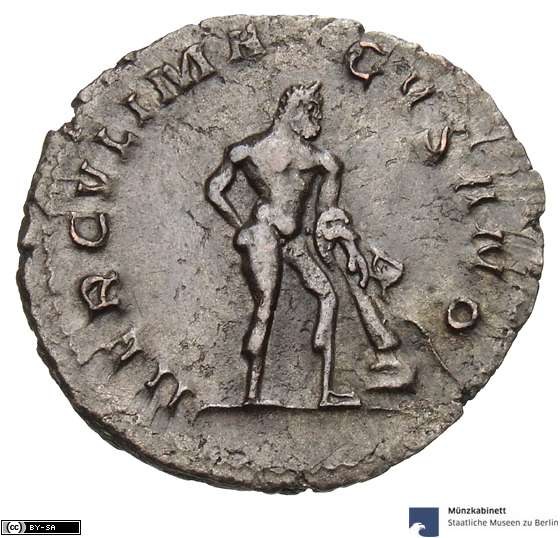
His coins show it. Around 261 Postumus issued pieces with the reverse legend HERCVLI MAGVSANO: Hercules stands with one hand on his hip, leaning on his club, the lion skin draped over it. There is a rare antoninianus (RIC 68) as well as double sestertii. Today the mint is usually placed at Cologne. How rare these coins are is shown by one auction catalogue, according to which the numismatist Schulzki knew of only eleven specimens of the antoninianus.
Alongside them are coins reading HERC DEVSONIENSI, for a Hercules of Deuso. Nobody knows where Deuso was; suggestions include Cologne-Deutz, Duisburg and Doesburg. Jerome's chronicle mentions, under the year 373, Saxons defeated at Deuso in Frankish territory. The emperor deliberately combined regional Hercules figures of the Lower Rhine. Honour your soldiers from the Waal and the Rhine, and you honour their god as well.
In AD 69, in the middle of the civil war after Nero's death, the Batavi rose under Julius Civilis, a nobleman of their royal line, a Roman citizen and an experienced officer. Tacitus describes the revolt in detail in books four and five of his Histories. For a while legionary fortresses on the Lower Rhine fell, among them Vetera near Xanten.
Tacitus sets the opening scene in a sacred grove (Histories IV, 14). Civilis invites the leading men of his people there under the pretext of a feast and swears them to the fight. Tacitus does not say which god lived in that grove. That it was Magusanus is an obvious guess, but only a guess. You can read more about such places in our piece on sacred trees and groves.
Another religious figure Tacitus does name: Veleda, the seeress of the Bructeri on the Lippe. She had foretold a Germanic victory, and after the surrender of Vetera the captured legionary legate Munius Lupercus was sent to her as a gift (Histories IV, 61). This was a war with a strong religious charge.
The end of the revolt in AD 70 brought no annihilation but a fresh start. The Batavi remained Rome's reservoir of horsemen, and in the following decades the great stone temples went up: Elst was rebuilt on a larger scale and Empel received its Gallo-Roman temple. Scholars, above all Nico Roymans, read the Hercules cult as part of a newly shaped Batavian identity: loyal to Rome, proud of its warrior tradition and protected by a god who embodied both.
This is the question that brings many readers here. The honest answer: it is a widespread and well-argued hypothesis, not an established fact.
The case for: Roman writers seem to have used Hercules regularly for a native Germanic god of strength and combat. The Germanic thunder god, Thor in the North and Donar on the continent, is the god of bodily strength, the giant-slayer, the protector of humankind. Jan de Vries saw exactly that strength as the link. Rudolf Simek suggests in his dictionary that Magusanus may originally have been an epithet of the thunder god. Hammer and club, fights against monsters, a rough, hard-drinking character: the likeness between Thor and Hercules struck early scholars too.
The case for caution: In the days of the week, Donar was matched not with Hercules but with Jupiter, so that dies Iovis became Thursday, Donnerstag in German. "Hercules equals Donar" is therefore not the only Roman-Germanic translation of the thunder god. We also have not a single myth about Magusanus from the Roman period, no hammer, no goats, no thunder. His images follow the Roman Hercules type completely. And at Malburgen he appears beside the goddess Haeva as a family god, a role we do not find for Thor in the thirteenth-century sources.
There is a third way of looking at it. Magusanus may have been an independent tribal god of the Batavi whose profile overlapped with Hercules and perhaps shared features with the later Donar without being identical to him. Germanic religion was regional, as the Matronae, Nehalennia or Tiwaz show. A single, unified pantheon stretching from the Waal to Iceland is a modern idea fed largely by Snorri's thirteenth-century Edda.
Hercules Magusanus is one of those rare cases where Germanic religion speaks to us from its own time: through stones people set up with their own hands, through temples where they laid down their weapons, through coins that passed through Cologne and Bonn. No saga, no skald, no medieval monk stands in between. That makes him precious, and it demands modesty, because these sources tell us a great deal about who worshipped the god and very little about the stories told of him.
When we engrave motifs from the Germanic peoples of the Rhineland on slate in our Alsdorf workshop, that same question is always in the room: what is attested, and what is interpretation? With Magusanus the answer is clear. Attested are a name, a people, a landscape, a lion skin and a club. Everything else is research, and it stays exciting for as long as excavators keep cutting through the clay of the Betuwe.
Who was Hercules Magusanus? A Germanic god, above all the chief god of the Batavi in the Rhine delta, worshipped in the Roman period under the name of Hercules. He is attested by around twenty inscriptions, temples and coins.
What does the name Magusanus mean? Nobody knows for sure. Germanic readings such as "the mighty one" or "the young man" compete with Celtic derivations such as "old young man" or a link to Noviomagus (Nijmegen).
Where was Hercules Magusanus worshipped? Mainly between the Rhine, Waal and Meuse, with sanctuaries at Empel and probably Elst and altars from Bonn to Walcheren. Soldiers carried his cult as far as Scotland, Rome and Dacia.
Is Hercules Magusanus the same as Donar or Thor? That is a common scholarly hypothesis but not proven. He may also have been an independent tribal god whose strength profile fitted Hercules.
Why is Hercules Magusanus on Roman coins? Emperor Postumus of the Gallic Empire struck coins reading HERCVLI MAGVSANO around 261, probably at Cologne, to honour the god of his important Lower Rhine troops.
What was found at the temple of Empel? Hundreds of offerings, including coins, brooches, weapons, horse gear, a cavalry helmet, a Hercules statuette and a veteran's bronze plaque dedicated to Hercules Magusanus.
For courage. For remembrance. For legends that live on.
Donar · Interpretatio Romana · The Batavi · The Matronae · Germanic Religion.
All Gods & Goddesses articles →
Loki fits no box. Now he saves the gods with a trick, now he plunges them into ruin. It is exactly this doubleness that …
Read more →The strongest god has two sons: Magni („the mighty") and Modi („the brave / wrathful"). They are more than minor …
Read more →In the North, the moon is a man. Máni, brother of the sun, steers his heavenly body across the sky night after night …
Read more →