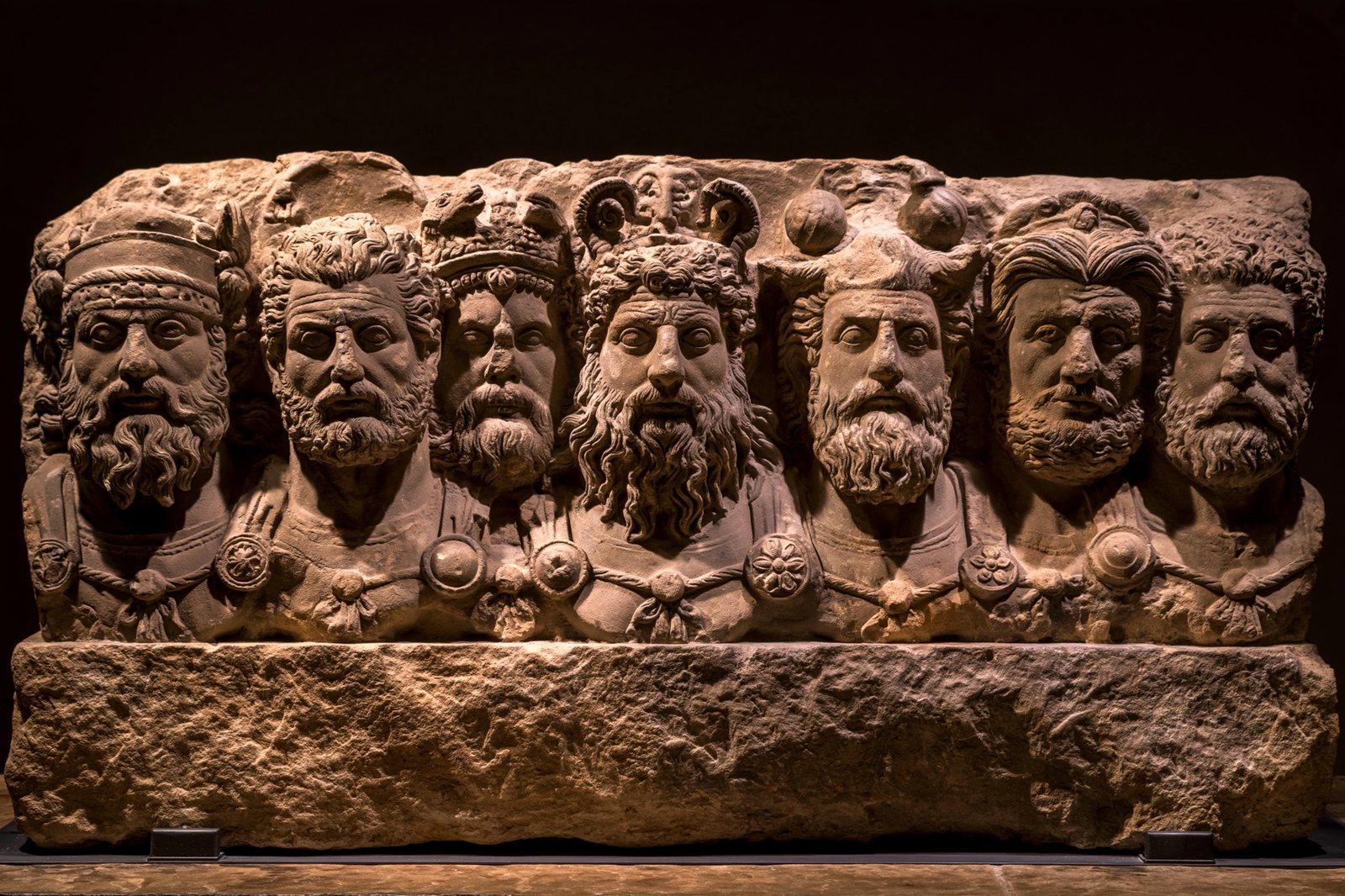
The English days of the week come from Rome's planetary week, with the Roman gods swapped for Germanic ones: the day of Mars became the day of Tiw (Tuesday), the day of Mercury became Woden's day (Wednesday), Jupiter's day became the thunder god's day (Thursday), and the day of Venus went to the goddess Frig (Friday). Sunday and Monday simply kept the sun and the moon. Saturday is the odd one out: in English it still belongs to the Roman Saturn, and no Germanic deity was ever involved. German, Icelandic and Bavarian dialects took some surprising detours along the way.
You say their names every day without a second thought. Monday meetings, Friday drinks, a parcel arriving on Thursday. Yet the week is the most-used piece of religious history any of us owns. No runestone, no bog find, no Edda manuscript is "read" as often as the seven words printed at the top of every planner – and four of them name gods who were still receiving offerings some fifteen hundred years ago.
In our engraving workshop in Alsdorf, near Aachen, weekday questions come up all the time. Is Thursday really Thor's? Is Friday named after Freya? Why does German call Wednesday "Mittwoch", plain old "midweek"? The real answers are better than the internet versions, and they take us from Roman astrologers via Gothic missionaries to an Icelandic bishop who struck the gods out of the calendar in the twelfth century. Let's walk through the week from the start.
The Germanic peoples did not invent the seven-day week. They borrowed it from the Roman Empire, where it was itself a fairly recent arrival. Two roots had merged there: the Jewish week with its Sabbath, and Hellenistic astrology, which assigned each day to one of the seven "wandering stars" visible to the naked eye. Those seven were the five classical planets plus the sun and the moon.
The order of the days looks random, but it rests on neat astrological arithmetic. Ancient astronomers ranked the seven bodies by their supposed distance from Earth: Saturn, Jupiter, Mars, Sun, Venus, Mercury, Moon. Each hour of the day was ruled by one of them in turn, and the ruler of the first hour gave its name to the whole day. Since a day has 24 hours, and 24 divided by 7 leaves a remainder of 3, the ruler of each new day's first hour sits three places further down the list. The result is exactly our sequence: Saturn, Sun, Moon, Mars, Mercury, Jupiter, Venus. The Greek historian Cassius Dio explained the system in the early third century (Roman History, book 37) and credited it to the Egyptians.
The Latin names were dies Saturni, dies Solis, dies Lunae, dies Martis, dies Mercurii, dies Iovis, dies Veneris. You can still hear them in French mardi, mercredi, jeudi, vendredi and Italian martedì, mercoledì, giovedì, venerdì. These were the names that reached the Germanic neighbours along the Rhine and the Danube.
The Germanic peoples did not simply pronounce the Latin names the way one adopts a loanword. They translated them by meaning. For every Roman god they picked the native god who seemed most alike. Scholars call this interpretatio germanica, the mirror image of the interpretatio Romana, in which Roman writers labelled foreign gods with Roman names.
Tacitus gives us the Roman side of the story. In his Germania (chapter 9, around AD 98) he says, in substance, that of all the gods they worship Mercury most, even offering him human victims on certain days, while Hercules and Mars are appeased with animal sacrifices. He names no Germanic gods. But that Mercury means Woden and Mars the old sky and war god is strongly suggested by the weekdays themselves. In the eighth century the Lombard historian Paul the Deacon says it outright: Wodan is the one the Romans call Mercury.
There is a nice wrinkle here. Tacitus mentions Hercules, not Jupiter, and scholars have often linked that Hercules with the thunder god – the club-wielder matched with the hammer-bearer. In the week, however, the thunder god is equated with Jupiter. The equations were not carved in stone. Look at the weapon and you get Hercules; look at the lightning and you get Jupiter.
When the Germanic peoples adopted the week is unknown. Only the outer limits are clear: after the first century, when the planetary week became common in the empire, and before Christianisation, since missionaries would hardly have written pagan gods into the calendar. Because English, Frisian, German and the Scandinavian languages share the same equations, the translation is usually thought to predate the Anglo-Saxon migration to Britain in the fifth century. The third or fourth century, amid close contact between Germanic warriors and the Roman army on the Rhine, is a common working assumption. It is plausible – but it is an assumption, not a dated find.
| Latin | God/body | Old High German | Old English | Old Norse | German today | English today |
|---|---|---|---|---|---|---|
| dies Solis | Sun | sunnūntag | sunnandæg | sunnudagr | Sonntag | Sunday |
| dies Lunae | Moon | mānetag | mōnandæg | mánadagr | Montag | Monday |
| dies Martis | Mars → Tiwaz/Tiw | ziostag | tīwesdæg | týsdagr | Dienstag | Tuesday |
| dies Mercurii | Mercury → Woden | mittawehha | wōdnesdæg | óðinsdagr | Mittwoch | Wednesday |
| dies Iovis | Jupiter → Thunor/Donar | donarestag | þunresdæg | þórsdagr | Donnerstag | Thursday |
| dies Veneris | Venus → Frija/Frig | frīatag | frīgedæg | frjádagr | Freitag | Friday |
| dies Saturni | Saturn / Sabbath | sambaztag, sunnūnāband | sæternesdæg | laugardagr | Samstag, Sonnabend | Saturday |
The easy ones first. For Sunday and Monday nothing needed reinterpreting. Sun and moon were heavenly bodies for the Germanic peoples too, and both had personalities. In the North they are Sól and Máni, who in Snorri's Edda are chased across the sky by wolves. The Second Merseburg Charm, written down in the tenth century, names a Sunna as the sister of one Sinthgunt.
One charming difference from Latin: in the Germanic languages the sun is feminine and the moon masculine, the reverse of Sol and Luna. Whether the day names should be read as "day of the goddess Sunna" and "day of the god Máni", or simply as "sun day" and "moon day", cannot be settled. First and foremost they are translations of dies Solis and dies Lunae.
The Roman dies Martis belonged to Mars, god of war. In his place the Germanic peoples set the god linguists reconstruct as Tiwaz. His name is related to Greek Zeus and Latin deus; originally he was probably a sky god who later lost ground. In the North he is Týr, the one-handed god who left his hand in the jaws of the wolf Fenrir. He gives English its Tuesday (Old English tīwesdæg), Old Norse its týsdagr, and Old High German its ziostag, the day of Ziu.
That old name still lives on in southern German dialects. Travel through Swabia or Switzerland and you will hear Zischtig or Zeischdig – nothing other than Ziu's day. Standard German, however, chose a different word: Dienstag. And this is where it gets interesting.
"Dienstag" has nothing to do with Dienst, "service". The word spread from the Lower Rhine; the Middle Low German form is dingesdach, and Dutch still says dinsdag. Behind dinges- many see a god called Thingsus, and we actually know him from an inscription. At Housesteads on Hadrian's Wall, a stone pillar was found in 1883 that Germanic soldiers from the Tuihanti tribe – from the area of modern Twente in the Netherlands – had dedicated to Mars Thincsus and two goddesses called Beda and Fimmilena. The dedication is generally dated to the third century.
Read Thingsus as "god of the thing", the assembly where law was spoken and disputes settled, and a coherent picture emerges: a Mars who protects law as well as waging war. That fits remarkably well with Týr, who in Norse tradition is bound up with oaths and pledges. Many scholars therefore take Thingsus to be a byname of Tiwaz.
Then there is Bavaria and Austria. There, older dialect called Tuesday Ertag or Erchtag. That word is neither Tiwaz nor Thingsus but a visitor from the east. The usual explanation traces it to Greek Áreos hēméra, "day of Ares", carried to the Bavarians via Gothic. The Goths had accepted Arian Christianity through Wulfila in the fourth century and were in close contact with the Greek-speaking world. A Bavarian weekday arriving by way of Constantinople is one of the finest twists in German word history. The Gothic route is not proven, though; Gothic weekday names themselves are barely recorded.
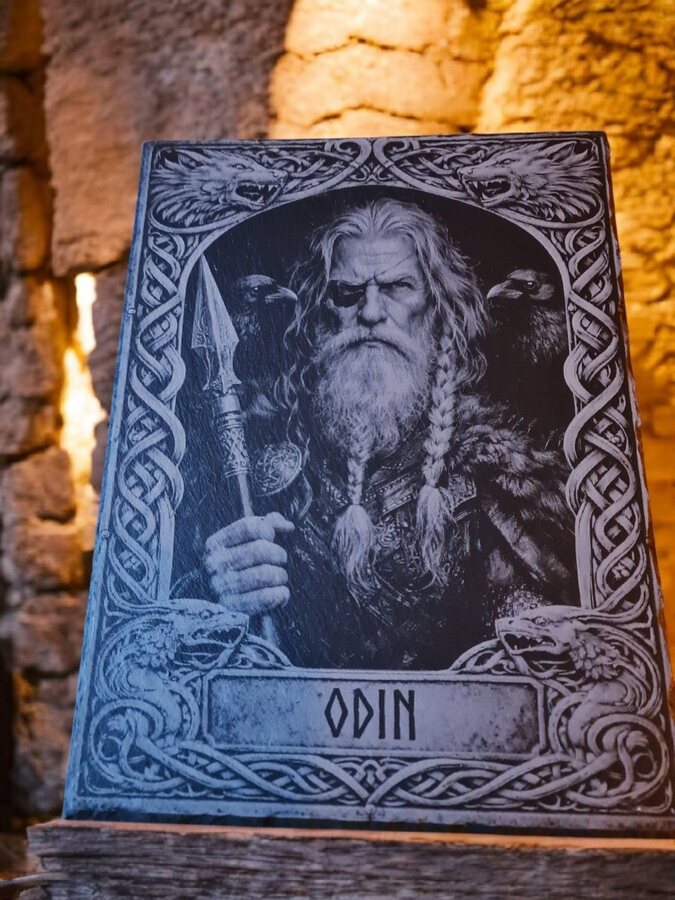
Mercury was the god of merchants, travellers and messengers, a guide of souls and a clever head. The Germanic peoples set Woden in his place – Odin in the North: wanderer, god of the dead, of poetry and of runes. That gave us Woden's day, and in English it is alive and well: Wednesday, Old English wōdnesdæg. The silent "d" that trips up every schoolchild is a fossil of the god's name. Dutch says woensdag, Low German kept Wodensdach or Wunsdag, and all of Scandinavia says onsdag, from Old Norse óðinsdagr.
Only standard German lacks him. Since Old High German times it has used Mittwoch, recorded from the tenth century as mittawehha or mittiwehha, among others in the works of Notker. It is a loan translation of Church Latin media hebdomas, "the middle of the week". Behind it lies a Church practice of simply counting the days and so avoiding the gods. Missionaries in southern Germany seem to have deliberately avoided the name of the chief pagan god. With the thunder god and Frija they were less thorough – perhaps because Woden was seen as the main adversary.
The Roman dies Iovis belonged to Jupiter, king of the gods and hurler of lightning. The Germanic peoples chose their thunder god: Donar on the continent, Thunor in England, Thor in the North. The name is transparent; it simply means "thunder". Old High German has donarestag (Notker writes toniristag), Old English þunresdæg, Old Norse þórsdagr. Hence German Donnerstag, English Thursday, Swedish and Danish torsdag. English Thursday, by the way, owes its shape partly to Norse influence: the native Old English form was "Thunresday".
Bavaria took its own route here too. The old Bavarian name for Thursday was Pfinztag, from Greek pémptē hēméra, "fifth day", probably also via Gothic. It counts the days, as the eastern Church did. Pfinztag and Ertag are therefore seen as traces of an eastern Christian influence in the Bavarian area, though the exact route is still debated.
The day of Venus, the Roman goddess of love, went to the goddess Frija. Old High German frīatag, Old English frīgedæg, Old Norse frjádagr. In the North Frija is called Frigg: Odin's wife, Baldr's mother, a goddess of the household, of marriage and of knowing what fate will bring.
Which brings us to the most common weekday mistake of all: Friday is not named after Freya. The forms in the old languages point to Frija/Frigg. The name Freyja means "lady" and is a different one, even though the two goddesses share some features and scholars have debated since the nineteenth century whether they were originally a single figure. Why Frija rather than Freya became Venus, even though Freya would make the better love goddess, is a story of its own. We tell it in full in Freya or Frigg – whose day is Friday?
Now the day with the most legends attached. In Latin it was dies Saturni, Saturn's day – and in English it still is: Saturday, Old English sæternesdæg. That is remarkable. Here nothing was translated; the Roman god was simply taken over. Apparently no Germanic god seemed a good fit.
German has two words, and neither has anything to do with Saturn. Samstag comes from Old High German sambaztag, which goes back to a nasalised popular Greek form sambaton and ultimately to Hebrew Shabbat, the Jewish day of rest. It is the same route we already saw with Ertag and Pfinztag: from the Greek east, probably along the Danube, into the south of the German-speaking area. French samedi and Italian sabato come from the same source.
Sonnabend, Old High German sunnūnāband, is instead a loan translation from Old English sunnanæfen, "Sunday eve". It probably arrived with the Anglo-Saxon mission of the eighth century, in the circle of Saint Boniface. Today Sonnabend is mostly heard in northern and eastern Germany, Samstag in the south and west and in Austria and Switzerland. Both are equally correct; the German Civil Code even says Sonnabend in section 193.
And the North? There the day is laugardagr – Swedish lördag, Danish and Norwegian lørdag. It means "washing day" or "bath day" (Old Norse laug, a bath). An alternative, þváttdagr, also meaning "washing day", is recorded as well. No god, no planet – just soap and hot water.
Perhaps the most striking twist happens in the far North. Open a calendar in Reykjavík today and you will not find a single god: sunnudagur, mánudagur, þriðjudagur, miðvikudagur, fimmtudagur, föstudagur, laugardagur. That is: Sunday, Monday, "third day", "midweek day", "fifth day", "fast day", washing day.
According to Icelandic tradition the man behind this was Jón Ögmundarson (also Ögmundsson), born in 1052, from 1106 the first bishop of the newly founded see of Hólar in northern Iceland, died 1121. He was remembered as a strict reformer bent on rooting out pagan remnants in daily life. Týsdagr became the third day, óðinsdagr the midweek day, þórsdagr the fifth day and frjádagr the fast day – Friday being a day of fasting. Sunday, Monday and washing day were left alone: sun, moon and bathwater were theologically harmless. In the Faroe Islands, by contrast, some old names survived, such as týsdagur for Tuesday.
Iceland was not the only place to try. As early as the sixth century Martin of Braga, in what is now Portugal, railed against naming days after pagan gods. To this day Portuguese counts its weekdays: segunda-feira (Monday) to sexta-feira (Friday). The Church would gladly have replaced the planetary week everywhere. It succeeded in only a few places – everyday habit was stronger than theology.
The weekdays are an unusual kind of source. They are not a story, a picture or an inscription, yet they prove something important. At the time of adoption, Tiwaz, Woden, the thunder god and Frija must have been so familiar to people from the Lower Rhine to England that anyone could match them to Roman gods. That is evidence from everyday life, independent of the much later Icelandic tradition of the thirteenth century. Snorri Sturluson could not have "invented" the weekdays; they were older than any Edda manuscript. You can meet the three main gods in more depth in Wodan, Donar & Ziu.
And they show the tug of war of Christianisation. The mission did not delete everything; it chose. Woden went in southern Germany, all the gods went in Iceland, Saturn gave way to the Sabbath in the south. Yet the thunder god was left standing almost everywhere. A pagan god in the calendar was apparently easier to live with than a calendar nobody used. The old Germanic month names had a similar fate, except that they lost their fight against the Latin months.
In the workshop we are regularly asked about "weekday runes". Honest answer first: there is no historical system that assigns a rune to each day of the week. Runic inscriptions never mention weekdays, and the planetary week arrived at a time when runes were mainly used for names, formula words and short dedications.
A few connections are sound, though. The rune ᛏ is reconstructed as Tiwaz in the Elder Futhark and is called Týr in the Younger Futhark – it carries the name of the Tuesday god. The rune ᛊ (sowilo, "sun") suits Sunday. After that it gets thin. The rune ᚦ is called þurs in Norse, meaning "giant" – Thor's enemy, of all things, not Thor himself. Woden and Frija have no runes of their own; ᚨ (ansuz, "god") is often linked with Odin, but that is a modern reading.
So if you want a weekday board, a family planner on slate or a gift for a "Thursday person", we treat runes here as beautiful decoration, not a historical message. What really carries weight are the old names themselves: týsdagr, óðinsdagr, þórsdagr, frjádagr in runes or Latin letters, with the modern name beneath. That is genuine, it is attested, and it tells the whole story in a single line. Which runes work well for an engraving in general is covered in Which rune should you get engraved?
Which days of the week are named after Norse gods? Tuesday (Tiw/Týr), Wednesday (Woden/Odin), Thursday (Thunor/Thor) and Friday (Frig/Frigg). Sunday and Monday are named after the sun and the moon, Saturday after the Roman god Saturn.
Where do the names of the days of the week come from? From the Roman planetary week, which linked each day to a heavenly body. The Germanic peoples replaced the Roman gods with their own, probably sometime between the second and fifth centuries; the third to fourth century is often assumed.
Is Friday named after Freya? No. Friday belongs to Frija, Frigg in the North, Odin's wife. Freya is a different goddess, though the two are often confused.
Why is Wednesday called Mittwoch in German? Because High German adopted the Church loan translation "middle of the week" (media hebdomas). Woden survives in English Wednesday, Dutch woensdag and Scandinavian onsdag.
Is Saturday named after a Norse god? No. English Saturday keeps the Roman Saturn, German Samstag comes from the Sabbath, and Scandinavian lördag/lørdag means "washing day". No Germanic or Norse deity is involved.
Why do Icelandic weekdays have no gods in them? Tradition credits Bishop Jón Ögmundarson of Hólar (1106–1121), who is said to have replaced the gods' names with counting and church names, such as "third day" for Tuesday.
For courage. For remembrance. For legends that live on.
Interpretatio Romana · Tiwaz · Wodan, Donar & Ziu · Donar · Frija – Goddess of the Week.
All Festivals & Belief articles →
While elsewhere a round man with a reindeer sleigh rolls in, in Iceland thirteen troll boys come down from the …
Read more →A fire in the open, a drinking horn passed from hand to hand, a few words to gods and ancestors, and at the end a …
Read more →A life has its great thresholds: the arrival of a child, the coming-together of two people, the farewell to a loved …
Read more →