Mars Thingsus is a Germanic god known only from Roman stones: in the 3rd century, Germanic soldiers from Twenthe in the eastern Netherlands set up a dedication to him at Housesteads fort on Hadrian's Wall, together with two goddesses called Beda and Fimmilena. His epithet points to the thing, the assembly of free men where disputes were settled and law was spoken. Most scholars see in him the old god Tiwaz, later known in the North as Týr. Here is what the stones actually say, where that theory holds up and where it wobbles.
Picture a hillside in Northumberland: wet wind, sheep, and a stone wall running over the crags like the spine of some sleeping dragon. In 1883, at the foot of the northern slope of Chapel Hill just below the Roman fort of Housesteads, workmen uncover dressed sandstone blocks. One of them carries a name nobody had ever read before: THINCSO. A god, honoured by men who called themselves "Germans", a thousand kilometres from home, at the very edge of the Roman Empire.
This find ranks among the most precious pieces of evidence for Germanic religion anywhere. Not because it looks spectacular, but because it is contemporary. No Edda, no saga, but stone cut on behalf of the worshippers themselves, roughly a thousand years before Snorri Sturluson. That is exactly why it pays to look closely – including at the places where older accounts (our own earlier version of this article among them) simplified too quickly.
Scholars cite these inscriptions by their numbers in The Roman Inscriptions of Britain (RIB), the standard corpus of Roman inscriptions from the province. Three numbers matter for Mars Thingsus and his goddesses, and they differ more than many websites let on.
RIB 1593 is not actually a classic altar. It is a tall, slender pillar of buff sandstone, almost 1.83 metres high. The editors interpret it as the left-hand jamb of a shrine doorway: it has no focus for offerings on top, it is decorated on one side only, and its right flank shows a female figure, presumably one of the goddesses. It was found in 1883 together with an arched lintel, the curved stone that once sat over an entrance. This pillar is the only stone that carries the god's full name.
RIB 1594 is a true altar, 1.27 metres tall, found in the same year at the same spot. Its sides are carved with sacrificial implements: a knife and an axe on the left, a patera (offering dish) and a jug on the right. Here the god is simply "Mars", with no epithet. In exchange, the altar gives us something historians treasure: the name of the unit and the emperor it was named after.
RIB 1576 only turned up in 1920, a few metres west of the 1883 findspot. This small altar is not dedicated to Mars at all, but to the goddesses alone – and to two different ones from those on the pillar: Baudihillia and Friagabis. It was set up by a different unit altogether, the numerus Hnaudifridi.
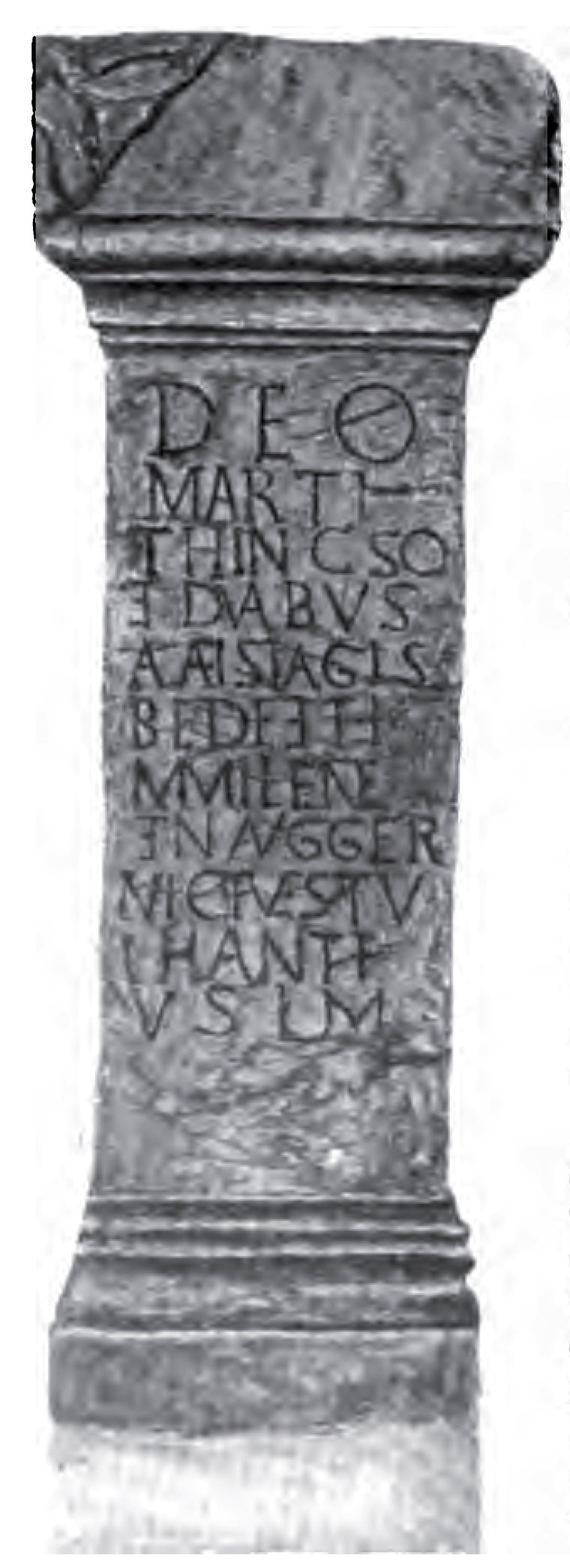
Latin dedications follow a fixed pattern – recipient, dedicators, closing formula – and they abbreviate ruthlessly. Editors expand the abbreviations in round brackets. Expanded, the pillar RIB 1593 reads: Deo Marti Thincso et duabus Alaisiagis Bede et Fimmilene et N(umini) Aug(usti) Germ(ani) cives Tuihanti v(otum) s(olverunt) l(ibentes) m(erito).
"To the god Mars Thincsus and the two Alaisiagae, Beda and Fimmilena, and to the divine power of the emperor, the Germans, tribesmen of Tuihanti, willingly and deservedly fulfilled their vow."RIB 1593, Housesteads; our own translation
Note the spelling. The stone has Thincsus with "nc", not "Thingsus". "Thingsus" is a modern normalisation that makes the link to the word "thing" more obvious. Latin stonecutters simply had no letter for the Germanic sound and did the best they could.
The altar RIB 1594 names its dedicators as Ger(mani) cives Tuihanti cunei Frisiorum Ver(covicianorum) Se(ve)r(iani) Alexand(riani) – the Germans, tribesmen of Tuihanti, of the cuneus of Frisians of Vercovicium, styled "Severus Alexander's own". In the 3rd century, units liked to carry the reigning emperor's name as an honorific. Severus Alexander ruled from 222 to 235, which dates this altar firmly to those years. The pillar RIB 1593 has no date of its own. Since both were found together and name the same dedicators, a similar date is likely, but it is not proven.
The formula v. s. l. m. reveals the piety behind it: a gift promised, a prayer answered, a word kept. Religion as contract – fitting for a god of law and assembly.
For a long time, ourselves included, people wrote that Batavians set up these stones. That is not what they say. The dedicators call themselves Tuihanti. As early as 1884 the German philologist Wilhelm Scherer connected the name with Twente (Twenthe), a region in the east of today's Netherlands, on the border with Germany. The area around Enschede, Hengelo and Almelo still bears the name.
Ancient authors place a tribe called the Tubantes in roughly this part of the world. Tacitus mentions them in the Annals (1.51): in AD 14, after a raid on the Marsi, Germanicus had to march back through the lands of the Bructeri, Tubantes and Usipetes. Whether the Tuihanti of Housesteads were direct descendants of those Tubantes is a plausible link rather than a proven one. Linguistically the name fits Twente well; the tribal history across two centuries is full of gaps.
They served in the cuneus Frisiorum, a "wedge" of Frisians. A cuneus was an irregular cavalry formation, often recruited from one particular region. That men from Twente rode in a Frisian unit shows how loosely Rome used ethnic labels: "Frisians" meant, more or less, people from the North Sea coast and its hinterland. You can read more about the Frisians themselves in our article on the Frisians and their terps.
Housesteads, Roman Vercovicium, was a busy fort at the time. From the early 3rd century its main garrison was the cohors I Tungrorum, infantry from around Tongeren in modern Belgium. Alongside them were the Frisian cuneus and the numerus Hnaudifridi, "Hnaudifridus's unit". Hnaudifridus is a Germanic personal name, probably that of the unit's commander or founder. So Housesteads was a place where at least three groups from the Continent lived side by side, each with its own speech and gods, all under one paymaster.
Archaeology adds a lovely detail. Around the fort, excavators found a hand-made pottery known in the literature as "Housesteads Ware", which resembles pottery from the Frisian coastlands of North Holland. It suggests that the soldiers did not come alone: families and dependants came too, and kept their own way of cooking. People who bring their pots bring their gods.
The whole debate hinges on one word. Linguists take Thincsus to be a Latin rendering of a Germanic *Þingsaz. The asterisk marks a reconstructed form, not an attested one. It is built on *þinga-, the root behind English "thing" and Old Norse þing: the assembly in which the free men of a district met to settle disputes, find judgements and make common decisions.
We describe how such an assembly worked in our article The Thing – Where Law Was Spoken. For our god, one idea is enough: if a deity is named after the assembly, he is presumably the one who presides over it, protects it and guarantees its peace. "Thing god" is therefore the usual translation. Wolfgang Pfeifer's etymological dictionary of German paraphrases it as roughly "the god who protects the thing".
That is not entirely clear-cut, since the word could also mean "meeting" or "matter" – the drift that produced English "thing". One might think of an army assembly instead. Hardly a contradiction: in Tacitus, army and assembly are largely the same armed men.
Now we step into interpretation. The stone says "Mars", not "Tiwaz". The idea that the Germanic god Tiwaz stands behind him – called Týr in the North and Ziu in Old High German – is a thesis. It is, however, a well-founded one.
First, the equation itself. Romans and Romanised Germans routinely identified foreign gods with their own, a practice Tacitus calls interpretatio Romana. We explain how it worked in Interpretatio Romana – Germanic gods under Roman names. Mercury usually stood for Wodan, Hercules for Donar (as with Hercules Magusanus), and Mars for a god of war and law.
Second, the day of the week. When Germanic speakers adopted the Roman planetary week, they translated the gods' names. Latin dies Martis, "the day of Mars", became Germanic *Tīwas-dagaz, "the day of Tiwaz": Old English Tīwesdæg, modern English Tuesday, Old Norse Týsdagr, Swedish tisdag, Old High German ziestag. Whoever rendered Mars as Tiwaz clearly saw the same god in both. Our overview of the Germanic days of the week traces the whole set.
Third, the profile of Norse Týr. In the Prose Edda, Snorri Sturluson tells how the gods set out to bind the wolf Fenrir. The wolf distrusts the fetter and demands a pledge: one of the gods must place a hand in his mouth. Only Týr dares. When the wolf realises he has been tricked, he bites the hand off. It is a story about oath, surety and the price of a bargain. A god who stakes his own body on a promise sounds very much like the patron of an assembly where oaths are sworn.
Fourth, the scholarly tradition. Georges Dumézil placed Týr in the realm of law, contract and sovereignty; his three-function model is contested today but has left its mark. Rudolf Simek describes Tiwaz as a sky god, war god and thing god.
There are more cautious voices too. The classicist Martin West pointed out that *Tīwaz originally just meant "god" and only gradually became the name of one particular deity. Even so, "Mars = Tiwaz" remains the standard assumption. It just needs to be stated carefully: Housesteads does not prove that Mars Thingsus was Tiwaz. It shows a god of war and assembly under the name of Mars – and everything else we know about Tiwaz makes the identification very likely.
Mars does not stand alone on the pillar. Next to him the inscription names "the two Alaisiagae", Beda and Fimmilena. The later find, RIB 1576, names two more "goddesses Alaisiagae": Baudihillia and Friagabis. Whether these are four separate goddesses, two pairs from a larger group, or different epithets for the same beings, we do not know. None of the names is attested anywhere outside Housesteads.
The group name Alaisiagae is itself a puzzle: perhaps "the all-revered", from "all-" and a word for awe, perhaps derived from an unknown place name.
The individual names get more interesting still. Already in the late 19th century, German philologists linked Beda and Fimmilena with two terms from medieval Frisian law: the bodthing and the fimelthing. The bodthing was probably a "summoned" court, convened by order; the fimelthing another kind of judicial assembly, though how exactly the two differed is not agreed. If the reading is right, Beda and Fimmilena were goddesses of two kinds of thing – ideal companions for a thing god.
The theory is elegant, and many reference works, Simek's among them, adopt it. It has one weak point, though: the Frisian law texts are high medieval, roughly a thousand years younger than the stones. Legal vocabulary is often remarkably tenacious, so a bridge across a millennium is not impossible. But it is a bridge built of assumptions.
Baudihillia is usually explained as a hybrid: a Celtic element boudi-, "victory", as in the name of Queen Boudicca, plus Germanic -hildiz, "battle" – roughly "victory-fighter". In 1922 the philologist Theodor Siebs proposed a purely Germanic etymology instead and even suggested a link with Beadohild, the king's daughter of the Weland legend. Friagabis is generally read as "the kindly giver" or "the free giver".
Scholars have built very different pictures from these names. Hilda Ellis Davidson saw the Alaisiagae as war goddesses, forerunners of the valkyries. Others, most recently the Dutch archaeologist Daniël Gerrets, place them close to the Matronae, the mother goddesses of the Rhineland, who likewise appear in groups and are tied to fertility and ancestors. These readings need not exclude each other entirely.
The 1883 find included the arched lintel that probably sat above the entrance of the little shrine. According to the drawing made for John Clayton, the antiquarian landowner who excavated along the Wall, and as described by the RIB editors, the central panel shows Mars as a warrior with sword, shield and spear, with a goose at his right. On either side float two naked, cross-legged figures, each holding a palm branch out towards Mars and a wreath in the other hand. These are almost certainly the two Alaisiagae.
The visual language is thoroughly Roman. Palm branch and wreath are the classic signs of victory, and the floating figures recall Victories, the Roman winged goddesses of triumph. What the goose means is open. The soldiers from Twente did not depict their gods in some "Germanic style"; they used the imagery a Roman stonemason could offer. The names are Germanic, the form is Roman. That is simply how religion worked on the frontier.
Exactly where the shrine stood has not been settled. A building excavated on Chapel Hill by the Birley family in the 20th century was for a while identified as his temple; that identification is now doubted.
A god of the assembly, worshipped by cavalrymen on active service – does that fit? Tacitus' Germania, written around AD 98, helps. Describing Germanic assemblies, he says the men came armed, and silence was commanded by the priests, who at that moment also had the power to enforce it. If a proposal displeased them, the crowd murmured; if it pleased them, they clashed their spears (Germania 11). Before this assembly one could also bring charges, including capital ones (Germania 12).
Elsewhere (Germania 7) Tacitus writes that in war nobody but the priests was allowed to punish, bind or flog a man – not on the leader's orders, but as if at the command of the god whom they believed to be present among the fighters. The god who watched over the law of the assembly also watched over discipline in the field. Law and war were not separate spheres but two faces of the same community of free, armed men.
Seen this way, Housesteads makes sense. A unit like the Frisian cuneus was also a community with its own origins and customs. A thing god was no exotic legal abstraction to these men, but the god under whose eye they swore oaths – including the oath to the emperor.
If you want to see what such meeting places looked like later in the North, our article on Bällsta and Anundshög covers Swedish thing and cult sites of the Viking Age, and our piece on the Icelanders and their Althing describes the most famous assembly of the Middle Ages. That a sacred place could be named directly after Týr is shown by the Danish lake Tissø.
English speakers have it easy: Tuesday is transparently Tīw's day. German is more tangled, and the tangle leads straight back to our thing god.
In the south, the German name long matched the English one: Old High German ziestag, Middle High German ziestac, and Swiss German "Zischtig" to this day. In Bavaria and Austria people said "Ertag" or "Erchtag", a word usually traced back to the Greek war god Ares and thought to have reached the Danube region through Gothic. And in the northwest, on the Lower Rhine and in the Low Countries, the form arose that would eventually win: Middle Low German dingesdach and dinstach, Middle Dutch dinxendach and dinsdach. Modern Dutch says dinsdag, modern German Dienstag.
Since the 19th century a tempting explanation has been on the table: dingesdach is the day of Thingsus, the thing god. The god from Hadrian's Wall would then have lived on among the Tuihanti's neighbours, and the god of the assembly would have become the German word for Tuesday.
Wolfgang Pfeifer's authoritative etymological dictionary (online at DWDS) is more cautious. It mentions the Thingsus derivation but suggests that, given how well the other forms are attested, it may be better abandoned. On that view, the Lower Rhine names also go back to *Tīwas-dagaz. To erase the pagan god, initial t- was replaced by d-; via intermediate forms such as dīsdach and dīsendach, and by analogy with woensdach (Wednesday), the form dinsdach eventually emerged. Dinstach is attested from the 13th century, spread east in the 14th and then gradually south. "Dienstag" only became the general written standard in the second half of the 17th century.
When the Germanic peoples adopted the planetary week cannot be pinned to a year; most scholars think of the first centuries AD, the very period in which men from Twente served in Roman units.
Put all the uncertainties together and a remarkable amount still stands: a Germanic divine name from the hands of its own worshippers, the origin and unit of the dedicators, four goddesses known from no myth. And we have a hint that the god the Vikings later called Týr was once more than the one-handed supporting character of the Edda. For the continental Germanic peoples he may have been the guardian of the assembly, the god before whom you gave your word. How he changed by the Viking Age, and why Odin pushed him aside, is the subject of Wodan, Donar & Ziu. The Norse god of justice par excellence gets his own portrait in Forseti.
In our workshop in Alsdorf this is more than theory. When someone asks us to engrave the Tiwaz rune on slate, we like to ask why. Some think of battle and courage. Others, and there are more of them every year, think of something older: a promise kept, a word you stand behind. Mars Thingsus says both are right.
Who was Mars Thingsus? A Germanic god known from a single inscription at Housesteads on Hadrian's Wall (RIB 1593, spelled "Thincsus"). His epithet is read as "god of the thing (assembly)", and most scholars identify him with Tiwaz, the later Týr.
Where were the Mars Thingsus stones found? In 1883, at the foot of the northern slope of Chapel Hill below Housesteads fort (Vercovicium) in Northumberland. A third stone for the Alaisiagae (RIB 1576) came to light in 1920 a few metres to the west.
Who dedicated the altars to Mars Thingsus? Germanic soldiers calling themselves "cives Tuihanti", most likely from Twente in the eastern Netherlands. They served in the Frisian cuneus at Housesteads; their altar RIB 1594 dates to the reign of Severus Alexander (222–235).
Who were the Alaisiagae? Germanic goddesses named in pairs at Housesteads: Beda and Fimmilena, and Baudihillia and Friagabis. Whether they were goddesses of the assembly, war goddesses or relatives of the Matronae is debated.
Is Tuesday named after the thing god? English Tuesday is named after Tīw, the Germanic equivalent of Mars. Whether Dutch "dinsdag" and German "Dienstag" also contain the epithet Thingsus is uncertain, and Pfeifer's etymological dictionary doubts it.
Is Mars Thingsus the same as Týr? Probably, but not provably. The weekday name, the image of Týr pledging his hand in the Fenrir myth, and the Roman habit of equating Tiwaz with Mars all point that way.
For courage. For remembrance. For legends that live on.
Tiwaz · Wodan, Donar & Ziu · Interpretatio Romana · Germanic Religion · The Matronae.
All Gods & Goddesses articles →
Few figures in Norse myth are as puzzling and as important as Mimir. Sometimes he is a being at the well of wisdom …
Read more →Some figures of Norse mythology stand in the bright spotlight, others in the shadow of the great ones. Nanna belongs to …
Read more →Almost a thousand years before the Edda was written down, Germanic tribes drove a veiled goddess across the fields on …
Read more →Every god has a mother. Heimdall has nine – at once. Nine sisters, giant maidens, bore the watchman of the gods “at the …
Read more →