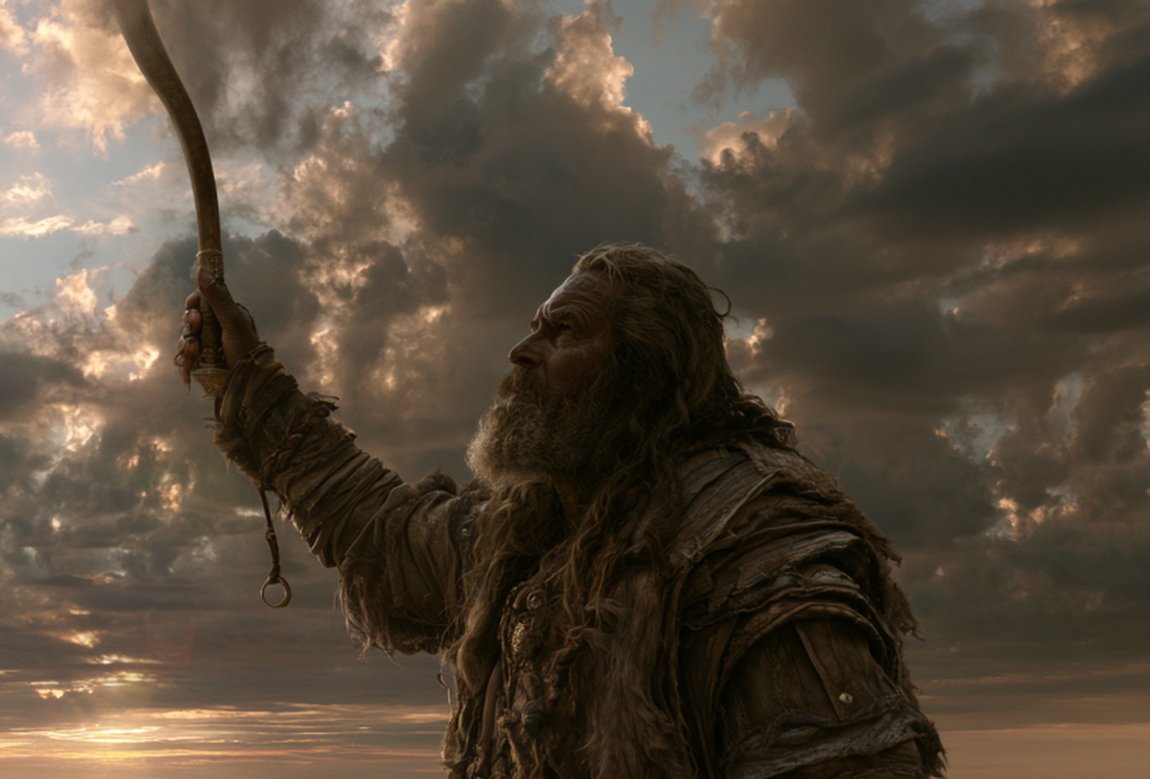
Every god has a mother. Heimdall has nine – at once. Nine sisters, giant maidens, bore the watchman of the gods “at the edge of the earth”. No other birth miracle of Norse mythology is as puzzling – and hardly any is retold as wrongly.
The story stands in the Völuspá hin skamma, the “Short Völuspá”, embedded in the Eddic poem Hyndluljoth. There we hear of a mighty one “of the race of the gods” – the stanza never names him, but the nine give him away:
“One there was born in the bygone days,
Of the race of the gods, and great was his might;
Nine giant women, at the world’s edge,
Once bore the man so mighty in arms.
[…]
Gjolp there bore him, Greip there bore him,
Eistla bore him, and Eyrgjafa,
Ulfrun bore him, and Angeyja,
Imth and Atla, and Jarnsaxa.”
— Hyndluljoth 35/37, translation Henry Adams Bellows (1923, public domain)
The child was strengthened “with the might of earth, with the ice-cold sea” – and with sonardreyri, by today’s reading the blood of the sacrificial boar. Earth, sea and offering blood: the future warden of the border carries every sphere of the world within him.
That the nameless one is Heimdall is vouched for by Snorri – and by a poem we have almost entirely lost: the Heimdalargaldr, “Heimdall’s chant”. Only two lines survive, because Snorri quotes them, and in them the god himself speaks: “Offspring of nine mothers am I, of nine sisters am I the son.” Older still is the third witness: around the year 985 the skald Ulf Uggason, in his Húsdrápa – composed on the carved god-images of an Icelandic hall – calls Heimdall the “son of eight mothers and one”, a skaldic loop around the nine. The motif is no late invention; it was already famous in the Viking Age.
The mothers’ names – Gjalp, Greip, Eistla, Eyrgjafa, Ulfrun, Angeyja, Imd, Atla, Jarnsaxa – are attested throughout as giantess names; they are read as “the roaring one”, “the gripper”, “the she-wolf”, “the one with the iron knife”. Two are known from other tales: Gjalp and Greip are also the daughters of the giant Geirrod who tried to kill Thor, and Jarnsaxa is elsewhere Thor’s lover and mother of his son Magni. Whether these are the same figures, no source says – the Edda deliberately leaves us in the mist here, as so often with the giants. And the Hyndluljoth names no father at all; only Snorri’s tradition makes Heimdall a son of Odin.
The most famous interpretation sounds like poetry itself: the nine mothers are the nine daughters of the sea giant Ägir and of Ran – the waves themselves. Heimdall would then be the light born of the sea at the horizon: white as spray, born “at the edge of the earth”, strengthened by the cold sea. Georges Dumézil added an astonishing Celtic parallel: in Welsh tradition the waves are the sheep of the sea-woman – and every ninth wave is the ram of the flock; in Irish tales the ninth wave is a magical boundary. A ram, of all creatures: Heimdall’s byname Hallinskidi and the poetic word heimdali both mean “ram”, his teeth are golden like an old buck’s, his sword is called “Head” – the ram fights with its head – and he hears the wool grow on the sheep. It fits almost too well.
What became of the child of the nine? The god of borders, through and through. Heimdall dwells in Himinbjörg, the “heaven-cliffs”, where the bridge Bifröst reaches the sky, and there “gladly drinks the good mead” – so the Grimnismol. He needs less sleep than a bird, sees a hundred leagues by night as by day, and hears the grass grow in the earth. His horn, the Gjallarhorn, is heard in all the worlds – its blast will open Ragnarök. Loki jeers in the Lokasenna that Heimdall drew a “hateful lot”: to stand watch forever “with a wet back”. And at the end of time the two meet one last time: the watchman and the boundary-breaker slay each other – a duel like a formula. They had wrestled once before, in seal form on a skerry, over Freyja’s necklace Brísingamen: the son of the sea fights in the water like a sea creature.
A second legacy sits in the very first stanza of the Edda. When the seeress of the Völuspá begins, she calls upon “both high and low of Heimdall’s sons” – meaning: all of humankind. The Rigsthula tells why. Under the name Rig, a god wanders to three farmsteads, shares bed and board with the couples – and nine months later Thrall, Karl and Jarl are born: serf, farmer and nobleman, the three estates of the world. That Rig is Heimdall, however, is said only by the short prose note before the poem; some scholars suspect Odin behind the wanderer. Either way it suits the child of nine mothers: one born of so many is fit to be the ancestor of all.
Why nine, of all numbers? Nine is the number of the North: Yggdrasil carries nine worlds, nine nights Odin hung on the windy tree, every nine years Uppsala held its great sacrifice, nine paces Thor takes after his last fight with the Midgard Serpent, and from the ring Draupnir eight new rings drip every ninth night. Three times three – the number of completeness. One born of nine mothers has, in a sense, been brought into the world by the whole world. For a god standing guard at the threshold of all the worlds, there is no better pedigree.
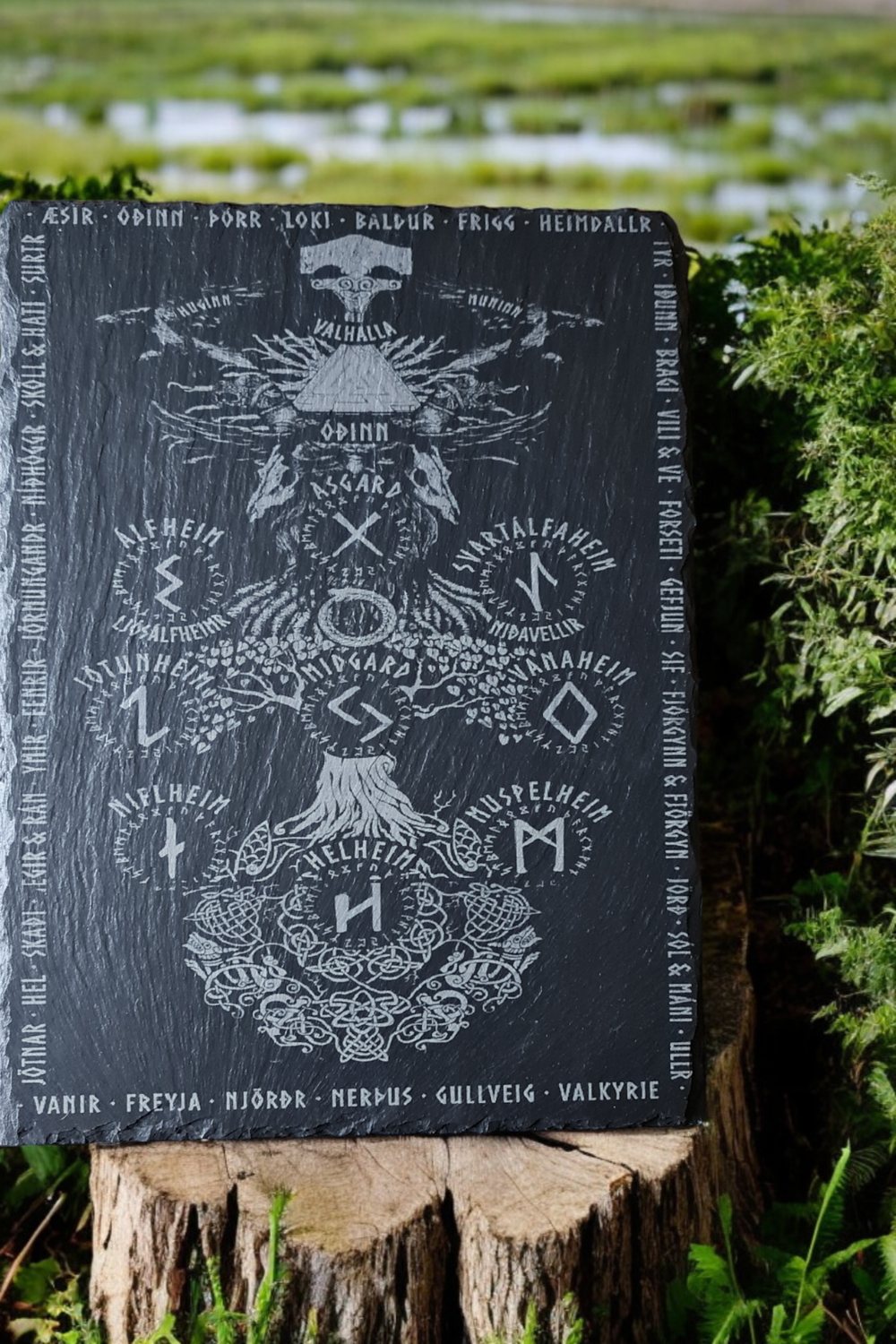
Heimdall – watchman of the gods · The Nine Worlds · The three wells beneath Yggdrasil · The Norse pantheon.
Hyndluljoth 35–38, Völuspá 1/27, Grimnismol 13, Thrymskvitha 15, Lokasenna 47–48, Rigsthula (Poetic Edda), English public domain: Henry Adams Bellows (1923). Snorri Sturluson, Gylfaginning 27/51 (with the Heimdalargaldr fragment), Skáldskaparmál 8/16/25 (Húsdrápa, Ägir’s daughters). Scholarship: Rudolf Simek, Dictionary of Northern Mythology (2007); Sebastian Cöllen, Heimdallr – der rätselhafte Gott (2015); Georges Dumézil, Gods of the Ancient Northmen (1973); Karl Müllenhoff, Deutsche Altertumskunde V (1883–91); Rudolf Much, “Der nordische Widdergott” (1930); John Lindow, Norse Mythology (2002); E. O. G. Turville-Petre, Myth and Religion of the North (1964); Birger Pering, Heimdall (1941).
All Gods & Goddesses articles →
When a Viking prayed before a sea voyage for wind, safe return and a full catch, he prayed to Njörðr. The god of the …
Read more →Odin is no comfortable sky-father. He is wanderer, war god, poet, sorcerer and lord of the dead – a god who pays almost …
Read more →There is a love story in Norse mythology made almost entirely of longing. Its hero is a god of whom we know little more …
Read more →Her hair was of pure gold – and this hair set off one of the most consequential stories in all of mythology. Sif, wife …
Read more →