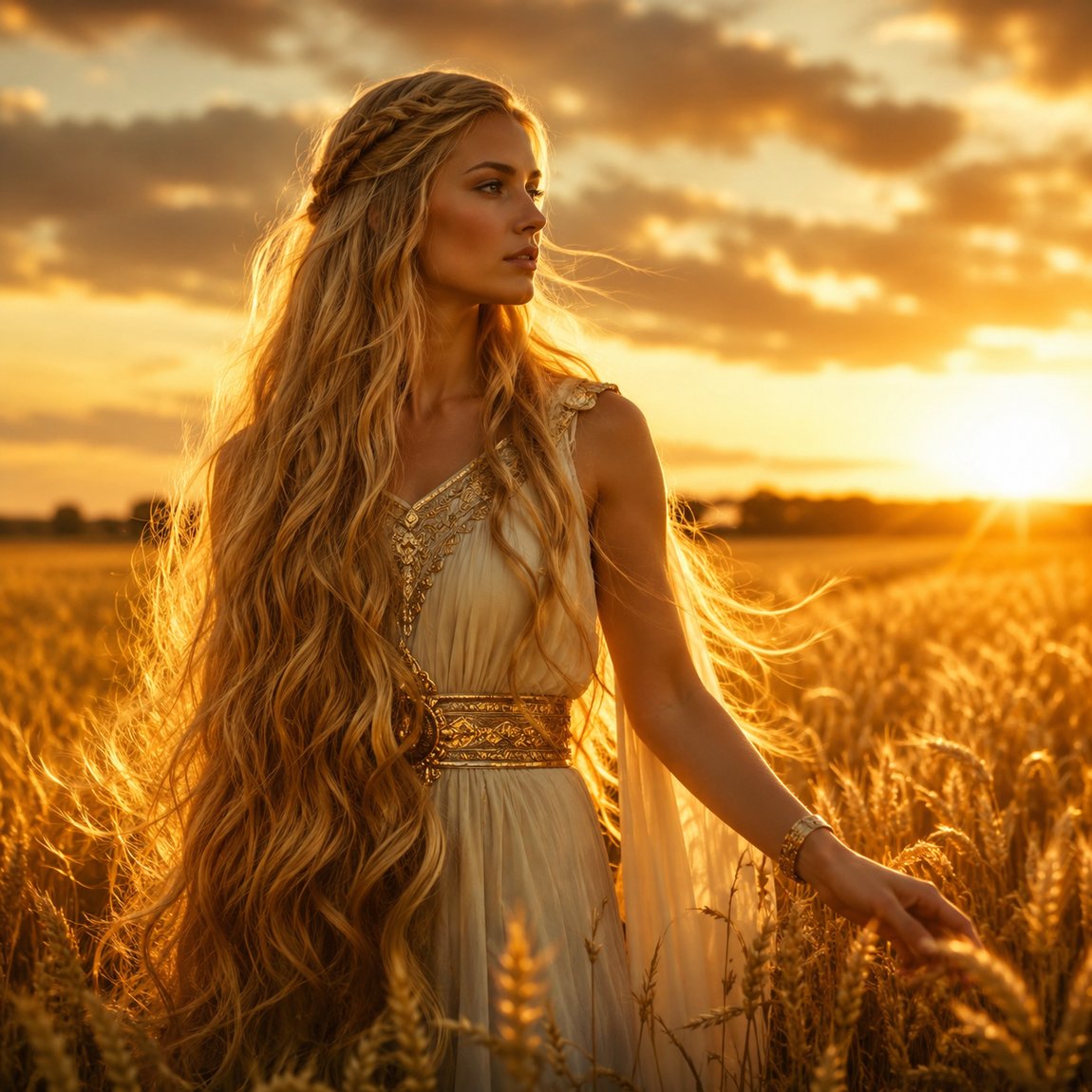
Thor's wife is Sif, a goddess of the Æsir famous for her hair of gold. When Loki shears it off while she sleeps, he sets off the chain of events that ends with Mjölnir, Gungnir and the other great treasures of the gods. Snorri also names a second partner of Thor: the giantess Járnsaxa, mother of his son Magni. But only Sif is his wife – the sources explicitly call Járnsaxa her rival.
For a goddess whose hair armed an entire pantheon, Sif says remarkably little. In the whole surviving corpus she speaks exactly one stanza. And yet the poets of the North knew her so well that they used her name as a word in its own right: say "Sif's hair" and your audience heard gold; say "Sif's husband" and they heard Thor.
The short answer is Sif. In the Prose Edda of the Icelander Snorri Sturluson (c. 1220) she is unambiguously Thor's wife. The Poetic Edda, the older collection of mythological and heroic poems, agrees in its own way: in Hymiskviða Thor is called simply Sifjar verr, "Sif's husband", three times (stanzas 3, 15 and 34). If you are looking for the name of Thor's wife, this is it.
The longer answer needs a second name. In his handbook for poets, Skáldskaparmál, Snorri tells of Thor's duel with the stone giant Hrungnir. At the end Thor lies pinned under the dead giant's leg and none of the gods can shift it. Then Magni, "son of Thor and Járnsaxa", arrives, just three nights old, and tosses the leg aside. Járnsaxa – the name means something like "iron knife" or "she of the iron blade" – is a giantess. That is all we learn about her there.
How does she relate to Sif? Snorri answers that himself, in his list of the ways a poet may refer to Sif: call her "Thor's wife, Ullr's mother, the fair-haired goddess, elja of Járnsaxa, mother of Þrúðr". Old Norse elja means a co-wife or rival – a woman who shares the same man. Sif is the wife; Járnsaxa is the other woman, by whom Thor has a son.
More on Thor's sons in our article on Magni and Modi.
Old Norse Sif is the singular of sifjar, a word for relationship by marriage, affinity, in-law kinship. It belongs to a word family found across the Germanic languages: Gothic sibja, Old High German sippa (modern German Sippe, "clan"), and Old English sibb, which also meant peace and concord and survives in English sib and the modern coinage sibling.
The reference works translate the goddess's name accordingly: Rudolf Simek gives "relation by marriage", John Lindow "in-law relationship". Thor's wife is, loosely, called "the in-law bond" – the tie a wedding creates between two families.
There is an intriguing parallel from England. In Beowulf, Queen Wealhtheow, who carries the mead cup round the hall and smooths over quarrels, is called friðusibb folca, "peace-bond of the peoples". Several scholars, starting with the Norwegian Magnus Olsen, have compared her with Sif, who in Lokasenna likewise pours mead to keep the peace. Whether an older shared idea lies behind both is an open question. The resemblance is real.
The best-known story about Sif sits in a chapter of Skáldskaparmál that opens with a textbook question: why is gold called "Sif's hair"? Snorri answers with a tale (chapter 35 in Anthony Faulkes's numbering; other editions number differently).
It begins abruptly. Loki Laufeyjarson, we are told, cut off all of Sif's hair out of sheer malice. No motive, no quarrel, no backstory. When Thor finds out, he seizes Loki and means to break every bone in his body. Loki swears he will get the black elves – the dwarves – to make hair of gold that will grow like any other hair.
He goes to the dwarves called the sons of Ívaldi. They forge the hair, and along with it the ship Skíðblaðnir, which always has a fair wind as soon as the sail is raised and can be folded up like a cloth. The third piece is the spear Gungnir, later carried by Odin.
Loki bets his own head with the dwarf Brokkr that Brokkr's brother cannot make three treasures as good as these. The brother is called Sindri in most editions, Eitri in one group of manuscripts. The smith puts a pigskin in the forge and tells Brokkr to keep working the bellows without a pause until he takes the piece out again.
As soon as he has left, a fly lands on Brokkr's hand and bites him. Snorri does not spell it out, but every listener knew whose buzzing that was. Brokkr keeps pumping, and out of the forge comes a boar with golden bristles – Gullinbursti, who will belong to Freyr. With the second piece, gold, the fly bites his neck twice as hard. The result is the ring Draupnir, from which eight rings of equal weight drip every ninth night.
With the third piece, iron, the fly stings Brokkr between the eyes; blood runs into his eyelids and for a moment he lets go of the bellows to swat it away. What comes out is a hammer: Mjölnir. It hits whatever it is thrown at, returns to the hand and can be made small. Its only flaw is a handle that came out a little short. The fly very nearly succeeded.
Odin, Thor and Freyr sit in judgement and decide: the hammer is the best, because with it the gods can hold off the giants. Loki has lost his head. He saves himself with a lawyer's trick – the head, yes, but not the neck. So Brokkr takes an awl and a thong and sews Loki's lips together instead.
He tries to run, and Thor catches him. Then comes the famous lawyer's trick: the head, yes – but not the neck, and the dwarf has no right to touch the neck. Brokkr gives way, takes an awl and a thong, and sews Loki's lips together. That is where the chapter ends.
Sif stands at the start of this chain but never acts in it. She sleeps, loses her hair, gets new hair. The story asks nothing more of her.
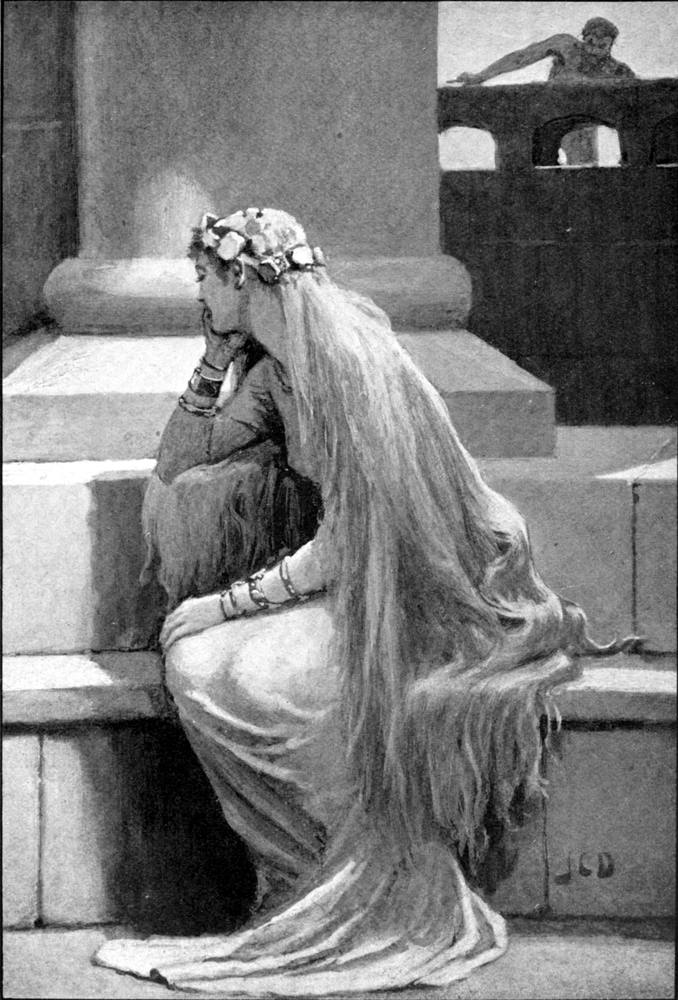
To a modern reader the haircut looks like a schoolboy prank. To the people who heard this story it was something else, and Thor's rage has nothing to do with vanity.
Among the Germanic peoples hair signalled rank and honour. The Frankish kingdom offers the best-known case: the Merovingian kings wore their hair long and uncut as a mark of royalty. When Pippin deposed the last Merovingian, Childeric III, in 751, he had him shorn and sent to a monastery. Lose the hair, lose the claim.
For women an even older passage is telling. Writing around AD 98, the Roman historian Tacitus reports in his Germania (ch. 19) that among the Germani an adulterous wife was shorn by her husband in front of her kin and driven naked from the house. That is some seven centuries before the Viking Age, and Tacitus writes as an outsider with his own agenda. But it shows what a woman's cropped head could signify in this cultural world: public punishment and disgrace.
Read against that, Loki's prank gains a nasty edge. He secretly inflicts on the wife of the strongest god what elsewhere was a punishment for infidelity, and makes her look, in everyone's eyes, like something she is not. Whether Snorri or his sources thought of it that way we cannot know. But in Lokasenna, of all things, Loki claims to have slept with Sif – more on that below.
In Viking Age towns – Hedeby, Birka, York, Dublin – the comb is among the most common finds of all. It was cut from antler, riveted together from several plates, often decorated with incised patterns, and frequently kept in its own case. People wore it at the belt the way we carry a phone. Our article on combs, bathing and Viking hairstyles shows what they did with it.
Then there are voices from outside. A thirteenth-century English chronicle attributed to John of Wallingford claims that the Danes combed their hair every day, bathed on Saturdays and changed their clothes often – and so found too much favour with English women. That is a late anecdote, not a measurement. But it tells you what the Northmen were known for.
For women, the hairstyle itself matters too. Small silver figures and pendants from Birka, from Hårby in Denmark and elsewhere show women with an elaborate knot at the nape from which a long tail falls. A style like that takes time and a second pair of hands. Whether married women always covered their hair, as later sources suggest, cannot be stated with confidence for the Viking Age.
The dwarves do not deliver a wig. Snorri stresses that the gold hair will take root as soon as it touches Sif's head and grow on like real hair. That is the real feat: not replacement, but healing.
That captures what makes the dwarves so powerful: they do not make objects, they make properties. A hammer that comes back. A ring that multiplies. A ship that fits in a pouch. And metal that lives.
Ullr, the son. Snorri calls Ullr "Sif's son and Thor's stepson". He is such a fine archer and skier that no one can compete with him, handsome and warlike, a good god to call on in single combat. No source names Ullr's father. That is striking, because Ullr was evidently more important in cult than the poetry suggests: his name appears in a great many place names in Sweden and Norway, and Grímnismál gives him his own dwelling, Ýdalir, the "yew dales".
Þrúðr, the daughter. With Thor, Sif has a daughter, Þrúðr (Thrud), whose name means "strength" – fitting for a father who lives in Þrúðheimr. Snorri explicitly calls Sif "mother of Þrúðr" and Thor "father of Þrúðr". A stanza by the early skald Bragi calls the giant Hrungnir "thief of Þrúðr" – an abduction story otherwise lost.
You will often read that Þrúðr is the bride in the Eddic poem Alvíssmál, wooed by the dwarf Alvíss until Thor keeps him answering questions till sunrise and he turns to stone. That is a reasonable guess, but strictly it is a scholarly identification: the poem itself never names the daughter. An earlier version of this article put that too neatly.
Lokasenna 53–54. Lokasenna ("Loki's quarrel") is set at a feast in the hall of the sea giant Ægir. Loki insults everyone present in turn. Then Sif steps forward, pours him mead into a rime-cold cup and says, in our own rendering:
"Hail to you now, Loki, take the frosted cup, full of ancient mead – and let me alone among the Æsir stay free of blame."Lokasenna 53, our own translation
Loki takes the horn, drinks – and replies that she would indeed be the only one, if she really were so chaste towards her husband. But he knows of one who has been her lover besides Thor, and that was the crafty Loki himself.
Whether that is true the poem leaves open; Loki accuses almost every goddess there of infidelity. What stands out is Sif's role: she is the only one who tries to defuse the quarrel with hospitality. It fails, but the attempt marks her out.
Hárbarðsljóð 48–49. In Hárbarðsljóð, Thor stands at a sound and wants to be ferried across. The ferryman Hárbarðr – generally taken to be Odin in disguise – mocks him and claims in stanza 48 that Sif has a lover at home, whom Thor would do better to go and find. In stanza 49 Thor replies that Hárbarðr is saying whatever would hurt him most, and adds that he thinks the coward is lying.
Hymiskviða. In the poem about Thor's visit to the giant Hymir, on which he fishes for the Midgard Serpent, Sif does not appear. But Thor is named three times after her: Sifjar verr, "Sif's husband". The marriage was so taken for granted that it could serve as the god's by-name.
The skalds, the court poets of the North, worked with circumlocutions called kennings. You do not say "gold"; you name something every competent listener will recognise as gold: "fire of the sea", "Freyja's tears" – or haddr Sifjar, "Sif's hair".
Snorri lists this kenning explicitly, and his whole chapter on the shearing exists to explain it. That is the key to the episode: Skáldskaparmál is a textbook for poets. Snorri tells the story so that his readers know why gold may be called this.
The other way round, Sif's name serves as a building block for Thor kennings. Snorri's list calls him "husband of Sif" and "stepfather of Ullr", and the Poetic Edda uses Sifjar verr, as we have seen. On top of that, goddess names in skaldic verse could serve generally as the base word for "woman": a beloved might be called, for example, "Sif of gold".
This is probably Sif's most important role in the literature: not as an actor but as an image. How old that image is, is hard to say. Rudolf Simek even thinks it possible that Snorri assembled the shearing story himself to explain the kenning. Neither view can be proven.
Sif gets an odd cameo in the Prologue to the Prose Edda. There Snorri explains the heathen gods as ancient humans who were later worshipped – a method called euhemerism, after the Greek writer Euhemerus. It let a Christian Icelander write the old myths down without having to declare them true.
In the Prologue, Thor is Tror, a grandson of King Priam of Troy. He marries a prophetess called Sibil, "whom we call Sif". Snorri describes her as the loveliest of women, with hair like gold. The name is a learned pun: Sibil echoes the Sibyls, the prophetesses of antiquity, and Sif at the same time.
One of the most widespread readings turns Sif into a fertility goddess: her golden hair is the ripe grain, Loki's cut the harvest, the regrowing gold the return of the crop next year. Marriage to the thunder god, whose rain waters the fields, seems to fit perfectly.
Where does that picture come from? Jacob Grimm considered it in his Teutonic Mythology and compared Sif with the Roman Ceres, but explicitly left the question open because the sources are silent. In 1874 the Icelandic scholar Guðbrandur Vigfússon spoke of mother earth with her golden sheaves. In the twentieth century Hilda Ellis Davidson took the idea up again and linked Sif's hair with golden fields of wheat. Gabriel Turville-Petre put forward a different hypothesis: that Sif was once imagined as a rowan tree, which Thor clings to in one story.
On the other side stands, above all, Rudolf Simek. He sees Sif rather as a figure created as a counterpart to Thor, and rejects the idea of a vegetation cult behind her.
These are serious suggestions, but they are interpretations. No text says Sif's hair is grain, and none links her with harvest or the turning year. The idea has propagated through handbooks and websites until it looks like tradition.
You might conclude she was a minor figure. That would be hasty. What we have is almost entirely poetry about fights, wagers and slanging matches, written down in Christian Iceland in the thirteenth century, generations after the old cult had ended. What is missing from that selection is not necessarily missing from the religion.
That makes Sif a good example of a basic rule for this material: absence from the texts is not proof of absence from belief. Where the record is thin, we would rather say so than fill the gap with pretty inventions.
Sif does not appear in Richard Wagner's Ring of the Nibelung; there Donner has no wife on stage. Her big entrance into popular culture came with comics.
Marvel introduced her in 1964 in Journey into Mystery #102. Comic-book Sif has little in common with the original: she is dark-haired, a warrior, and not Thor's wife but his childhood friend and on-and-off love interest. In the films from Thor (2011) onwards she is played by Jaimie Alexander, and one episode of the series Loki even nods to the hair-cutting story. What else Marvel gets right or wrong we checked in our Marvel Thor fact check.
God of War Ragnarök (2022) stays closer to the Edda: there Sif really is Thor's wife and the mother of Þrúðr. And if you look up, you will find her too: a large volcano on Venus is named Sif Mons.
What is the name of Thor's wife? Thor's wife is Sif, a golden-haired goddess of the Æsir. She is the mother of Ullr (from an earlier union) and of Þrúðr (with Thor).
Who is Járnsaxa? Járnsaxa is a giantess with whom Thor has his son Magni. Snorri calls her Sif's rival; she is not Thor's wife.
Why did Loki cut off Sif's hair? Snorri gives no reason beyond Loki's malice. The compensation produced the golden hair and five more treasures, including Mjölnir and Gungnir.
What does the name Sif mean? Sif means "relationship by marriage, in-law kinship" and is related to German Sippe and Old English sibb.
Is Sif a goddess of grain or fertility? That is a 19th- and 20th-century interpretation not found in any source. What is attested is her marriage to Thor, her golden hair and the kenning "Sif's hair" for gold.
Did Sif cheat on Thor? Loki claims so in Lokasenna and Hárbarðr hints at it in Hárbarðsljóð. Both are mockers, Thor calls the claim a lie, and no story about it survives.
For courage. For remembrance. For legends that live on.
Thor (Donar) · The Treasures of the Gods · Mjöllnir · Loki · Frigg.
All Gods & Goddesses articles →
She does nothing grand – no heroic deed, no spell – and yet she is one of the most moving figures in all of mythology …
Read more →She came to Asgard to take revenge – and stayed as a goddess. Skadi is the mistress of the mountains, of winter, of the …
Read more →In the North, the sun is female. Sunna – Sól to the Norse – races across the sky day after day, pursued by a wolf who …
Read more →He stood at the beginning and he stands at the end: Surtur, the fire giant, has guarded the border of the burning world …
Read more →