
Njord, in Old Norse Njörðr, is the Norse god of the sea, the winds and wealth: according to Snorri Sturluson he rules the course of the wind, calms sea and fire, and is the one to call on for seafaring and fishing. He belongs to the Vanir, came to the Æsir as a hostage, lives at Nóatún, the "ship-enclosure", and is the father of Freyr and Freyja. Here is what the Eddas, the sagas, an Icelandic oath and Tacitus actually say about him – and where speculation takes over.
Picture a grey dawn on a Norwegian fjord. The boats are ready, the wind is shifting, and whether the breeze holds decides if there is fish on the table tonight or a family in mourning. People living like that did not need a god of glorious death. They needed one for a fair wind, a calm sea and a full storehouse. That god was Njörðr.
In English he usually appears as Njord, sometimes Njorth or Njörd. The final ð is the voiced "th" of English "this". Njord is not one of the loud gods. He swings no hammer like Thor and gives up no eye like Odin. Yet his trail reaches further back than almost anyone's – past the Eddas to a Roman historian of the first century AD. He is also one of very few gods whose name survives in a heathen oath formula.
Norse myth knows two families of gods: the Æsir around Odin and Thor, and the Vanir, who are closely tied to fertility, prosperity and magic. Njord is the eldest Vanir god we know of. His children Freyr and Freyja are far more famous than he is, and the sources mostly tell us things about him rather than stories in which he acts: where he lives, what he governs, whom he marries and why he lives among the Æsir at all.
Nearly everything we know comes from thirteenth-century Iceland and Norway – a Christian society, more than two centuries after the official conversion. The key texts are the Poetic Edda with its mythological poems, the Prose Edda of the Icelandic scholar Snorri Sturluson (around 1220), and Snorri's history of the Norwegian kings, Heimskringla. Add some older skaldic verse, a handful of place names and an Icelandic oath formula. We will keep these layers apart, because with Njord, evidence and guesswork often sit just one sentence apart.
The fullest portrait is in the first part of Snorri's Prose Edda, Gylfaginning ("The Deluding of Gylfi"), chapter 23. Snorri calls Njord the "third of the Æsir" and places his home in heaven at Nóatún. Then comes the key sentence:
"Hann ræðr fyrir göngu vinds ok stillir sjá ok eld." – He rules the course of the wind and stills sea and fire.Snorri Sturluson, Gylfaginning 23 (Old Norse text; our own translation)
Men should call on him, Snorri goes on, for voyages and for fishing. And he is "so rich and prosperous" (svá auðigr ok fésæll) that he can grant wealth in lands or in movable goods to anyone who prays to him for it. That is a strikingly practical job description. Njord is not the god of the wild, devouring ocean – that role belongs rather to the sea-giant Ægir and his wife Rán, who gathers the drowned in her net. Njord is the sea as a workplace: the shore, the catch, the trade route, the safe homecoming.
His hall is called Nóatún, from nór ("ship") and tún ("enclosure, farmstead"): roughly "ship-yard" or "harbour-home". Think of it as an idealised harbour, a place where ships lie safe. The Eddic poem Grímnismál ("The Lay of Grímnir") lists the halls of the gods and, in stanza 16, names Nóatún as the eleventh. There, the stanza says, Njord has built his hall; he is a "prince of men", free of malice, ruling a high-timbered sanctuary. Among quarrelsome gods he comes across like a calm old harbour master.
Why does a Vanir god live among the Æsir? Gylfaginning says it briefly: Njord was raised in Vanaheim, the world of the Vanir, and the Vanir gave him to the gods as a hostage, taking in exchange an Æsir god named Hœnir. The exchange sealed the peace after the war between Æsir and Vanir, the first war in the world.
In Ynglinga saga, the opening saga of Heimskringla, chapter 4, Snorri tells it as history. Odin and the Æsir fight the Vanir, neither side wins, they make peace and swap hostages. The Vanir send their noblest men, Njord the Wealthy and his son Freyr; the Æsir send Hœnir and wise Mímir. Odin makes Njord and Freyr sacrificial priests, and Freyja, Njord's daughter, is said to have taught the Æsir the magic called seiðr. In the next chapter Odin gives Njord Nóatún as his seat.
An older witness is an Eddic poem. In Vafþrúðnismál, stanza 38, Odin asks the giant Vafþrúðnir where Njord came from to the Æsir – he rules many temples and shrines (hof and hörgar) yet was not born among them. The answer in stanza 39: wise powers shaped him in Vanaheim and gave him as a pledge to the gods; at the end of the age he will return home to the wise Vanir. While Odin, Thor and Freyr fall at Ragnarök, Njord apparently goes home. What exactly the poet imagined, the stanza does not say.
Njord's best-known story is his marriage to the giantess Skadi (Skaði). Its prelude is not in Gylfaginning but at the start of Skáldskaparmál ("The Language of Poetry"). The gods had killed Skadi's father, the giant Thjazi, after the theft of the goddess Idun. Skadi marched on Asgard in full war gear to avenge him. The gods offered compensation instead, and part of it was that she might choose a husband from among the Æsir – on one condition: she could see nothing of them but their feet.
Skadi chose the most beautiful pair, saying in effect that this must be Baldr, for little about Baldr could be ugly. The feet belonged to Njord. Snorri never explains why they were so handsome. As further compensation, Loki had to make Skadi laugh, and Odin threw Thjazi's eyes into the sky, where they became stars.
The scene was clearly old and well known. An eleventh-century verse that Snorri quotes in Skáldskaparmál, attributed to the poet Þórðr Sjáreksson, alludes to Skadi leaving Njord. Snorri also preserves the puzzling poetic name "god of chariots" for Njord – which inevitably makes people think of Nerthus and her wagon, of which more below.
Gylfaginning 23 tells what happened next. Skadi wanted to live at Þrymheimr, her father's mountain home; Njord wanted to live by the sea. They agreed to take turns: nine nights in Þrymheimr, then nine at Nóatún. (The manuscripts disagree on the numbers; some editions and translations give only three nights at Nóatún.) Back from the mountains, Njord said:
"Leið erumk fjöll, vark-a ek lengi á, nætr einar níu; ulfa þytr mér þótti illr vera hjá söngvi svana."
Hateful are the mountains to me; I was not long there, only nine nights. The howl of the wolves seemed ugly to me beside the song of the swans.Gylfaginning 23, Njord's verse (our own translation)
Skadi answered with her own complaint:
"Sofa ek né máttak sævar beðjum á fugls jarmi fyrir; sá mik vekr, er af víði kemr, morgin hverjan már."
I could not sleep in my bed by the sea for the screeching of birds; every morning the gull wakes me, coming in from the open sea.Gylfaginning 23, Skadi's verse (our own translation)
Then Skadi went back to the mountains, to her skis and her bow. It is one of the most human moments in the whole Edda: two people who wish each other no harm, undone simply because each is at home where the other cannot breathe.
Ynglinga saga (ch. 8) gives a drier version: Njord married Skadi, but she would not live with him, and later married Odin and bore him many sons. In the poem Skírnismál, on the other hand, Skadi speaks of Freyr as if he were her son. And the Danish historian Saxo Grammaticus (around 1200) tells a strikingly similar tale of the hero Hadingus: a woman chooses him by his legs, and the couple complain in verse about sea and land. Many scholars see an echo of the Njord myth here.
After parting from Skadi, says Gylfaginning 24, Njord had two children, Freyr and Freyja, fair of face and mighty. Gylfaginning is silent about their mother. Ynglinga saga (ch. 4) is clearer and more awkward: while Njord lived among the Vanir he had his own sister as his wife, because that was their law, and their children were Freyr and Freyja. Among the Æsir, marriage between such close kin was forbidden.
Loki seizes on exactly this in Lokasenna, the great flyting at Ægir's feast. Stanzas 33 to 36 run like this. Loki has just insulted Freyja. Njord defends her: it is no great harm if a woman has a lover besides her husband – the real wonder is that an unmanly god has come in here who has himself borne children (st. 33, a jab at Loki's turn as a mare). Loki hits back hard: Njord was sent east as a hostage to the gods, and the daughters of the giant Hymir used him as a chamber pot and pissed in his mouth (st. 34). Njord stays remarkably calm. That was his consolation, he says, when he was sent far away as a hostage: he fathered a son whom no one hates and who is counted a protector of the gods (st. 35). Loki presses on: it was with his sister that he fathered this son – and that was hardly worse than one might expect (st. 36).
Who "Hymir's daughters" are remains unclear; one interpretation sees them as rivers emptying into the sea, a coarse nature image that Loki twists into an insult. It cannot be proven. What is certain is that Lokasenna and Ynglinga saga share the same motif: brother-sister marriage among the Vanir.
In Ynglinga saga Snorri turns the gods into men. This is called euhemerism: gods are explained as early kings who were worshipped after death.
After Odin's death, chapter 9 says, Njord of Nóatún became ruler of the Swedes and kept up the sacrifices. His reign brought peace and such good harvests that the Swedes believed Njord governed the seasons and the prosperity of men. He died in his bed, but before dying had himself "marked for Odin" – scratched with a spear so that he would go to Odin like a man fallen in battle. The Swedes burned him and wept greatly at his grave. After him ruled his son Freyr, ancestor of the Ynglings, the royal house of Uppsala.
This is no evidence for a historical king. It does show what a thirteenth-century Icelander associated with Njord: peace, fertility, good years. Another passage of Heimskringla confirms it. In the saga of Hákon the Good (ch. 14) a heathen sacrificial feast in Trøndelag is described. First Odin's cup was drunk, for victory and power for the king; then the cup of Njord and Freyr, til árs ok friðar – "for a good year and peace". You could hardly sum up Njord's portfolio more neatly.
Now we go really far back. Around AD 98 the Roman historian Tacitus wrote his Germania. In chapter 40 he describes seven peoples in the north, among them the Angles and the Varini, who jointly worshipped Nerthus, "that is, Mother Earth" (id est Terram matrem). On an island in the ocean, Tacitus says, there is a sacred grove with a consecrated wagon covered with cloth, which only one priest may touch. When he senses the goddess present, he accompanies the wagon, drawn by cows, with deep reverence. Then come days of rejoicing: no one goes to war, all weapons are locked away, peace and quiet alone are known. Afterwards wagon, cloths and – if you care to believe it – the deity herself are washed in a hidden lake. The slaves who perform the service are at once swallowed by that same lake. Read more in our articles on Nerthus and on the Nerthus league.
What does this have to do with Njord? Linguistically, a great deal. The Latin name Nerthus corresponds exactly to a Proto-Germanic form *Nerþuz, which would regularly have become Old Norse Njörðr. Scholars such as Jan de Vries and Rudolf Simek treat the equation of the names as secure. The meaning of the name itself is uncertain; one suggestion links it to Old Irish nert, "strength".
The difficulty is gender. Tacitus describes a goddess, the Eddas a god. Several explanations exist, and none is proven:
The content overlaps only partly. Nerthus is an earth mother, Njord a sea god. Yet both stand for peace and fertility, both are close to water, and – if you take the "god of chariots" seriously – both may have had a wagon. Incidentally, most manuscripts of the Germania read Nerthum; the once-popular "Hertha" is an outdated emendation.
That Njord was actually worshipped, and not just a figure of learned poetry, is suggested by a passage in the Icelandic Landnámabók, the Book of Settlements. The version in Hauksbók (early fourteenth century) describes how a legal oath was supposedly sworn in heathen times: on every principal temple lay a ring, worn by the chieftain-priest at assemblies. Anyone swearing a legal oath laid a hand on the ring and spoke a formula ending:
"Hjálpi mér svá Freyr ok Njörðr ok inn almáttki áss."
So help me Freyr and Njord and the almighty god.Landnámabók, Hauksbók version (our own translation)
Who the "almighty áss" is remains debated: Thor is the favourite, Odin, Ullr and Týr have all been proposed, and some suspect the word "almighty" is a Christian touch by the scribe. Undisputed is that Freyr and Njord – son and father – are named as witnesses. More on these rings in our article on oath rings. The formula was written down some three centuries after Iceland's conversion; whether it is heathen word for word cannot be proven.
Other traces: in Egils saga, the poet Egill Skallagrímsson praises his friend Arinbjörn in Arinbjarnarkviða by saying that Freyr and Njord had endowed him with wealth – a perfect match for Snorri's "giver of riches". Snorri lists poetic names for Njord such as "descendant of the Vanir", "father of Freyr and Freyja" and "the giving god". Skalds also used Njord's name as the base word in kennings for "warrior" or "seafarer".
And one note shows how tough old names can be. The French scholar Georges Dumézil reports a Norwegian woman from the Odda area in Hordaland, Gunnhild Reinsnos (born 1746), who is said to have thanked "Njor" for a good catch of fish. Whether that is genuine tradition across a thousand years or a name that reached the people by learned detours cannot be decided.
The firmest evidence for a real Njord cult comes not from literature but from the map. Place names are hard to fake and hard to forget. Names formed with Njord include:
The Swedish names with vé and lundr are especially valuable because they point to cult sites: a hallowed place or a sacred grove. Many of them lie inland, not on the coast. That supports the idea that Njord was originally a broader fertility god and became mainly a sea god later, especially in western Norway and Iceland. For an overview of gods in the landscape, see our article on gods in place names.
Two curiosities: in Icelandic a sponge was called Njarðarvöttr, "Njord's glove". And Old Icelandic translators of classical material rendered the Roman Saturn as "Njörðr" – the reverse of the Roman habit known as interpretatio Romana.
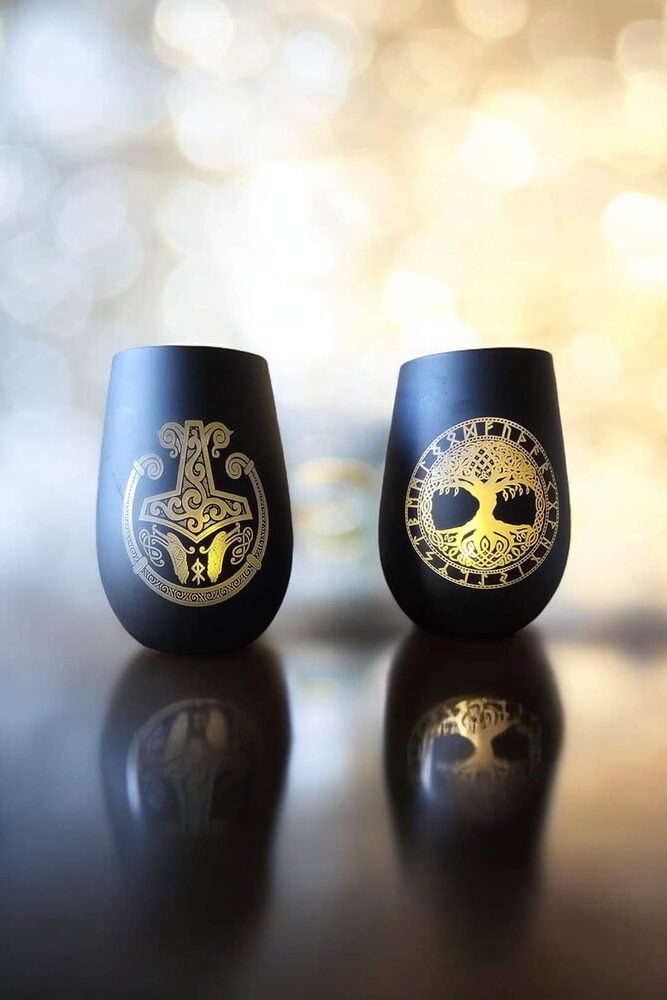
For us in the workshop Njord is a grateful subject, precisely because no image ties him down. There is no securely identified Viking-age depiction of him, no "Njord pendant", no emblem like Thor's hammer. So rather than pretend to copy an ancient model, we prefer motifs that come straight from the sources:
Got an idea of your own? Talk to us – we will gladly check with you what holds up historically.
Who is Njord in Norse mythology? Njord (Njörðr) is a god of the Vanir, responsible for wind, sea, seafaring, fishing and wealth. He lives among the Æsir as a hostage in his hall Nóatún and is the father of Freyr and Freyja.
Is Njord the god of the sea? Yes – according to Snorri he rules the wind and calms the sea. The dangerous, devouring side of the ocean belongs rather to the giant Ægir and to Rán. Inland place names suggest Njord was once a broader fertility god too.
Who is Njord's wife? The best known is the giantess Skadi, who chose him by his feet; the marriage failed over mountains versus sea. According to Ynglinga saga and Lokasenna he had earlier been married among the Vanir to his unnamed sister, mother of Freyr and Freyja.
Are Njord and Nerthus the same deity? Both names go back to the same Proto-Germanic form *Nerþuz. Whether they are one figure, a divine pair or two separate beings is unresolved.
What happens to Njord at Ragnarök? According to the Eddic poem Vafþrúðnismál (st. 39) Njord returns to the Vanir at the end of the age. No source describes him dying in the final battle.
How do you pronounce Njörðr? Roughly "NYUR-th", with a soft "th" as in "this" at the end. In English the simplified spelling Njord is standard.
For courage. For remembrance. For legends that live on.
Freyr · Freyja · The Vanir · Vanaheim · The Norse pantheon.
All Gods & Goddesses articles →
Odin is no comfortable sky-father. He is wanderer, war god, poet, sorcerer and lord of the dead – a god who pays almost …
Read more →There is a love story in Norse mythology made almost entirely of longing. Its hero is a god of whom we know little more …
Read more →Her hair was of pure gold – and this hair set off one of the most consequential stories in all of mythology. Sif, wife …
Read more →She does nothing grand – no heroic deed, no spell – and yet she is one of the most moving figures in all of mythology …
Read more →