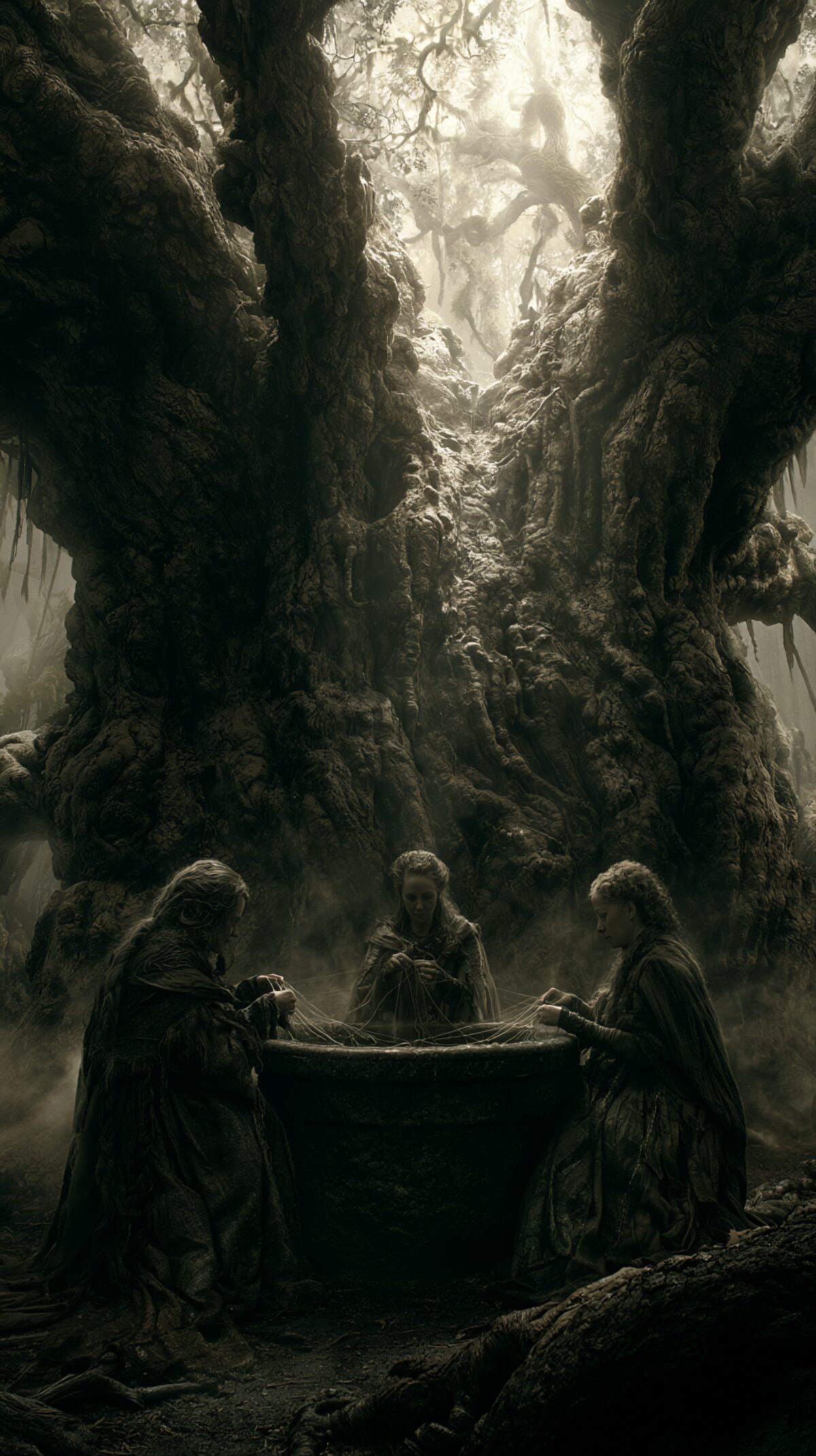
Veleda was an unmarried seeress of the Bructeri, a Germanic tribe between the rivers Lippe and Ems, whose authority during the Batavian revolt of AD 69/70 was so great that rebels and Romans alike courted her. Tacitus tells us she foretold the Germanic victory and the destruction of the legions, lived in a tower and answered only through a kinsman. A few years later she apparently ended up in Roman hands. Here is what the ancient sources actually say – and what later imagination added.
Picture yourself as an envoy of the city of Cologne in the spring of AD 70. Your mission is delicate. The Germanic peoples across the Rhine are demanding that your town tear down its walls and drive out its Roman settlers. You carry gifts and carefully chosen words. Then you arrive at a tower and are told that you will not see the woman on whom everything depends. No conversation, not even a glimpse. One of her relatives takes your question, climbs up, and returns with the answer.
That is how the Roman historian Tacitus describes it in his Histories. The woman in the tower was called Veleda. She was no queen, no warrior and, as far as we can tell, no temple priestess either. She was a seeress – and for a few months one of the most powerful people on the Lower Rhine. She is the best-documented Germanic seeress we have, and at the same time a lesson in how little we may squeeze out of the sources.
Veleda belonged to the Bructeri, a Germanic tribe settled in the 1st century between the Lippe and the Ems, roughly today's Münsterland in north-western Germany. Rome knew the Bructeri well, and not fondly. They fought against Rome in the Teutoburg disaster of AD 9, and in a campaign of AD 15 the Roman general Lucius Stertinius recovered the lost eagle of the 19th Legion from them (Tacitus, Annals 1.60). This was a people with experience of defying the empire.
AD 69 went down in history as the Year of the Four Emperors: Galba, Otho, Vitellius and finally Vespasian fought over the throne. The Rhine army was weakened, its best units marched off to Italy. Into this vacuum stepped Julius Civilis, a nobleman of the Batavi from the Rhine delta who had served Rome for many years.
What began disguised as support for Vespasian turned into open rebellion. Civilis won over peoples on both banks of the Rhine, among them the Cananefates, Frisians, Tencteri and Bructeri, and later Gallic groups such as the Treveri and Lingones, who proclaimed an "empire of the Gauls". The double legionary fortress of Vetera near Xanten was besieged for months and surrendered in spring 70; the garrison was massacred despite the promise of safe conduct. Only Quintus Petillius Cerialis, arriving with fresh legions, managed to crush the revolt in the course of AD 70.
Our main source is Tacitus' Histories, written around AD 100–110, roughly a generation after the events. Veleda appears in four short passages. The first comes in Book 4, chapter 61, right after the fall of Vetera:
"This maiden of the Bructeri held sway far and wide, according to an ancient custom of the Germans by which they regard many women as endowed with foresight and, as superstition grows, as goddesses."Tacitus, Histories 4.61 (own translation)
Tacitus continues that Veleda's authority grew at this time, because she had predicted success for the Germans and destruction for the legions. The Latin word virgo here first of all means "unmarried young woman". Whether it implies a deliberate religious celibacy, Tacitus does not say. The verb imperitabat, "she held sway", also needs care: it means influence and authority, not a throne or an administration.
Then comes a sentence that still sends a chill down the spine. Munius Lupercus, the legionary legate who had commanded the fallen Vetera, was sent to Veleda "among other gifts". A Roman officer as an offering to a seeress. He never arrived; he was killed on the way. Why, Tacitus does not tell us. Whether he was meant as a sacrifice, a captive or a prestige gift remains open, and any firmer claim is speculation.
The second passage, Histories 4.65, is the most famous. The Tencteri, neighbours from across the Rhine, demand that the Colonia Agrippinensis – modern Cologne – pull down its walls. The citizens answer diplomatically and propose two arbiters: Civilis and Veleda, before whom any agreement should be sworn. Envoys then travel with gifts to both. And then comes the scene we opened with:
"But they were refused permission to approach and address Veleda face to face; they were kept from seeing her, so that there might be more awe about her. She herself dwelt high up in a tower; one chosen from her relatives carried the questions and answers like a messenger of the divine."Tacitus, Histories 4.65 (own translation)
Three things stand out. Veleda was accepted as an arbiter not only by her own people but by a Roman citizen colony – an authority reaching across tribal and even imperial boundaries. She was physically out of reach. And the communication ran through a kinsman whom Tacitus calls internuntius numinis, "go-between of the divine power".
Notice the explanation "so that there might be more awe". That is Tacitus' interpretation, not necessarily that of the Bructeri. The Roman historian loves to see calculated power politics behind religious custom. Whether Veleda's seclusion was a ritual rule, a protection or a deliberate piece of staging, we cannot say. The tower itself is a puzzle too: Germanic settlements of this period do not have stone towers. Perhaps it was a timber structure, a watchtower or a raised granary, or perhaps Tacitus used a Roman word for something he never saw. Nobody knows where it stood, and the locations you occasionally read about are pure guesswork.
The third passage is one of the most cinematic episodes of the whole war. In the autumn of 70, Germanic warriors launched a night attack on the Roman fleet that Cerialis had with him. The general himself, Tacitus notes with a certain relish, was not sleeping on board at all but elsewhere – rumour said with a woman of the Ubii. The raiders towed away several ships, and at daybreak they hauled the commander's ship, a trireme (a warship with three banks of oars), up the river Lippe as a gift for Veleda (Hist. 5.22).
Imagine the scene: a Roman flagship, built for display and battle, dragged upstream on a Germanic river as a trophy for the woman who had foretold the victory. From this passage scholars usually infer that Veleda's tower stood on or near the Lippe. That is plausible, but it is an inference, not a statement in the text. What became of the ship we never learn.
The fourth passage shows that the Romans, too, understood her weight. As the war turned, Cerialis sent secret messages: offers of peace to the Batavi, a promise of pardon to Civilis, and an appeal to "Veleda and her relatives". They should change the fortune of war, which after so many defeats had turned against them, by doing a timely service to the Roman people (Hist. 5.24). Shortly afterwards the surviving text of the Histories breaks off in mid-chapter 26. How Veleda responded we do not know.
Around two decades after the revolt, in AD 98, Tacitus wrote his short ethnography, the Germania. Chapter 8 deals with the role of women. First he recounts how, according to tradition, women had rallied wavering battle lines; then comes the key sentence. The Germans believe there is "something holy and prophetic" in women, and they neither scorn their advice nor ignore their answers.
"In the reign of the deified Vespasian we saw Veleda, long regarded by most as a divine being; but in earlier times, too, they revered Aurinia and several others – not out of flattery, nor as if they were making goddesses of them."Tacitus, Germania 8 (own translation)
Many older books, and the earlier version of this article, name a seeress called Albruna alongside Veleda. A correction is due. The manuscripts of the Germania offer various readings at this point, most of them Auriniam, with forms such as Albriniam or Fluriniam alongside. "Albruna" is a conjecture – a scholarly emendation – going back to the 19th-century philologist Wilhelm Wackernagel. It was taken to mean something like "she who has the secret knowledge of the elves", which suits a seeress beautifully. Perhaps too beautifully.
The Swedish name scholar Lena Peterson called Albruna a "ghost name", and many specialists now follow her and prefer Aurinia; others still consider the emendation defensible. The honest position: Tacitus names an earlier revered woman, and her name is uncertainly transmitted. We therefore write Aurinia, noting the old reading Albruna.
Here three independent traces fit together into a picture – but not a certain one.
First, Statius. Around AD 90 the poet Publius Papinius Statius wrote a poem celebrating the recovery of Rutilius Gallicus, a senior senator who had governed Lower Germany around 77/78. Listing his achievements, Statius mentions the armies of the north, the rebellious Rhine and the captivae preces Veledae, "the pleas of captive Veleda" (Silvae 1.4.89–90). It is half a line in a poem of praise, not a chronicle, but it clearly speaks of captivity and links it to Rutilius Gallicus. The usual date of about AD 77 follows from his governorship. Some scholars also allow that Veleda may have come to Rome as a refugee rather than as booty – the "pleas" could be read that way.
Second, the Ardea inscription. At Ardea, an old Latin town a few kilometres south of Rome, a small marble fragment with a Greek text was found; it is now in the Museo di Villa Giulia. The epigraphist Margherita Guarducci published it (Année Épigraphique 1953, 25). The text is in verse and badly damaged. What can be made out is a question, put in Vespasian's name, about what should be done with Veleda, the "tall maiden whom the Rhine-drinkers revere", before whose power the Germans tremble. The answer seems to order her to clean a bronze object – probably a lamp-stand in the temple – so that she does not grow idle.
Is it a mocking poem? Many read it that way, and the punchline is hard to miss: the woman whose word moved the Rhine now polishes temple furniture. Others see it rather as the record of a real or fictitious oracular response, a kind of dedicatory text. Both are possible, and both depend heavily on restorations that specialists dispute. The fragment is dated to Vespasian's reign, so no later than AD 79. If it concerns our Veleda, which hardly anyone doubts, it shows that she was brought to Italy. That she actually lived at Ardea is a natural inference, but not a certainty.
Third, Cassius Dio. For the reign of Domitian (81–96) the Greek historian reports that Masyos, king of the Semnones, and Ganna, a maiden who was a seeress in Germany after Veleda, came to Domitian, were honoured by him and returned home (Cassius Dio 67.5.3). "After Veleda" implies that her role had ended by then – through captivity, death or both.
The upshot: Veleda was probably taken into Roman custody around AD 77 and brought to Italy. When and how she died is unknown. Tacitus' wording in the Germania suggests she was no longer active in Germania by 98. Everything beyond that – a long life as a temple servant, for example – is embroidery.
The name is a small riddle of its own. The most widespread explanation derives it from Celtic: Gaulish is thought to have had a word for "seer", related to Old Irish fili (plural filid), the learned poet-seers of Ireland, and Middle Welsh gweled, "to see". Veleda would then originally be not a personal name but a title: "the seeress".
The problem is that the Bructeri did not speak Celtic. Borrowing is a possible answer, since Celts and Germanic peoples had been in contact in the Rhineland for centuries, as the Matronae stones with their mixed epithets show. Other scholars look for a Germanic root, for instance around *waldan, "to rule, to wield power". No derivation has won general acceptance. Even the pronunciation is uncertain: Statius scans the middle vowel as short, while Cassius Dio's Greek spelling points rather to a long e.
The woman at the Elbe. In 9 BC the Roman general Drusus reached the river Elbe. There, according to Suetonius (Claudius 1) and Cassius Dio (55.1), a woman of superhuman size confronted him, warned him in Latin not to advance further and foretold his approaching end. Drusus died soon afterwards following a fall from his horse. Whether a real seeress lies behind this or a Roman story about an omen is open. It is striking that the Ardea inscription also describes Veleda as "tall".
Ariovistus' women. Caesar already reports in his Gallic War (1.50) that among the Germans of Ariovistus the mothers of families decided by lots and prophecies whether battle was advisable, and declared that the Germans could not win if they fought before the new moon. For more on such lot-casting, see our article on Germanic oracles.
Ganna. Veleda's successor, who travelled to Domitian with the Semnonian king Masyos. Her name is often linked with Old Norse gandr, a word for a magic staff or magic power, though this explanation is not undisputed either. Remarkably, here a seeress travels on an official diplomatic mission to the imperial court and returns with honours.
Waluburg. The most surprising trace leads to Egypt. On the Nile island of Elephantine near Aswan, excavations in 1906–1908 turned up an inscribed potsherd, an ostracon, now in the Berlin Papyrus Collection. It contains a Greek list of names from the 2nd century, and one line reads "to Baluburg, the Semnonian sibyl". The name is read as Waluburg. Its first element is often connected with Germanic *waluz, "staff", which brings to mind the staff of later seeresses. The rest of the list names members of a Roman staff and household servants, probably from the entourage of the governor of Egypt. A Germanic fortune-teller in the household of a top Roman official, thousands of kilometres from the Rhine: such women evidently had value for Romans too.
Almost a thousand years later another famous seeress figure meets us in the North: the völva. The Old Icelandic Saga of Erik the Red describes one such woman, Þorbjörg the "little völva", who is received at a farm in Greenland, takes her place on a raised seat and, with the help of a chant, looks into the future. The Eddic poem Völuspá puts the entire history of the world into the mouth of a seeress. In Viking-Age women's graves, for instance at Fyrkat in Denmark, archaeologists found iron staffs that scholars such as Neil Price interpret as seeresses' staffs. The practice of these women, seiðr, is a fascinating chapter of its own.
The parallels with Veleda are obvious: a woman with foreknowledge, highly respected, consulted on weighty matters, often unmarried or outside ordinary family roles, seated on high. Even the staff appears in names such as Waluburg and perhaps Ganna, and "völva" itself probably means "staff-bearer".
Still, be careful about drawing a straight line. Some 1,100 years, different languages, regions and societies lie between Veleda and the Icelandic sagas, and the sagas were written down by Christian authors in the 13th century. The similarities point rather to a long-lived basic pattern: in the Germanic world, women could gain religious authority through knowledge of what was to come. How that knowledge was obtained – trance, chant, lots or reading signs – we simply do not know for Veleda. And a völva was a travelling specialist moving from farm to farm, while Veleda sat in one place and received visitors. That is a clear difference.
Tacitus never calls Veleda a sacerdos, a priestess, and describes no sacrifices or rites led by her. He does know Germanic priests who interpret lots or may punish in the army; we cover them in our article on Germanic priests and seeresses. Veleda does not fit that role well. She appears rather as an oracle, a person through whom a higher power speaks.
At the same time she acts in highly political ways: she arbitrates between the Tencteri and Cologne, receives envoys, is courted by Cerialis, and her family acts as a party. That religious and political power were tightly interwoven among the Germanic peoples we know from other sources too; Veleda may be the clearest example we possess. And she shows that such power could belong to a woman who was neither wife nor mother of a chieftain. For more background, see women among Germanic peoples and Vikings.
For all the fascination, a long list of open questions remains. We do not know what she actually prophesied, how she arrived at her answers, how old she was, whether "Veleda" was her name or her title, exactly where the tower stood, whether she came to Italy voluntarily or as a prisoner, or when she died. Not a single word from her own mouth survives. Everything we read about her comes from Romans describing a foreign religion from a distance and with their own purposes.
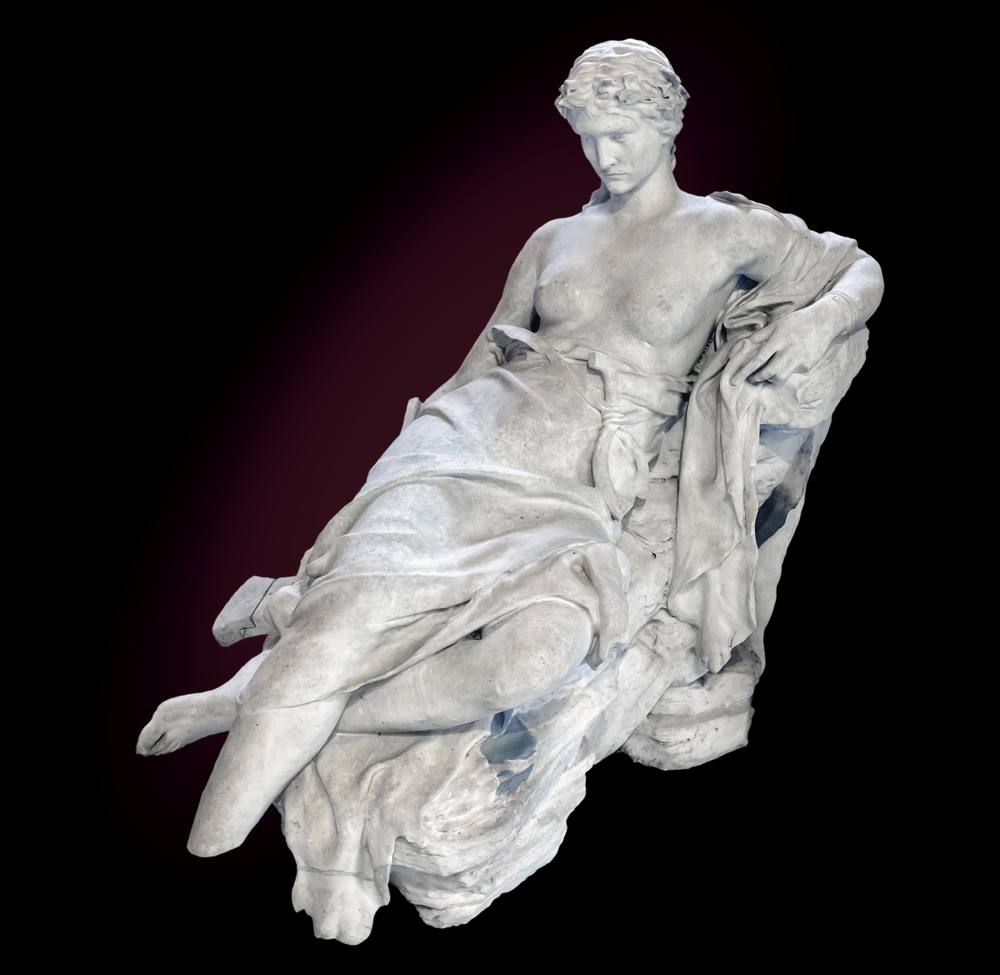
Precisely because the sources are so thin, Veleda became an ideal canvas for later ages. Benedikte Naubert wrote a novel about her in 1795, Friedrich de la Motte Fouqué a tale in 1818, Eduard Sobolewski an opera in 1835. In France she merged with the idea of Celtic druidesses; the marble figures by Étienne-Hippolyte Maindron and Laurent Marqueste show her as a pensive prophetess of the forest. These images have little to do with the historical woman of the Bructeri.
What fascinates us about Veleda is something else: the brief moment in which a woman from a society without writing carried so much weight that a world empire had to put her into its history books. When we engrave motifs of seeresses, staffs and runes in slate, we think of women like her – not fantasy figures, but real people whose voice can still be heard, even through a Roman pen.

Who was Veleda? Veleda was an unmarried seeress of the Germanic Bructeri who held great influence during the Batavian revolt of AD 69/70. Our main sources are Tacitus' Histories and Germania.
Where did the seeress Veleda live? In the territory of the Bructeri between the Lippe and the Ems, in a tower according to Tacitus. Because the captured Roman trireme was towed up the Lippe to her, the tower is thought to have stood near that river; the exact site is unknown.
What did Veleda prophesy? According to Tacitus, she foretold success for the Germans and destruction for the Roman legions. Her actual words are not recorded.
What happened to Veleda after the Batavian revolt? The poet Statius speaks of "captive Veleda" and links this to Rutilius Gallicus, governor around AD 77. A Greek inscription from Ardea near Rome mentions her in connection with Vespasian. When and where she died is unknown.
Is Veleda a name or a title? That is disputed. Many scholars see a Celtic word for "seeress" behind it, which would make it a title; others look for a Germanic origin.
Was Veleda a völva? Not in the strict sense: the völva belongs to the Viking-Age North and to Icelandic literature about a thousand years later. Both figures, however, show a similar pattern of female prophetic authority.
For courage. For remembrance. For legends that live on.
Germanic Religion · The Matronae · The Batavi · The Cherusci & Arminius · Seiðr – the magic.
All Festivals & Belief articles →
When the nights are longest and the fire in the house is warmest, the departed draw nearer. Yule, the midwinter feast …
Read more →For our ancestors the year was no sheet on the wall but hard, beautiful work: to sow, to tend, to harvest, to store …
Read more →The old faith of our ancestors has not died out – it is being lived again. “Ásatrú”, literally “true to the Æsir”, is …
Read more →