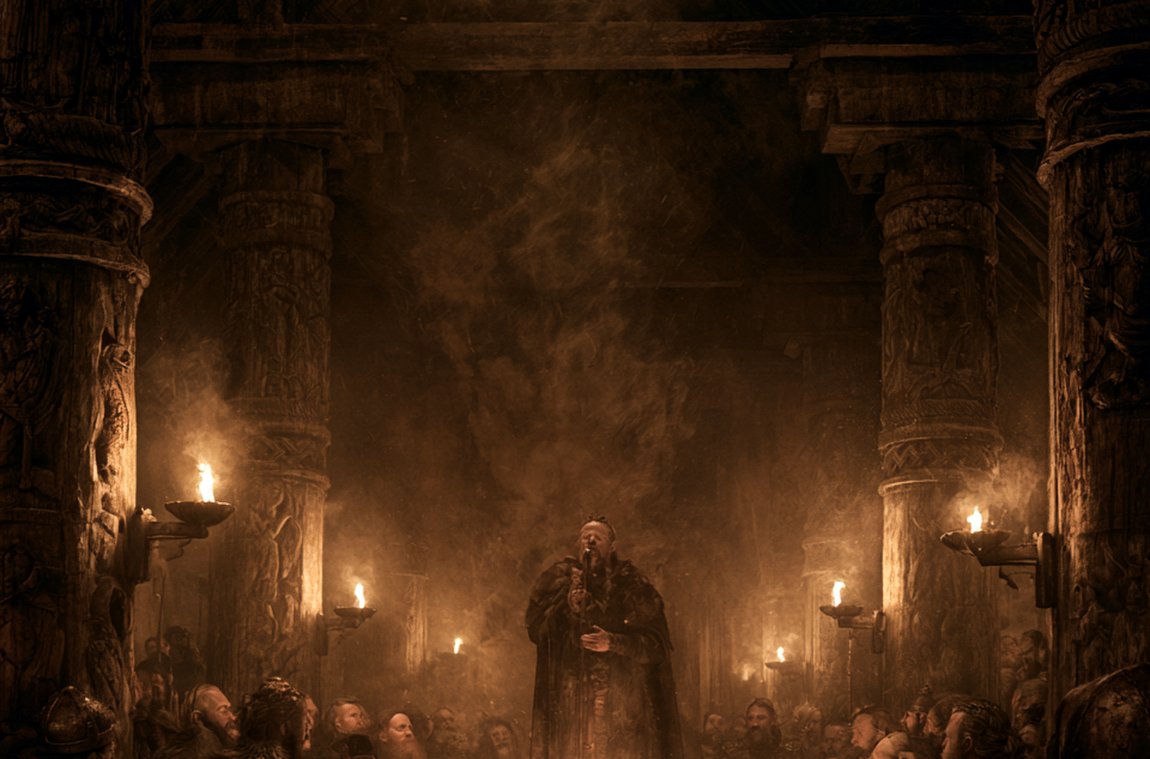
Can a poem save a life? In the North, yes. The skald Óttarr svarti („the Black") had drawn the wrath of King Óláfr the Holy – and saved his head with verses.
At the beginning stands a mistake that could cost a head. The Icelandic skald Óttarr svarti, „the Black", had – so tradition says – in his younger years composed a love-poem about Ástríðr, the wife of King Óláfr the Holy of Norway. A praise-poem about a woman, a mansöngr, counted as an insult to her husband and could be punished as a grave offence with death. When Óttarr later came to Óláfr’s court, this old sin lay upon him, and the king’s wrath was not small.
Óttarr was no unknown: he came from a family of poets and was the nephew of one of the greatest skalds of his age, Sigvatr Þórðarson, who himself stood in high honour at Óláfr’s court. And it was this very uncle who became his salvation.
Sigvatr, seeing his nephew’s plight, advised the only way out the North knew for a poet: not flight, not battle, but a better poem. Óttarr was to compose a great praise-poem for the king himself – so artful that Óláfr could do nothing but let himself be reconciled. Legend has it that Sigvatr even secretly helped and polished the verses.
In only three nights Óttarr created the Hǫfuðlausn, the „head-ransom". When he recited the poem before Óláfr and the assembled court, what everything had aimed at came to pass: the king, praised in splendid, truthful verses, let his wrath fall and granted the poet his life. A poem had, quite literally, ransomed a head.
„The tongue is the bane of the head." — Hávamál 73, after Bellows
Hardly any proverb fits better – and here it is reversed in the finest way. Óttarr’s tongue had first brought him into mortal danger, with the wrong poem about the wrong woman. And the same tongue, with the right poem about the right man, saved his head. In the North the word could kill and heal, wound and release.
The name Hǫfuðlausn is almost a genre of its own in the North. Egill Skallagrímsson too is said to have bought back his head from his mortal enemy Eric Bloodaxe in York with a praise-poem composed in a single night. Behind it lies a deep, for us almost alien belief in the power of poetry: the praise of a true skald was more precious than gold, for it alone carried a lord’s fame beyond death. A king could win battles – but whether his name was still known a thousand years on was decided by the poet.
That is exactly why a ruler kept skalds, gave them rich gifts and bore their outspokenness. And that is exactly why a poem could outweigh a life. The dramatic frame – love-poem, death-threat, rescue in three nights – is surely embellished in the later-written saga. But the core reflects real courtly practice: poetry in the North was a power to reckon with.
Óttarr svarti is no world-shaking hero, and yet his story tells something fundamental about the culture our motifs come from. It was a world in which the spoken, artfully wrought word held real power – to grant honour, to take honour, to reconcile, to wound and even to save a life. This reverence for the good word and the lasting name is something we share in our work: an engraving, too, is an attempt to give a name, a saying, a memory permanence. The mead of poetry that our windlight evokes is exactly the stuff of which fame was made.
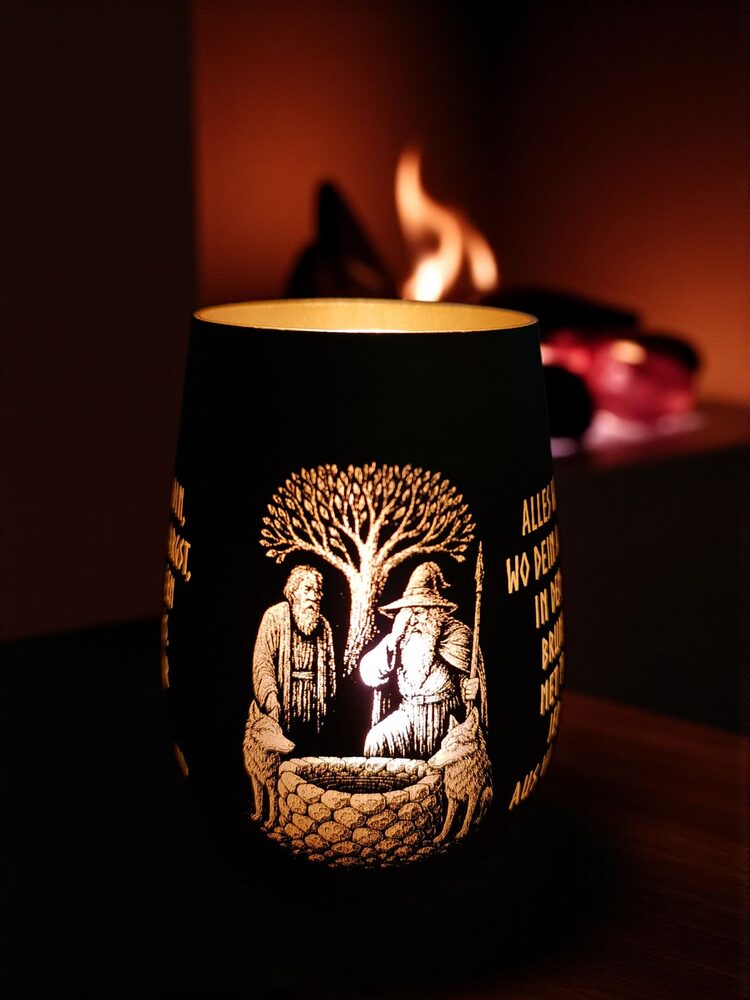
Vellekla · Eyvindr skáldaspillir · The Edda · Runes.
Óttarr svarti, Hǫfuðlausn (Snorri, Óláfs saga helga); Skaldic Poetry of the Scandinavian Middle Ages. Rudolf Simek, Dictionary of Northern Mythology.
Norse religion has no distant, all-powerful deity on a throne. It has a family – quarrelsome, cunning, loving, mortal …
Read more →Few names sound as thoroughly Viking as Ragnar Lodbrok. Television has made him the face of the entire North – the …
Read more →Norse mythology is the only great tradition in which the gods themselves are doomed – and in which they know it …
Read more →Ragnar Lodbrok, so the saga goes, died in a pit of snakes – laughing, we are told, and with a threat on his lips. His …
Read more →